February to March 2026 — The fleet operates within a limited geofence, accumulating data and demonstrating safety. NHTSA (National Highway Traffic Safety Administration) monitors the operation and reports no accidents during this period.
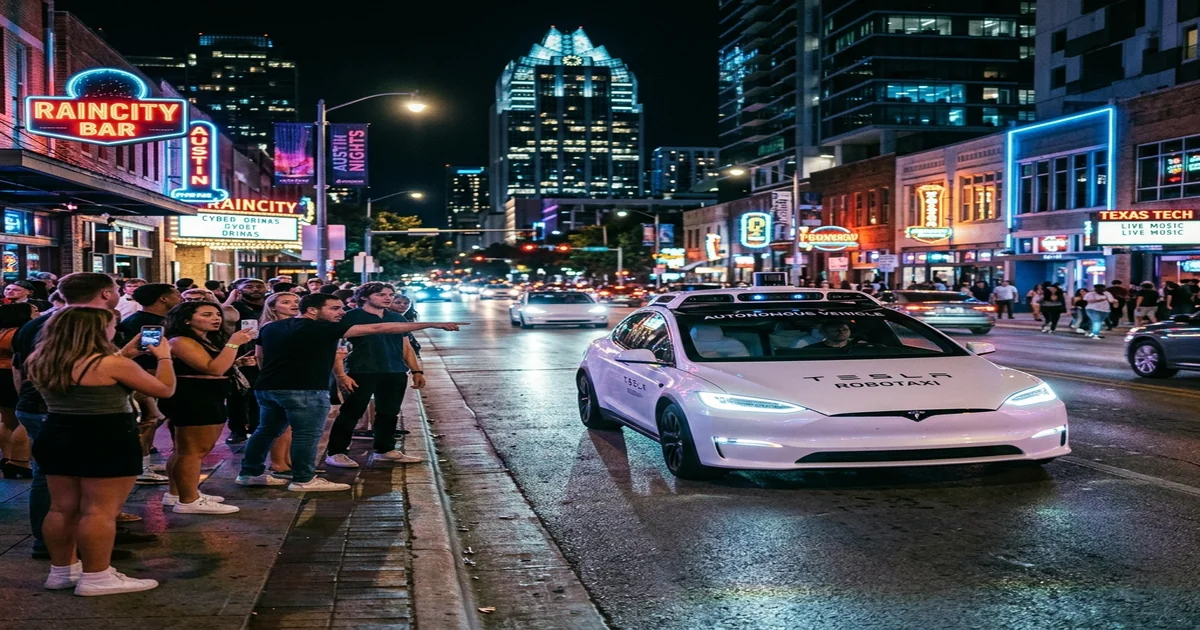
April 2026 — Tesla doubles the geofence area, crossing the Colorado River for the first time and reaching downtown Austin. The fleet grows to more than 12 vehicles operating simultaneously. Sped-up 30-minute videos showing the robotaxis navigating without a driver go viral on social media.
The process for passengers is surprisingly simple:
- Open the Tesla app on your phone
- Request a ride by entering your destination
- A driverless Model Y arrives at the pickup point
- Get in the vehicle — the driver's seat is empty
- Confirm the destination on the dashboard screen
- Relax while the car navigates autonomously to your destination
- Exit and rate the ride in the app
There's no steering wheel being turned by invisible hands — the FSD system controls acceleration, braking, steering, signaling, and all navigation decisions. The car obeys traffic lights, yields to pedestrians, changes lanes when necessary, and parks itself at the end of the ride.
Tesla's Full Self-Driving is one of the most ambitious — and most controversial — projects in automotive history. Elon Musk first promised fully autonomous cars in 2016, and since then the delivery date has been repeatedly postponed, generating skepticism among analysts and critics.
Tesla's approach is radically different from the competition. While companies like Waymo (Google) and Cruise (General Motors) invested heavily in LiDAR sensors — laser devices that create detailed 3D maps of the environment — Tesla bet exclusively on cameras and computer vision.
Musk's logic has always been: if humans can drive using only their eyes, a sufficiently advanced artificial intelligence should be able to do the same. This bet was ridiculed by many experts for years, but the results in Austin are beginning to vindicate the strategy.
Tesla isn't alone in this race. The global robotaxi market is in full swing:
Waymo (Google/Alphabet) operates the most mature service in the United States, with fleets in San Francisco, Phoenix, and Los Angeles. Its Jaguar I-PACE vehicles are equipped with 29 cameras, 5 LiDARs, and 6 radars, offering sensor redundancy that Tesla doesn't have. Waymo has already completed millions of commercial rides and is considered the leader in autonomous driving technology.
Baidu Apollo Go (China) is the world's largest robotaxi operation by scale, with over 1,000 vehicles in 10 Chinese cities. In Wuhan, the fleet completes millions of trips per year at prices up to 60% lower than conventional taxis. However, a serious incident in March 2026 — when more than 100 robotaxis stopped simultaneously in traffic — shook confidence in the service.
Pony.ai and WeRide (China) operate smaller fleets but with a focus on safety and partnerships with traditional automakers like Toyota and Nissan.
| Company |
Country |
Cities |
Fleet |
Technology |
Status |
| Waymo |
USA |
San Francisco, Phoenix, LA |
~700 |
Cameras + LiDAR + Radar |
Commercial |
| Tesla |
USA |
Austin |
12+ |
Cameras + AI (FSD) |
Commercial (new) |
| Baidu Apollo Go |
China |
10 cities |
1,000+ |
Cameras + LiDAR |
Commercial |
| Pony.ai |
China |
Beijing, Guangzhou |
~200 |
Cameras + LiDAR |
Commercial |
| WeRide |
China/UAE |
Guangzhou, Abu Dhabi |
~100 |
Cameras + LiDAR |
Commercial |
| Motional |
USA |
Las Vegas |
~50 |
Cameras + LiDAR |
Commercial |
The choice of Austin as the pilot city wasn't random. The Texas capital offers a unique combination of favorable factors:
Favorable regulation — Texas has one of the most permissive laws in the US for autonomous vehicles. The state allows testing and commercial operation of driverless vehicles with relatively simple regulatory requirements compared to states like California or New York.
Predictable climate — Austin has more than 300 sunny days per year, which is ideal for camera-based systems like Tesla's FSD. Torrential rain, snow, and dense fog — conditions that challenge computer vision systems — are relatively rare.
Modern road infrastructure — Austin's streets are well-marked, with clear lanes and modern traffic signals, making it easier for the autonomous system to read the environment.
Tesla's presence — Gigafactory Texas, located on the outskirts of Austin, is Tesla's largest factory in the world. Having the robotaxi operation near the factory facilitates maintenance, software updates, and fleet logistics.
The arrival of driverless robotaxis in Austin is generating waves of impact that go far beyond technology. The local population is divided between enthusiasm and concern, and the practical effects are already being felt.
For Austin residents, the robotaxi represents a new transportation option that could be more accessible and convenient than traditional services like Uber and Lyft. The ability to request a driverless car through the Tesla app, at any time of day, without depending on the availability of human drivers, is particularly attractive during peak hours and late at night.
The initial numbers are promising. NHTSA reported no accidents involving Tesla's robotaxis during the February to mid-March 2026 period. For context, Austin averages about 85 traffic accidents per day involving human drivers, according to data from the Texas Department of Transportation.
However, the sample size is still small — 12 vehicles operating for a few months isn't enough to draw definitive statistical conclusions about safety.
The most sensitive issue is the impact on rideshare drivers. Austin has approximately 45,000 drivers registered on platforms like Uber and Lyft. If robotaxis expand significantly, a portion of these workers could lose their source of income.
| Aspect |
Before Robotaxis |
After Robotaxis |
Impact |
| Transportation options |
Uber, Lyft, taxi, bus |
+ Tesla Robotaxi |
More consumer choices |
| Late-night availability |
Limited (few drivers) |
24/7 (autonomous fleet) |
Better coverage |
| Cost per ride |
$15-25 (Uber average) |
TBD (downward trend) |
Potential savings |
| Driver jobs |
~45,000 in Austin |
Threatened long-term |
Unemployment risk |
| Traffic accidents |
~85/day (human drivers) |
0 reported (robotaxis) |
Potential reduction |
| Coverage area |
Entire city |
Limited geofence (expanding) |
Still restricted |
| Accessibility |
Depends on driver |
Standardized |
More predictable |
| Wait time |
5-15 min (varies) |
TBD |
Depends on fleet size |
A data point that adds important context to the traffic safety debate in Austin: according to hospital data, by 2023, more than half of all bike and scooter trauma cases treated at US trauma centers involved e-bikes — a dramatic jump from the 8% recorded in 2018. This explosive increase in accidents involving electric micromobility vehicles reinforces the urgency for safer transportation solutions, and robotaxi advocates argue that autonomous vehicles could be part of that solution.
Tesla has not issued a detailed official statement about the geofence expansion in Austin, maintaining its usual minimal communication with the press. However, the company has been active on social media, sharing videos of the robotaxis in operation and highlighting the zero-accident record during the NHTSA-monitored period.
Elon Musk, in posts on X (formerly Twitter), has celebrated the milestones of the Austin operation, stating that FSD is "improving exponentially every week" and that expansion to other American cities is "a matter of months, not years."
The National Highway Traffic Safety Administration confirmed that it actively monitors Tesla's robotaxi operation in Austin. In a partial report covering the February to mid-March 2026 period, the agency reported no accidents involving Tesla's autonomous vehicles.
However, NHTSA also emphasized that "the absence of incidents over a short period with a small fleet does not constitute definitive proof of safety" and that "regulatory oversight will continue to intensify as the operation expands."
Reactions from residents are mixed. In an informal survey conducted by the Austin American-Statesman, 62% of respondents said they were "curious or enthusiastic" about the robotaxis, while 28% expressed "concern or distrust" and 10% declared themselves "indifferent."
Passengers who have already used the service report mostly positive experiences, highlighting the smoothness of the ride and the "surreal" feeling of being in a driverless car. The main complaints involve the still-limited coverage area and the inability to request intermediate stops during the ride.
Waymo, Tesla's main competitor in the American robotaxi market, did not comment directly on the Austin expansion, but company executives have publicly reinforced the importance of "multiple layers of sensor redundancy" — an indirect reference to Tesla's decision not to use LiDAR.
The trend is clear: Tesla will continue expanding the operating area in Austin in the coming weeks and months. Sources close to the operation indicate that the next step will be to include the Interstate 35 corridor, the main highway cutting through Austin from north to south, which would represent the first test of the robotaxis on high-speed roads.
With only 12 vehicles currently operating, Austin's fleet is still tiny compared to competitors. The expectation is that Tesla will gradually increase the number of robotaxis, potentially reaching 50-100 vehicles by the end of 2026. The proximity of Gigafactory Texas facilitates the rapid addition of new vehicles to the fleet.
Elon Musk has already signaled that Austin is just the beginning. Other American cities are being evaluated to receive the robotaxi service, with Houston, Dallas, and Miami among the most likely candidates. International expansion — possibly starting with markets with favorable regulation like the United Arab Emirates — is also in the long-term plans.
The success or failure of the Austin operation will have a direct impact on regulatory discussions in Washington. American lawmakers are debating a federal regulatory framework for autonomous vehicles that could facilitate — or hinder — the expansion of services like Tesla's across the country.
Tesla has not yet disclosed details about pricing and the business model for the Austin robotaxi service. Market expectations are that prices will be competitive with Uber and Lyft, with the advantage of much higher margins for Tesla since there's no human driver to compensate. Morgan Stanley analysts estimate that the robotaxi service could become Tesla's largest revenue source by 2030, surpassing vehicle sales.
Tesla shares already reflect optimism about the robotaxi program. Since the launch of unsupervised rides in January 2026, the stock has appreciated significantly, with Wall Street analysts revising their price targets upward. Goldman Sachs raised its valuation estimate for Tesla's robotaxi business to $200 billion, representing about 25% of the company's total market capitalization.
What's happening in Austin is no longer an Elon Musk promise for five years from now. It's real, it's on the streets, and it's expanding. Twelve driverless Model Y vehicles crossing the Colorado River, navigating through the city center, carrying real passengers to real destinations — without a single pair of human hands on the steering wheel.
Tesla still has a long road ahead. Twelve cars in one city don't make a revolution. But what Austin is demonstrating is that the vision of a future with accessible autonomous transportation is no longer science fiction — it's engineering in progress.
The coming months will be decisive. If Tesla can maintain its zero-accident record while expanding the fleet and geofence, the impact will be felt far beyond the borders of Texas. If something goes wrong, the regulatory backlash could set the entire industry back by years.
For now, Austin is the stage. And the whole world is watching.
Read also: