🌍 Your knowledge portal
science-nature

Scientific Discovery: Venus is Geologically Active and Expanding

📅 2026-07-26⏱️ 6 min read📝
⚡

Quick Summary

Advanced 3D simulations from ETH Zurich show that Venus' massive rift valleys and volcanic systems are geologically young and actively expanding today. The planet Venus, often referred to as Earth's "evil twin" due to its extreme atmospheric conditions, has just revealed one of its most guarded secrets.

Key Takeaways:

  • For decades, scientists debated whether Venus retained enough internal heat to power volcanoes and deform its rocky surface.
  • The internal dynamics of Venus are significantly different from those observed on planet Earth.
  • The confirmation of ongoing geological activity on Venus has direct implications for astrobiology and modern astrophysics.
Scientific Discovery: Venus is Geologically Active and Expanding
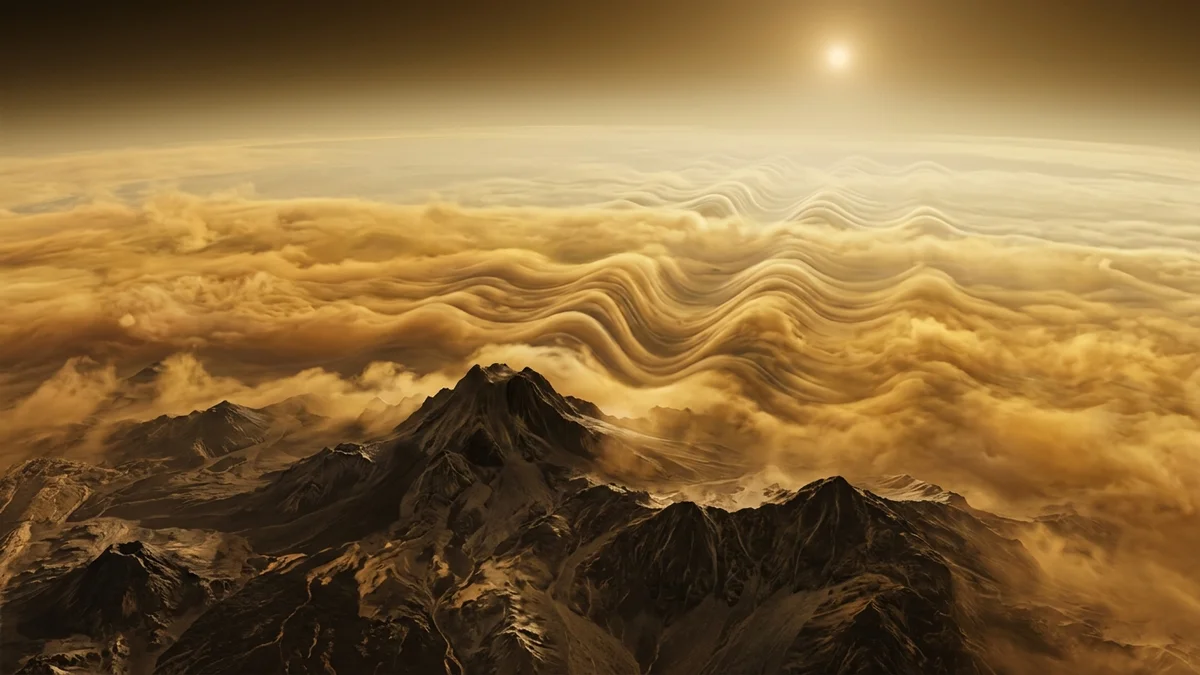
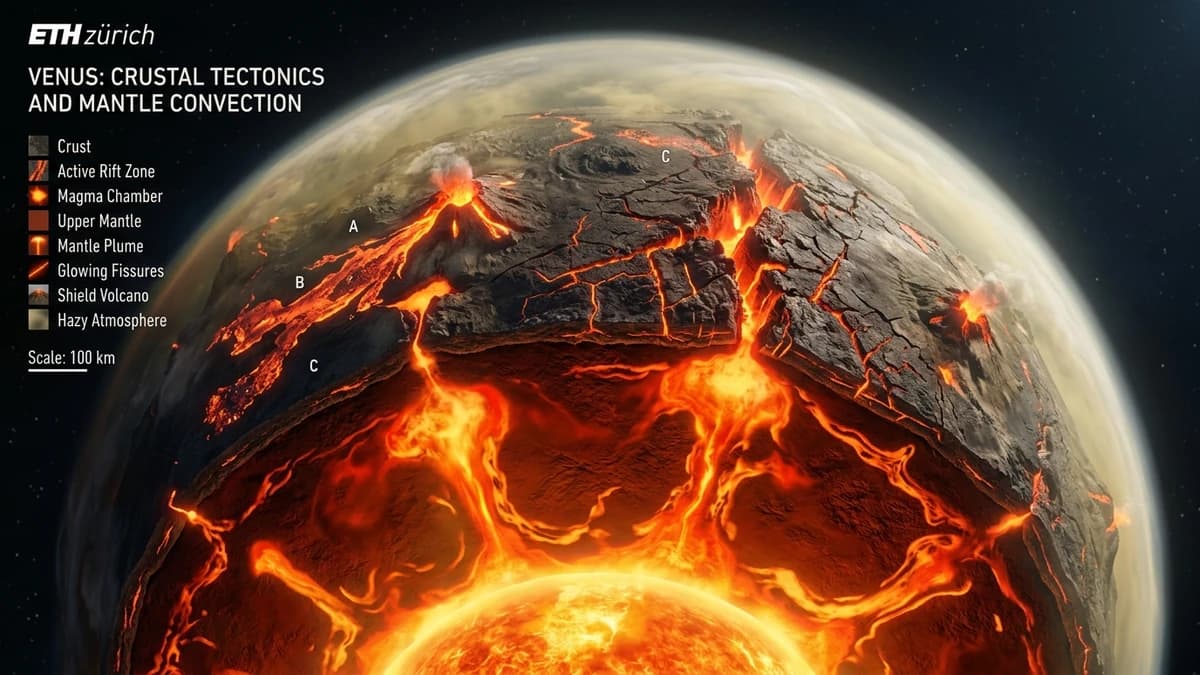
Scientific Discovery: Venus is Geologically Active and Expanding — High-Fidelity Artistic Illustration created by artificial intelligence based on scientific research.

Scientific Discovery: Venus is Geologically Active and Expanding

3D simulation of Venus geological activity and mantle convection

The planet Venus, often referred to as Earth's "evil twin" due to its extreme atmospheric conditions, has just revealed one of its most guarded secrets. In a study published in July 2026 in the prestigious scientific journal Nature Geoscience, astrophysicists presented indisputable evidence that the planet is geologically alive.

Using new three-dimensional models based on thermal and radar data, researchers demonstrated that the planet's massive rift valleys and trenches are not ancient relics. On the contrary, these enormous tears in the Venusian crust are actively expanding due to intense underground magma currents.

This revelation dramatically changes the scientific consensus that Venus has been a dead geological wasteland for billions of years. The discovery rewrites textbooks on planetary astronomy and opens new avenues for understanding distant worlds outside our Solar System.


How 3D Simulations Unlocked the Mystery #

For decades, scientists debated whether Venus retained enough internal heat to power volcanoes and deform its rocky surface. Due to the dense carbon dioxide atmosphere and corrosive sulfuric acid clouds, observing the surface directly has always been impossible for optical telescopes.

To overcome this impenetrable barrier, scientists from the Institute of Geophysics at ETH Zurich created state-of-the-art three-dimensional supercomputer simulations. They fed the system with topographic maps generated by radar from past space missions and thermal data from Europe's Venus Express probe.

Sinuous lava channels and simulated tectonic faults on Venus

The results of these geophysical simulations allowed researchers to peer into the Venusian mantle and crust at an unprecedented resolution. The digital models reproduced with extreme fidelity the formation of the circular tectonic deformation structures called "coronae" that cover the planet.

By cross-referencing the generated models with actual physical observations, the simulation showed that the fractures surrounding these coronae are geologically young. The study proves that internal heat continues to push hot material toward the surface, driving local tectonic activity at a rapid pace.


Active Volcanism and Mantle Convection #

The internal dynamics of Venus are significantly different from those observed on planet Earth. On our planet, the lithosphere is divided into mobile tectonic plates that slide and collide, helping to distribute and release heat from the core.

Venus, however, possesses a continuous and rigid outer shell, classified by geologists as a "single-plate" lithosphere. The heat from the deep mantle escapes through large, rising jets of molten rock known as mantle plumes.

These plumes act like giant thermal blowtorches, weakening the crust and forcing surface rocks to fracture and sink. This process creates massive flows of basaltic lava that constantly reshape the deep Venusian valleys.

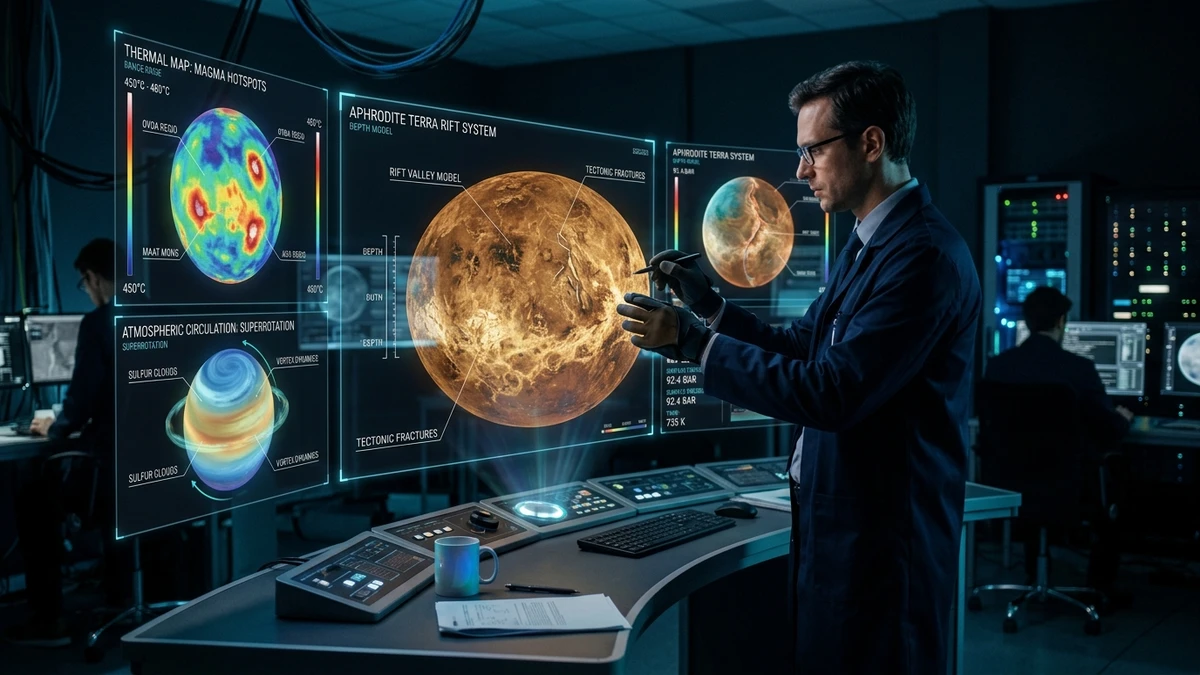
Scientist analyzing three-dimensional models of Venus in the laboratory

The identification of active shield volcanoes confirms that the planet has not lost its primordial internal energy. The discovery indicates that the planet's interior remains dynamic and flexible, challenging previous models of rapid planetary cooling.

Understanding this active volcanism helps explain how the planet maintains its runaway greenhouse effect. The constant release of sulfur-bearing gases and carbon dioxide into the atmosphere feeds the extreme thermal cycle that makes Venus one of the most hostile environments in the solar system.


Impact on Science and Society #

The confirmation of ongoing geological activity on Venus has direct implications for astrobiology and modern astrophysics. The discovery provides a unique natural laboratory for studying the early stages of rocky planet formation similar to Earth.

Furthermore, the study helps calibrate space telescopes that search for habitable exoplanets outside our solar system. If single-plate planets can retain active volcanism for so long, the chances of finding dynamic worlds in the galaxy increase significantly.

Below, the table highlights how this discovery has redefined key scientific parameters:

Impact Area Previous Scientific View New Reality Revealed in 2026 Practical Benefit for Science
Planetary Geophysics Venus was considered cold and tectonically dead. The mantle remains hot and drives active convection. Calibration of thermal models of rocky planet evolution.
Atmosphere and Climate The greenhouse effect was considered an ancient static state. Volcanic gases continue to fuel the thermal cycle. Improved understanding of extreme runaway greenhouse warming.
Space Exploration Mission focus was solely on historical static mapping. Critical need to monitor real-time topography changes. Optimization of radar designs for upcoming space probes.
Astrobiology Surface was considered sterile and unchanging over time. Active rift zones offer variable chemical gradients. Study of prebiotic reactions under extreme heat conditions.

Space geologists must now plan new strategies to analyze orbital data. The identification of thermal hotspots on the surface suggests that future probes should focus on specific coordinates to capture active eruptions.

This shift in focus promises to accelerate the development of more resilient electronic sensors. Instruments capable of withstanding the suffocating heat and crushing pressure of the Venusian surface will be crucial in the coming decades.

With the application of these new research methodologies, researchers aim to map the chemical signature of magma in real time. This direct chemical analysis will reveal the exact composition of Venus' deep minerals without landing physical probes on the surface. In addition to optimizing the financial resources of space agencies, the new method will protect sensitive scientific instruments from premature thermal wear.


The Future of Missions to Venus #

The revelations obtained through ETH Zurich's 3D simulations come at a crucial moment for international planetary exploration. Both NASA and the European Space Agency (ESA) are preparing new fleets of spacecraft destined for Venus.

NASA's VERITAS orbiter will map the surface with unprecedented resolution using state-of-the-art radar systems. The vehicle's main objective will be to detect physical changes in the topography to prove active volcanic eruptions in real time.

Similarly, ESA's EnVision mission will provide detailed measurements of atmospheric gases and subsurface structures. Scientists hope these measurements will reveal the exact frequency of volcanic events shaping the deep Venusian plains.

The combination of advanced computer simulation and direct observation promises to usher in a golden age in the study of our neighboring planet. Understanding Venus helps us understand Earth's own history, warning us about the dangers of runaway atmospheric evolution.

Astronomers also expect these findings to improve the artificial intelligence algorithms used to process remote terrain maps. Automating image processing will allow for the rapid identification of new lava flows as they emerge on the surface. In this way, scientists will be able to monitor Venusian tectonic activity in a manner similar to how they monitor active volcanoes on terrestrial ocean islands.

Mantle Plume Thermomechanics and Coronae Crustal Recycling on Venus #

Three-dimensional thermomechanical numerical simulations developed by planetary geophysicists at ETH Zurich and the University of Maryland resolve a decades-old paradox initiated by NASA's Magellan radar mapping in the 1990s. Although Venus lacks Earth-style mobile plate tectonics driven by oceanic subduction zones, its lithosphere is far from a stagnant, dead shell. Instead, buoyant plumes of superheated mantle rock ascend from the core-mantle boundary and impinge upon the base of the crust, inducing localized partial melting, radial fracturing, and annular tectonic uplift across hundreds of circular structures known as coronae.

By matching high-resolution gravity and topography profiles across major Venusian coronae—including Quetzaelpetlatl, Aramaiti, and Ba'het—the ETH Zurich models demonstrate that at least thirty-seven volcanic ring complexes are actively undergoing plume-induced lithospheric dripping and radial expansion today. This squishing-and-stretching tectonic regime recycles crustal basalts back into the interior and continuously outgasses sulfur dioxide, water vapor, and carbon dioxide into the dense 92-bar atmosphere.

These computational findings directly shape the instrumentation baselines for upcoming orbital and atmospheric missions, specifically NASA's VERITAS and DAVINCI spacecraft and the European Space Agency's EnVision orbiter. Equipped with interferometric synthetic aperture radar (InSAR) and near-infrared surface emissivity spectrometers, those missions will measure centimeter-scale ground deformation and fresh basaltic lava flows across Venusian coronae, providing empirical proof of interior convective dynamics on Earth's sister planet.

Sources and References #

🏷️ Tags:

#activevenusgeology#3dsimulationethzurich#volcanoesonvenus#naturegeosciencevenus2026#spaceexplorationvenus#universemysteries

📢 Gostou deste artigo?

Compartilhe com seus amigos e nos conte o que você achou nos comentários!

❓Frequently Asked Questions

Astrophysicists and senior researchers from ETH Zurich utilized highly advanced three-dimensional virtual simulations powered by high-resolution radar topography datasets collected by previous planetary missions from NASA and the European Space Agency. These complex computer models successfully simulated the internal thermal convection dynamics within Venus mantle and the structural fracture patterns of its rocky lithosphere. By comparing these virtual projections directly with the physical surface features observed in planetary radar maps, the scientific team identified geologically young tectonic rift systems and active volcanic centers that continue to expand rapidly at present.
Unlike the dynamic tectonic setup observed on planet Earth, where the lithosphere is divided into multiple mobile plates that constantly drift and collide over a hot upper mantle, Venus operates under a rigid single-plate system. Its internal heat release and active geology are driven primarily by powerful thermal mantle plumes that rise from the deep interior and fracture the static crust locally. This continuous thermal process creates massive tectonic rift valleys and large-scale shield volcanoes in concentrated areas, functioning efficiently without the need for global continental drift processes.
The groundbreaking discoveries achieved through these 3D simulations provide a highly detailed scientific roadmap for the next generation of robotic exploration spacecraft scheduled to launch in the coming years. NASA's upcoming VERITAS and DAVINCI+ orbital probes, working in tandem with the European Space Agency's EnVision spacecraft, will carry advanced synthetic aperture radar instruments designed to penetrate the planet's thick sulfuric acid clouds. These state-of-the-art scientific sensors will continuously monitor real-time topography changes and thermal anomalies, helping researchers identify and confirm active volcanic eruptions as they happen.

Receba novidades!

Cadastre seu email e receba as melhores curiosidades toda semana.

🔒 Sem spam. Cancele quando quiser.

💬 Comentários (0)

Seja o primeiro a comentar! 👋

📚Related Articles

Receba novidades no WhatsApp!