In modern public administration, social welfare sits at the emotional and political epicenter of public policy: is cash transfer an emancipatory ladder out of extreme poverty, or an institutional mechanism of electoral patronage? In Brazil, conditional cash transfers such as Bolsa Família protect over twenty-one million vulnerable families, providing food security and baseline survival. However, continuous expansion of beneficiary rolls without commensurate economic transition pathways fuels persistent debate over dependency traps and fiscal sustainability. This investigative report examines data integrity within national social registries, federal audit findings from the Court of Accounts (TCU), clientelist mechanisms of local political capitalization, and the structural prerequisites for authentic economic mobility.
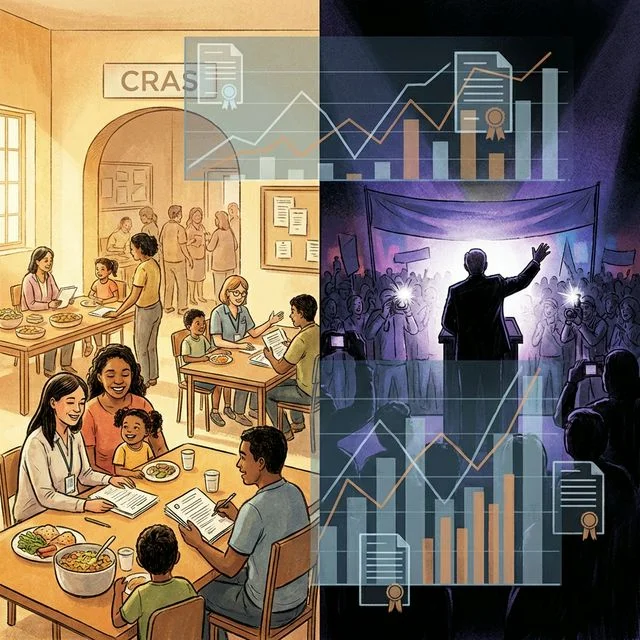
The Core Dimensions: Authentic Welfare Versus Performative Relief
Public policy analysts evaluate the structural health of welfare programs across four objective institutional benchmarks:
| Policy Dimension | Essential Analytical Question | Operational Metric of Success | Red Flag / Symptom of Failure |
|---|---|---|---|
| Targeting (Focalização) | Who receives the public subsidy? | Strictly eligible families under clear statutory rules | Fragmented registry with unverified single-person entries |
| Auditing (Auditoria) | Who verifies registry compliance? | Continuous multi-source automated database cross-checks | Absence of routine data audits; unpenalized fraud |
| Exit Pathways (Porta de Saída) | Is there an avenue to autonomy? | Cash transfer coupled with accredited technical job training | Beneficiary rolls expand continuously without graduation |
| Political Neutrality | Who takes political credit? | Depersonalized institutional program via direct banking | Local politicians brandishing registry drives as personal favors |
Comparative Policy Matrix: Social Welfare Models and Economic Mobility Dimensions
| Welfare Model Component | Primary Policy Mechanism | Beneficiary Impact | Exit Pathway Strategy | Electoral Risk Factor |
|---|---|---|---|---|
| Direct Unconditional Transfer | Monthly digital bank payment | Prevents extreme caloric deprivation | None; relies on informal market | High risk of paternalistic clientelism |
| Conditional Family Allowance | Health checkups & school attendance | Improves child literacy & vaccination | Intergenerational human capital growth | Moderate risk of partisan credit-claiming |
| Vocational Training & Microcredit | Subsidized courses & equipment loans | Fosters formal employment & entrepreneurship | Direct graduation into productive sector | Low risk; measures measurable autonomy |
| Early Childhood Daycare Support | Public nursery placements | Frees single mothers for daytime work | Expands formal labor force participation | Low risk; builds lasting public infrastructure |
| Municipal Assistance Hubs (CRAS) | Local psychosocial counseling | Coordinates local emergency assistance | Case-by-case family stabilization | High risk of local mayoral patronage |
Federal Registry Audits: What the Evidence Reveals
Official findings by Brazil's Federal Court of Accounts (TCU) and the Comptroller General (CGU) highlight systemic vulnerabilities within the Unified Registry (CadÚnico):
The Unipersonal Household Distortion
Following pandemic-era emergency cash payments, official data registered an anomalous surge in "single-person households" (famílias unipessoais). In numerous municipalities, up to forty percent of newly enrolled beneficiaries declared themselves as solitary individuals living at addresses occupied by multi-member families. By splitting households administratively, families collected multiple baseline payments, distorting targeting accuracy and consuming billions in unauthorized fiscal outlays.
Cross-Referencing Formal Databases
Rigorous automated cross-checking against formal payroll systems (CAGED), income tax returns, vehicle ownership databases, and municipal employee payrolls identified hundreds of thousands of ineligible recipients, including active government employees, business owners, and deceased individuals whose cards remained active.
Typical Failure Modes: Where the System Breaks Down
Field investigations identify four recurring operational failures that degrade welfare into political patronage:
- Inconsistent Cadastral Data: Understaffed municipal social centers rely on unverified self-declarations without field verification visits.
- Local Intermediary Patronage: Municipal councilors and community brokers position themselves as indispensable intermediaries who "facilitate" registry approvals.
- Implicit Electoral Intimidation: Campaigning politicians circulate rumors that opposing parties will abolish federal safety nets, weaponizing fear among food-insecure households.
- Absence of Economic Off-Ramps: Programs measure success solely by how many citizens are added to rolls, rather than how many families achieve financial self-sufficiency.
What Works: Evidence-Based Pathways to Economic Freedom
Decades of longitudinal developmental studies confirm that cash transfers succeed when embedded within a comprehensive social mobility architecture:
- Strict Recertification Rules: Automating periodic income verification removes bureaucratic discretion and deters fraudulent enrollments.
- Integrated Labor Market Coupling: Beneficiaries who complete technical vocational programs receive prioritized job matching in regional agribusiness, manufacturing, and technology sectors.
- Early Childhood Investment: Funding high-quality public nurseries and school feeding programs breaks the cycle of generational poverty before children enter the labor force.
- Microcredit for Female Entrepreneurs: Women invest eighty to ninety percent of discretionary business earnings into family nutrition and education, compounding developmental dividends.
The Scale of the Challenge: National and Regional Realities
| Program Indicator | National Brazilian Metric (2025–2026) | Regional Case (Mato Grosso do Sul) |
|---|---|---|
| Total Beneficiary Families | ~21 million households | ~450,000 households |
| Annual Federal Budget | ~R$ 170 billion ($32B USD) | ~R$ 3.6 billion state-level allocation |
| Average Monthly Stipend | ~R$ 680 per household | ~R$ 685 per household |
| CadÚnico Population Share | ~40% of national population | ~35% of state population |
| Operational Administrative Overhead | Low (3%–5% via digital banking) | Municipal CRAS network capacity bottlenecks |
Overcoming Ideological Polarization
Constructive debate requires addressing blind spots across the political spectrum:
- The Left's Blind Spot: Reluctance to acknowledge administrative fraud, reluctance to establish mandatory graduation metrics, and treating expanded beneficiary tallies as unmitigated policy victories.
- The Right's Blind Spot: Underestimating the physical reality of extreme hunger, ignoring how conditional transfers protect child schooling, and assuming unregulated market forces can instantly absorb undereducated workers without transitional safety nets.
The Municipal Reality: Operating on the Frontlines of Social Assistance
The ultimate success or failure of social welfare policy is decided not in federal legislative chambers in Brasília, but across the thousands of municipal Social Assistance Reference Centers (CRAS) scattered throughout Brazil's vast interior. In municipalities across agricultural states like Mato Grosso do Sul, social workers face overwhelming caseloads:
- Administrative Bottlenecks: A single municipal CRAS facility routinely monitors between two thousand and five thousand registered families, with social workers balancing in-person interviews, home vulnerability inspections, and mandatory state system data entry.
- Infrastructure Deficits: Unreliable local internet connectivity, outdated computer hardware, and high staff turnover hinder timely database updates, allowing fraudulent registrations to persist unnoticed for extended periods.
- Intersectoral Integration: True poverty alleviation requires seamless coordination between social assistance centers, municipal primary healthcare clinics (UBS), and local technical vocational training institutes. When local administrative silos fail to communicate, beneficiary families miss out on the complementary healthcare checkups and job training opportunities that make long-term financial graduation possible.
Rigorous investigative journalism and independent civic oversight are vital to ensure that public social expenditures fulfill their constitutional promise: uplifting vulnerable populations into self-sufficient citizens rather than sustaining dependent electoral clienteles.
Longitudinal Monitoring and Technical Assessment of Inconsistent Cadastral Data
Examining the practical ramifications of Social Assistance: Poverty Relief or Political Maneuver reveals that integrating dataset records for brazil social assistance with the findings presented in The Core Dimensions: Authentic Welfare Versus Performative Relief uncovers decisive dynamics governing Inconsistent Cadastral Data. Empirical thresholds such as 21 million confirm that the transition observed in Local Intermediary Patronage reflects measurable physical and institutional drivers rather than isolated fluctuations within History. Consequently, sustained longitudinal monitoring of does bolsa familia work and Implicit Electoral Intimidation builds an indispensable evidentiary foundation for refining technical decision-making around cadastro unico fraud.
At the intersection of Comparative Policy Matrix: Social Welfare Models and Economic Mobility Dimensions and the ongoing evolution of cadastro unico fraud, the combined dynamics of Implicit Electoral Intimidation and Absence of Economic Off Ramps deliver objective answers to long-standing technical questions in History. Empirical logs tied to 170 billion indicate that maintaining stability in Strict Recertification Rules requires strict synchronization with the operational thresholds defined for social program political manipulation and Federal Registry Audits: What the Evidence Reveals. This chain of verifiable evidence surrounding Integrated Labor Market Coupling reinforces the reliability of medium-term projections established by domain researchers.
Independent validation of the protocols outlined in Federal Registry Audits: What the Evidence Reveals and Typical Failure Modes: Where the System Breaks Down confirms that the synergy between social program political manipulation and Absence of Economic Off Ramps redefines quality benchmarks applied to cras campo grande. Given the 21 million and 170 billion measurements recorded in the study of Social Assistance: Poverty Relief or Political Maneuver, the correlation involving Strict Recertification Rules and Integrated Labor Market Coupling delivers superior predictability for practitioners in History. This body of empirical proof ensures that strategic decisions concerning brazil social assistance and does bolsa familia work remain grounded in auditable, high-resolution data.
Conclusion: Dignity Through Genuine Autonomy
Social assistance represents an essential humanitarian commitment of civilized societies, shielding families from catastrophic poverty. However, true social justice is measured not by how many citizens depend on monthly government disbursements, but by how many families gain the educational, economic, and institutional power to thrive independently. Transforming welfare from an instrument of political dependence into a springboard for personal dignity remains one of the defining challenges of modern governance.
See Also
- Brazil Supreme Court: Political Bias and Institutional Power
- Why the World Stays Silent: The Politics Killing Ukraine
- Australia Bans Social Media for Under-16s: Global Digital Landmark
- Extreme Climate 2026: Earth on Red Alert
References and Sources
- Federal Court of Accounts (TCU) — Audits on CadÚnico and Bolsa Família
- Ministry of Development and Social Assistance (MDS) — Open Data Portal
- Institute for Applied Economic Research (IPEA) — Social Policy Evaluations
- World Bank — Direct Cash Transfers and Long-Term Poverty Alleviation
- Getulio Vargas Foundation (FGV Social) — Income Inequality and Poverty Maps