Talent: Born or Made? What Science Says 🧬🎯
Mozart composed at age 5. Messi was dribbling past adults at 8. Some people seem to have been born with a supernatural gift. But modern science shows the story is far more complex — and far more hopeful for anyone who thinks they "have no talent."
The scientific answer? Both. Talent is the result of a complex, ongoing interaction between genetics (nature) and environment (nurture). But the exact proportion may surprise you.
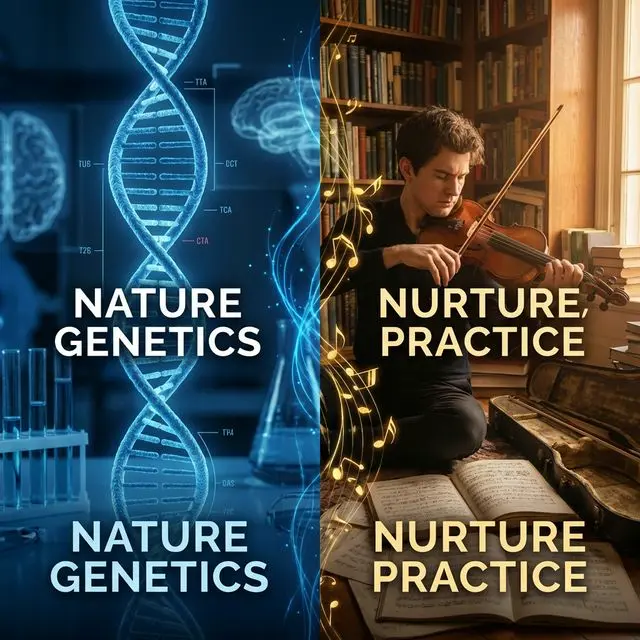
🧬 Part 1: The Role of Genetics (Nature)
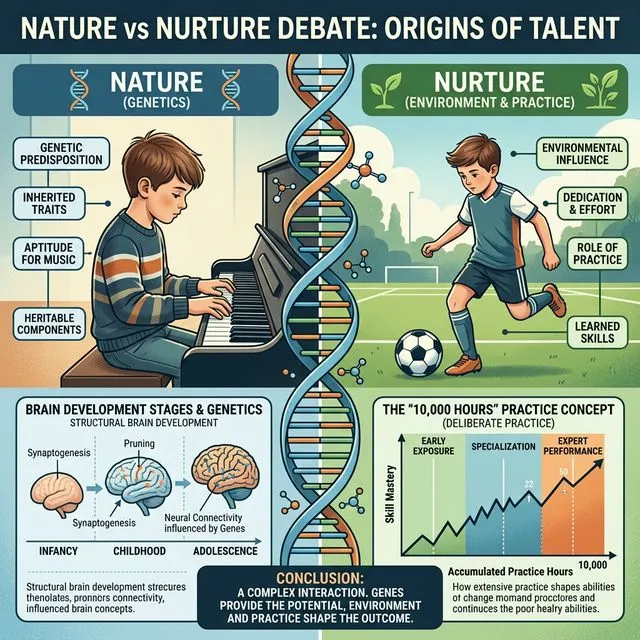
What Genes Do
Genetics doesn't determine whether you'll become Messi or Einstein. It provides predispositions — a kind of "starting point":
| Genetic Factor | Influence |
|---|---|
| IQ/Cognitive capacity | 50-80% hereditary |
| Brain structure (gray/white matter) | 70-90% genetic |
| Muscle fiber types (explosive vs. endurance) | Strongly genetic |
| Temperament (extroversion, persistence) | ~40-60% genetic |
| Height | ~80% genetic |
The Scientific Evidence
1. Identical Twin Studies
- Identical twins raised apart have more similar IQs than fraternal twins raised together
- This proves that genetics > environment for raw intelligence
- However: identical twins raised together are MORE alike than those raised apart — meaning environment ALSO matters
2. ACTN3 — The "Speed Gene"
- The R577X variant of the ACTN3 gene determines muscle fiber type
- Nearly 100% of elite Olympic sprinters carry the "R" variant (explosive power)
- Without this variant, it's genetically impossible to be the fastest person in the world — even with 10,000 hours of training
3. The "Experience-Producing Drive"
A fascinating theory: genes can create an "internal motivation" that drives a person to SEEK experiences that develop talent. Mozart didn't just have musical genes — he had a genetic compulsion for music that made him practice obsessively from early childhood.
What Genes DON'T Do
- ❌ There is no single "success gene"
- ❌ Genetics doesn't determine career or profession
- ❌ Having "favorable" genes without practice = wasted potential
- ❌ Unfavorable genes don't prevent excellence (they just change the ceiling)
🏋️ Part 2: The Role of Practice and Environment (Nurture)
Deliberate Practice — The Key Concept
Not just any practice develops talent. Psychologist K. Anders Ericsson (Florida State University) defined "deliberate practice" as:
| Element | Description |
|---|---|
| Specific goal | Focus on WEAK points, not strengths |
| Immediate feedback | Teacher/coach/real-time data |
| Outside the comfort zone | If it's easy, it's NOT deliberate practice |
| Structured repetition | Not "playing soccer" — it's "practicing crosses with the left foot" |
| Total concentration | Daydreaming ≠ practice |
The 10,000-Hour Rule: Truth or Myth?
Malcolm Gladwell popularized it in the book Outliers (2008): "It takes 10,000 hours of practice to master any skill."
🔍 What science actually says:
| Aspect | Reality |
|---|---|
| Is it an exact number? | NO. It was an average from elite violinists |
| Does it work for everyone? | NO. Some reach excellence with less; others never get there with 25,000h |
| Does practice explain everything? | NO. Meta-analyses show practice explains only: |
| 🎵 21% of variation in music | |
| ♟ 26% in chess | |
| ⚽ 18% in sports | |
| 📚 4% in education |
Conclusion: Practice is necessary but not sufficient. The other 74-96% of variation comes from genetics, environment, personality, timing, and luck.
The Matthew Effect
A cruel phenomenon: people with an initial genetic advantage benefit MORE from practice, causing the gap between talented and non-talented individuals to INCREASE over time, not decrease.
Example: A child with a musical predisposition receives praise → is encouraged → practices more → improves more → receives more praise → positive cycle.
🧠 Part 3: Where They Meet — Neuroplasticity
The Brain That Rebuilds Itself
The great discovery of modern neuroscience: the brain PHYSICALLY CHANGES with practice. This is neuroplasticity:
- New synapses form when we learn something new
- Frequently used regions become physically larger
- Rarely used neural pathways are pruned (efficiency)
- Neurogenesis (creation of new neurons) occurs even in old age
Concrete Examples
| Group | Brain Change |
|---|---|
| London taxi drivers | Posterior hippocampus 7% larger (navigation) |
| Professional musicians | Thicker corpus callosum (hemispheric coordination) |
| Bilinguals | More gray matter in the prefrontal cortex |
| Meditators | Smaller amygdala (less anxiety) |
| Jugglers | Increased gray matter after just 3 months of training |
📊 Part 4: The Talent Formula
Based on all the science:
Talent = Genetics (starting point)
       + Deliberate Practice (development)
       + Environment (opportunity)
       + Mindset (persistence)
       + Timing (luck)
Approximate Distribution of Influence
| Factor | Estimated Weight |
|---|---|
| 🧬 Genetics | 30-50% |
| 🏋️ Deliberate practice | 20-30% |
| 🌍 Environment/opportunity | 15-25% |
| 💪 Mindset/persistence | 10-15% |
| 🍀 Timing/luck | 5-10% |
What This Means for You
- If you have genetic predisposition + practice: extremely high ceiling (Messi, Carlsen)
- If you have genetic predisposition without practice: wasted potential (thousands of "Messis" who never played soccer)
- If you lack predisposition but practice extensively: you can reach excellence (top 5-10%) but probably not the absolute pinnacle
- If you have neither genetics nor practice: low ceiling
The good news? 99% of people never come close to exploring their genetic potential. Before blaming your genes, ask yourself: how much have you really practiced deliberately?
🌟 Cases That Illustrate
Mozart — The "Born Genius" Who Practiced 10,000 Hours Before Age 10
- His father was a conductor and music teacher
- He started practicing before age 3
- He practiced 3-4 hours a day from childhood
- His earliest compositions are considered "mediocre" by experts
- His masterpieces came after 10+ years of intense practice
Conclusion: Mozart had genes + a PERFECT environment + obsessive practice. Remove any factor and he wouldn't exist.
Tiger Woods — Engineered Talent
- Father Earl introduced golf at 6 months (observation)
- First swing at 11 months
- Was practicing before he could walk
- Environment meticulously designed to create a champion
Einstein — The "Lazy Genius" Who Wasn't
- His notebooks reveal years of obsessive work on physics problems
- He had the right environment (elite European education)
- His "revolutionary" ideas were built upon years of DELIBERATE study
💼 Talent vs. Practice Across Different Fields
The relative influence of genetics and practice varies dramatically depending on the field. You can't compare elite sports with programming, for example:
| Field | Genetics | Deliberate Practice | Notes |
|---|---|---|---|
| Sprinting (100m dash) | 🔴 Very High | 🟡 Important | Without fast-twitch muscle fibers, impossible to compete at the top |
| Classical music | 🟡 Moderate | 🔴 Very High | Perfect pitch is genetic, but technique is 80%+ practice |
| Programming | 🟢 Low | 🔴 Very High | Almost anyone can become excellent with deliberate practice |
| Basketball | 🔴 Very High | 🟡 Important | Height is genetic and significantly impacts performance |
| Chess | 🟡 Moderate | 🔴 Very High | IQ helps, but deliberate study explains more of the variation |
| Creative writing | 🟡 Moderate | 🟡 Moderate | Balanced combination of innate sensitivity and learned technique |
| Entrepreneurship | 🟢 Low | 🟡 Moderate | Environment, timing, and resilience matter more than genetics |
The lesson: in purely physical activities, genetics weighs more heavily. In cognitive and creative activities, deliberate practice carries far greater weight. This means that most careers and skills in the modern world are within reach for anyone who commits consistently.
🏙️ The Role of Socioeconomic Environment in Talent Development
Science may prove you have the genes to be an elite athlete, but if you were born in a region without access to training, proper nutrition, or sports infrastructure, that genetic potential may never manifest. The socioeconomic environment is one of the most underestimated factors in the talent equation — and perhaps the most decisive in practice.
Consider Brazilian soccer. The country is a factory of superstars, and many of them come from impoverished communities. Neymar grew up in Praia Grande under modest conditions, but he had access to Santos FC from age 11 — a professional structure with nutritionists, physical trainers, and elite coaches. Without that bridge between raw talent and infrastructure, how many "Neymars" were left behind playing pickup games on dirt fields, never to be discovered?
Now compare that with tennis. To develop a competitive tennis player in Brazil, a family needs to invest in rackets, court time (charged by the hour), tournament travel, private coaches, and specialized academies. The annual cost can exceed $20,000. It's no coincidence that most elite tennis players come from upper-middle-class or wealthy families. The genetic talent for tennis may exist in any social class, but the opportunity to develop it is brutally unequal.
Gladwell's famous "10,000-hour rule" hides a cruel assumption: it presumes you have 10,000 hours available to practice. A child who has to work from age 12 to help support the family doesn't have that luxury. A teenager attending a public school without a sports program doesn't have access to deliberate practice with qualified feedback. The privilege of time is invisible to those who possess it.
Olympic data confirms this reality. Countries with the highest per-capita investment in sports infrastructure — such as Norway, Australia, and New Zealand — win disproportionately more medals relative to their population. Norway, with just 5.4 million inhabitants, consistently outperforms nations with populations 50 times larger at the Winter Games. The secret isn't superior genetics — it's universal access to facilities, coaches, and development programs from childhood.
Nutrition also functions as a core mechanism. Studies published in The Lancet show that malnutrition during the first 1,000 days of life can permanently reduce a child's cognitive and physical potential. A brain that didn't receive adequate nutrients during formation cannot express its full genetic potential, regardless of how much training comes later. This means socioeconomic inequality doesn't just limit access to practice — it can literally alter an individual's biology before they even have a chance to try.
🧠 Growth Mindset vs. Fixed Mindset: The Work of Carol Dweck
If genetics defines the starting point and practice builds the path, there's a third factor that determines whether a person will even start walking: mindset. And no one has studied this better than psychologist Carol Dweck, a Stanford professor whose research transformed how we understand motivation and learning.
Dweck identified two fundamental mental patterns:
| Mindset | Core Belief | Behavior |
|---|---|---|
| Fixed (Fixed Mindset) | "Talent is something you either have or don't" | Avoids challenges, gives up when facing obstacles, sees effort as a sign of weakness |
| Growth (Growth Mindset) | "Skills can be developed through effort and strategy" | Embraces challenges, persists through failures, sees effort as the path to mastery |
In one of her most famous experiments, Dweck gave hundreds of students a set of easy problems. Afterward, half received the praise "You're very smart" (reinforcing a fixed mindset) and the other half heard "You worked really hard" (reinforcing a growth mindset). In the next phase, when offered harder problems, 90% of the "effort" group chose the greater challenge, while most of the "smart" group preferred to stay in their comfort zone.
The most disturbing result: when both groups faced deliberately impossible problems, the "smart" group gave up faster and reported less enjoyment. Worse: when they returned to solving easy problems, their performance dropped 20% compared to the beginning. The simple act of hearing "you're smart" made the children more fragile in the face of failure.
The practical implications are enormous. Parents who say "my child is a math genius" may be unintentionally raising a child who will avoid mathematical challenges for fear of losing the label. Teachers who label students as "talented" or "not cut out for this" are programming mindsets that can last decades.
The good news is that mindset can be changed. Intervention programs based on Dweck's work, implemented in schools across the United States, showed that teaching students the brain is like a muscle — it gets stronger with use — significantly improved math scores, especially among low-performing students. In a study of more than 12,000 ninth-graders published in the journal Nature in 2019, a mere 25-minute intervention on growth mindset raised the grades of the lowest-performing students by 0.3 points on average.
To apply this in real life: when facing a difficulty, replace "I can't do this" with "I can't do this yet." That single word — "yet" — transforms a statement of defeat into a statement of process. And process is exactly what science shows builds talent.
🔬 Epigenetics: When the Environment Changes Your Genes
If until now the discussion seemed to clearly divide "nature" on one side and "environment" on the other, epigenetics came along to completely blur that boundary. This revolutionary field of biology shows that the environment can literally turn genes on and off without altering a single letter of DNA — and these changes can even be inherited by future generations.
To understand: imagine your DNA is a book with 20,000 chapters (genes). Epigenetics consists of the bookmarks and highlighted passages that determine which chapters will be read and which will be ignored. Two identical twins have exactly the same book, but over their lifetimes, their bookmarks diverge based on different experiences — diet, stress, exercise, exposure to toxins, emotional trauma.
One of the most impactful studies on epigenetics came from analyzing survivors of the Dutch Hunger Winter of 1944-45. Researchers discovered that children of women who were pregnant during the famine had higher rates of obesity, diabetes, and cardiovascular disease — even though they grew up with normal nutrition. Even more surprising: the grandchildren of these women also showed metabolic alterations. The famine experienced by the grandmother had left epigenetic marks that crossed two generations without the DNA itself being altered.
What does this mean for talent? A great deal. Studies with elite athletes show that intense training can activate dormant genes related to muscular efficiency, aerobic capacity, and recovery. A study published in Cell Metabolism demonstrated that just six weeks of intense exercise altered methylation patterns (an epigenetic mechanism) at more than 5,000 sites in the genome of muscle cells. In other words, training doesn't just strengthen muscles — it reprograms gene expression.
Chronic stress, on the other hand, can have devastating epigenetic effects. Research on children who suffered neglect or abuse shows alterations in genes related to cortisol response (the stress hormone), making them biologically more vulnerable to anxiety and depression. This can compromise the capacity for concentration, persistence, and deliberate practice — all essential ingredients for talent development.
Epigenetics also explains why the early environment is so crucial. The first years of life represent a window of intense epigenetic programming. A child exposed to varied musical, linguistic, and motor stimuli in the first five years may be literally activating genes that will facilitate learning those skills for the rest of their life. It's not just "exposure" — it's biological reprogramming.
The deepest message of epigenetics is this: your genes are not your fixed destiny. They are a set of possibilities that the environment — including your own choices — can activate or silence. The boundary between "being born with talent" and "building talent" is far more fluid than any previous generation imagined. And this, paradoxically, places more responsibility — and more power — in the hands of each individual and the society that surrounds them.
❓ Frequently Asked Questions
Is talent genetic?
Partially. Genetics accounts for 30-50% of the equation. The other 50-70% depends on practice, environment, and choices.
Does the 10,000-hour rule work?
It's a useful simplification but not literal. Deliberate practice is essential, but the amount required varies between individuals and fields.
Can I become excellent at something without natural talent?
Yes! You can reach the top 5-10% of any field with consistent deliberate practice (years). The top 0.1% (Olympic/world level) generally requires genetics + practice.
Why do some children seem to "just know" things from birth?
It's usually a combination of: (1) genetic predisposition that generates early interest, (2) a stimulating environment, (3) accumulated invisible practice that adults don't notice.
🏁 Conclusion
Talent is not a mysterious gift that falls from the sky. It is the predictable result of favorable genetics + deliberate practice + a stimulating environment + persistence.
Genetics provides the starting point. But the path is built by you. And here's the most important takeaway: most people never explore even 30% of their genetic potential.
Before saying "I have no talent," the right question is: have you truly practiced in a deliberate, consistent, and challenging way?
If the answer is no, you don't yet know what your ceiling is.
Sources
- The Guardian — Talent: Born or Made
- NIH — Deliberate Practice
- Science Daily — Brain Structure & Genetics
- 6seconds.org — 10,000 Hour Rule
- University of Michigan — Nature vs Nurture
Last updated: February 17, 2026
Frequently Asked Questions
Is talent genetic or acquired?
Science shows that talent results from the interaction between genetics and environment. Genes can create predispositions, but without deliberate practice and a favorable environment, these predispositions rarely manifest as exceptional talent. Studies with identical twins confirm that both factors are essential.
How many hours of practice are needed to master a skill?
Anders Ericsson's famous 10,000-hour rule is an oversimplification. The time required varies enormously depending on the field, quality of practice, and individual characteristics. What matters most is not the quantity of hours, but the quality of deliberate practice with constant feedback.
Are child prodigies born with special talent?
Child prodigies typically combine genetic predisposition with intense early exposure and a stimulating family environment. Studies show that most prodigies had access to resources, mentors, and thousands of hours of practice from a very early age, not just innate talent.
Is it possible to develop talent at any age?
Yes, neuroplasticity allows the brain to form new connections at any age. Although learning is faster in childhood, adults can develop significant skills with consistent deliberate practice. Many successful artists and athletes started late in their careers.