Wayve Launches Autonomous Robotaxis in London
On February 20, 2026, British autonomous driving pioneer Wayve officially initiated commercial passenger operations for its fleet of fully autonomous robotaxis across central London, marking the formal arrival of Level 4 commercial driverless mobility on European soil. Unlike previous closed-loop pilots or geofenced research trials restricted to pre-selected corporate test groups, the London launch operates as a fully public on-demand transit service accessible to municipal commuters through a dedicated smartphone application.
The commercial rollout represents a pivotal inflection point for global transportation technology. Operating across the historically chaotic, narrow, and pedestrian-heavy street networks of London's Zones 1 and 2, Wayve's deployment challenges the long-standing industry assumption that autonomous passenger fleets can only function within the spacious, sun-drenched, grid-aligned boulevards of American suburban hubs like Phoenix or Austin. By navigating double-decker buses, cyclists, unpredictable rainstorms, and roundabouts without relying on pre-rendered centimeter-accurate HD maps, the British venture signals that autonomous urban navigation has reached operational maturity.
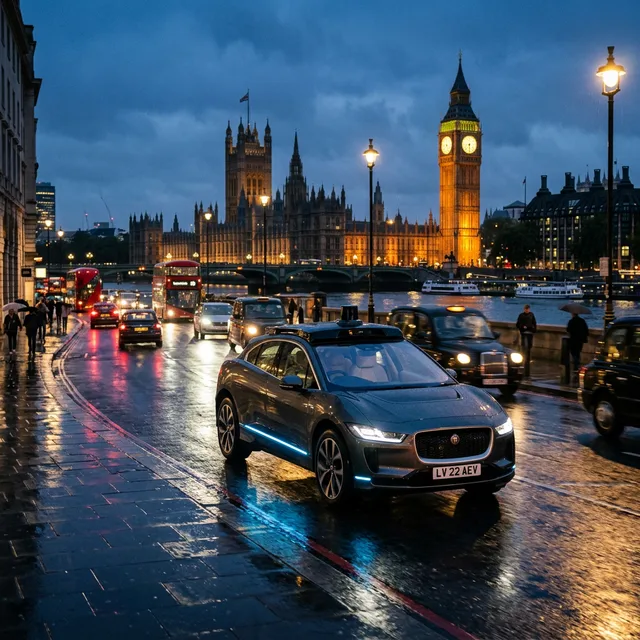
The Operational Blueprint: Commercial Launch Metrics
The initial commercial phase introduces a meticulously staged deployment across London's densest urban corridors:
| Operational Dimension | Commercial Parameter (Q1 2026) | Scaled Projections (2027–2028) | Strategic Transit Objective |
|---|---|---|---|
| Operational Territory | London Central Zones 1 & 2 | Greater London & M25 Ring | Seamless integration with TfL transit |
| Active Vehicle Fleet | 50 Custom Electric Vehicles | 1,000+ Multi-Model Units | High-frequency on-demand availability |
| Base Vehicle Platform | Modified Jaguar I-PACE EV | Purpose-Built Commercial Pods | Zero-emission municipal compliance |
| Autonomy Certification | SAE Level 4 (Defined Operational Domain) | SAE Level 4 (Unrestricted Weather) | Complete removal of in-cabin safety monitors |
| In-Cabin Supervision | Passive Safety Engineer in Passenger Seat | 100% Uncrewed Operations | Autonomous fleet tele-guidance via 5G |
| Service Operating Hours | 06:00 to 23:00 Daily | 24/7 Continuous Service | Round-the-clock night transit support |
Architectural Divergence: Vision-Based Deep Learning versus HD-Map LiDAR
The technological philosophy underpinning Wayve represents a radical departure from the classical robotics stack favored by industry incumbents such as Alphabet's Waymo and Baidu's Apollo Go:
+-----------------------------------------------------------------------------+
|               AUTONOMOUS NAVIGATION ARCHITECTURES CONTRASTED                |
+-----------------------------------------------------------------------------+
                                       |
                +----------------------+----------------------+
                |                                             |
                v                                             v
     [Legacy Robotics Paradigm: Waymo]              [Embodied AI Paradigm: Wayve]
     - Centimeter-Accurate Pre-Mapped HD LIDAR     - Zero Pre-Mapping / Pure Vision + Radar
     - Hand-Coded Heuristic Decision Trees         - End-to-End Multimodal Transformers
     - Fragile When Encountering Roadworks         - Generalizes Naturally to New Cities
     - Hardware Sensor Cost: ~$200,000+            - Hardware Sensor Cost: ~$40,000–$60,000
                |                                             |
                +----------------------+----------------------+
                                       |
                                       v
                     [The LINGO-2 Multimodal Advantage]
                     - 8 High-Frame-Rate HD Cameras (360° Vision)
                     - Natural Language Reasoning Engine
                     - Explains Driving Decisions in Real-Time
Classical autonomous architectures decompose vehicle control into rigid, sequential sub-modules: high-definition mapping, LiDAR point-cloud localization, rule-based object classification, and deterministic trajectory mathematics. When a vehicle encounters an undocumented construction trench or a traffic police officer directing traffic with hand gestures, these legacy systems frequently freeze or initiate hazardous emergency pull-overs because the physical reality contradicts their static pre-loaded map database.
Wayve discards pre-rendered HD maps entirely, adopting an end-to-end embodied artificial intelligence model. The vehicle's computing cluster ingests raw video feeds from eight surround cameras alongside automotive radar telemetry, feeding the unified sensory tensor directly into deep transformer networks trained on millions of miles of diverse human driving behavior. The vehicle perceives its surroundings, reasons through ambiguities, and computes steering, braking, and throttle actuations in a continuous mathematical loop, mirroring how a biological brain navigates unfamiliar urban environments.
The Cognitive Engine: Multimodal Reasoning with LINGO-2
At the core of Wayve's technological stack operates LINGO-2, a multi-billion-parameter multimodal foundation model engineered specifically for physical spatial reasoning. LINGO-2 combines visual perception with a large language model backbone, endowing the vehicle with the unprecedented ability to verbalize and justify its tactical maneuvers in real time:
- Continuous Semantic Scene Narration: The onboard neural model generates an internal running commentary of its perceptual focus: "Decelerating smoothly because a delivery cyclist forty meters ahead is glancing over their right shoulder to change lanes";
- Counterfactual Scenario Projection: The system projects multiple probabilistic futures, evaluating how surrounding motorists, electric scooters, and pedestrians will react to vehicle maneuvers;
- Conversational Passenger Interface: Occupants can converse directly with the car via interior microphones, instructing the vehicle to pull over safely near a specific shop entrance or inquiring why a specific detour was chosen.
This interpretability provides automotive safety certifiers with unprecedented transparency, converting what was once an inscrutable deep-learning "black box" into an auditable cognitive decision stream.
Global Fleet Benchmark: International Robotaxi Commercialization
The deployment of commercial driverless services across London marks Europe's entry into a competitive global mobility race:
| Enterprise & Platform | Home Base | Operational Status (2026) | Active Fleet Size | Deployment Geography | Technology Stack Architecture |
|---|---|---|---|---|---|
| Waymo (Alphabet) | United States | Fully Commercial | ~1,200 Vehicles | Phoenix, San Francisco, Los Angeles | HD LiDAR Maps + Rule-Based ML |
| Baidu (Apollo Go) | China | Fully Commercial | ~2,500 Vehicles | Wuhan, Beijing, Shenzhen, Chongqing | Hybrid LiDAR + V2X Infrastructure |
| Wayve Technologies | United Kingdom | Commercial Launch | 50 (Scaling to 1,000) | London (Expanding to Manchester) | Pure Vision End-to-End Embodied AI |
| Cruise (General Motors) | United States | Supervised Re-Testing | ~150 Vehicles | Austin, Dallas, Phoenix | Redesigned LiDAR Safety Stack |
| Zoox (Amazon) | United States | Commercial Pilot | ~120 Vehicles | Las Vegas, San Francisco | Purpose-Built Bi-Directional Pods |
Real-World Passenger Experience: The Mechanics of an Autonomous Ride
Passenger journeys during the inaugural commercial weeks in London reveal a driving demeanor described by early riders as "strikingly composed and disciplined":
- Summoning via Mobile Application: A user requests a vehicle through the Wayve iOS or Android interface, which calculates a guaranteed pickup arrival window within six to twelve minutes;
- Contactless Vehicle Ingress: The vehicle glides to the curb with centimeter precision. The passenger authenticates and unlocks the doors via near-field communication (NFC) or an in-app biometric slider;
- In-Cabin Journey Initiation: Touching an interactive rear-seat touch display launches the journey. In this initial regulatory phase, a licensed safety engineer sits silently in the front passenger seat, monitoring real-time diagnostics on a tablet without touching vehicle controls;
- Defensive Road Navigation: The vehicle adheres meticulously to London's 20 mph urban speed mandates, yields proactively to pedestrians waiting at zebra crossings, and navigates roundabouts with smooth, natural lane positioning;
- Automated Fare Settlement: Fares are charged automatically to the registered corporate or personal payment card, averaging twenty to thirty percent lower than traditional black cab tariffs.
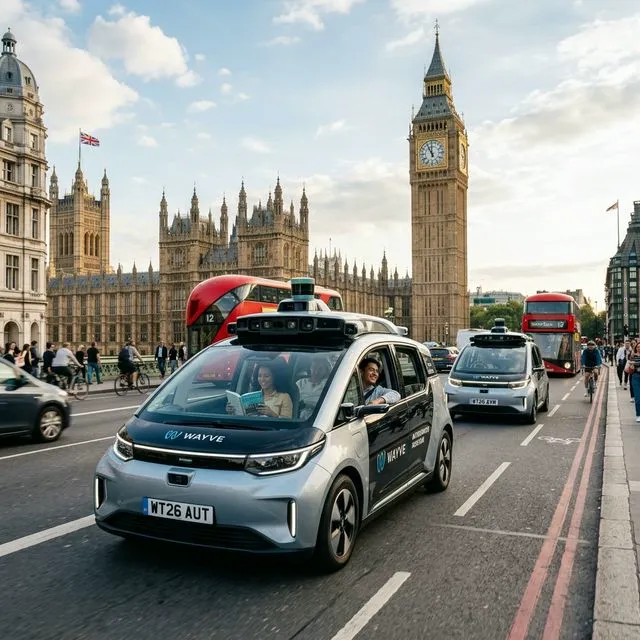
Ethical, Regulatory, and Economic Challenges Ahead
Despite celebrating a milestone technological rollout, autonomous vehicle deployment faces significant socioeconomic and legal headwinds across European municipalities:
- Labor Disruption and Reskilling: The United Kingdom supports approximately three hundred thousand licensed taxi and private hire drivers. Trade unions have called for statutory automation transition funds to support driver retraining as autonomous fleets expand;
- Inclement Weather Attenuation: Dense maritime fog, heavy downpours, and wet asphalt reflections can degrade optical camera clarity, necessitating robust radar sensor fusion to maintain safe stopping envelopes;
- Urban Surveillance and Data Governance: Wayve's high-definition camera arrays continually record public street scenes. Compliance with the UK General Data Protection Regulation (UK GDPR) mandates rigorous edge-based facial and license-plate blurring before telemetry data is archived for model training.
The Long-Term Horizon: Reimagining European Urban Spaces
The successful introduction of Level 4 robotaxis in London signals the commencement of a generational transformation in urban mobility. If shared autonomous fleets expand according to municipal projections, cities can systematically decommission massive multi-story parking structures, repurposing valuable real estate for affordable housing, pedestrian plazas, and green transit corridors.
By proving that artificial intelligence can master one of the world's most demanding urban road networks without brittle hand-coded maps, Wayve has demonstrated that driverless technology is no longer a speculative engineering ambition. It is a tangible commercial reality reshaping the daily lives of global metropolitan citizens.
Embodied Foundation Models Versus HD-Map LiDAR Stacks in Urban Britain
Wayve's commercial robotaxi deployment across Greater London represents an architectural paradigm shift from first-generation modular autonomy stacks (such as Waymo and Baidu Apollo) toward end-to-end Embodied AI foundation models. Whereas legacy autonomous vehicles rely on centimeter-accurate pre-mapped high-definition (HD) 3D point clouds and brittle rule-based motion planners that struggle when roadworks alter lane geometry, Wayve's LINGO vision-language-action neural network translates multi-camera video and radar streams directly into continuous steering and braking trajectories.
Navigating London's medieval street layouts, unmarked roundabouts, double-decker bus lanes, and rainy low-visibility evenings requires causal scene understanding capable of predicting pedestrian intent and courteous right-of-way negotiation. By training on millions of hours of diverse UK driving telemetry alongside natural-language reasoning traces, the vehicle can explain its driving decisions in plain English for regulatory safety audits.
Under the United Kingdom's Automated Vehicles Act framework, statutory legal liability shifts from the human occupant to the Authorized Self-Driving Entity (ASDE), establishing a clear insurance and homologation model that positions London as Europe's primary proving ground for scalable, mapless autonomous mobility.
Technical documentation compiled for "Wayve Launches Autonomous Robotaxis in London" within the Technology research domain demonstrates how empirical parameters tied to wayve london robotaxi 2026, autonomous vehicles uk, lingo-2 vision model require continuous verification across the institutional datasets examined under "The Operational Blueprint: Commercial Launch Metrics". Cross-referencing primary observations involving Wayve Launches Autonomous, Robotaxis, London, February alongside quantitative benchmarks (2026) establishes a reproducible analytical framework for tracking subsequent developments across the robotaxis wayve londres futuro autonomo 2026 dossier.
Institutional References and Technical Sources
- Wayve Technologies Official Engineering Blog — LINGO-2 Multimodal Architecture
- UK Department for Transport — Automated Vehicles Act Regulatory Guidelines
- Transport for London (TfL) — Innovation Framework for Autonomous Ride-Hailing
- Financial Times — Wayve Launches Commercial Driverless Taxi Service in London
- Society of Automotive Engineers (SAE) — Taxonomy and Definitions for Automated Driving Systems