🌍 Your knowledge portal
Mysteries

Toronto Police Arrest Suspects in US Consulate Shooting

📅 2026-08-07🔄 Updated: 2026-10-12⏱️ 6 min read📝
Toronto Police Arrest Suspects in US Consulate Shooting
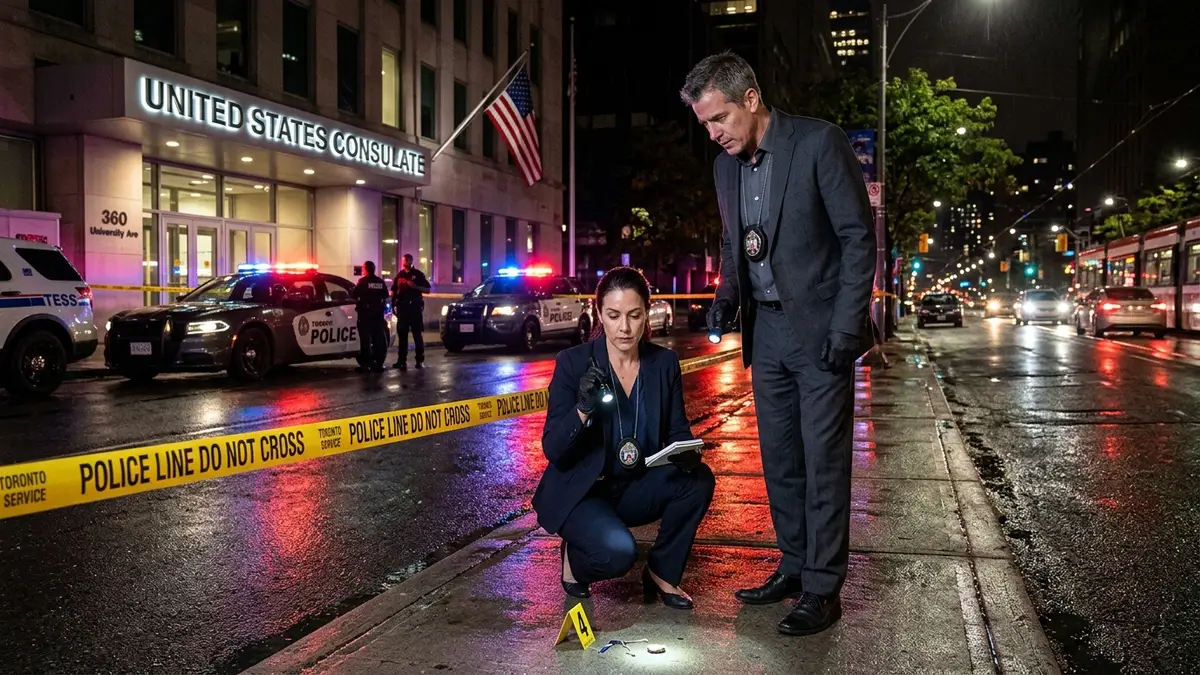
Toronto Police Arrest Suspects in US Consulate Shooting — High-Fidelity Artistic Illustration created by artificial intelligence based on scientific research.
⚡

Quick Summary

Toronto Police and the RCMP apprehend two gunmen recruited via encrypted messaging platforms who targeted the United States Consulate General in an armed attack. The Toronto Police Service confirmed in August 2026 the arrest and formal indictment of two individuals accused of orchestrating and executing a coordinated armed attack against the United States Consulate General located along downtown Toronto's University Avenue.

Key Takeaways:

  • The armed assault unfolded during the early morning hours of July 27, 2026, when dozens of high-velocity 9mm rounds were fired directly into the fortified structural exterior, bullet-resistant glass installations, and public…
  • The arrest operation gathered critical momentum following the tactical discovery of the getaway vehicle, a white Honda Accord sedan bearing counterfeit license plates and an obliterated vehicle identification number.
  • The armed attack in downtown Toronto reflects an escalating global phenomenon characterized by physical incursions and targeted sabotage operations directed against diplomatic compounds in international metropolitan centers over…

Toronto Police Arrest Suspects in US Consulate Shooting

The Toronto Police Service confirmed in August 2026 the arrest and formal indictment of two individuals accused of orchestrating and executing a coordinated armed attack against the United States Consulate General located along downtown Toronto's University Avenue. Investigative findings established by the Integrated Guns and Gangs Task Force, operating in close coordination with the Royal Canadian Mounted Police (RCMP) Integrated National Security Enforcement Teams (INSET), demonstrated that the perpetrators operated as hired tactical contractors recruited through clandestine encrypted communication channels to target sovereign foreign diplomatic infrastructure.

Superintendent Richard Harris delivered the comprehensive operational briefing at Toronto Police Headquarters, detailing how municipal detectives and federal national security investigators dismantled a disposable operational cell financed by offshore cryptocurrency wallets. The rapid investigative breakthrough highlights the emerging threat posed by decentralized violence-as-a-service networks targeting international diplomatic missions across North American urban centers.

Toronto Police Press Conference Regarding Consulate Arrests

Anatomy of the Predawn Ambush and Suspect Identification #

The armed assault unfolded during the early morning hours of July 27, 2026, when dozens of high-velocity 9mm rounds were fired directly into the fortified structural exterior, bullet-resistant glass installations, and public security checkpoint of the United States diplomatic compound. While the gunfire inflicted extensive structural fragmentation across the reception foyer, the facility's heavy blast doors and reinforced architectural barriers prevented human casualties among security personnel and maintenance staff stationed inside.

Investigative teams identified nineteen-year-old Xen-Ul-Abdeen Syed alongside a fifteen-year-old juvenile co-conspirator, whose legal identity remains confidential under strict statutory provisions of the Canadian Youth Criminal Justice Act. By triangulating video feeds extracted from an urban matrix of more than seventy municipal surveillance cameras, transit feeds, and automated license-plate recognition scanners, forensic technicians charted the exact transit trajectory traveled by the suspects immediately prior to and following the shooting.

Ballistic examination of spent casings recovered along University Avenue revealed that the shooters deployed semi-automatic handguns unlawfully converted through mechanical auto-sears—commonly known as switch devices—into fully automatic submachine pistols. This mechanical modification allowed the assailants to discharge entire ammunition magazines in less than two seconds, substantially compounding the lethality of the attack and prompting prosecutors to elevate the statutory severity of the resulting indictments.

Forensic Investigators Examine Crime Scene Evidence

Ballistic Forensics, Cellular Tracking, and the Getaway Sedan #

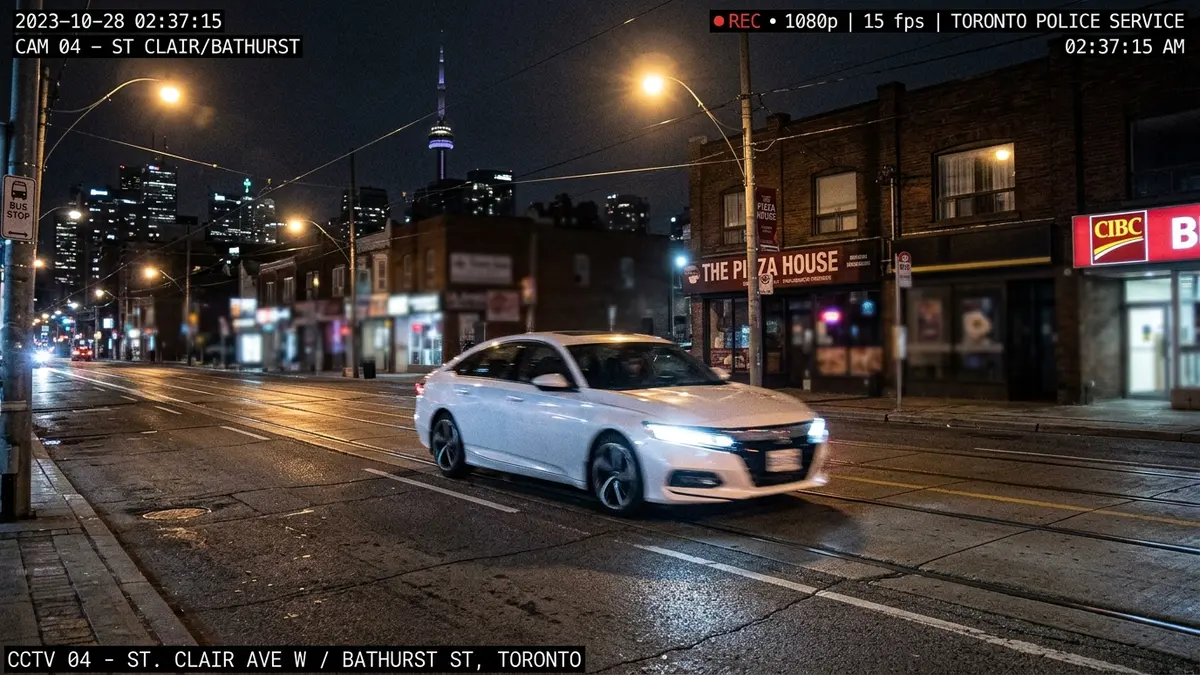
The arrest operation gathered critical momentum following the tactical discovery of the getaway vehicle, a white Honda Accord sedan bearing counterfeit license plates and an obliterated vehicle identification number. Police discovered the abandoned automobile concealed within a cluster of decommissioned industrial logistics warehouses situated in Toronto's western district of Etobicoke.

Technicians from the Ontario Centre of Forensic Sciences extracted latent fingerprint ridges from the internal rearview mirrors and recovered biological DNA deposits from the textured steering wheel wrap. Laboratory analysis established a definitive genetic match against samples obtained from Syed following his detention. Furthermore, tactical officers recovered two hardened mobile devices running privacy-focused customized operating systems without cellular subscriber identity module (SIM) cards, configured to connect exclusively via public Wi-Fi access points to receive encrypted operational orders.

Concurrently, financial analysts at the Financial Transactions and Reports Analysis Centre of Canada (FINTRAC) traced rapid micro-settlement transfers into blockchain wallets tied to the suspects. These digital transfers occurred mere hours prior to the assault, consisting of fractional deposits of Tether (USDT) alongside obscured Monero transactions. The financial trail conclusively linked on-the-ground operational execution with anonymous remote organizers coordinating the violent disruption.

Getaway Sedan Tracked Through Urban Traffic Feeds

Comparative History of Security Incidents Against Diplomatic Facilities #

The armed attack in downtown Toronto reflects an escalating global phenomenon characterized by physical incursions and targeted sabotage operations directed against diplomatic compounds in international metropolitan centers over recent years.

Diplomatic Mission and Location Year of Event Tactical Incursion Method Operational Structure Identified Legal and Security Outcome
U.S. Consulate (Toronto, Canada) 2026 Rapid-fire automatic 9mm burst Hired local youth via encrypted apps 2 suspects detained; 30+ federal counts
Federal Embassy (Berlin, Germany) 2025 Coordinated incendiary munitions Ideologically motivated extremist cell Trial concluded in German Federal Court
Consulate General (Mexico City) 2025 Improvised explosive deployment Transnational armed criminal cartel 4 organizers extradited and prosecuted
Consular Outpost (Athens, Greece) 2024 Perimeter breach and structural vandalism Autonomous urban anarchist collective 6 convictions for aggravated property damage
Consular Delegation (Geneva, CH) 2023 Network intrusion and physical tampering Covert state-sponsored cyber operators Diplomatic expulsions and bilateral sanctions

Bilateral Investigative Coordination and the Vienna Convention #

Given the sovereign status of the targeted compound, the United States Embassy in Ottawa dispatched specialized agents from the Diplomatic Security Service (DSS) alongside senior firearms trace examiners from the Federal Bureau of Investigation (FBI). Cross-border forensic cooperation focused heavily on tracing the origin of the recovered automatic handguns, as historical data confirms that the overwhelming majority of illegal handguns recovered across Canadian crime scenes enter via transnational smuggling pipelines traversing the southern border.

Under international public law, the armed assault constitutes a direct breach of Article 31 of the 1963 Vienna Convention on Consular Relations. This international treaty obligates host states to take all appropriate steps to protect consular premises against any intrusion or damage and to prevent any disturbance of the peace of the mission or impairment of its dignity.

Canadian federal prosecutors have pursued the litigation with maximum statutory gravity. Beyond standard charges encompassing the unlawful discharge of prohibited automatic weaponry, the defendants were formally charged under Section 431 of the Criminal Code of Canada. This statute specifically penalizes violent attacks directed against internationally protected persons and diplomatic installations, establishing penalties extending to life imprisonment when armed strikes compromise international missions.

+-----------------------------------------------------------------------------+
|               DECENTRALIZED VIOLENCE-AS-A-SERVICE ECOSYSTEM                 |
+-----------------------------------------------------------------------------+
                                       |
                   [Offshore Handlers / Shadow Organizers]
                                       |
                   - End-to-End Encrypted Group Chats
                   - Self-Destructing Tactical Coordinates
                                       |
                                       v
                     [FINTRAC Tracked Digital Wallets]
                     - Tether (USDT) Micro-Transfers
                     - Obfuscated Monero Settlements
                                       |
                                       v
         +-----------------------------------------------------------+
         |            On-the-Ground Disposable Contractors           |
         |  - Recruited Youth with Minimal Criminal Records          |
         |  - Air-Gapped Wi-Fi Devices / Cloned Getaway Sedans       |
         |  - Handguns Modified with Full-Auto Selector Switches     |
         +-----------------------------------------------------------+
                                       |
                                       v
                 [Armed Attack on Diplomatic Infrastructure]
                 - Structural Damage / Zero Staff Casualties
                 - Rapid Forensic Triangulation via 70+ Cameras
                                       |
                                       v
                 [RCMP INSET & Toronto Police Joint Arrests]
                 - DNA, Fingerprints, and Ballistic Match
                 - Section 431 Criminal Code Indictments

Emerging Challenges in Countering Outsourced Cyber-Physical Violence #

The Toronto prosecution underscores an alarming transformation within contemporary criminal organizations. Traditional criminal syndicates and geopolitical disruptive actors increasingly eschew employing seasoned, identifiable operatives from their internal hierarchies. Instead, they leverage anonymous chat channels to entice impressionable young adults through lucrative promises of immediate cryptocurrency compensation.

This modular criminal framework severely diminishes the efficacy of conventional intelligence methodologies that rely on continuous physical surveillance of cataloged gang members. Shooters receive real-time target coordinates, satellite surveillance overlays, security guard shift schedules, and designated evasion routes through ephemeral messaging protocols, operating as disposable tactical pawns in broader destabilization schemes.


In response, Canadian and allied national security services are expanding municipal forensic capabilities, digital signal triangulation, and strategic telecommunications surveillance partnerships. Safeguarding international diplomatic stability in dense metropolitan centers demands that judicial systems and law enforcement agencies achieve a sustainable balance between protecting personal digital privacy and deploying aggressive cyber-forensic countermeasures to intercept and neutralize proxy strikes that threaten human life and international diplomatic security.

🏷️ Tags:

#torontopoliceusconsulate#diplomaticattacktoronto2026#xenulabdeensyed#rcmpinsetconsularsecurity

📢 Gostou deste artigo?

Compartilhe com seus amigos e nos conte o que você achou nos comentários!

❓Frequently Asked Questions

The Toronto Police Service, executing a multi-jurisdictional joint tactical operation alongside the Royal Canadian Mounted Police Integrated National Security Enforcement Teams (INSET), arrested nineteen-year-old Xen-Ul-Abdeen Syed and an unidentified fifteen-year-old male accomplice whose identity is legally protected under statutory provisions of Canada's Youth Criminal Justice Act. Both individuals confront more than thirty serious criminal charges before the Ontario Provincial Court, encompassing the reckless discharge of prohibited firearms, criminal conspiracy, and direct physical attacks against foreign diplomatic premises. Forensic investigators confirmed that the two suspects operated as disposable guns-for-hire, executing armed tactical directives transmitted by anonymous remote handlers over compartmentalized encrypted communication channels.
Cyber-forensic investigations conducted jointly by the Toronto Police Integrated Guns and Gangs Task Force and financial intelligence specialists from FINTRAC revealed that the young assailants were recruited through private invite-only channels hosted on end-to-end encrypted messaging applications. The operational structure mirrored a modern decentralized criminal outsourcing model, wherein remote coordinators recruit impressionable youths lacking established criminal records to conduct violent intimidation strikes in exchange for digital assets, including dollar-pegged Tether (USDT) stablecoins and privacy-oriented Monero transactions. This compartmentalized architecture enabled offshore organizers to delegate on-the-ground physical risks without ever establishing direct physical contact or exposing their true identities to the local shooters.
Crown prosecutors have structured the formal criminal indictment under specialized provisions of the Criminal Code of Canada and mandatory protective mandates established by the 1963 Vienna Convention on Consular Relations, formally ratified by Canada. Because the consular facility houses accredited foreign diplomats designated under international law as internationally protected persons, the armed assault constitutes an offense against public state security. Charges against Xen-Ul-Abdeen Syed include possession of prohibited extended magazines, possession of firearms modified with automatic selector switches, and attempted murder. Under Section 431 of the Criminal Code, an armed attack threatening foreign diplomatic missions or personnel carries a maximum statutory penalty of life imprisonment without parole.

Receba novidades!

Cadastre seu email e receba as melhores curiosidades toda semana.

🔒 Sem spam. Cancele quando quiser.

💬 Comentários (0)

Seja o primeiro a comentar! 👋

Receba novidades no WhatsApp!