
Menendez Brothers: The Beverly Hills Parricide That Divided America
On the night of August 20, 1989, two brothers entered the living room of their family's Beverly Hills mansion, armed with 12-gauge shotguns, and fired 15 shots at their own parents. Jose Menendez, a 45-year-old Cuban-American executive who ran the video distribution company LIVE Entertainment (now Artisan Entertainment), and his wife Mary Louise "Kitty" Menendez, 47, died instantly. The two shooters — Lyle, 21, and Erik, 18 — called 911 in tears 45 minutes later, claiming to have found the bodies upon returning home. What followed were two of the most televised and controversial trials in American history, a national debate about male sexual abuse that anticipated discussions that wouldn't reach the mainstream for decades, and a life imprisonment sentence that to this day, in 2026, generates appeals, petitions, and new documentaries. This is the complete story — without romanticization, but without simplification.
The Menendez Family: Wealth, Control, and Secrets
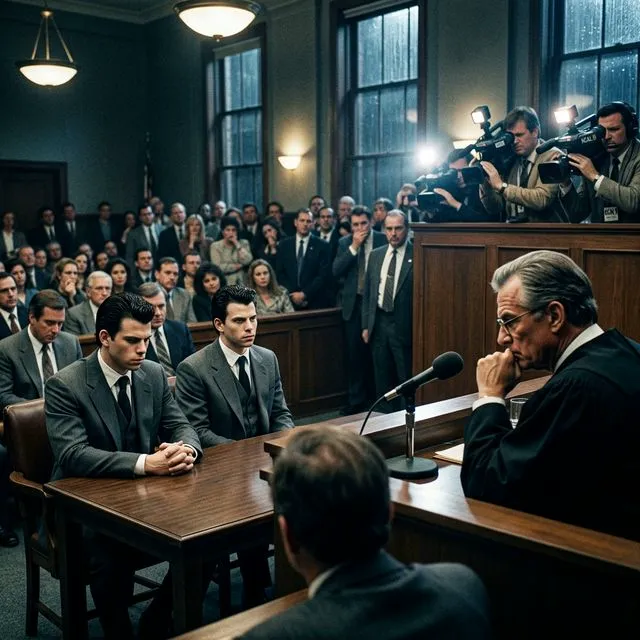
Jose Menendez: The Immigrant Who Built an Empire
Jose Enrique Menendez was born in Havana, Cuba, in 1944, and emigrated to the United States at 16, after the Cuban Revolution. Alone, not speaking English and virtually penniless, Jose embodied the "American dream" in its most aggressive form. He graduated in accounting from Southern Illinois University on scholarship and quickly climbed the corporate world.
By 30, he was already an executive at Hertz Corporation. By 37, he became CEO of RCA Records (an RCA subsidiary that included artists like Duran Duran and the Eurythmics). By 40, he was CEO of LIVE Entertainment, a home video distribution company with annual revenue exceeding $400 million — a fortune in the pre-streaming era. The family lived at 722 North Elm Drive, a mansion in the heart of Beverly Hills valued at $4 million (equivalent to about $10 million in 2026).
But behind the facade of success there was, according to the sons' later testimonies, a controlling, violent, and sexually predatory man. Jose was described by colleagues as "brilliant but terrifying" — a perfectionist who demanded absolute results and punished failures with calculated cruelty.
Kitty Menendez: The Wife Who Knew — and Did Nothing
Mary Louise "Kitty" Andersen, born in Illinois, was a teacher and housewife who abandoned her career to dedicate herself entirely to the family and the social status her husband provided. According to the sons, Kitty suffered from chronic depression, abused alcohol and prescription medications, and — the most disturbing detail — knew about the sexual abuse Jose allegedly committed against both sons, but not only refused to intervene but, on some occasions, participated emotionally in the degradation.
Erik described in testimony that, at age 6, when he tried to tell his mother about the father's abuse, she responded: "Don't tell me these things. I don't want to hear it." This reaction — the maternal protective failure — became one of the central pillars of the defense in the trials.
The Night of August 20, 1989: What Happened
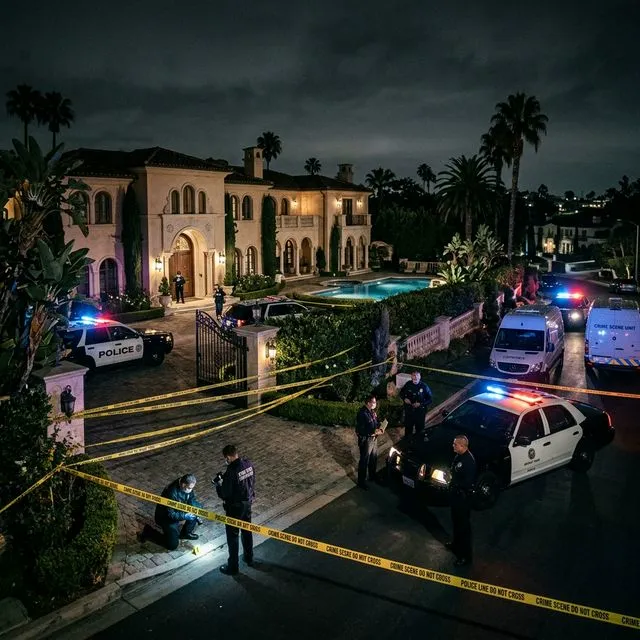
The Sequence of Events
At 10 PM, Jose and Kitty were watching television in the mansion's living room. According to the prosecution's reconstruction, Lyle and Erik entered through the garage's side door, each carrying a Mossberg 12-gauge shotgun — purchased days earlier from a gun shop in San Diego under false documents.
The ballistic details reveal the brutality of the act:
| Victim | Number of shots | Wound locations |
|---|---|---|
| Jose Menendez | 6 shots | Head (2), arm, elbow, thigh, knee |
| Kitty Menendez | 9 shots (including 1 contact shot) | Leg, arm, chest, face, skull |
Jose died with the first shots. Kitty, however, didn't die immediately. According to forensics, she tried to crawl away from the shooters after the first shots. Lyle had to reload the shotgun and returned to fire the fatal shot — a contact shot to the face, from a distance of centimeters. This detail was especially devastating during the trial: the prosecution argued it represented the "calculated coldness" of the murders; the defense maintained it represented the desperation of two young men who, overtaken by panic after starting something they could no longer contain, acted in a dissociative state.
The 911 Call
At 10:47 PM, Lyle called 911 in tears. The partial transcript:
"Someone killed my parents! [...] I came from the movies and they're dead! Erik, my brother, is here... They were shot!"
The officers who responded described the scene as "one of the most violent in Beverly Hills" — an area where homicides are extremely rare. Blood covered the walls, ceiling, and furniture around the bodies.
Before the Murder: The Lives of the Menendez Brothers
Lyle Menendez
The eldest son, Lyle, was born in 1968 in New York. Studious, athletic, and socially skilled, Lyle attended Princeton University — but was suspended for academic plagiarism. According to his later account, he lived under constant pressure from his father, who expected him to be "perfect at everything, all the time." Lyle alleged that sexual abuse by the father began when he was 6 and continued until he was 8, when he confronted his father and the direct abuse against him ceased — but continued with Erik.
Erik Menendez
The younger brother, born in 1970, was a talented tennis player who competed at the national junior level. More introverted and emotionally vulnerable than his brother, Erik alleged he suffered sexual abuse from his father from age 6 to 18 — that is, until just months before the murder. In his testimony, Erik described in graphic detail the abuse: forced oral sex, penetration, "massage" sessions that turned into sexual violence, and constant death threats if he told anyone.
The Abuse Thesis: Evidence and Controversies
The allegation of sexual abuse as the central motivation for the murder divided the country. The elements supporting the thesis included:
- Testimony from cousins and relatives: Diane Vander Molen, the brothers' cousin, testified that Lyle told her about the abuse when both were 11 years old
- Andy Cano, Erik's cousin: Testified that Erik mentioned the sexual abuse before the murders
- Dr. Jerome Oziel: The therapist who treated the brothers and who — in one of the most controversial twists — recorded sessions in which Lyle and Erik confessed to the murders. These recordings were used by the prosecution, despite challenges regarding doctor-patient confidentiality
- Roy Rossello's statement (2023): In 2023, the former member of boy band Menudo publicly revealed that Jose Menendez sexually abused him when he was a minor in the 1980s, corroborating the predatory pattern described by the sons
- Erik's unseen letter (1988): A letter written by Erik to his cousin 8 months before the murders, describing the father's abuse, was discovered in 2018 and presented as new evidence
The Two Trials: A Portrait of 1990s America
First Trial (1993-1994)
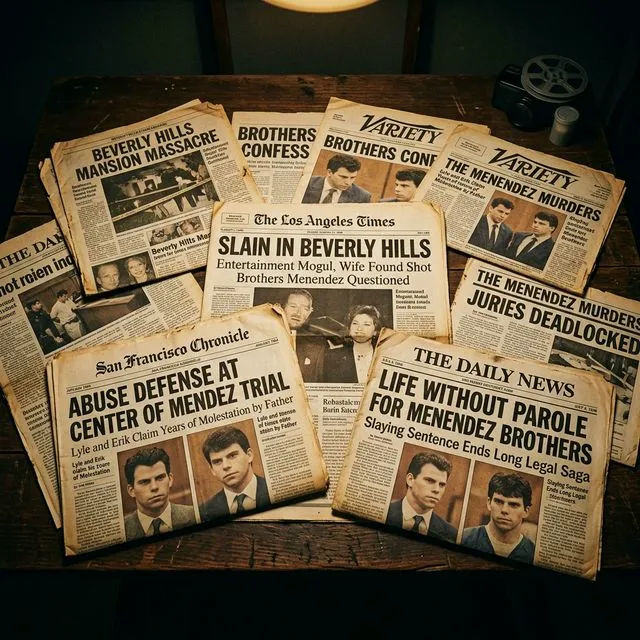
The first trial was an unprecedented media spectacle — surpassed only by the O.J. Simpson trial the following year. Court TV broadcast the trial live, and millions of Americans followed every testimony.
The defense (attorney Leslie Abramson for Erik, and Jill Lansing for Lyle) argued self-defense based on ongoing abuse. The brothers feared Jose would kill them because Erik had threatened to reveal the abuse publicly.
The prosecution (Pamela Bozanich and Lester Kuriyama) argued the motive was pure financial greed. In the months following the murders, the brothers spent nearly $700,000 on extravagant purchases: Rolex watches, a Porsche, designer clothes, expensive restaurants, trips, and even a restaurant franchise. The prosecution called it "the biggest spending spree in American criminal history."
Result: Both juries were split and couldn't reach a verdict. Lyle: 6 votes for first-degree murder, 6 for involuntary manslaughter. Erik: similar result. The judge declared a mistrial.
Second Trial (1995-1996)
The second trial was drastically different. Judge Stanley Weisberg made decisions that favored the prosecution:
- Prohibited live television broadcast — eliminating public pressure on jurors
- Severely limited abuse evidence — excluding much of the sexual abuse testimony
- Combined the trials into a single proceeding with a single jury
- Excluded the involuntary manslaughter instruction — jurors could only choose between first-degree murder, second-degree murder, or acquittal
With limited options, the jury convicted both brothers of two counts of first-degree murder and conspiracy to commit murder. Sentence: life imprisonment without the possibility of parole (LWOP).
In Prison: 36 Years Behind Bars
Separation and Reunion
After the conviction, the brothers were sent to separate prisons — standard practice for co-defendants. Lyle went to Mule Creek State Prison, and Erik to Pleasant Valley State Prison. They didn't see each other in person for nearly 20 years.
In 2018, both were transferred to the Richard J. Donovan Correctional Facility in San Diego, where they remain today. The reunion, according to prison administration reports, was emotional — the brothers hugged and cried.
Life in Prison
In prison, both married:
- Lyle married Anna Eriksson in 1996 (divorced 2001), then Rebecca Sneed in 2003
- Erik married Tammi Saccoman in 1999 — the marriage continues to this day
Both became model prisoners, participating in educational programs, volunteer work, and community activities within the prison. Erik became a facilitator of a support program for inmates who are sexual abuse survivors, and Lyle worked as an educational tutor.
Freedom Attempts (2024-2026)
The case gained new life in 2024-2026, driven by converging factors:
| Year | Event |
|---|---|
| 2017 | Series Law & Order True Crime: The Menendez Murders (NBC) |
| 2018 | Brothers reunited in the same prison (San Diego) |
| 2022 | Documentary Menendez: The Erik and Lyle Story generates renewed public interest |
| 2023 | Roy Rossello (ex-Menudo) reveals abuse by Jose Menendez, corroborating the sons' claims |
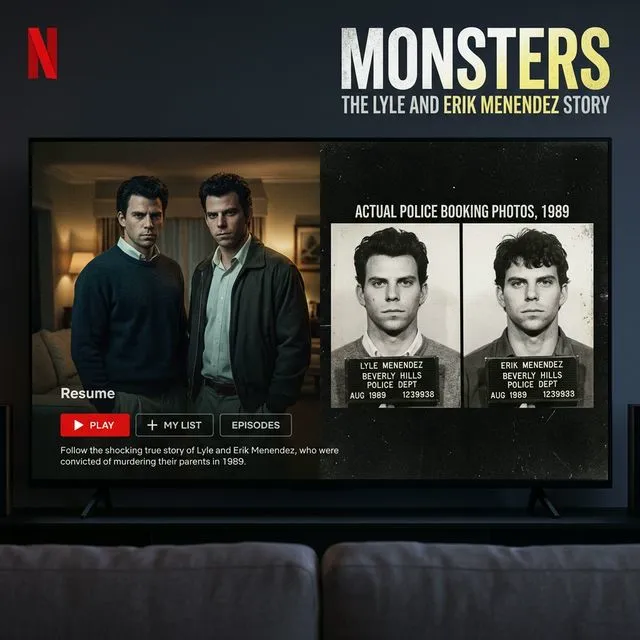
| 2024 (Sep) | Series Monsters: The Lyle and Erik Menendez Story (Netflix/Ryan Murphy) |
| 2024 (Oct) | Prosecutor George Gascón recommends sentence reduction |
| 2025 (May) | Judge reduces sentence to "50 years to life" — eligible for parole |
| 2025 (Aug) | Parole DENIED — Erik had rule violations, Lyle had cellphone infractions |
| 2026 | Clemency petition to Governor Gavin Newsom and petition for new trial underway |
The Never-Ending Debate: Killers or Victims?
Defenders' Arguments
The brothers' defenders — and there are millions, especially after the Netflix series — argue:
- The abuse was real and documented: Erik's 1988 letter, Roy Rossello's testimony, and family members' accounts form a consistent pattern of sexual abuse by Jose
- The law has changed: In the '90s, society and the legal system were far less receptive to male sexual abuse allegations. Today, the same evidence would likely result in a different verdict
- Stockholm syndrome and complex trauma were poorly understood in the '90s — abused children can simultaneously love and fear their abusers
- The sentence is disproportionate: Inmates who committed similar or worse crimes received lighter sentences
Critics' Arguments
The prosecution and critics maintain:
- The spending spree is indefensible: If they acted out of fear, why did they spend $700,000 on luxuries in the following months?
- The gun purchase was premeditated: They traveled to San Diego, bought shotguns under false documents, and planned the execution
- The abuse evidence is circumstantial: The allegations were never independently verified during Jose's lifetime
- Kitty was a victim, not an accomplice: The mother received 9 shots, including one to the face — the violence against her is incompatible with "self-defense"
The Menendez Case in the Context of 2026
The Menendez brothers' case is inseparable from the cultural transformations of the last three decades. In the '90s, public opinion was largely against the brothers — the narrative of "rich kids who killed for inheritance" prevailed in the media. In 2026, after decades of advances in understanding childhood trauma, the #MeToo movement, and a society more willing to listen to male victims of sexual abuse, the cultural pendulum has swung dramatically.
The case remains legally active: the brothers' attorneys are preparing a petition for a new trial based on "new evidence" (the 1988 letter and Roy Rossello's testimony), and a formal clemency request to Governor Gavin Newsom is under review. If granted, the Menendez brothers could be released after 36 years in prison.
The question remains: Are Erik and Lyle Menendez cold killers who murdered for inheritance, or survivors of sexual abuse who exploded in a desperate act of self-defense? The answer probably contains elements of both truths — and that's exactly why this case continues to fascinate, disturb, and divide public opinion more than three decades later.
Frequently Asked Questions (FAQ)
Can the Menendez brothers be released in 2026?
It's possible, but not guaranteed. A formal resentencing petition is being analyzed by the Los Angeles County court, based on new evidence of sexual abuse (Erik's 1988 letter and Roy Rossello's 2023 testimony). Simultaneously, there's a clemency request addressed to California's governor. If granted, the brothers could be resentenced based on current abuse survivor legislation, which didn't exist in 1996, potentially allowing parole.
Was the Menendez case really televised live?
Yes. The first trial (1993-1994) was among the first criminal cases broadcast live in its entirety by Court TV, a precursor to the "trial television" era that would include the O.J. Simpson trial shortly after. Audiences reached millions of viewers, with Lyle and Erik becoming polarizing figures in American culture. The second trial (1995-1996), by the judge's decision, had more restricted television coverage.
Is the Netflix series about the Menendez brothers accurate?
The series "Monsters: The Lyle and Erik Menendez Story" (2024), created by Ryan Murphy, mixes documented facts with fictional dramatizations. The Menendez brothers publicly criticized the series, alleging it distorts various events and perpetuates stereotypes. Experts note the series is reasonably accurate on major events but takes significant liberties in characterizing motivations and personalities. For a more faithful version, documentaries like "Menendez + Menendez" (Peacock, 2023) are considered more accurate.
How much did the Menendez defense cost?
The defense in the first trial cost an estimated $750,000, paid from the parents' inheritance (which the prosecution used as evidence of financial motive). After conviction and financial resources were depleted, the brothers were represented by public defenders in subsequent appeals. Leslie Abramson, the attorney who defended Erik in the first trial, became a legal celebrity and her emotional courtroom performance is considered one of the most memorable defenses in American legal history.


