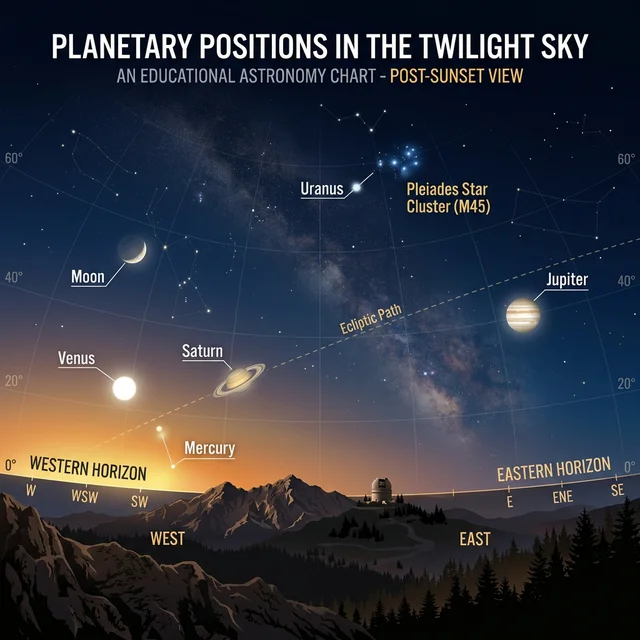
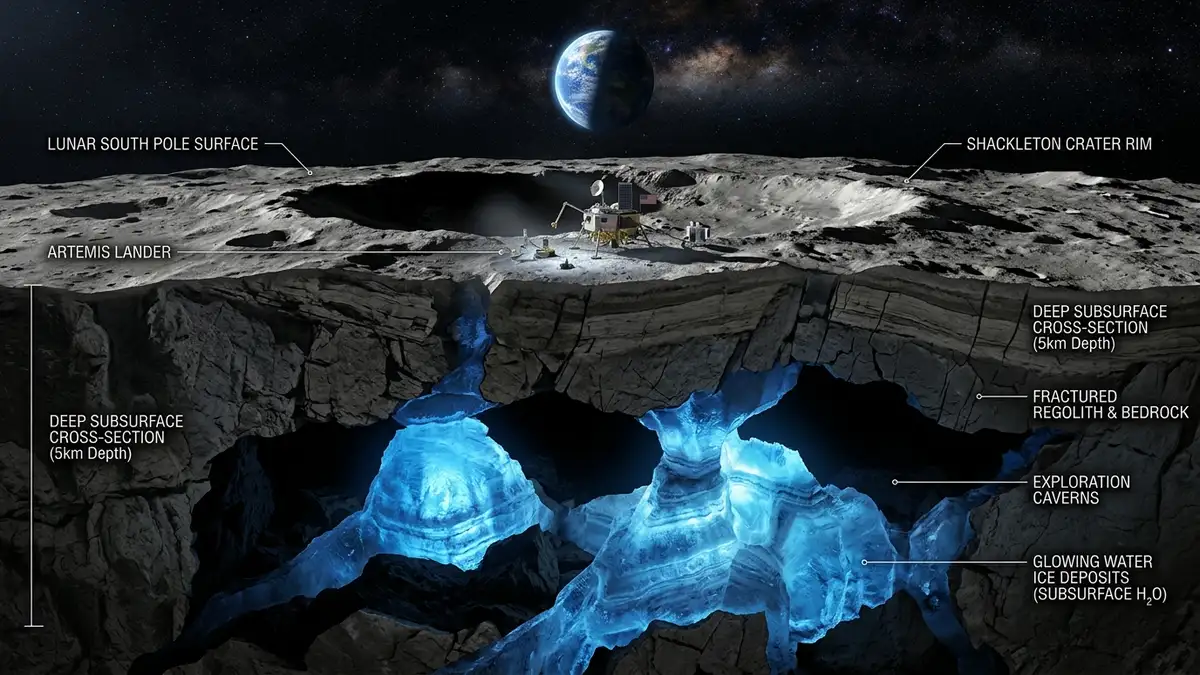
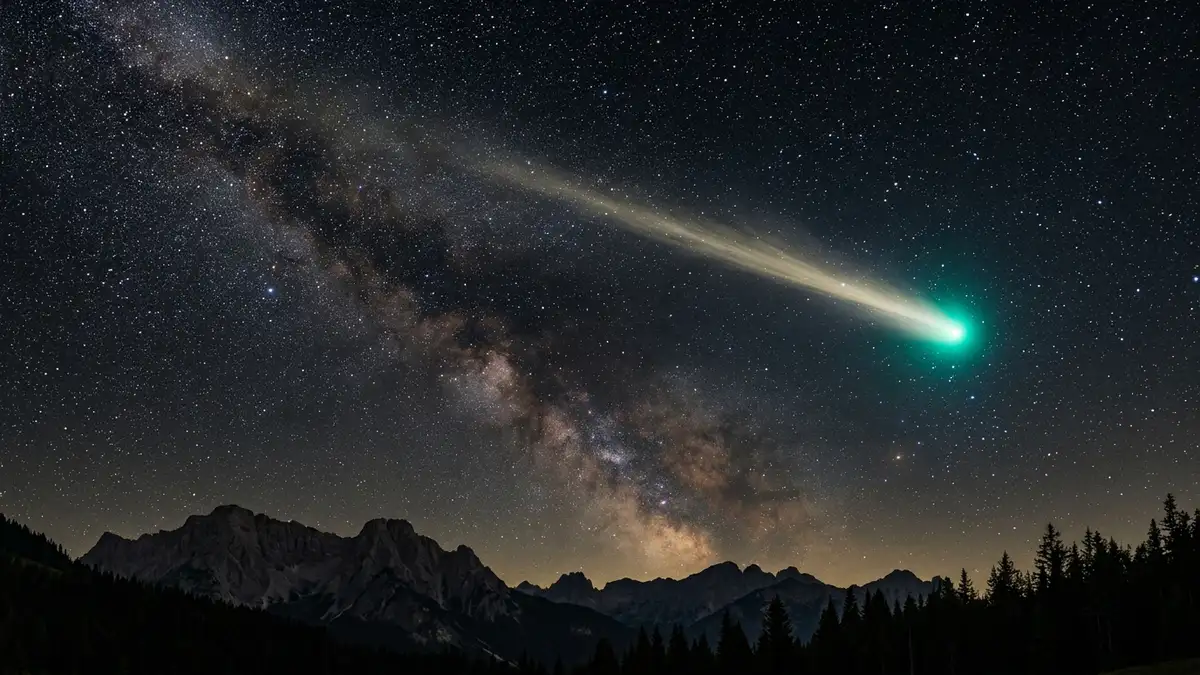
- Position: Shining vigorously in the western sky, well above the horizon
- Visibility: Excellent — impossible to miss
- Magnitude: −3.9 (the brightest object in the sky after the Moon)
- Tip: It's the brightest "star" you'll see — if something looks absurdly luminous, it's Venus
Venus is the undisputed superstar of this parade. With a thick atmosphere that reflects over 70% of sunlight, it shines so intensely it can be confused with an airplane or even a UFO by inattentive observers. Historically, Venus is responsible for more "flying saucer" reports than any other celestial object.
- Position: Near Venus, in the western sky, but lower and less bright
- Visibility: Moderate — visible to the naked eye in clear conditions
- Magnitude: ~0.7
- Tip: Look for a golden-yellowish dot not far from Venus. Its rings are NOT visible to the naked eye, but a small telescope will reveal them magnificently
Fascinating fact: in 2025, Saturn's rings practically "disappeared" when viewed from Earth, as they were edge-on. In 2026, they're starting to reappear, offering a slightly tilted angle — enough to enchant anyone with a telescope.
- Position: Very close to Saturn, almost indistinguishable to the naked eye
- Visibility: Impossible without a telescope or powerful binoculars
- Magnitude: +7.8 (very faint)
- Tip: With a telescope of 80mm or more, look for a faint bluish dot in Saturn's vicinity
Neptune is the most distant planet from the Sun (since Pluto was demoted in 2006). At 4.5 billion kilometers away, its light takes over 4 hours to reach us. Even so, it's there, silently participating in this cosmic choreography.
- Position: Much higher in the sky, in the constellation Taurus, near the Pleiades cluster
- Visibility: Technically visible to the naked eye (~5.7 mag), but requires very dark skies
- Magnitude: ~5.7
- Tip: Use binoculars and search around the Pleiades. A stargazing app helps enormously
Uranus has a unique peculiarity in the solar system: its axis of rotation is tilted at nearly 98°, making it essentially "roll" along its orbit like a ball. This means its seasons last 21 Earth years each. Imagine a winter lasting two decades!
- Position: High in the sky, toward the east/southeast
- Magnitude: −2.2 (extremely bright, second only to Venus)
- Visibility: Excellent — impossible to mistake
- Tip: It's the second brightest point in the night sky. With binoculars, you can see its 4 Galilean moons as tiny aligned dots
Jupiter is the true giant of the solar system. With a mass 318 times greater than Earth's and 95 known moons (updated count as of 2024), it's practically a miniature solar system. Had Jupiter been only 80 times more massive, it would have become a brown dwarf star.
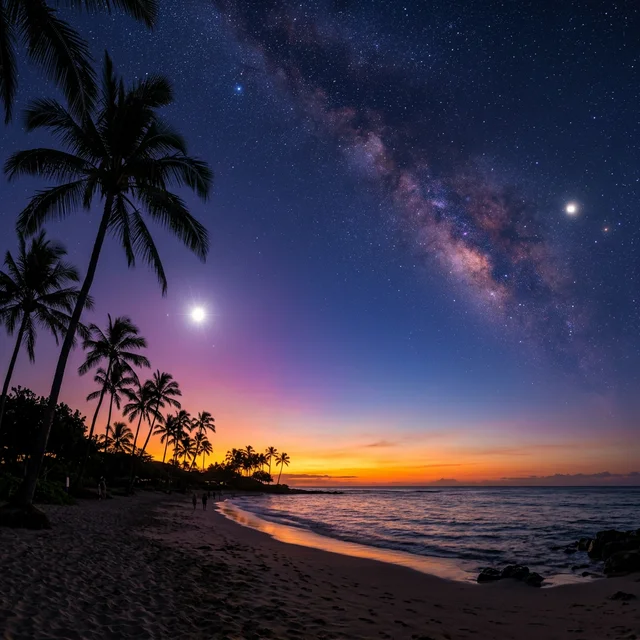
To understand why planetary alignments occur, we need to grasp a fundamental concept: the ecliptic. The ecliptic is the imaginary plane in which Earth orbits the Sun. All planets, having formed from the same protoplanetary disk 4.6 billion years ago, orbit in planes very close to the ecliptic.
This means that, from Earth's perspective, all planets always appear in a narrow band of the sky — like cars on a highway. Sometimes, several of them are on the same side of that highway, and that's when we get the "parades."
Each planet has its own orbital period:
| Planet |
Orbital Period |
Distance from Sun |
| Mercury |
88 days |
58 million km |
| Venus |
225 days |
108 million km |
| Earth |
365.25 days |
150 million km |
| Jupiter |
11.86 years |
778 million km |
| Saturn |
29.46 years |
1.43 billion km |
| Uranus |
84 years |
2.87 billion km |
| Neptune |
164.8 years |
4.50 billion km |
The inner planets (Mercury and Venus) move quickly, constantly changing position relative to the Sun. The outer giants (Jupiter, Saturn, Uranus, Neptune) move so slowly they practically appear "parked" in the sky for months or years. It's like a race where some cars complete laps every few minutes while others take decades to finish a single one.
The alignment of six planets at once is, mathematically, a matter of probability. It's not a gravitationally significant event — the planets are separated by billions of kilometers. But it's visually spectacular and scientifically instructive.
Throughout history, planetary alignments have inspired panic and apocalyptic prophecies. Let's separate fact from fiction:
| Myth |
Scientific Reality |
| "Alignments cause earthquakes" |
No proven correlation. The combined gravitational pull of aligned planets on Earth is billions of times weaker than the Moon's |
| "Alignments cause giant tides" |
The gravitational influence of planets is negligible compared to the Moon and Sun |
| "Alignments open dimensional portals" |
Pure fiction, no scientific basis |
| "The alignment affects your zodiac sign" |
Astrology is not science — planet positions don't influence human behavior |
| "Alignments are extremely rare" |
Partial parades (3-4 planets) happen several times a year |
The only real influence planets exert on Earth is gravitational, and that influence is extremely weak. Even in the most favorable configuration, the combined attraction of all aligned planets would be less than that exerted by a single mountain near you.
To observe with the naked eye (4 planets: Mercury, Venus, Saturn, Jupiter):
- An unobstructed western horizon
- Clear, cloudless sky
- Location with minimal light pollution
- Timing: 30-60 minutes after local sunset
To observe with binoculars (+ Uranus):
- 10x50 or better binoculars
- Stable support (tripod or wall)
- Star chart or astronomy app (Stellarium, SkySafari, Star Walk)
To observe all 6 (+ Neptune):
- Refractor or reflector telescope of at least 80mm
- Celestial coordinates for Neptune (easily obtained via apps)
- Rural location with truly dark skies
- 5:30-6:00 PM: Arrive at your observation location. Allow your eyes to gradually adapt to the diminishing light
- 6:15-6:30 PM (just after sunset): Locate Venus — impossible to miss. It's the brightest point in the western sky
- 6:20-6:40 PM: Look for Mercury below and to the right of Venus, very close to the horizon. This is the most critical window — it will disappear quickly
- 6:30-7:00 PM: Locate Saturn, near Venus but less bright, like a golden "star"
- 6:30-7:00 PM: With binoculars, try to find Neptune in Saturn's vicinity
- 7:00-7:30 PM: Look high toward the east. Jupiter will be unmistakable — the second brightest point
- 7:00-8:00 PM: With binoculars, search for Uranus in the Taurus constellation area, near the Pleiades
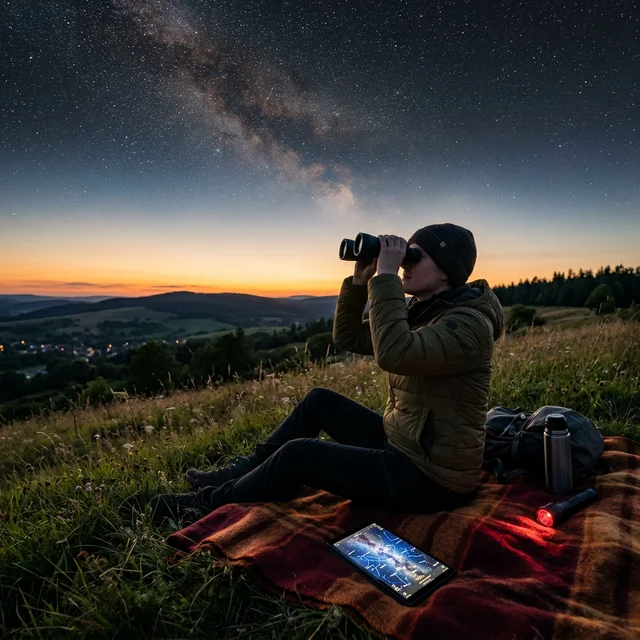
Many astronomers believe the famous Star of Bethlehem, mentioned in the Bible as a guide for the Magi, may have been an alignment of Jupiter and Saturn in the constellation Pisces. In 7 BC, these two giants met three times in a phenomenon called a "triple conjunction" — something extremely rare. If this theory is correct, astronomy may have been the basis for one of the most celebrated events in Christian tradition.
On December 21, 2020, Jupiter and Saturn came so close in the sky that they appeared as a single "Christmas Star." The angular distance between them was only 0.1° — less than the apparent diameter of the Moon. This specific phenomenon hadn't occurred since 1623, and before that, since 1226.
In February 1962, five planets plus the Sun and Moon grouped together in the constellation Aquarius. Indian astrologers predicted the "end of the world," causing widespread panic. Schools were closed, temples were overwhelmed with worshippers. No disaster occurred, obviously, but the episode demonstrates the power these events hold over human imagination.
In the year 2000, Mercury, Venus, Mars, Jupiter, and Saturn approximately aligned. Apocalyptic groups predicted devastating earthquakes and the reversal of Earth's magnetic poles. Nothing happened. The difference in scientific knowledge between 1962 and 2000 meant much less panic this time, but conspiracy theories flourished on the nascent internet.
The fact that all planets orbit approximately in the same plane is visual proof of the nebular theory — the idea that the solar system formed from a rotating disk of gas and dust. If planets had formed randomly, their orbits would have varied inclinations and alignments would be impossible.
When you observe Mercury alongside Neptune in the sky, they seem "close." In reality, the distance between them is nearly 4.5 billion kilometers. If Earth were the size of a marble (1 cm), Neptune would be 300 meters away. Jupiter would be an orange at 52 meters. And the Sun would be a beach ball at 12 meters.
Planets don't simply "align" and then return to their places. They're in perpetual motion, each following slightly different elliptical orbits, mutually influencing each other with their gravity. These interactions, accumulated over billions of years, are responsible for:
- The migration of Jupiter and Saturn in the primordial solar system (the "Grand Tack")
- The destabilization of the asteroid belt
- The delivery of water to primordial Earth by deflected comets
- The eventual capture of moons by gas giants
If you missed today's Planet Parade, don't despair. The universe is generous with its spectacles:
| Date |
Event |
Visibility |
| March 2026 |
Venus-Saturn Conjunction |
Naked eye |
| August 2026 |
Total Lunar Eclipse |
Visible from Americas |
| 2028 |
5-planet alignment |
Naked eye (partial) |
| 2040 |
7-planet alignment |
Rare — telescope needed for some |
| 2080 |
All 8 planets alignment |
Generational event |
If you want to go beyond simple observation and capture the Planet Parade in photos:
- Use night mode or long exposure
- Rest the phone on a stable surface (phone tripods cost less than $10)
- Disable flash
- Consider apps like NightCap or ProCam for manual control
- Venus and Jupiter will look great; fainter planets will be challenging
- Wide-angle lens (14-35mm) to capture the entire arc
- ISO 800-3200, aperture f/2.8 or wider
- 15-30 second exposure on tripod
- Manual focus at infinity
- Remote shutter or 2-second timer to avoid camera shake
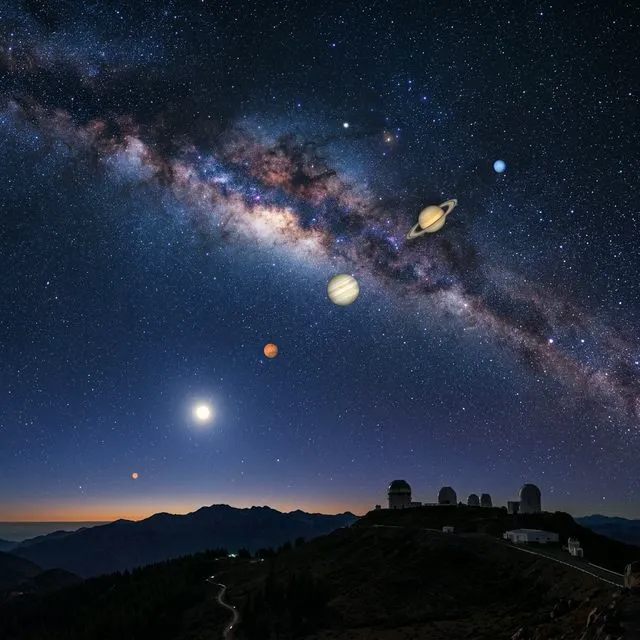
The best alignment photos include terrestrial elements — mountain silhouettes, trees, monuments, or even people observing. This gives human scale to the cosmic immensity and transforms a technical photo into a work of art.
The Planet Parade reminds us of something that daily life makes us forget: we're flying through space at 107,000 km/h on a water-covered rock, orbiting an average star on the outskirts of a galaxy with 200 billion other stars. And at this precise moment, six incredibly different worlds — from scorching Mercury to frozen Neptune — are conspiring to give us a spectacle that our ancestors would have interpreted as messages from the gods.
Today, we understand the mechanics. But that doesn't diminish the wonder — in fact, it amplifies it. Knowing that each photon arriving from Neptune traveled 4 hours at the speed of light to reach your eye is, in itself, a miracle of physics. Knowing that Jupiter, with its monstrous gravity, has acted as a protective shield for Earth over billions of years, deflecting comets and asteroids that could have extinguished life, transforms simple observation into cosmic gratitude.
Look up tonight. The planets are waiting.