Do We Really Only Use 10% of Our Brain? Science Answers 🧠
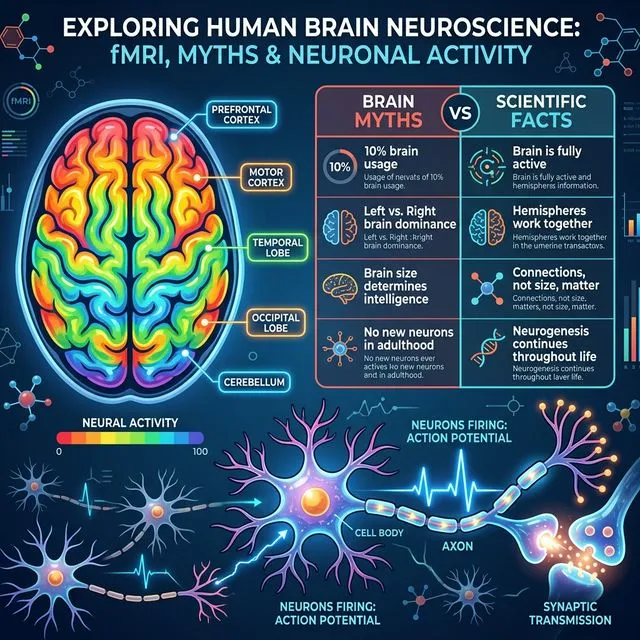
Short answer: NO. The myth that we only use 10% of our brain is one of the most persistent scientific misconceptions in history. Modern neuroscience, using fMRI and PET scans, proves that we use virtually 100% of our brain — most of it active nearly all the time.
But if we already use all of it, why do some people seem to "think better" than others? And what does science say about improving brain performance?
Let's dive into the science. All of it.
🔬 Part 1: The 10% Myth — How It Was Born and Why It's False
The Origin of the Myth
The exact origin is uncertain, but it likely came from:
- William James (1907): The psychologist wrote that we only use "a fraction of our mental potential" — note: POTENTIAL, not physical brain
- Albert Einstein: The quote "we use 10% of our brain" was attributed to him — with zero evidence
- Self-help industry: Adopted the myth to sell "mental unlocking" courses
- Hollywood: Films like Lucy (2014) and Limitless (2011) popularized the idea
Why It's 100% False
Neuroscience proves it on multiple levels:
| Evidence | What It Shows |
|---|---|
| fMRI (Functional Magnetic Resonance Imaging) | Even at rest, large areas of the brain are active |
| PET Scan | Records glucose metabolism — ALL regions consume energy |
| Brain injuries | Damage to ANY area causes specific deficits — no area is "useless" |
| Neuroanatomy | No brain region has been identified as "unnecessary" |
| Evolution | The brain consumes 20% of the body's energy — it weighs only 2% of body weight. Evolution would NOT maintain an organ that spends 10x more energy than normal if 90% were useless |
What Really Happens
- Not all areas are active at the same time — that would cause a seizure
- Different tasks activate different regions of the brain
- Over the course of 24 hours, 100% of the brain is used at some point
- Even while sleeping, the brain is extremely active (consolidating memories, clearing toxins)
🧬 Part 2: How the Brain Actually Works
Impressive Numbers
| Metric | Value |
|---|---|
| Neurons | ~86 billion |
| Synapses (connections) | ~100 trillion |
| Processing speed | ~120 m/s in motor nerves |
| Energy consumption | 20% of all body energy |
| Estimated memory capacity | ~2.5 petabytes (2,500 TB) |
| Thoughts per day | ~6,200 (Queen's University study, 2020) |
The 4 Main Areas
| Region | Function |
|---|---|
| Frontal Lobe | Planning, decisions, personality, speech |
| Parietal Lobe | Sensations, spatial perception, mathematics |
| Temporal Lobe | Hearing, memory, language |
| Occipital Lobe | Vision |
Default Mode Network (DMN)
A revolutionary discovery in neuroscience: when you are "not doing anything," the brain remains extremely active in a network called the DMN (Default Mode Network). It is responsible for:
- Processing self-awareness and identity
- Consolidating memories
- Engaging in future planning
- Generating daydreams and creativity
- Consuming as much energy as active tasks
In other words: your brain NEVER stops working.
🧪 Part 2.5: Recent Neuroscience Discoveries (2024-2026)
Neuroscience has advanced more in the last three years than in the three previous decades. New technologies and interdisciplinary approaches are revealing layers of brain complexity we could barely imagine.
Brain-Computer Interfaces (BCIs)
Neuralink, Elon Musk's company, successfully implanted its brain chip in human patients between 2024 and 2025. The device, called N1, allows people with paralysis to control computer cursors and devices using thought alone. Although still in the experimental phase, the results are promising: one of the first patients managed to play chess online and browse the internet using only neural signals.
But Neuralink is not alone. Synchron, an Australian competitor, uses a less invasive approach — a stent inserted through a blood vessel that captures brain signals without open surgery. In 2025, the company expanded its clinical trials to more than 100 patients in the USA and Australia.
The Convergence of AI and Neuroscience
Researchers are using artificial neural networks to decode patterns of brain activity. In 2024, a team at the University of Texas managed to reconstruct the general meaning of thoughts from fMRI data — a rudimentary form of "mind reading." It is not telepathy, but it is a concrete step toward direct neural communication.
Artificial intelligence is also accelerating the discovery of new medications for neurological diseases. Deep learning algorithms analyze millions of chemical compounds in weeks, work that would take decades using traditional methods.
New Discoveries About Memory Consolidation
Studies published in 2025 in the journal Nature Neuroscience revealed that the brain "replays" the day's experiences during sleep at accelerated speed — up to 20 times faster than the original experience. This process, called neural replay, is essential for transferring information from short-term memory (hippocampus) to long-term memory (cortex). Interrupting this process, as happens with excessive screen use before bed, significantly impairs the formation of lasting memories.
The Gut-Brain Axis
One of the most surprising discoveries in recent neuroscience is the importance of the gut-brain axis. The gut contains approximately 500 million neurons and produces roughly 95% of the body's serotonin — the neurotransmitter associated with well-being and mood.
Research from 2024-2025 demonstrated that the composition of the gut microbiota (the bacteria living in the intestine) directly influences cognitive functions such as memory, decision-making, and even the risk of developing depression and anxiety. Fermented foods like yogurt, kefir, and kimchi showed measurable benefits in cognitive function in controlled clinical trials.
🚀 Part 3: How to Have a "Super Mind" — What Science REALLY Says
You cannot "unlock 90% of the brain." But you can optimize what you already use. Neuroscience confirms these strategies:
1. Neuroplasticity — The Brain That Recreates Itself
The brain can create new connections and even generate new neurons throughout life (neurogenesis). This happens more when:
- We learn new and challenging things
- We practice skills with deliberate repetition
- We expose ourselves to diverse experiences
Study: London taxi drivers have a physically LARGER hippocampus (spatial navigation center) than regular drivers — their brains grew to accommodate the mental map of the city!
2. Physical Exercise — The Brain's "Fertilizer"
| Type of Exercise | Impact on the Brain |
|---|---|
| Aerobic (30min, 3x/week) | Increases BDNF (protein that makes neurons grow) |
| Strength training | Improves executive functions |
| Yoga | Reduces cortisol (stress hormone that kills neurons) |
Fact: Regular exercise can increase the hippocampus by 2% in adults — reversing 1-2 years of brain aging.
3. Sleep — The Brain's "Reset"
| Sleep Phase | What Happens |
|---|---|
| Deep sleep (N3) | The glymphatic system "washes" the brain, removing toxic proteins (like beta-amyloid, linked to Alzheimer's) |
| REM sleep | Memory consolidation, emotional processing, creativity |
Deprivation: One night of poor sleep reduces cognitive capacity by up to 30%. Sleeping 6 hours for several nights = being drunk.
Recommendation: 7-9 hours per night for adults.
4. Meditation — Reshaping the Brain
Studies with meditators show:
- Increased gray matter in the prefrontal cortex (decisions) and hippocampus (memory)
- Reduction of the amygdala (center of fear and anxiety)
- Improved sustained attention in just 8 weeks of practice
Harvard Study (2011): 8 weeks of mindfulness meditation = measurable changes in brain structure via fMRI.
5. Brain-Boosting Nutrition
| Nutrient | Source | Benefit |
|---|---|---|
| Omega-3 | Fish, nuts | Neural membrane structure |
| Flavonoids | Berries, dark chocolate | Antioxidant protection |
| Choline | Eggs, liver | Acetylcholine production (memory) |
| Vitamin D | Sunlight, supplements | Neuroprotection |
| Curcumin | Turmeric | Brain anti-inflammatory |
6. Continuous Learning
The brain follows the rule of "Use It or Lose It." Activities that stimulate the most:
| Activity | Why It Works |
|---|---|
| Learning a language | Activates multiple areas simultaneously |
| Playing a musical instrument | The most complete exercise for the brain |
| Playing chess | Trains planning, memory, and calculation |
| Reading books | Stimulates imagination, vocabulary, and empathy |
| Solving puzzles | Strengthens neural connections |
7. Socialization
Study: People with an active social life have a 70% lower risk of cognitive decline in old age. The brain was made to interact.
💊 Part 4: Nootropics and Brain Biohacking — What Actually Works?
What Are Nootropics?
Nootropics, popularly called "smart drugs" or "cognitive enhancers," are substances that promise to improve cognitive functions such as memory, focus, creativity, and motivation. The term was coined in 1972 by Romanian chemist Corneliu Giurgea, who established strict criteria: a true nootropic should improve cognition without significant side effects.
The global nootropics market surpassed $5 billion in 2025 and continues to grow, driven by Silicon Valley's high-performance culture and the pressure for productivity.
Nootropics Table: What Science Says
| Substance | Type | Evidence Level | Main Effect | Risks |
|---|---|---|---|---|
| Caffeine | Natural | ⭐⭐⭐⭐⭐ Strong | Attention, alertness, reaction time | Insomnia, anxiety, mild dependence |
| L-Theanine | Amino acid (green tea) | ⭐⭐⭐⭐ Good | Relaxation without drowsiness, calm focus | Virtually none |
| Creatine | Supplement | ⭐⭐⭐⭐ Good | Brain energy, working memory | Safe at recommended doses |
| Omega-3 (DHA) | Fatty acid | ⭐⭐⭐⭐ Good | Neural structure, anti-inflammatory | Safe; avoid excessive doses |
| Modafinil | Medication (prescription) | ⭐⭐⭐ Moderate | Wakefulness, prolonged focus | Headache, insomnia, requires prescription |
| Racetams (Piracetam) | Synthetic | ⭐⭐ Weak | Memory (inconsistent results) | Generally well tolerated, but limited evidence |
| Bacopa monnieri | Ayurvedic herb | ⭐⭐⭐ Moderate | Long-term memory (chronic use) | Gastrointestinal discomfort |
The Biohacking Trend in Silicon Valley
Tech executives and entrepreneurs have adopted practices ranging from psychedelic microdosing (sub-perceptual doses of LSD or psilocybin) to transcranial direct current stimulation (tDCS) — a device that sends weak electrical currents to the brain to supposedly improve focus.
Some of these practices have preliminary scientific backing. Psilocybin, for example, is being studied in phase 3 clinical trials for treatment-resistant depression, with promising results published in the New England Journal of Medicine. However, most brain biohacking practices lack long-term studies on safety and efficacy.
What Science Actually Supports vs. Marketing
The inconvenient truth is that no supplement replaces the fundamentals: adequate sleep, physical exercise, balanced nutrition, and continuous learning. The combination of caffeine + L-theanine (found naturally in green tea) is probably the "nootropic" with the best cost-benefit-safety ratio available.
Warning: Nootropic supplements sold online frequently contain doses different from those declared on the label, and some have been found to contain contaminants. The FDA does not regulate most of these products with the same rigor applied to medications. Before taking any substance, consult a doctor.
🚫 Other Popular Myths About the Brain
The 10% myth is not alone. Neuroscience has already debunked other extremely popular misconceptions about how the brain works:
| Myth | Scientific Reality |
|---|---|
| "People are left-brained or right-brained" | False. Both hemispheres work together in virtually all tasks. There is no such thing as a "more logical" or "more creative" person because of a dominant hemisphere |
| "Listening to Mozart makes babies smarter" | The "Mozart Effect" was based on a single 1993 study with questionable methodology. Subsequent studies failed to replicate the results |
| "The brain stops developing in adolescence" | False. The prefrontal cortex continues maturing until ages 25-30. Neuroplasticity allows changes throughout life |
| "Alcohol kills neurons" | Partially false. Alcohol does not directly kill neurons at moderate doses, but it damages synapses and can cause brain atrophy with chronic use |
| "We only have 5 senses" | We have at least 9: vision, hearing, smell, taste, touch, proprioception, nociception, balance, and thermoception |
| "Multitasking makes you more productive" | False. Research from Stanford University shows that so-called "multitasking" reduces efficiency by up to 40%. The brain does not perform two cognitive tasks simultaneously — it rapidly switches between them, losing time and accuracy with each switch. People who consider themselves good at multitasking are, ironically, the ones who suffer the most from performance decline |
| "Brain games prevent Alzheimer's" | Insufficient evidence. Although apps like Lumosity and Peak improve performance on the specific tasks trained, there is no robust evidence that they prevent dementia or Alzheimer's. A 2024 meta-analysis published in the Cochrane Database concluded that the benefits do not transfer to everyday life in a significant way. Social activities, physical exercise, and learning real new skills remain more effective |
| "We are born with a fixed number of neurons" | False. Neurogenesis — the formation of new neurons — continues throughout adult life, especially in the hippocampus (the region linked to memory). Aerobic exercise, learning, and enriched environments stimulate the production of new neurons. Studies from 2023-2024 confirmed active neurogenesis in the brains of people over 80 years old |
🔮 The Future of Neuroscience
Brain Mapping Projects
Two megaprojects are attempting to create the first complete map of the human brain. The European Union's Human Brain Project, with a budget of one billion euros, has built computational simulations of neural circuits with unprecedented resolution. In the USA, the BRAIN Initiative (Brain Research Through Advancing Innovative Neurotechnologies), launched in 2013 and significantly expanded in 2024, has already cataloged more than 3,300 different types of brain cells — revealing a cellular diversity far greater than previously imagined.
The ultimate goal of these projects is ambitious: to create a complete "brain atlas" that maps every cell type, every connection, and every functional circuit of the human brain. This map would be to neuroscience what the Human Genome Project was to genetics — a database that would exponentially accelerate research for decades.
Treatment of Neurodegenerative Diseases
The medical implications are enormous. Alzheimer's affects more than 55 million people worldwide, and that number is expected to triple by 2050. In 2023, the drug lecanemab became the first approved treatment that effectively slows cognitive decline in patients with early Alzheimer's, targeting beta-amyloid plaques in the brain. Although it is not a cure, it represents a paradigm shift: for the first time, we can interfere with the mechanism of the disease, not just the symptoms.
For Parkinson's disease, therapies based on stem cells and gene therapy are in advanced clinical trials. Researchers at Lund University in Sweden transplanted neurons derived from stem cells into the brains of Parkinson's patients, with preliminary results showing improvement in dopamine production.
Ethical Questions About Cognitive Enhancement
As brain enhancement technologies advance, profound ethical dilemmas arise. If brain-computer interfaces can increase memory or mental processing speed, who will have access? If only the wealthiest can afford cognitive implants, we will create a new form of inequality — a divide between "augmented brains" and "natural brains."
There is also the question of personal identity. If a chip significantly alters the way we think, feel, and remember, are we still the same person? Philosophers and neuroscientists are already debating these scenarios, and governments are beginning to discuss regulations for what some call "neurorights" — the right to mental privacy, cognitive integrity, and freedom of thought. Chile became, in 2021, the first country in the world to include neurorights in its constitution.
📊 What REALLY Differentiates Exceptional Minds
| Factor | Impact |
|---|---|
| Genetics | ~50% of variation in IQ |
| Environment | ~30% (education, nutrition, stimuli) |
| Personal choices | ~20% (exercise, sleep, study, meditation) |
In other words: you have ~50% control over your brain's performance. That is A LOT.
❓ Frequently Asked Questions
Do we really use 100% of the brain?
Yes. Over the course of 24 hours, all regions of the brain are activated. There is no "reserve area" waiting to be unlocked.
Can you increase intelligence?
Yes, partially. IQ has a genetic component, but neuroplasticity allows you to improve memory, attention, processing speed, and creativity with training.
What is the best "exercise" for the brain?
Playing a musical instrument — it is the most complete exercise because it activates hearing, vision, coordination, memory, emotion, and planning SIMULTANEOUSLY.
Do "brain training" games (Lumosity, etc.) work?
The science is mixed. They improve the SPECIFIC skill trained, but do NOT transfer to other areas. Better options: learning a language or an instrument.
Do nootropic supplements work?
Most have little scientific evidence. Exceptions: caffeine (attention), creatine (brain energy), omega-3 (neural structure). Be cautious of miraculous promises.
🏁 Conclusion
You already use 100% of your brain. The question is not about "unlocking" anything — it is about optimizing what already works. The 5 pillars of a super mind, according to neuroscience, are:
- Regular physical exercise (the most impactful)
- Quality sleep (7-9 hours)
- Continuous learning (challenge yourself)
- Smart nutrition (omega-3, fruits, less sugar)
- Meditation or mindfulness practice
Do these 5 things consistently and you will be operating at the peak of human potential — without needing to unlock any myth.
Read also: Talent: Born or Made?
Sources
- Medical News Today — 10 Percent Brain Myth
- MIT — Brain Utilization
- Harvard — Meditation & Brain
- Psychology Today — Brain Myths
- Britannica — Do We Really Use Only 10%?
Last updated: February 17, 2026
Frequently Asked Questions
Is it true that we only use 10% of our brain?
No, this is a myth. Neuroimaging studies show that we use virtually 100% of our brain throughout the day. Different regions are activated for different tasks, and even during sleep, much of the brain remains active. No area is completely inactive in healthy people.
Is it possible to increase brain capacity?
Yes, it is possible to improve cognitive functions through regular physical exercise, quality sleep, omega-3 rich diet, meditation, and continuous learning. Neuroplasticity allows the brain to form new connections throughout life, especially when challenged with new activities.
Do nootropics really work?
The effectiveness of nootropics varies greatly. Substances like caffeine and L-theanine have solid scientific evidence of mild cognitive improvement. However, many supplements sold as brain enhancers lack robust studies. Always consult a doctor before using any substance.
What happens to the brain during sleep?
During sleep, the brain performs essential functions: it consolidates memories, eliminates toxins through the glymphatic system, processes emotions, and repairs neural connections. Sleep deprivation significantly impairs memory, concentration, and decision-making.