A dog so big it needed a king-size bed. A tortoise born before Napoleon that's still alive. A cheetah that reaches 120 km/h in 3 seconds. A beetle that lifts 1,141 times its own weight. A blue whale with a heart the size of a car. The animal kingdom is filled with creatures that defy imagination — and Guinness World Records documents the most extraordinary. Get ready for a safari through the most impressive records in the animal world.
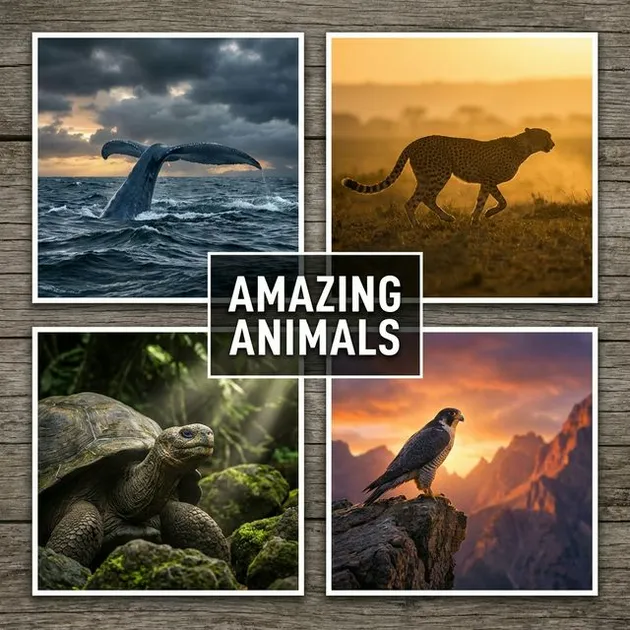
The World's Largest Animals: Nature's Giants
The Blue Whale — The Largest Animal That Ever Existed (30 m, 190 tonnes)
Record: Largest animal that ever existed on Earth (including dinosaurs)
Maximum recorded length: 33.58 meters (110 feet)
Maximum weight: Approximately 190 tonnes (418,878 lbs)
Status: Endangered (estimated population: 10,000-25,000)
The blue whale (Balaenoptera musculus) isn't just the largest living animal — it's the largest animal that HAS EVER EXISTED in the history of life on Earth, including all dinosaurs. To put it in perspective:
| Comparison | Blue Whale | Reference |
|---|---|---|
| Length | 100 ft | Longer than a Boeing 737 |
| Weight | 190 tonnes | = 33 African elephants |
| Heart | 400 lbs | Size of a small car |
| Tongue | 5,950 lbs | Weight of an elephant |
| Aorta | 9 in diameter | A child could crawl inside |
| Baby at birth | 23 ft, 5,500 lbs | Larger than most cars |
| Daily consumption | 7,940 lbs of krill | Equivalent to 40 million shrimp |
The blue whale's heart beats only 2 times per minute during deep dives (vs. 60-100 bpm in humans). Its call can be heard over 1,000 miles away — the loudest sound produced by any animal.
Reggie — The World's Tallest Living Dog
Record: Tallest living dog in the world (2024-present)
Height: 107 cm (42.13 inches) from paw to shoulder
Breed: Great Dane
Country: United States
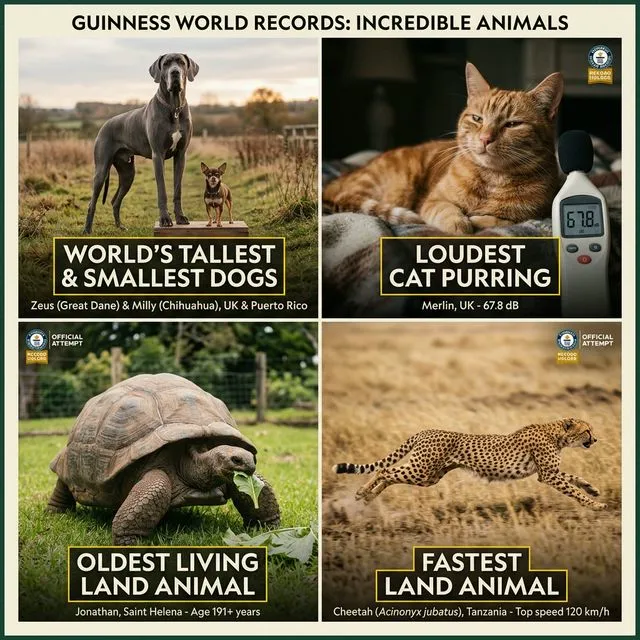
Reggie, a gray Great Dane standing 107 centimeters from ground to shoulder, was certified as the world's tallest living dog in 2024. When standing on his hind legs, Reggie exceeds 7 feet — taller than most humans.
Reggie's meeting with Pearl, the world's shortest dog (a Chihuahua measuring just 3.59 inches tall), generated one of Guinness's most viral photos in 2024. The difference of over 38 inches between the two is visually surreal.
Zeus — The Tallest Dog in History (Deceased)
Record: Tallest dog ever recorded
Height: 111.8 cm (44 inches) from paw to shoulder
Standing height: 7'2" (2.18 m)
Breed: Great Dane
Name: Zeus
Country: Otsego, Michigan, USA
Died: 2014
Zeus from Otsego, Michigan, holds the record for the tallest dog in history: 44 inches at the shoulder. When standing on his hind legs, he reached 7 feet 2 inches. Zeus consumed 31 lbs of food per day and his owners had to buy a van because he couldn't fit in regular cars.
The World's Smallest Animals: Natural Miniatures
Pearl — The World's Shortest Dog (3.59")
Record: Shortest living dog in the world
Height: 9.14 cm (3.59 inches)
Breed: Chihuahua
Country: United States
Pearl is so small she fits in the palm of a hand. At just 3.59 inches tall, she's smaller than many dog toys and requires special care to avoid being stepped on or hurt by everyday objects.
The World's Smallest Frog — Paedophryne amauensis
Record: Smallest vertebrate in the world
Size: 7.7 mm in length
Discovery: 2009
Location: Papua New Guinea
Paedophryne amauensis is so small it fits on a penny. At just 7.7 millimeters, it's the smallest known vertebrate — smaller than many insects. It was discovered in 2009 in the leaf litter of Papua New Guinea's tropical forest floor.
The World's Oldest Animals: Extraordinary Longevity
Jonathan — The World's Oldest Tortoise (~192 years)
Record: Oldest living land animal in the world
Age: Approximately 192 years (born ca. 1832)
Species: Seychelles giant tortoise (Aldabrachelys gigantea hololissa)
Location: Saint Helena Island, South Atlantic
Jonathan is the oldest living land animal on the planet. Born around 1832, he was already an adult when Queen Victoria ascended the throne (1837), when the American Civil War happened (1861-1865), and when World War I began (1914).
When Jonathan was born:
- Photography didn't yet exist (invented in 1839)
- Charles Darwin was beginning his famous voyage on HMS Beagle
- Abraham Lincoln was 23 years old
- There were no cars, airplanes, telephones, or electricity
Jonathan lives in the gardens of Plantation House, the official residence of the Governor of Saint Helena. Despite being blind and having lost his sense of smell, he still feeds regularly and is bathed weekly by a veterinarian. He is considered a national treasure of the island.
| Age | Historical Event | Jonathan |
|---|---|---|
| ~1832 | Birth | Born in Seychelles |
| ~1882 | 50 years | Transported to Saint Helena |
| 1914 | 82 years | World War I begins |
| 1939 | 107 years | World War II begins |
| 1969 | 137 years | Man walks on the Moon |
| 2022 | 190 years | Certified by Guinness as oldest |
| 2026 | ~194 years | Still alive and eating! |
Ming — The Oldest Individual Animal Ever Found (507 years)
Record: Oldest individual animal ever found
Age: 507 years
Species: Bivalve mollusk (Arctica islandica) — Ocean quahog
Discovery: 2006, Iceland
Status: Deceased (during research)
Ming, a mollusk found on the ocean floor near Iceland, was 507 years old when collected in 2006 — meaning it was born around 1499, during the reign of Henry VII of England and before Columbus completed his fourth voyage to the Americas.
Ming's age was determined by counting its growth rings (similar to a tree's). Tragically, Ming died when researchers opened its shell to study it — not knowing they were killing the oldest animal in the world.
Animal Longevity Comparison
| Animal | Age Record | Species |
|---|---|---|
| Mollusk (Ming) | 507 years | Arctica islandica |
| Greenland shark | ~400 years | Somniosus microcephalus |
| Bowhead whale | ~211 years | Balaena mysticetus |
| Tortoise (Jonathan) | ~194 years | Giant tortoise |
| Parrot (Cookie) | 83 years | Major Mitchell's cockatoo |
| Cat (Flossie) | 28 years | Domestic cat |
| Immortal jellyfish | Potentially infinite | Turritopsis dohrnii |
The World's Fastest Animals: Natural Speed
Peregrine Falcon — The Fastest Animal on Earth (242 mph)
Record: Fastest animal on Earth
Maximum speed: 389 km/h (242 mph) in a dive (stoop)
Horizontal flight speed: 56-68 mph
The peregrine falcon (Falco peregrinus) is the fastest animal ever recorded, reaching up to 242 mph during its hunting dives. For comparison: that's faster than a Japanese bullet train (200 mph) and only slightly slower than a human skydiver's terminal velocity.
Cheetah — The Fastest Land Animal (75 mph)
Record: Fastest land mammal
Maximum speed: 112-120 km/h (70-75 mph)
Acceleration: 0-60 mph in ~3 seconds
Duration: Maximum 60 seconds at top speed
The cheetah (Acinonyx jubatus) can accelerate from 0 to 60 mph in just 3 seconds — faster than most supercars. Its adaptations include:
- Ultra-flexible spine that curves like a spring
- Semi-retractable claws that function like track spikes
- Long tail that acts as a rudder for high-speed maneuvers
- Enlarged nasal cavity for maximum oxygenation
- Fast-twitch muscle fibers in exceptionally high proportion
| Rank | Animal | Speed | Type |
|---|---|---|---|
| 1 | Peregrine falcon | 242 mph | Aerial (dive) |
| 2 | Golden eagle | 200 mph | Aerial (dive) |
| 3 | Cheetah | 75 mph | Land |
| 4 | Sailfish | 68 mph | Aquatic |
| 5 | Swordfish | 60 mph | Aquatic |
| 6 | Pronghorn | 55 mph | Land |
| 7 | Lion | 50 mph | Land |
| 8 | Quarter horse | 48 mph | Land |
The World's Strongest Animals: Disproportionate Power
Dung Beetle — The Strongest Animal in the World (Proportionally)
Record: Strongest animal relative to body weight
Strength: Capable of lifting 1,141 times its own weight
Species: Onthophagus taurus (horned dung beetle)
The dung beetle Onthophagus taurus can lift the equivalent of 1,141 times its own weight. For a 176-lb human, that would be equivalent to lifting 200,816 lbs — or 12 buses simultaneously.
Gorilla — The Strongest Primate
Record: Strongest primate in the world
Strength: Estimated at 10 times that of a strong adult human
Capability: Can bend iron bars and exert bite force of 1,300 PSI
An adult male gorilla (silverback) is estimated to be 10 times stronger than an athletic adult human. Its bite force of 1,300 PSI is enough to crush a crocodile skull.
Bizarre and Surprising Animal Records
| Record | Animal | Data | Detail |
|---|---|---|---|
| Loudest animal | Pistol shrimp | 218 dB | Louder than a gunshot |
| Most electric | Electric eel | 860 volts | Can knock down a horse |
| Longest migration | Arctic tern | 44,000 mi/year | Pole to pole |
| Longest sleep | Koala | 22 hours/day | 91.7% of day sleeping |
| Deepest dive (mammal) | Cuvier's beaked whale | 9,816 ft | Almost 2 miles deep |
| Sharpest vision | Golden eagle | 8x better than human | Spots a rabbit at 2 miles |
| Most powerful smell | Polar bear | Detects seals 20 mi away | Under snow and ice |
| Most lethal venom | Irukandji jellyfish | 100x more than cobra | One sting can kill |
| Animal that doesn't age | Turritopsis dohrnii | Potentially immortal | Reverses maturity |
Size Records: Largest vs. Smallest
| Category | Largest | Smallest |
|---|---|---|
| Mammal | Blue whale (100 ft, 190 t) | Bumblebee bat (1.2 in, 0.07 oz) |
| Bird | Ostrich (9 ft, 344 lbs) | Bee hummingbird (2.2 in, 0.06 oz) |
| Reptile | Saltwater croc (20 ft, 2,200 lbs) | Brookesia nana (0.85 in) |
| Amphibian | Chinese giant salamander (6 ft) | Paedophryne amauensis (0.3 in) |
| Fish | Whale shark (40-60 ft) | Paedocypris progenetica (0.31 in) |
| Insect | Hercules beetle (6.7 in) | Fairyfly wasp (0.005 in) |
| Spider | Goliath birdeater (12 in span) | Patu marplesi (0.017 in) |
The Science Behind Animal Extremes
Why Is the Blue Whale So Large?
The blue whale achieved its colossal size through a combination of factors:
- Aquatic buoyancy: Water supports its weight, enabling growth impossible on land
- Energy efficiency: Filter-feeding krill is extremely efficient at large scale
- Thermoregulation: Large body = better heat retention in cold waters
- Food abundance: Ice Ages created krill explosions favoring larger whales
- No predators: Only orca pods dare attack calves
Why Do Tortoises Live So Long?
Extreme longevity in giant tortoises is attributed to:
- Ultra-slow metabolism: They burn energy very slowly
- Resilient telomeres: Their chromosomes degrade more slowly
- Low senescence rate: Cellular aging is almost negligible
- Calm lifestyle: Low stress, few predators as adults
- Fasting capability: Can survive months without food or water
Why Is the Cheetah So Fast?
The cheetah sacrificed everything for speed:
| Adaptation | Benefit | Cost |
|---|---|---|
| Light body (88-143 lbs) | Less mass to accelerate | Weak in confrontations |
| Semi-retractable claws | Traction like spikes | Cannot climb trees |
| Ultra-flexible spine | Giant stride amplitude | Vulnerable to injuries |
| Heart 3x larger than normal | Pumps more blood | Overheats in 60 seconds |
| No roar | Jaw optimized for breathing | Less intimidating than lions |
Conservation and Endangered Record Holders
Many of the animals that hold Guinness World Records are also among the most threatened species on the planet. Their extraordinary traits — the very features that make them record-breakers — often make them vulnerable to exploitation, habitat loss, and climate change.
Blue Whales: A Slow Recovery from Near-Extinction
The blue whale, the largest animal that ever existed, was hunted to the brink of extinction during the industrial whaling era. By the time the International Whaling Commission banned commercial whaling in 1966, the global blue whale population had been reduced to roughly 1% of its original numbers — from an estimated 350,000 individuals to fewer than 5,000. While populations have slowly recovered to an estimated 10,000-25,000 today, that figure still represents a fraction of pre-whaling levels. Recovery is painfully slow because blue whales reproduce at an extremely low rate, with females giving birth to a single calf every two to three years.
Cheetahs: Speed Can't Outrun Extinction
The cheetah, the fastest land animal, faces a crisis that raw speed cannot solve. According to the IUCN Red List (2024), only approximately 7,100 cheetahs remain in the wild — a staggering decline from an estimated 100,000 just a century ago. Habitat fragmentation, human-wildlife conflict, and illegal wildlife trade have pushed cheetahs out of 91% of their historic range in Africa and Asia. Their low genetic diversity, a legacy of a population bottleneck roughly 10,000 years ago, makes them especially vulnerable to disease and environmental change.
Mountain Gorillas: A Conservation Success Story
Not all stories are bleak. The mountain gorilla, one of the strongest primates on Earth, represents one of conservation's greatest triumphs. In 1989, their population had dwindled to just 620 individuals in the volcanic mountains of Central Africa. Thanks to decades of intensive protection — including anti-poaching patrols, veterinary intervention, and community-based tourism programs — the population has grown to over 1,000 individuals as of 2024. It remains the only great ape species whose numbers are increasing.
The Vaquita: Racing Against Time
Perhaps the most urgent case is the vaquita porpoise (Phocoena sinus), the world's rarest marine mammal. Found only in the northern Gulf of California, Mexico, fewer than 10 individuals are believed to remain. Entanglement in illegal gillnets set for another endangered species, the totoaba fish, has driven the vaquita to the very edge of extinction despite international conservation efforts.
Giant Tortoises and Island Threats
Record-holders like Jonathan, the world's oldest living land animal, belong to giant tortoise species that face ongoing threats from habitat loss and invasive species. On islands like the Galápagos and Seychelles, introduced rats, cats, and goats destroy tortoise eggs and compete for food. Conservation programs involving captive breeding and invasive species removal have been critical to stabilizing several tortoise populations.
Records as Conservation Ambassadors
Guinness records serve a powerful purpose beyond entertainment: they turn animals into global ambassadors for their species. When millions of people learn about the blue whale's heart or the cheetah's acceleration, those creatures become symbols worth protecting. Zoos and breeding programs play a vital role in this effort, maintaining genetically diverse populations of endangered record-holders while funding field conservation.
Looking further ahead, de-extinction efforts like those led by Colossal Biosciences — which aims to revive functional versions of the woolly mammoth using gene-editing technology — raise fascinating questions about whether lost record-holders could one day walk the Earth again. While controversial, such projects highlight how deeply humanity values the extraordinary creatures that define the limits of life on our planet.
Conclusion: What Animal Records Teach Us
Animal kingdom records aren't just curiosities — they're windows into evolution in action. Each record is the result of millions of years of natural selection that shaped creatures perfectly adapted to their ecological niches.
The blue whale shows us what happens when evolution maximizes size. The cheetah demonstrates total sacrifice for speed. Jonathan, the 192-year-old tortoise, proves that life can persist for centuries when conditions are right.
Protecting these record-holding species isn't just preserving curiosities — it's protecting the pinnacle of billions of years of evolution. And honestly, a world where cheetahs run, whales sing, and centuries-old tortoises graze is infinitely more interesting than the alternative.
Frequently Asked Questions
What is the largest animal ever to have lived?
The blue whale holds this record at up to 30 meters long and 200 tonnes. Its heart is the size of a small car and its tongue weighs as much as an elephant. Despite their enormous size, blue whales feed almost exclusively on tiny krill.
What is the smallest mammal in the world?
The bumblebee bat from Thailand weighs just 2 grams and measures about 3 cm in length. The Etruscan shrew is the smallest by mass at 1.8 grams. Both species face habitat threats.
What animal holds the most Guinness records?
Dogs hold the most Guinness records of any animal species, with records for longest tongue, highest jump, fastest 100 meters on a ball, and many more. Among wild animals, cheetahs hold the land speed record at 120 km/h.
What is the oldest animal ever recorded?
An ocean quahog clam named Ming was 507 years old when discovered in 2006 off Iceland. Among vertebrates, a Greenland shark was estimated at 400 years old. The oldest land animal is Jonathan, a Seychelles giant tortoise born around 1832.
Sources: Guinness World Records, National Geographic, Smithsonian Institution, IUCN Red List, BBC Earth. All records verified and officially certified by Guinness World Records.
References: Guinness World Records, National Geographic — Animals, IUCN Red List