12 Animal Kingdom Records That Will Amaze You 🏆🦅
The animal kingdom is full of super athletes, giants, sprinters, and creatures with abilities that defy imagination. Get ready to meet the absolute champions of nature!
Have you ever wondered which animal is the fastest? Or the strongest? Or which lives the longest? Nature is a constant competition for survival, and over millions of years of evolution, some species have developed extraordinary abilities that put them at the top of their categories.
These records aren't just curiosities - they're testimonies to the power of evolution and adaptation. Each champion has a fascinating story of how they reached the top, and what makes their abilities possible.
1. Fastest Animal: Peregrine Falcon - The Living Missile 🚀
Maximum Speed: 389 km/h (in vertical dive)
Imagine a living projectile cutting through the air at almost 400 km/h. That's what the peregrine falcon does when hunting. It's officially the fastest animal on the planet - faster than any race car, bullet train, or even some small planes.
How Does It Achieve This Insane Speed?
Perfect Aerodynamics:
The peregrine falcon's body is a masterpiece of evolutionary engineering. Its feathers are smooth and compact, creating a surface that minimizes air resistance. When diving, it folds its wings against its body, transforming into a living arrow.
Special Nostrils:
At such high speeds, air entering the nostrils could damage the lungs or even cause fainting. But the falcon has special bone structures called "tubercles" inside the nostrils that create controlled turbulence, reducing air pressure before it enters the lungs. Aeronautical engineers studied this and applied the concept to jet engines!
Eye Protection:
Its eyes have a third eyelid (nictitating membrane) that functions like protective goggles, cleaning and protecting the eyes without blocking vision. Without this, the wind at 389 km/h would instantly blind the falcon.
Superhuman Vision:
The peregrine falcon's vision is 8 times sharper than ours. It can detect a pigeon 8 km away. When diving, its eyes constantly adjust focus, keeping the prey in perfect aim.
The Hunting Technique
The falcon doesn't fly at 389 km/h all the time - it would be exhausting and unnecessary. It patrols the sky at altitudes of 1,000-3,000 meters, flying calmly at 60-90 km/h, looking for prey.
When it identifies a target (usually pigeons, ducks, or other birds), it positions itself above and slightly behind. Then, it closes its wings and dives at a 45-60 degree angle, accelerating rapidly.
The impact is devastating. The falcon strikes the prey with closed talons like a fist, like a supersonic punch. The force of the blow (calculated at up to 450 kg of force) usually kills the prey instantly. If not, the falcon captures it in the air and breaks its neck with its beak.
Impressive Comparisons
- Formula 1: 372 km/h (falcon is faster!)
- Japanese bullet train: 320 km/h
- Cheetah: 120 km/h (falcon is 3x faster)
- Usain Bolt: 44 km/h (almost 9x slower)
Limitations
In horizontal flight (not diving), the falcon reaches "only" 110 km/h - still impressive, but not a record. The horizontal flight winner is the white-throated needletail, which reaches 170 km/h.
The dive also can't be maintained for long. After 15-20 seconds of falling, the falcon needs to level out to avoid hitting the ground. And each dive expends a lot of energy.
Distribution and Conservation
Peregrine falcons are found on all continents except Antarctica. They've adapted to urban environments, nesting on skyscrapers (which mimic natural cliffs) and hunting urban pigeons.
In the 1960s-70s, they were nearly extinct due to DDT (pesticide that weakened eggshells). After DDT was banned and captive breeding programs began, the population recovered - one of conservation's greatest success stories.
2. Fastest Land Animal: Cheetah - The Savanna Sprinter 🐆
Maximum Speed: 120 km/h (in land sprint)
The cheetah is the Ferrari of the animal kingdom. No other land animal comes close to its explosive speed. But unlike the falcon that dives using gravity, the cheetah generates all this speed with pure muscular force and perfect biomechanics.
Anatomy of Speed
Flexible Spine - The Secret Spring:
The cheetah's spine is extremely flexible, functioning like a giant spring. During the run, the spine curves and extends dramatically, increasing stride length. At maximum speed, the cheetah can cover 7 meters in a single stride - more than the length of a car!
When the hind legs touch the ground, the spine compresses like a spring. When the front legs touch, the spring releases, catapulting the body forward. It's like having a turbo engine built into the spine.
Non-Retractable Claws:
Unlike other felines, the cheetah's claws don't fully retract. They function like an Olympic athlete's running spikes, providing maximum traction. Each step has perfect grip, even at high speed.
Long Tail - The Rudder:
The cheetah's tail measures 60-80 cm and functions like a ship's rudder. During zigzag chases (gazelles are masters at sudden direction changes), the cheetah uses its tail as a counterweight, allowing tight turns without losing speed.
Turbocharged Cardiorespiratory System:
The cheetah's heart is proportionally larger than other felines. Its lungs are enormous, and its nostrils are wide to maximize oxygen intake. During a run, respiratory rate jumps from 60 to 150 breaths per minute.
Fast-Twitch Muscles:
The cheetah's muscles are composed mainly of fast-twitch fibers (type IIb) - the same that human sprinters have in abundance. These fibers generate bursts of power but exhaust quickly.
The Hunt
A cheetah doesn't simply run after prey. The hunt is a precise science:
1. Stealthy Approach (5-10 minutes):
The cheetah silently approaches to within 50-100 meters of prey, using vegetation as cover. Unlike lions that hunt in groups, cheetahs are solitary hunters.
2. Initial Explosion (3 seconds):
When the prey detects danger and flees, the cheetah explodes into speed. It accelerates from 0 to 100 km/h in just 3 seconds - faster than most sports cars!
3. Chase (20-30 seconds):
The chase rarely lasts more than 30 seconds. If the cheetah doesn't capture the prey in that time, it gives up. Why? Overheating.
4. Capture or Give Up:
If successful, the cheetah knocks down the prey and suffocates it with a throat bite. If it fails, it needs to rest for 30 minutes before trying again.
The Overheating Problem
Here's the cheetah's Achilles heel: it overheats quickly. During a 30-second run at 120 km/h, body temperature rises from 38°C to 40.5°C - dangerously close to the 41°C limit that would cause brain damage.
That's why, after a hunt, the cheetah pants for 30 minutes, completely vulnerable. Lions and hyenas often steal their prey during this moment of weakness.
Success Rate
Despite impressive speed, cheetahs only have a 50% success rate in hunts. Why?
- Gazelles are masters at sudden direction changes
- Cheetahs overheat quickly
- Uneven terrain makes straight-line running difficult
- Prey often detect the cheetah before ideal approach
Comparisons
- Usain Bolt: 44 km/h (cheetah is almost 3x faster)
- Racehorse: 88 km/h
- Lion: 80 km/h
- Average city car: 60 km/h (speed limit)
The Conservation Tragedy
Historical population (1900): ~100,000 cheetahs
Current population (2024): ~7,000 cheetahs
Decline: 93% in one century
Causes:
- Habitat loss (agriculture and urbanization)
- Conflict with farmers (cheetahs occasionally attack livestock)
- Low genetic diversity (population bottleneck 10,000 years ago)
- Competition with lions and hyenas
- Cub trafficking (illegal exotic animal market)
Status: Vulnerable (IUCN)
3. Strongest Animal (Proportionally): Rhinoceros Beetle
Strength: Lifts 850 times its own weight!
Human equivalent: Lifting 6 double-decker buses!
How it does it:
- Reinforced exoskeleton
- Dense muscles
- Perfect biomechanical levers
Use: Fighting for females and territory.
4. Tallest Animal: Giraffe
Height: Up to 5.8 meters
Incredible adaptations:
- Neck: 2 meters (only 7 vertebrae, like humans!)
- Tongue: 50cm (reaches thorny leaves)
- Heart: 11kg (pumps blood to head)
- Blood pressure: 2x higher than humans
Fun fact: Sleeps only 30 minutes per day (standing up)!
5. Heaviest Animal: Blue Whale - The Giant of Giants 🐋
Maximum Weight: 200 tons (200,000 kg)
Length: Up to 30 meters
The blue whale isn't just the largest living animal - it's the largest animal that has ever existed in Earth's history. Larger than any dinosaur. Larger than any prehistoric creature. It's the absolute size champion in 4 billion years of life on Earth.
Dimensions That Defy Imagination
Weight:
An adult blue whale weighs as much as:
- 33 African elephants
- 2,670 adult humans
- 40 rhinoceroses
- A fully loaded Boeing 737
Length:
At 30 meters, a blue whale is longer than:
- 3 school buses lined up
- A basketball court
- 10 average cars
- Most dinosaurs (including T-Rex)
Heart:
A blue whale's heart weighs 180 kg - the size of a small car. It beats only 2 times per minute when the whale dives (to conserve oxygen). Each beat pumps 220 liters of blood.
The arteries are so wide that a small child could swim through them (theoretically - please don't try!).
Tongue:
The tongue weighs 2.7 tons - as much as an adult African elephant. It's so large that 50 people could stand on it.
Mouth:
The mouth can hold 90 tons of water and food. When the whale opens its mouth to feed, it can swallow a volume of water equivalent to its own body.
Calf:
A blue whale calf is born with:
- 7 meters length
- 3 tons weight
- Already larger than most adult land animals
And grows absurdly fast: gains 90 kg per day during the first year, drinking 200 liters of mother's milk daily. It's the fastest growth of any animal.
How Can Something So Large Exist?
Water Is the Key:
On land, a 200-ton animal would be crushed by its own weight. Gravity would make it impossible to move or even breathe. But in water, buoyancy neutralizes gravity.
Water supports the whale's weight, allowing it to grow to sizes impossible on land. That's why the largest land animals (elephants, 6 tons) are tiny compared to the largest marine animals.
Efficient Metabolism:
Blue whales have surprisingly efficient metabolism. They don't need to eat constantly like smaller animals. They can fast for months during migrations, living off fat reserves.
No Predators:
Adults have no natural predators (orcas occasionally attack calves, but rarely adults). Without threats, evolution favored increasingly larger size.
Feeding: The Giant That Eats Tiny Things
Here's the paradox: the world's largest animal feeds on one of the smallest - krill (small crustaceans 2-3 cm long).
Feeding Technique:
- Whale locates krill cloud (can contain millions of individuals)
- Accelerates toward cloud with mouth open
- Swallows 90 tons of water + krill
- Closes mouth and uses tongue to push water through baleen (keratin plates that function as filter)
- Krill gets trapped in baleen, water exits
- Whale swallows krill
Quantity:
- 4 tons of krill per day during feeding season
- 40 million individual krill
- Equivalent to 1.5 million calories
Season:
Blue whales feed intensively for 4 months in summer (in polar waters rich in krill), accumulating fat. Then migrate to tropical waters for reproduction, fasting for months.
6. Longest-Living Animal: Greenland Shark
Age: Up to 512 years!
Longevity secrets:
- Extremely slow metabolism
- Cold waters (slows aging)
- Growth: 1cm per year
- Sexual maturity: 150 years
Fun fact: May have been born before Shakespeare!
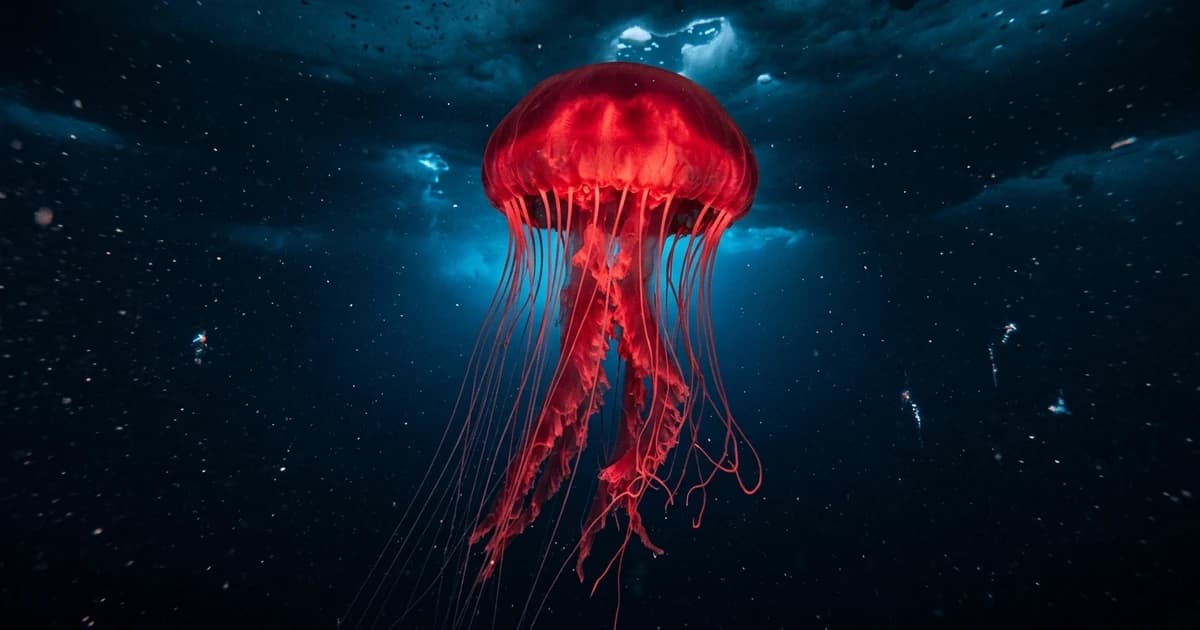
7. Most Venomous Animal: Box Jellyfish
Venom: Kills human in 3 minutes
Potency:
- Toxins attack heart, nervous system, and skin
- Pain described as "red-hot iron"
- Antidote exists but must be quick
Tentacles: Up to 3 meters with millions of stinging cells.
Location: Australia and Southeast Asia.
8. Animal with Best Vision: Eagle
Visual acuity: 4-8x better than humans
Superpowers:
- Sees rabbit 3km away
- Detects ultraviolet light
- Binocular and peripheral vision simultaneously
- Focuses on two things at once
Application: Inspired camera zoom.
9. Animal with Best Hearing: Moth
Frequency: Detects up to 300,000 Hz (humans: 20,000 Hz)
Why:
- Detect bat ultrasound (predators)
- Ears on thorax (not head!)
Comparison: 15x better than humans.
10. Loudest Animal: Blue Whale
Volume: 188 decibels
Comparison:
- Jet plane: 140 dB
- Rock concert: 120 dB
- Conversation: 60 dB
Range: Sound travels 1,600 km in ocean!
Function: Communication between distant whales.
11. Animal with Longest Migration: Arctic Tern
Distance: 90,000 km per year (round trip)
Route: Arctic → Antarctic → Arctic
Time: 3 months of continuous flight
Fun fact: Sees two summers per year (more sunlight than any animal)!
Lifetime: Can fly 2.4 million km in life (3x Earth-Moon distance)!
12. Most Intelligent Animal (Non-Human): Dolphin
Abilities:
- Recognizes itself in mirror (self-awareness)
- Uses tools (sponges to protect snout)
- Complex language (unique whistles = names)
- Solves abstract problems
- Teaches offspring (culture)
Brain: Larger than human proportionally.
Emotions: Demonstrates empathy, grief, and joy.
Honorable Mentions
Most Lethal to Humans: Mosquito
- Kills 725,000 people/year (malaria, dengue, etc.)
- More than all other animals combined!
Largest Wingspan: Wandering Albatross
- Wings: 3.5 meters
- Flies 10,000 km without landing
Biggest Sleeper: Koala
- Sleeps 22 hours per day
- Wakes only to eat eucalyptus
Fastest in Water: Sailfish
- 110 km/h swimming
- Spear-shaped bill
Strongest (Absolute): African Elephant
- Lifts 9,000 kg
- Pushes trees
Bizarre Records
Longest Tongue (Proportionally): Chameleon
- 2x body length
- Captures prey in 0.07 seconds
Largest Eyes: Colossal Squid
- 27cm diameter
- Size of dinner plate!
Most Eggs: Ocean Sunfish
- 300 million eggs at once
- Absolute record
Fastest on Land (Insect): Mite
- 322 body lengths per second
- Human equivalent: 2,092 km/h!
Why These Records Matter
1. Technological Inspiration
- Velcro (inspired by burrs)
- Sonar (bats and dolphins)
- Aerodynamics (falcons)
2. Conservation
- Record holders often threatened
- Awareness saves species
3. Medicine
- Venoms become medicines
- Animal longevity inspires research
4. Understanding Evolution
- Extreme adaptations show possibilities
- Limits of biology
Conclusion: Nature Without Limits
These records prove that evolution has no limits to creativity. Each extreme adaptation tells a story of millions of years of natural selection, survival, and specialization.
And the most incredible thing: we're still discovering new record holders! How many champions are still hidden in the ocean depths or unexplored forests?
Which record impressed you most? Know any others? Comment! 🏆
Frequently Asked Questions (FAQ)
Q: Which animal lives the longest?
A: Greenland shark (up to 512 years). Honorable mention: Galápagos tortoise (190 years).
Q: Do humans break any animal records?
A: Yes! Endurance in long distances. We can run marathons that no animal can handle.
Q: Which animal has the largest brain?
A: Sperm whale (7kg). But proportionally, dolphins and humans lead.
Q: Is there an immortal animal?
A: Turritopsis dohrnii jellyfish can reverse aging (theoretically immortal).
Sources:
- Guinness World Records - Animal Edition
- National Geographic - Animal Extremes
- BBC Wildlife Magazine
Read also: