3,028 people control $16.1 trillion. To put that in perspective: Brazil's entire GDP is approximately $2.1 trillion. That means the combined fortune of the world's billionaires equals the GDP of nearly 8 Brazils. And the man at the top — Elon Musk — is so far ahead he may become the first trillionaire in human history before 2030.
How Many Billionaires Exist in 2025?
According to Forbes, the world hit a record 3,028 billionaires in 2025, with a combined fortune of $16.1 trillion. In 25 years, billionaire count has multiplied by 6.4x and their combined wealth has grown 18x.
Top 10 Richest People on Earth
| # | Name | Fortune | Country | Sector |
|---|---|---|---|---|
| 1 | Elon Musk | ~$342-491B | 🇺🇸 USA | Tech (Tesla, SpaceX, X) |
| 2 | Jeff Bezos | ~$240B | 🇺🇸 USA | Tech (Amazon) |
| 3 | Mark Zuckerberg | ~$228B | 🇺🇸 USA | Tech (Meta) |
| 4 | Larry Ellison | ~$213B | 🇺🇸 USA | Tech (Oracle) |
| 5 | Bernard Arnault | ~$194B | 🇫🇷 France | Luxury (LVMH) |
| 6 | Warren Buffett | ~$164B | 🇺🇸 USA | Investments |
| 7 | Larry Page | ~$160B | 🇺🇸 USA | Tech (Google) |
| 8 | Sergey Brin | ~$152B | 🇺🇸 USA | Tech (Google) |
| 9 | Steve Ballmer | ~$147B | 🇺🇸 USA | Tech (Microsoft) |
| 10 | Jensen Huang | ~$127B | 🇺🇸 USA | Tech (NVIDIA) |
9 of the 10 richest are American. 8 of 10 made their fortunes in technology.
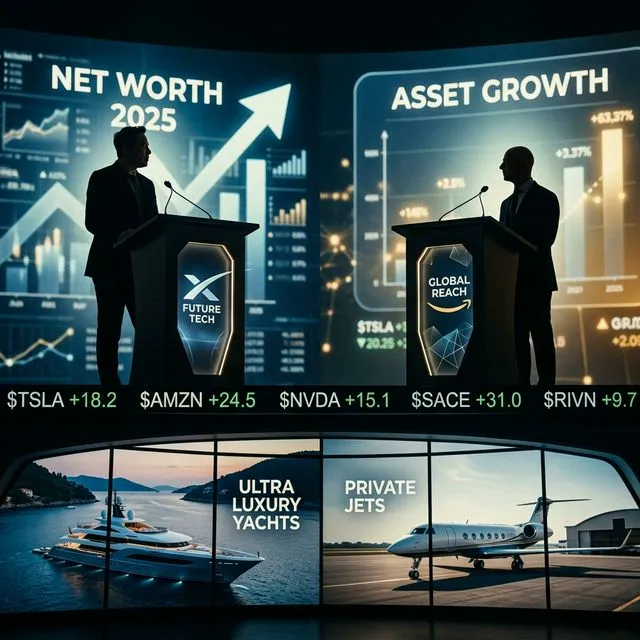
Countries With Most Billionaires
| Country | Billionaires | Combined Fortune |
|---|---|---|
| 🇺🇸 United States | 902 | $6.8 trillion |
| 🇨🇳 China | 450 | $1.7 trillion |
| 🇮🇳 India | 205 | $941 billion |
| 🇩🇪 Germany | 171 | $612 billion |
| 🇷🇺 Russia | 141 | $503 billion |
The top 3 countries concentrate over 50% of all billionaires.
The Global Wealth Pyramid
| Wealth Range | Adults | % of Population | % of Global Wealth |
|---|---|---|---|
| Over $1 million | 60 million | 1.6% | 48% |
| $100K - $1M | 600 million | 15.7% | 39.3% |
| $10K - $100K | 1.6 billion | 42% | 12.1% |
| Under $10K | 1.55 billion | 40.7% | 0.6% |
1.6% of adults control nearly half of all wealth on the planet.
The Race to a Trillion
Analysts project Elon Musk may become the first trillionaire before 2030, primarily due to SpaceX's expected valuation. If Musk spent $1 million per day, it would take 2,740 years to spend $1 trillion — he would have started spending during the Roman Empire and still wouldn't be done.
The Other Side: Extreme Poverty
While 3,028 people accumulate $16.1 trillion: 700 million people live on less than $2.15/day, 828 million suffer chronic hunger, and the estimated cost to eradicate world hunger is $33 billion/year — less than one billionaire's fortune. Oxfam calculates that the 26 richest people own as much wealth as the 3.8 billion poorest combined.
The Impact of Artificial Intelligence on New Billionaire Creation
The artificial intelligence revolution is reshaping the global wealth map in unprecedented ways. In 2025, AI has become the primary engine for creating new billionaire fortunes, surpassing even the cryptocurrency and fintech booms.
The New AI Billionaires
Jensen Huang, CEO of NVIDIA, saw his fortune leap from $20 billion to over $127 billion in just two years, driven by explosive demand for AI chips. Sam Altman, CEO of OpenAI, while not officially a billionaire on the Forbes list, leads a company valued at over $150 billion. Demis Hassabis, co-founder of DeepMind (Google), and Dario Amodei, CEO of Anthropic, represent a new generation of billionaires whose fortunes were built entirely on artificial intelligence.
The Cascade Effect
AI isn't just creating billionaires directly — it's amplifying existing fortunes. Microsoft shares rose over 60% since its investment in OpenAI. Meta saw its stock double after betting heavily on generative AI. Alphabet (Google) hit new records with Gemini. This cascade effect means AI is concentrating wealth even faster than any previous technology, raising urgent questions about regulation and the distribution of benefits from this technological revolution.
The Dark Side of AI Wealth
While AI creates enormous value, it also threatens to displace millions of workers. The World Economic Forum estimates that AI could eliminate 85 million jobs by 2030 while creating 97 million new ones. However, the new jobs typically require different skills and are concentrated in different geographic areas, potentially widening inequality further. The billionaires profiting from AI have a unique responsibility — and opportunity — to ensure the transition benefits everyone, not just shareholders.
Conclusion
The concentration of global wealth has reached unprecedented levels. 3,028 individuals — a number that could fit in a high school — control more wealth than billions combined. The first trillionaire will likely emerge before 2030, a deeply symbolic milestone: one person accumulating more wealth than the GDP of 170 countries.
The Evolution of Billionaire Wealth Over the Decades
The growth of billionaire wealth is not a linear phenomenon — it has accelerated dramatically in the 21st century, driven by technology, globalization, and financial markets.
Historical Timeline
| Year | Number of Billionaires | Combined Fortune | Key Driver |
|---|---|---|---|
| 2000 | 470 | $899 billion | Dot-com boom |
| 2005 | 691 | $2.2 trillion | Post-recession recovery |
| 2010 | 1,011 | $3.6 trillion | Emerging markets growth |
| 2015 | 1,826 | $7.1 trillion | Tech unicorn explosion |
| 2020 | 2,095 | $8.0 trillion | Pandemic digital acceleration |
| 2023 | 2,640 | $12.2 trillion | AI revolution begins |
| 2024 | 2,781 | $14.2 trillion | AI and crypto surge |
| 2025 | 3,028 | $16.1 trillion | Record year |
While the global population grew 33% in 25 years, billionaire wealth grew 1,700%. This exponential divergence is one of the defining economic stories of our era. The acceleration after 2020 is particularly striking — the pandemic created conditions where digital businesses thrived while traditional economies struggled, effectively transferring wealth upward at unprecedented speed.
The Technology Factor
The rise of technology as the dominant wealth-creation engine has fundamentally changed who becomes a billionaire and how quickly. In the 1990s, it took decades to build a billion-dollar fortune. Today, tech founders can reach billionaire status in under five years. Companies like OpenAI, SpaceX, and Stripe have created dozens of new billionaires in just a few years, a pace unimaginable in previous generations.
Elon Musk: The Path to Becoming History's First Trillionaire
Elon Musk dominates the top of the list with a fortune oscillating between $342 billion and $491 billion, depending on Tesla and SpaceX stock valuations.
Musk's Wealth Trajectory
| Year | Estimated Fortune | Key Event |
|---|---|---|
| 1999 | ~$22 million | Sale of Zip2 |
| 2002 | ~$165 million | Sale of PayPal |
| 2010 | ~$2 billion | Tesla IPO |
| 2020 | ~$25 billion | Tesla stock explosion |
| 2021 | ~$340 billion | Becomes world's richest |
| 2024 | ~$250 billion | Recovery after dip |
| 2025 | ~$342-491 billion | Path to trillion |
Analysts at the Bloomberg Billionaires Index project Musk could become the first trillionaire in human history before 2030, primarily due to SpaceX's expected valuation (currently over $350 billion in private markets) and potential future IPO.
What Does $1 Trillion Actually Look Like?
To visualize: if Elon Musk spent $1 million every single day, it would take 2,740 years to spend $1 trillion. He would have started spending during the Roman Empire and still wouldn't be finished today. A trillion dollars in $100 bills would weigh approximately 10,000 metric tons — enough to fill 40 Boeing 747 cargo planes.
The Trillion-Dollar Race
| Candidate | Current Fortune | Projected Trillion | Key Factor |
|---|---|---|---|
| Elon Musk | ~$491B | 2027-2029 | SpaceX IPO |
| Jensen Huang | ~$127B | 2032-2035 | AI growth |
| Mark Zuckerberg | ~$228B | 2031-2034 | Metaverse + AI |
| Jeff Bezos | ~$240B | 2032-2036 | AWS + Blue Origin |
How Billionaires Build Their Fortunes: Dominant Sectors
Distribution by Sector of Origin
| Sector | % of Billionaires | Notable Example |
|---|---|---|
| Technology | 25% | Elon Musk, Mark Zuckerberg |
| Finance / Investments | 18% | Warren Buffett |
| Manufacturing / Industry | 15% | Carlos Slim |
| Retail / E-commerce | 12% | Jeff Bezos, Amancio Ortega |
| Real Estate | 10% | Lee Family (Samsung) |
| Healthcare / Pharma | 7% | Patrick Soon-Shiong |
| Food / Beverages | 5% | Various |
| Energy | 4% | Koch Family |
| Luxury / Fashion | 3% | Bernard Arnault |
| Other | 1% | Miscellaneous |
The Self-Made Pattern
Forbes data reveals that most 2025 billionaires built rather than inherited their fortunes:
- 68% are "self-made" — built from scratch or modest beginnings
- 32% inherited part or all of their wealth
- Average age: 64 years old
- Gender: 87% male, 13% female (388 women billionaires)
- Education: 75% hold at least a bachelor's degree; 30% attended Ivy League or equivalent institutions
The technology sector has been the great equalizer in some ways — creating more first-generation billionaires than any other industry. However, critics point out that even "self-made" billionaires typically had access to elite education, family networks, and initial capital that most people never receive.
The Billionaire Map by Continent
The geographic distribution of billionaires reveals fascinating — and disturbing — patterns about global economic power:
| Continent | Billionaires | % of Total | Trend |
|---|---|---|---|
| Americas | ~1,040 | 34.3% | Stable dominance |
| Asia | ~950 | 31.4% | Fastest growing |
| Europe | ~850 | 28.1% | Slow growth |
| Middle East | ~120 | 4.0% | Oil + diversification |
| Africa | ~45 | 1.5% | Emerging |
| Oceania | ~23 | 0.8% | Stable |
Key Geographic Insights
China quadrupled its billionaire count in just 10 years, reflecting the country's explosive economic growth and the rise of tech giants like Alibaba, Tencent, and ByteDance. India's billionaire class has grown rapidly too, driven by IT services, pharmaceuticals, and the Reliance empire of Mukesh Ambani.
Africa remains dramatically underrepresented, with only 45 billionaires across an entire continent of 1.4 billion people. Nigeria's Aliko Dangote (cement and commodities) remains the continent's richest person, highlighting how African wealth creation remains concentrated in natural resources rather than technology.
The United States alone has more billionaires than the next four countries combined — a concentration of wealth that reflects both the dynamism of American capitalism and the structural advantages of the world's largest economy.
What $342 Billion Can Buy
To give tangible dimension to Elon Musk's fortune ($342 billion):
| What It Could Buy | Quantity |
|---|---|
| All homes in Brazil's Northeast region | ~3x |
| Solve world hunger for one year (UN estimate) | ~10x |
| Maracanã stadiums | ~34,200 |
| All NFL teams | ~2.5x |
| Private islands in the Maldives | ~6,840 |
| Boeing 747-8 aircraft | ~760 |
| Fund NASA for years | ~10 years |
| Give every person on Earth | ~$42 each |
These comparisons aren't meant to suggest billionaires should simply give away their wealth — most of it exists as stock in companies that employ millions. But they do illustrate the almost incomprehensible scale of modern fortunes and raise legitimate questions about resource allocation in a world where 700 million people live in extreme poverty.
The Brazilian Case: 62 Billionaires
Brazil ranks 9th globally in billionaire count. The most notable include:
| Name | Fortune (USD) | Sector |
|---|---|---|
| Eduardo Saverin | ~$29B | Technology (Facebook co-founder) |
| Jorge Paulo Lemann | ~$16B | Investments (3G Capital) |
| Marcel Herrmann Telles | ~$9B | Investments (3G Capital) |
| André Esteves | ~$8B | Finance (BTG Pactual) |
| Guilherme Benchimol | ~$5B | Finance (XP Inc.) |
Interestingly, Brazil's richest person — Eduardo Saverin — lives in Singapore and made his fortune as co-founder of Facebook alongside Mark Zuckerberg when both were Harvard students. His story illustrates how global mobility and technology have made billionaire wealth increasingly borderless.
Brazil's billionaire class is heavily concentrated in finance and commodities, reflecting the country's economic structure. Unlike the US or China, Brazil has produced relatively few tech billionaires, though this is beginning to change with the growth of fintechs like Nubank and iFood.
Frequently Asked Questions
How many billionaires are there in the world?
As of 2025, there are approximately 2,700-2,800 billionaires worldwide, according to Forbes and Bloomberg. The United States leads with about 750, followed by China (approximately 500), India (about 170), and Germany (about 130). The total combined wealth of all billionaires exceeds $14 trillion. The number has more than doubled since 2010, driven by technology, finance, and luxury goods sectors.
Is global wealth inequality getting worse?
Data shows mixed trends. The richest 1% own approximately 46% of global wealth, while the bottom 50% own less than 1%. The gap between the ultra-rich and everyone else has widened significantly since 2020. However, global extreme poverty has decreased dramatically — from 36% in 1990 to under 10% today. The middle class has grown substantially in Asia. So while the rich are getting richer faster, the poor are also getting less poor, though at a much slower rate.
Who is the richest person in history?
Adjusted for inflation, Mansa Musa, emperor of the Mali Empire in the 14th century, is often cited as the richest person in history, with an estimated wealth of $400-500 billion in today's dollars. His wealth was so vast that when he passed through Cairo on pilgrimage, his gold spending crashed the local economy for a decade. Among modern figures, John D. Rockefeller's peak wealth was equivalent to approximately $400 billion today. Elon Musk and Bernard Arnault have approached $250 billion.
Can billionaires solve world problems?
Theoretically, billionaire wealth could address many global issues. It would cost approximately $20 billion/year to end world hunger (UN estimate), $26 billion to provide clean water globally, and $39 billion to eliminate malaria. Total billionaire wealth could fund these many times over. However, wealth is mostly in stocks (not cash), selling would crash markets, and systemic problems require sustained institutional solutions, not one-time payments. Philanthropy helps but can't replace effective governance.
Sources: Forbes, Bloomberg Billionaires Index, Credit Suisse, Visual Capitalist, Statista, Oxfam.
References: Forbes, Visual Capitalist, Oxfam