
Global De-Dollarization: How BRICS Are Destroying Dollar Hegemony and Redrawing the World's Financial Map
Date: March 7, 2026
Reading time: 30 minutes
Emoji: 💵
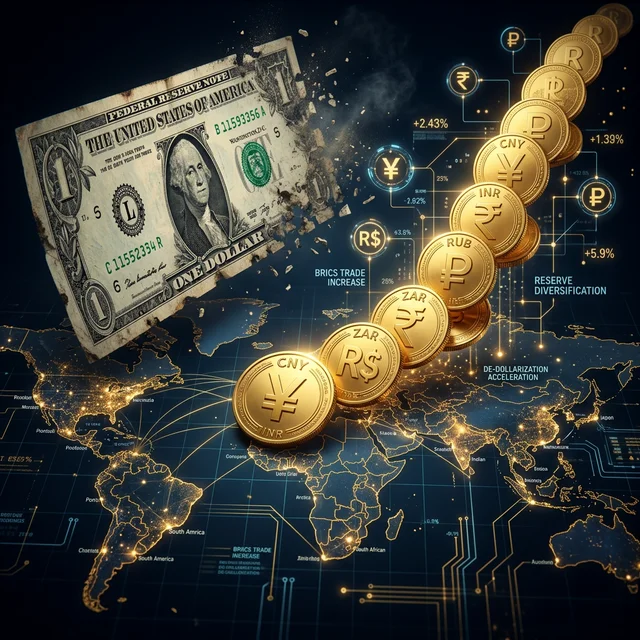
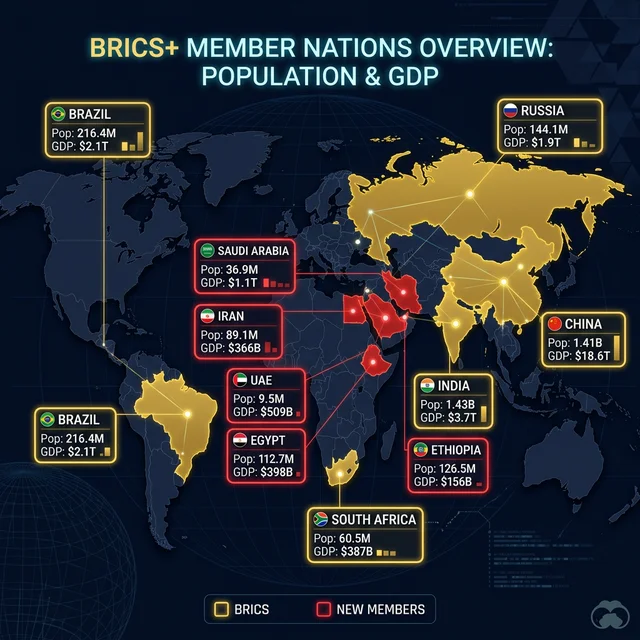
The US dollar has reigned supreme as the world's reserve currency for 80 years — since the Bretton Woods Agreements in 1944. But in 2026, that reign faces the greatest threat in its history. The BRICS+ — an alliance that now brings together Brazil, Russia, India, China, South Africa, Saudi Arabia, Iran, Egypt, Ethiopia, and the United Arab Emirates — control more than 45% of the world's population and nearly 40% of global GDP. And they want to end dollar dominance. This article dives into the most significant financial revolution of the 21st century: global de-dollarization, its causes, mechanisms, impacts, and what it means for every person on the planet.
What Is De-Dollarization?
De-dollarization is the process by which countries and institutions reduce their dependence on the US dollar in international transactions, foreign exchange reserves, and bilateral trade. It's not simply about "switching currencies" — it's a fundamental restructuring of the global financial system that has sustained the world order since the end of World War II.
The Current System: Why the Dollar Is King
To understand de-dollarization, one must first understand why the dollar dominates:
| Indicator | Dollar Share | Trend |
|---|---|---|
| Global foreign exchange reserves | 58.4% (was 72% in 2000) | ↓ Falling |
| SWIFT transactions | 47.3% | ↓ Falling |
| Global trade invoicing | 54% | ↓ Falling |
| Foreign exchange market (Forex) | 88.5% of all transactions | → Stable |
| Commodity pricing (oil, gold) | ~90% priced in dollars | ↓ Falling |
| International debt | ~65% denominated in dollars | ↓ Falling |
The dollar is not just a currency — it is the infrastructure of the global financial system. The SWIFT system, which processes trillions in daily transactions, operates predominantly in dollars. World oil is priced in dollars (the famous "petrodollar"). Central banks around the world maintain reserves in dollars. This privileged position gives the United States what former French President Valéry Giscard d'Estaing called an "exorbitant privilege": the ability to print the currency that the entire world needs to use.
The Rise of BRICS+: The Bloc That Challenges the Dollar
BRICS started as an acronym coined by Goldman Sachs economist Jim O'Neill in 2001, describing four promising emerging economies: Brazil, Russia, India, and China. South Africa joined in 2010. But it was at the Johannesburg Summit in August 2023 that the bloc made a seismic leap by admitting six new members: Saudi Arabia, Iran, Egypt, Ethiopia, the United Arab Emirates, and Argentina (which subsequently left under the Milei government).
The Numbers That Explain BRICS+ Strength
| Metric | BRICS+ | G7 (traditional wealthy nations) |
|---|---|---|
| Population | 3.7 billion (45% of the world) | 775 million (10%) |
| GDP (PPP) | US$ 65 trillion (38%) | US$ 46 trillion (27%) |
| Oil production | ~44% of global production | ~17% |
| Gold reserves | ~35% of world reserves | ~40% |
| Arable land | ~50% of world total | ~15% |
| Manufacturing capacity | ~55% of industrial production | ~30% |
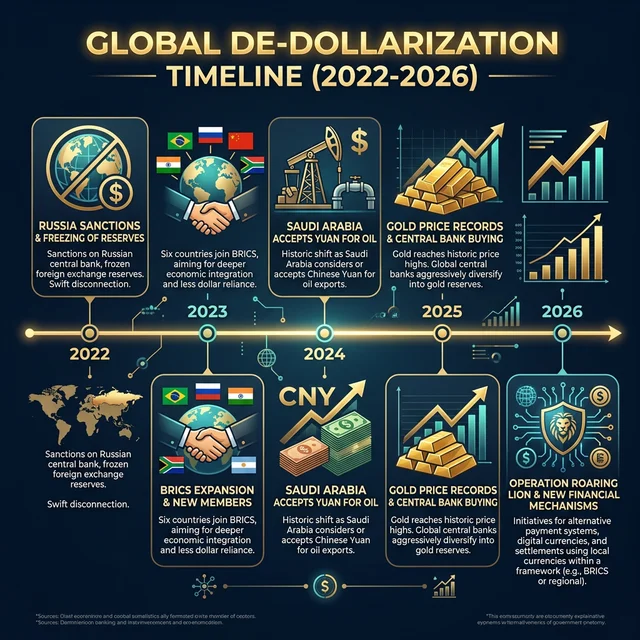
Most significantly, BRICS+ now includes Saudi Arabia — the world's largest oil exporter and historical architect of the petrodollar system. When the Saudis agreed to sell oil in Chinese yuan in 2023, many analysts considered that moment the "beginning of the end" of the petrodollar.
The Mechanisms of De-Dollarization: How It's Happening
De-dollarization is not a single event — it's a multifaceted process operating on multiple fronts simultaneously. Here are the main mechanisms in action in 2026:
1. Bilateral Trade in Local Currencies
The main driver of de-dollarization is the growing practice of countries trading with each other using their own currencies, without needing to convert to dollars. Concrete examples in 2026:
- China-Russia: 95% of bilateral trade now occurs in yuan and rubles (was less than 20% before 2022)
- China-Saudi Arabia: 40% of Saudi oil sales to China are settled in yuan
- India-Russia: Russian oil has been purchased in Indian rupees since 2023
- Brazil-China: Bilateral agreements in real-yuan for soybeans, iron ore, and manufactured goods
- Iran-China: Virtually 100% of trade in yuan, bypassing American sanctions
2. The Digital Yuan (e-CNY): China's Technological Weapon
China has developed the world's most advanced central bank digital currency (CBDC) — the digital yuan or e-CNY. With more than 900 million active wallets in 2026, the digital yuan is being gradually internationalized:
- mBridge Platform: International payments system created by the central banks of China, Hong Kong, Thailand, and the UAE, operating outside SWIFT
- Bilateral CBDC agreements: 23 countries have signed agreements to accept digital yuan in commercial transactions
- Adoption rate: Transactions in e-CNY grew 340% in 2025

3. The Return of Gold as a Monetary Anchor
In a trend that surprised many Western economists, central banks around the world are buying gold in record volumes. Gold reached $5,412 per ounce in March 2026 — a historical record — driven both by geopolitical tensions and the search for alternatives to the dollar.
| Country | Gold Purchases (2024-2026) | Total Reserves |
|---|---|---|
| China (PBoC) | +540 tonnes | 2,715 tonnes |
| India (RBI) | +210 tonnes | 1,048 tonnes |
| Turkey | +180 tonnes | 712 tonnes |
| Poland | +150 tonnes | 480 tonnes |
| Saudi Arabia | +120 tonnes (estimated) | ~530 tonnes |
The strategy is clear: reduce reserves in US Treasury bonds and convert to gold — an asset that no government can freeze or sanction. This strategy was accelerated after the US froze $300 billion in Russian reserves in 2022, demonstrating that holding reserves in dollars carries significant geopolitical risk.
4. The "BRICS Currency": From Concept to Reality
The idea of a common BRICS currency — initially called "R5" (referring to the five original currencies: real, ruble, rupee, renminbi, and rand) — has evolved significantly since 2023. In 2026, what emerged is not a single currency like the euro, but something more sophisticated:
- BRICS Unit of Account (BRU): A currency basket weighted by member countries' GDP, partially backed by gold and commodities
- BRICS Pay System: Multi-currency mechanism enabling instant conversion between member currencies
- Settlement Platform: Alternative infrastructure to SWIFT that processes transactions between members
5. Petrodollar in Decline: Saudi Arabia Changes Sides
The petrodollar system — the informal agreement by which Saudi Arabia and other OPEC producers sell oil exclusively in dollars — has been the backbone of dollar dominance since 1974. But that era is ending:
- In January 2025, the 50-year agreement between the US and Saudi Arabia expired and was not renewed on the same terms
- Saudi Arabia now accepts payment in yuan, rupees, and euros
- The UAE negotiates oil in dirhams with regional partners
- Iran sells 100% of its oil in non-dollar currencies
Global Impacts: What Changes for Everyone
De-dollarization is not an abstract event that only affects governments and central banks. Its consequences reach every person on the planet.
For the United States
The most direct impact is on the dollar-issuing country itself. The "exorbitant privilege" — the ability to finance enormous trade and budget deficits because the whole world demands dollars — is being eroded. Consequences include:
- Higher interest rates: If foreign central banks buy fewer US Treasury bonds, the US needs to offer higher yields to attract buyers
- Structural inflation: Reduced demand for dollars can weaken the currency, making imports more expensive
- Loss of sanctions power: Economic sanctions — America's "financial nuclear weapon" — become less effective when countries can circumvent them using alternative systems
- Unsustainable fiscal deficit: The US accumulates a national debt of $36 trillion in 2026. Without global demand for dollars, financing that debt will become increasingly expensive

For Brazil
Brazil occupies a unique position in de-dollarization — it's a BRICS+ member but also has strong economic ties with the US and Europe. The impacts are mixed:
- Positive: Exports of soybeans, iron ore, and oil to China can be settled in reais, reducing conversion costs
- Positive: Less vulnerability to dollar fluctuations and American sanctions
- Challenge: The real needs to strengthen and stabilize to be accepted as an international settlement currency
- Opportunity: The Central Bank of Brazil is developing DREX (digital real), which can integrate with the BRICS payment system
For Europe
The European Union is caught between two poles: the transatlantic alliance with the US and the economic reality that China is its largest trading partner. The euro, the world's second-largest reserve currency (20%), can gain or lose with de-dollarization:
- Potential gain: If the dollar loses share, some may migrate to the euro
- Risk: Fragmentation of the global monetary system could harm European trade
- Strategic dilemma: Europe needs to decide whether to align with the US-led financial system or seek an independent role
For Emerging Economies
For billions of people in developing countries, de-dollarization can mean:
- Access to financing: New development banks (like the BRICS NDB) offer loans in local currencies
- Less volatility: Countries stop being hostage to the Federal Reserve's monetary policy
- Cheaper trade: Bilateral transactions in local currencies eliminate the "tax" of converting to dollars
- Monetary sovereignty: Governments regain control over their economic policies
The Geopolitics Behind De-Dollarization
De-dollarization cannot be understood without its geopolitical context. The movement is as much economic as it is political — and the events of 2026 have dramatically accelerated the process.
Operation "Roaring Lion" and the Financial Domino Effect
The joint US-Israel military operation against Iran in February 2026 — Operation "Roaring Lion" — had profound financial consequences. Beyond raising the price of oil above $130 per barrel, the operation:
- Validated Global South countries' fears that the US-centered financial system can be "weaponized" at any moment
- Accelerated gold purchases by central banks of non-aligned countries
- Strengthened BRICS+ cohesion as a bloc opposing Western hegemony
- Increased demand for the digital yuan as a SWIFT alternative for countries at risk of sanctions
China vs USA: The Financial War of the Century
De-dollarization is fundamentally one of the battlefields of the Sino-American rivalry. China has a meticulously planned long-term strategy to internationalize the yuan:
- Infrastructure: Building alternative payment systems (CIPS, mBridge)
- Trade: Requiring yuan payment from trading partners
- Reserves: Accumulating gold and reducing US Treasury bond holdings
- Technology: Developing the digital yuan for international transactions
- Diplomacy: Using the Belt and Road Initiative to create economic dependency in more than 150 countries
Russia's Role as a Catalyst
Western sanctions against Russia after the invasion of Ukraine in 2022 were the biggest catalyst of de-dollarization in recent years. By freezing $300 billion in Russian reserves and excluding Russian banks from SWIFT, the US demonstrated that holding reserves in dollars is a geopolitical risk — a lesson absorbed by virtually every central bank in the world.
Counter-Arguments: Why the Dollar May Survive
It's crucial to maintain a balanced perspective. Despite all the momentum of de-dollarization, there are solid reasons to believe the dollar will maintain its dominant position — at least for a few more decades:
Depth of American Financial Markets
US capital markets are the deepest, most liquid, and most transparent in the world. There is no viable alternative for investors who need to park trillions of dollars:
- Treasury bonds: $27 trillion in circulation — no sovereign debt market comes close to that volume
- Stock exchanges: NYSE + NASDAQ represent more than 50% of global market capitalization
- Liquidity: The dollar can be bought and sold in any quantity, anywhere, at any time
System Inertia
Changing the global monetary system is like changing the engine of a plane in mid-flight. The infrastructure built around the dollar over 80 years — contracts, regulations, accounting systems, commodity pricing, legal frameworks, and centuries of financial jurisprudence — cannot be replaced overnight. Every international trade contract, insurance policy, and derivative instrument that references the dollar creates an enormous web of institutional dependency that resists rapid change.
Weaknesses of Alternatives
No alternative currency is ready to replace the dollar:
| Currency | Strength | Fatal Weakness |
|---|---|---|
| Chinese yuan | Enormous GDP, global trade | Capital controls, lack of transparency |
| Euro | Second largest, deep markets | EU political fragmentation |
| BRU (BRICS) | Diversification, gold backing | Doesn't exist as a real currency yet |
| Gold | Universal, no sovereign risk | Doesn't work for daily transactions |
| Bitcoin | Decentralized, borderless | Extreme volatility, limited capacity |
The Dollar as a "Safe Haven"
In moments of crisis — and 2026 has had many — investors around the world still rush to the dollar. This "safe haven" function is deeply rooted in the psychology of financial markets and will not be easily replaced.
The Future: Scenarios for 2030-2040
Scenario 1: Gradual Multipolar World (Most Likely)
The dollar maintains its dominant position but gradually loses share. By 2035:
- Dollar reserves fall to 45-50% (from 58%)
- Yuan rises to 15-20% of reserves (from 2.5%)
- Euro maintains 20-22%
- Gold and CBDCs represent 10-15%
Scenario 2: Accelerated Rupture
A financial crisis in the US (debt crisis, rating loss) accelerates the flight from the dollar. By 2032:
- Dollar reserves fall below 40%
- Payment system fragments into regional blocs
- Gold price exceeds $10,000/ounce
Scenario 3: Resilient Dollar
The US implements aggressive fiscal reforms and the Fed maintains credibility. The dollar retains 55%+ of reserves until 2040, but coexists with an internationalized yuan and the BRICS BRU.
What This Means for You: Everyday Impacts
De-dollarization may seem like a distant concept, confined to summit meetings and central bank communiqués. But its consequences are already reaching the pockets of ordinary citizens in 2026:
- Gasoline prices: With oil being traded in multiple currencies, fuel price volatility may increase in the short term, directly affecting fill-up costs worldwide.
- Exchange rates and travel: Reserve currency diversification may reduce the dollar's dominance as a reference, making trips to China or BRICS countries cheaper — but potentially making US travel more expensive.
- Investments: Smart investors are diversifying their portfolios to include gold, yuan, and BRICS country assets. Exclusive concentration in dollars and American assets carries growing risks.
- Jobs and trade: Deeper integration with BRICS+ can create opportunities in sectors like agriculture, mining, and technology — but may also generate competition in industrial sectors.
- Global inflation: Monetary system restructuring may cause temporary inflationary pressures worldwide, as markets adjust to new currency supply and demand dynamics.
For citizens worldwide, the expert recommendation is clear: follow BRICS movements, diversify investments, and understand that the financial world of 2030 will be radically different from what we know today.
Conclusion: The Twilight of an Era
De-dollarization is not a question of "if" — it's a question of "how fast." The absolute dominance of the dollar over the global financial system, which seemed eternal just a decade ago, is being challenged in ways that would have been unimaginable before 2020. The freezing of Russian reserves, the rise of the digital yuan, record gold purchases, and the expansion of BRICS+ to include Persian Gulf oil powers constitute a perfect storm against American monetary hegemony.
BRICS+ is not trying to destroy the dollar — they're building alternatives. And in a world where 45% of the population and 40% of GDP are in countries seeking those alternatives, change is inevitable. With every bilateral agreement in local currencies, every tonne of gold purchased by a central bank, every transaction processed outside SWIFT, the dollar's dominance diminishes a little more.
What emerges from the other side of this transition is uncertain. It could be a more equitable multipolar financial world, where no nation exercises disproportionate power over the global economy. Or it could be a period of instability and fragmentation, where rival monetary blocs fuel new tensions. History teaches us that hegemonic transitions — from the pound sterling to the dollar, for example — are long, turbulent processes frequently accompanied by conflicts.
What is certain is that the next 10 years will be the most transformative for the global financial system since Bretton Woods — and all of us, from Wall Street investors to farmers in rural Brazil, will be profoundly affected by this tectonic shift in the planet's monetary architecture.
Sources and References
- International Monetary Fund (IMF) — COFER Database — Global foreign exchange reserves composition
- Bank for International Settlements (BIS) — Triennial survey on foreign exchange markets
- SWIFT — RMB Tracker — Yuan share in international transactions
- World Gold Council — Gold reserves by country
- Atlantic Council — Dollar Dominance Monitor — Dollar position monitoring
- Brookings Institution — De-dollarization and BRICS analyses


