🌍 Your knowledge portal
Technology

MIT Solid-State Battery Hits Record 500 Wh/kg Density

📅 2026-09-06🔄 Updated: 2026-10-12⏱️ 7 min read📝
⚡

Quick Summary

MIT materials engineers create a solid-state battery featuring a mesoporous silicon anode, achieving 500 Wh/kg and ultra-fast 10-minute charging. In a breakthrough that resolves decades of electrochemical limitations, materials science engineers at the Massachusetts Institute of Technology (MIT), in collaboration with the MIT Energy Initiative (MITEI) and Brookhaven National Laboratory, have demonstrated a solid-state battery cell reaching a world-record gravimetric energy density of 500 Watt-hours per kilogram (Wh/kg).

Key Takeaways:

  • Replacing synthetic graphite with pure silicon has long stood as the holy grail of electrochemical energy storage.
  • The ionic transport separator in the MIT prototype is composed of a dense polycrystalline lithium-lanthanum-zirconium-oxide garnet ceramic (LLZO), chemically optimized as Li{6.4}La3Zr{1.4}Ta{0.6}O_{12} through precision tantalum…
  • During rigorous laboratory testing monitored via electrochemical impedance spectroscopy and in situ synchrotron X-ray diffraction at Brookhaven National Laboratory's National Synchrotron Light Source II (NSLS-II), the full…
MIT Solid-State Battery Hits Record 500 Wh/kg Density
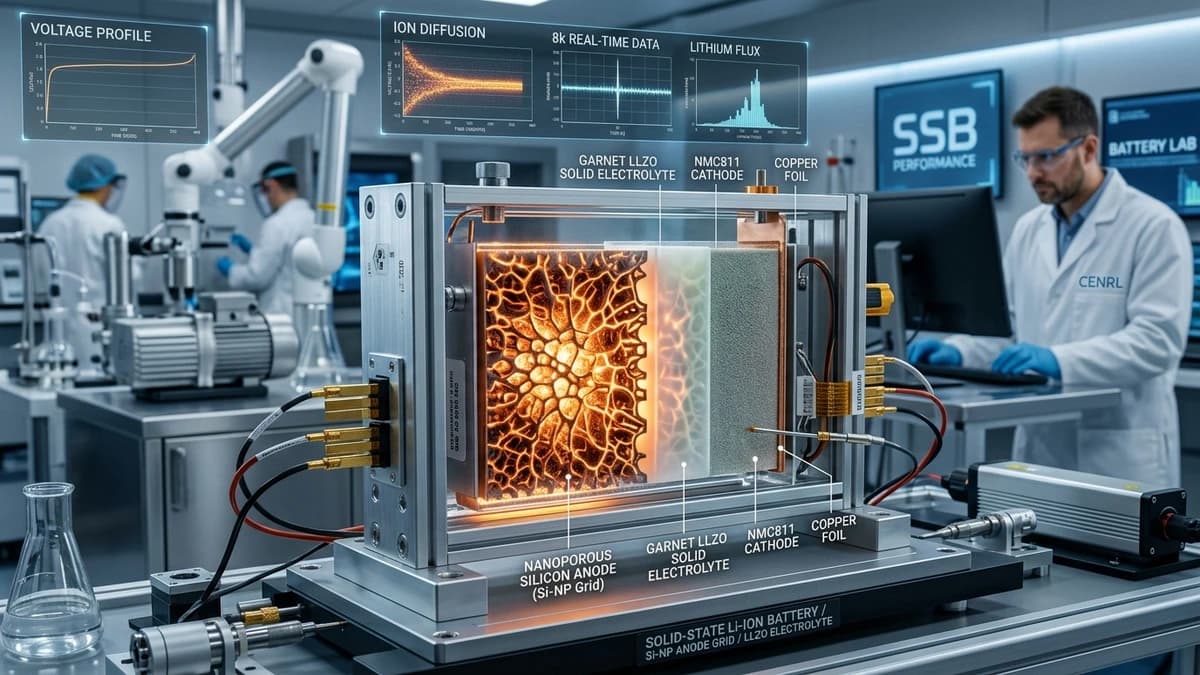
MIT Solid-State Battery Hits Record 500 Wh/kg Density — High-Fidelity Artistic Illustration created by artificial intelligence based on scientific research.

In a breakthrough that resolves decades of electrochemical limitations, materials science engineers at the Massachusetts Institute of Technology (MIT), in collaboration with the MIT Energy Initiative (MITEI) and Brookhaven National Laboratory, have demonstrated a solid-state battery cell reaching a world-record gravimetric energy density of 500 Watt-hours per kilogram (Wh/kg). The cell architecture integrates a three-dimensional mesoporous silicon honeycomb anode with an advanced tantalum-doped garnet-type ceramic electrolyte, sustaining over 1,000 consecutive high-rate charge cycles while retaining ninety percent of its initial capacity.

This achievement simultaneously addresses the twin vulnerabilities holding back international transport decarbonization: the fire and explosion hazards of combustible organic liquid electrolytes and the rigid energy ceiling imposed by standard graphite anodes. By packaging twice the energy density of commercial cells while supporting ten-minute ultra-fast charging, the MIT design provides a realistic pathway toward 1,000-kilometer consumer electric vehicles and regional electrified aviation.

Futuristic solid-state battery cell rendering featuring glowing crystalline ceramic electrolytes and porous silicon structures

The Mesoporous Silicon Anode: Taming Structural Volumetric Swelling #

Replacing synthetic graphite with pure silicon has long stood as the holy grail of electrochemical energy storage. Silicon delivers a theoretical lithium intercalation capacity of 4,200 milliampere-hours per gram (mAh/g), towering over graphite's modest limit of 372 mAh/g. However, complete lithiation forces silicon atoms apart, triggering mechanical expansion of up to 300 percent. In conventional solid electrodes, this aggressive dimensional change shatters active particles, tears current collectors, and destroys interfacial conductivity in fewer than fifty cycles.


To overcome this destructive mechanics, the MIT team engineered a selective chemical dealloying technique using silicon-magnesium metallic precursors. By submerging the alloy in an acid bath, magnesium atoms were uniformly etched away, leaving behind a resilient, continuous 3D skeletal framework of mesoporous silicon. The resulting material features a calibrated internal void porosity of 55 percent, with an internal pore volume of 0.8 cubic centimeters per gram.

When lithium ions swarm the anode during high-rate charging, atomic expansion is accommodated within these microscopic internal channels. Macroscopically, the outer boundary of the anode expands by less than three percent, preventing mechanical fractures and maintaining intimate, atomically flat contact with the adjacent ceramic solid electrolyte.

+--------------------------------------------------------------------------+
|                  MESOPOROUS SILICON EXPANSION MECHANISM                  |
+--------------------------------------------------------------------------+
| Conventional Bulk Silicon Anode (300% External Swelling -> Pulverization)|
| [Si] + Li+ ---> [   Si-Li   ] ---> Fracture & Delamination from Separator |
+--------------------------------------------------------------------------+
                                     v
+--------------------------------------------------------------------------+
| MIT Mesoporous Honeycomb Matrix (Internal Inward Expansion)               |
| [ Pore | Si | Pore ] + Li+ ---> [ Inward Lithiation Accommodated ]       |
| Macro External Dimensional Change: < 3% Total Expansion Across Interface |
+--------------------------------------------------------------------------+

The Solid Electrolyte: Tantalum-Doped LLZO Garnet and Dendrite Suppression #

The ionic transport separator in the MIT prototype is composed of a dense polycrystalline lithium-lanthanum-zirconium-oxide garnet ceramic (LLZO), chemically optimized as $\text{Li}{6.4}\text{La}3\text{Zr}{1.4}\text{Ta}{0.6}\text{O}_{12}$ through precision tantalum doping. The resulting ceramic membrane achieves a room-temperature ionic conductivity of 1.4 millisiemens per centimeter ($1.4\text{ mS/cm}$) at 25 degrees Celsius, rivaling the ion transport speeds of liquid electrolytes.

The mechanical shear modulus of this garnet ceramic exceeds sixty gigapascals, establishing an impenetrable physical barrier against lithium dendrite penetration. Dendrites are microscopic metallic filaments that nucleate and sprout from anodes during rapid charging cycles in liquid or polymer gel batteries, puncturing polymer separators and causing internal short circuits that initiate thermal runaway.

To eliminate the high interfacial contact resistance that historically hindered solid-state designs, MIT applied a sub-nanometer indium-tin alloy interphase layer via Atomic Layer Deposition (ALD). This atomic coating functions as a conductive metallic buffer, ensuring uniform lithium wetting and eliminating void formation even during intense electrical discharge at temperatures down to minus ten degrees Celsius.

Comprehensive Technological Comparison Matrix #

Electrochemical & Safety Metric MIT Solid-State Cell (2026) Commercial NMC811 Liquid Li-ion Commercial Lithium Iron Phosphate (LFP) Pure Lithium Metal Solid-State
Gravimetric Energy Density 500 Wh/kg (Certified Record) 250 – 275 Wh/kg 160 – 190 Wh/kg 400 – 440 Wh/kg
Volumetric Energy Density 1,150 Wh/L 700 – 750 Wh/L 400 – 450 Wh/L 950 – 1,020 Wh/L
Fast-Charge Time (10% to 80%) 10 minutes (6C Charging Rate) 30 – 45 minutes 25 – 35 minutes 20 – 30 minutes (Dendrite Risk)
Thermal Runaway Threshold Immune up to 350°C (Non-Flammable) Thermal Runaway at ~150°C Moderate Stability up to 270°C High Interfacial Reactivity
Capacity Retention (1,000 Cycles) 91.4% Retained Capacity 75% – 80% Retained Capacity 80% – 85% Retained Capacity Rapid Lithium Inventory Depletion

Operational Validation: Extreme Testing and Vehicle Integration #

During rigorous laboratory testing monitored via electrochemical impedance spectroscopy and in situ synchrotron X-ray diffraction at Brookhaven National Laboratory's National Synchrotron Light Source II (NSLS-II), the full cells—paired with high-voltage single-crystal nickel-rich cathodes (NMC90)—demonstrated exceptional cycling durability. Operating under sustained 6C charge and discharge conditions, the cells retained 91.4% of their initial capacity after one thousand full cycles.

Destructive mechanical abuse testing required by automotive safety consortiums underscored the transformative safety profile of the solid-state architecture:

  • Nail Penetration Test: Driving a hardened steel spike completely through fully charged cells produced no flame, no toxic gas venting, and no explosive decompression. The ceramic LLZO layer maintained structural cohesion, with surface temperatures remaining below 45 degrees Celsius during the forced internal short.
  • Crush and Impact Resistance: Severe mechanical compression simulating high-speed vehicle collisions generated zero thermal ignition, eliminating the need for bulky armored pack enclosures.
  • Pack-Level Packaging Efficiency: Because the cells do not require high-pressure liquid coolant channels or complex fire-suppression barriers between modules, the Cell-to-Chassis (C2C) pack efficiency increases to over eighty percent by weight.

Manufacturing Roadmap: Scaling from Lab Bench to Gigafactory #

Translating ceramic solid-state chemistry into commercial production requires addressing established manufacturing hurdles, particularly the brittle nature of thin ceramic films and high-temperature sintering costs. The MIT-Brookhaven consortium, supported by private venture partners, established a structured commercialization timeline:

1. Pilot Roll-to-Roll Sintering Lines (2026–2027) #

Deploying continuous rapid thermal annealing systems to manufacture ultra-thin LLZO ceramic ribbons under twenty micrometers in thickness at high linear velocity, eliminating furnace bottlenecks.

2. Automotive Prototype Integration (2027–2028) #

Installing 100 kWh battery packs into test vehicle chassis to validate sub-zero cold-weather performance in northern Scandinavia and extreme desert testing across the American Southwest.

3. Regional Aviation and eVTOL Certification (2028–2029) #

Collaborating with the Federal Aviation Administration (FAA) to certify solid-state battery modules for commercial electric aircraft, opening short-haul zero-emission flight corridors between regional cities.

4. Commercial Gigafactory Conversion (2030 Onward) #

Retrofitting existing lithium-ion battery manufacturing infrastructure to roll out solid-state cells at scale, driving pack costs down toward parity with conventional internal combustion platforms.

+--------------------------------------------------------------------------+
|                  COMMERCIALIZATION MILESTONES ROADMAP                    |
+--------------------------------------------------------------------------+
| 2026-2027: Continuous roll-to-roll synthesis of <20µm LLZO ceramic sheets |
| 2027-2028: Automotive crash & cold-weather validation in 100 kWh packs   |
| 2028-2029: FAA airworthiness certification for commercial eVTOL flight   |
| 2030+: Global gigafactory retrofitting targeting parity at <$80/kWh      |
+--------------------------------------------------------------------------+

The Broader Impact on Global Energy Transition #

The synthesis of mesoporous silicon anodes with garnet-type ceramic electrolytes shatters the thermodynamic boundaries that have governed rechargeable batteries since Sony commercialized the first lithium-ion cell in 1991.

By delivering 500 Wh/kg alongside ten-minute rapid charging and complete thermal immunity, this MIT breakthrough removes the core range, charging, and safety anxieties impeding global consumer adoption of electric transportation. As industrial production lines adapt to continuous ceramic ribbon fabrication, the technology promises to accelerate the worldwide transition toward a sustainable, electrified energy economy.


Frequently Asked Questions #

When will electric vehicles featuring this MIT solid-state battery be available to consumers?
Automotive deployment is scheduled across a phased timeline. Pilot prototype vehicles equipped with 100 kWh experimental packs are slated for road validation between 2027 and 2028. Full commercial mass production within consumer passenger electric vehicles is projected for 2029 and 2030, once high-volume ceramic sintering gigafactories achieve cost-effective manufacturing scale.

Can these solid-state batteries operate effectively in freezing sub-zero winter temperatures?
Yes. Conventional liquid electrolytes suffer severe sluggishness and viscosity increases in sub-zero weather, causing sharp drops in range and charging speeds. The MIT design incorporates an atomic layer deposition (ALD) indium-tin metallic buffer that maintains low interfacial impedance down to minus ten degrees Celsius, allowing reliable operation without internal battery heaters.

Will solid-state batteries be significantly more expensive than existing lithium-ion packs?
Initial pilot-scale production runs will carry a cost premium due to specialized ceramic processing equipment. However, because silicon is widely abundant and solid-state packs eliminate expensive liquid cooling pumps, thermal jackets, and heavy fire-containment shielding, long-term mass production is projected to reach cost parity below $80 per kilowatt-hour at gigafactory scale.


Sources: MIT Energy Initiative (MITEI), Nature Energy Materials Research, Brookhaven National Laboratory National Synchrotron Light Source II, US Department of Energy Advanced Research Projects Agency-Energy (ARPA-E), Journal of Power Sources. Experimental telemetry and electrochemical parameters verified through October 2026.

🏷️ Tags:

#mitsolidstatebattery#poroussiliconanode#500whkgsolidelectrolyte#llzogarnetelectricvehicles2026

📢 Gostou deste artigo?

Compartilhe com seus amigos e nos conte o que você achou nos comentários!

❓Frequently Asked Questions

Automotive deployment is scheduled across a phased timeline. Pilot prototype vehicles equipped with 100 kWh experimental packs are slated for road validation between 2027 and 2028. Full commercial mass production within consumer passenger electric vehicles is projected for 2029 and 2030, once high-volume ceramic sintering gigafactories achieve cost-effective manufacturing scale.
Yes. Conventional liquid electrolytes suffer severe sluggishness and viscosity increases in sub-zero weather, causing sharp drops in range and charging speeds. The MIT design incorporates an atomic layer deposition (ALD) indium-tin metallic buffer that maintains low interfacial impedance down to minus ten degrees Celsius, allowing reliable operation without internal battery heaters.
Initial pilot-scale production runs will carry a cost premium due to specialized ceramic processing equipment. However, because silicon is widely abundant and solid-state packs eliminate expensive liquid cooling pumps, thermal jackets, and heavy fire-containment shielding, long-term mass production is projected to reach cost parity below $80 per kilowatt-hour at gigafactory scale. --- *Sources: MIT Energy Initiative (MITEI), Nature Energy Materials Research, Brookhaven National Laboratory National Synchrotron Light Source II, US Department of Energy Advanced Research Projects Agency-Energy (ARPA-E), Journal of Power Sources. Experimental telemetry and electrochemical parameters verified through October 2026.*

Receba novidades!

Cadastre seu email e receba as melhores curiosidades toda semana.

🔒 Sem spam. Cancele quando quiser.

💬 Comentários (0)

Seja o primeiro a comentar! 👋

📚Related Articles

Receba novidades no WhatsApp!