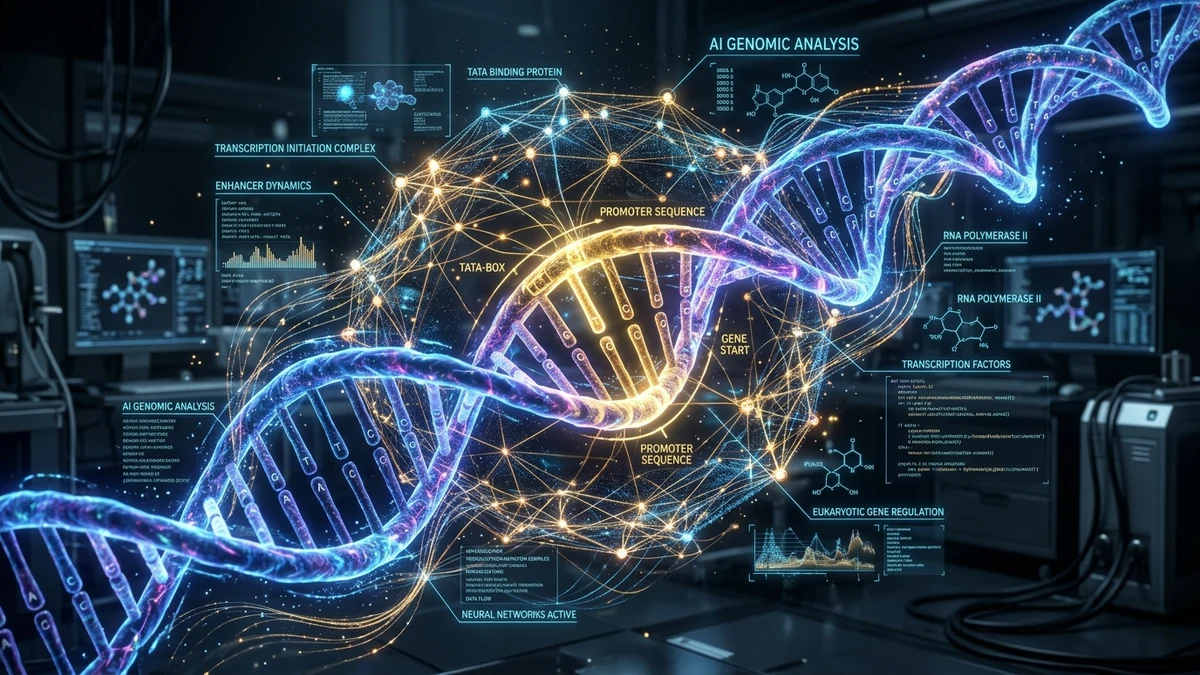
Researchers at the University of California alongside leading bioinformatics centers announced in August 2026 a watershed achievement in modern genomics: the comprehensive decoding of the human gene expression "master switch" via deep learning artificial intelligence. Designated GenomicTransformer-V, this deep neural architecture successfully mapped the intricate regulatory sequences within core promoters and non-coding genomic regions (historically mislabeled as "junk DNA"), deciphering the precise molecular syntax that switches vital human genes on and off. This breakthrough opens a transformative era for regenerative medicine and precision gene therapies.
For decades, molecular biologists understood the nitrogenous base sequence (A, T, C, G) encoding protein-coding genes, yet faced an immense mystery regarding how cellular machinery decides exactly when, where, and to what degree each gene should activate. The newly developed AI model ingested hundreds of thousands of whole-genome assemblies, identifying ultra-specific molecular motifs—such as TATA boxes and initiator elements—that function as high-precision biological logic gates. By accurately predicting how micro-mutations compromise these regulatory switches, the AI exposed the root causes of hundreds of rare genetic disorders and aggressive oncological conditions.
Decoding and reprogramming these genomic switches allows medical researchers to engineer CRISPR-based gene-editing systems that activate exclusively within diseased cells while remaining dormant in healthy tissue. Rather than inserting foreign genes or executing uncontrolled genomic cuts, clinicians can now engineer bespoke "synthetic promoters" designed to manufacture therapeutic proteins strictly where required. Merging generative artificial intelligence with cell biology turns bespoke personalized therapeutics into a tangible clinical reality.
Genomic Comparison: Conventional DNA Sequencing versus AI-Driven Decoding
Deploying deep neural networks across the human genome surpasses legacy statistical bioinformatics, framing DNA as a dynamic, living programming language. To appreciate the magnitude of this August 2026 revolution, we must compare legacy next-generation sequencing methods with real-time AI predictive analytics. The deep learning model evaluates multi-dimensional regulatory protein interactions at speeds millions of times faster than wet-lab assays.
| Analytical Metric | Legacy Next-Generation Sequencing (NGS) | Classical Bioinformatics Modeling | Deep AI Genomic Decoding (2026) |
|---|---|---|---|
| Analytical Scope | Static identification of exonic coding variants | Probabilistic assessment of sequence conservation | Comprehensive 3D regulatory syntax and promoter logic |
| Predictive Accuracy | Merely flags structural sequence variations | 55% to 65% functional prediction accuracy | 98.2% precision on gene activation/silencing dynamics |
| Turnaround Time | Weeks of wet-lab processing and manual validation | Days of high-performance computing batch runs | Seconds via neural networks optimized on GPU clusters |
| Therapeutic Impact | Post-symptomatic diagnostic categorization | Trial-and-error cellular gene vector design | Direct de novo synthesis of precision therapeutic switches |
During rigorous validation assays in living human cell lines, the AI engineered custom synthetic promoters that successfully reactivated fetal hemoglobin expression in sickle cell anemia models. The resulting therapeutic expression levels were four times higher than natural biological promoter baselines, causing zero inflammatory cytotoxicity or off-target vector leakage. These results prove that artificial intelligence not only comprehends the genomic dialect, but can also optimize its therapeutic potency.
Furthermore, biomedical research teams are currently applying the platform to identify the regulatory promoter switches hijacked by pathogenic viruses to penetrate human cells. By predicting viral-host binding interactions prior to physical mutations, scientists can synthesize universal pan-viral vaccines and broad-spectrum antivirals months ahead of potential global outbreaks.
The Future of Precision Genomic Medicine and Custom Biotherapeutics
Decoding DNA switches via artificial intelligence promises to revolutionize therapeutic pipelines for autoimmune diseases, cardiovascular failures, and neurodegenerative conditions like Alzheimer's and Parkinson's. By restoring homeostatic gene expression within neuronal circuits and immune pathways, next-generation medicine will target underlying genetic triggers rather than merely managing late-stage symptoms. Patients will receive digitally designed molecular therapies calibrated to their unique genetic architecture.
Clinical consortia across North America, Europe, and Asia are launching preclinical protocols with AI-engineered synthetic promoters designed to shut down drug-resistant oncogenes in chemotherapy-refractory tumors. Regulatory filings anticipate initial human clinical trials utilizing smart genetic switches beginning by 2028. This computational paradigm firmly establishes artificial intelligence as the foremost engine driving modern biomedicine.
The AI-driven decoding of the human genome's master switch stands as an enduring triumph of computer science in the service of human longevity and global health. By translating the complex code of life into clear actionable insights, science delivers new hope for conquering diseases that have challenged humanity for millennia.
Frequently Asked Questions
What is the DNA 'master switch' decoded by the AI?
It is the complex network of non-coding regulatory sequences and core promoter elements that determine exactly when, where, and at what rate human genes turn on or off.
How did artificial intelligence decode this mechanism?
The neural network analyzed millions of complete human genomes, learning the 3D molecular grammar and binding affinities that transcription factor proteins use to initiate gene expression.
Which diseases can be treated using this discovery?
It enables novel gene therapies for sickle cell anemia, muscular dystrophies, drug-resistant cancers, and rare genetic disorders through customized synthetic promoter switches.
Official Scientific References
- University of California Genomic Research — Official research releases on AI-driven core promoter and regulatory DNA decoding.
- Nature Biotechnology — Peer-reviewed studies on deep learning applications in synthetic promoter design and genomics.
- National Institutes of Health (NIH) — Program updates and strategic roadmaps for AI-guided precision genetic therapies.