The animal kingdom is a constant battlefield. Every day, predators and prey clash in combats that decide who lives and who dies. But what happens when the largest and most powerful animals on the planet meet? Who really wins when an African elephant faces a pride of lions? What happens when a territorial hippo encounters a Nile crocodile? And in the end, who is the most powerful animal on Earth?
Let's analyze the most epic battles of the animal kingdom based on scientific data, field records, and biologist observations. Get ready to discover that the outcome isn't always what you'd expect.
Battle 1: African Elephant vs Lion
The African elephant is the largest land animal on the planet. An adult male can weigh between 6,000 and 7,000 kg, stand 4 meters tall at the shoulder, and possesses tusks that can exceed 2 meters in length. Its skin is up to 2.5 cm thick in some areas.
The lion, the "king of the jungle," weighs between 150 and 250 kg. It has 7 cm retractable claws, jaws with a bite force of 650 PSI, and is a social predator that hunts in groups.
In nature, lions rarely attack healthy adult elephants. When they do, it's always in a group (an entire pride) and they usually target young females or sick, isolated elephants. A healthy adult male elephant is virtually invincible against lions.
The elephant can crush a lion with a stomp, hurl it with its trunk, or impale it with its tusks. There are documented records of elephants killing lions with a single trunk blow, launching them meters through the air.
Winner: African elephant. In individual combat, the lion has absolutely no chance. Even in groups, lions rarely manage to bring down a healthy adult elephant.
Battle 2: Hippopotamus vs Nile Crocodile
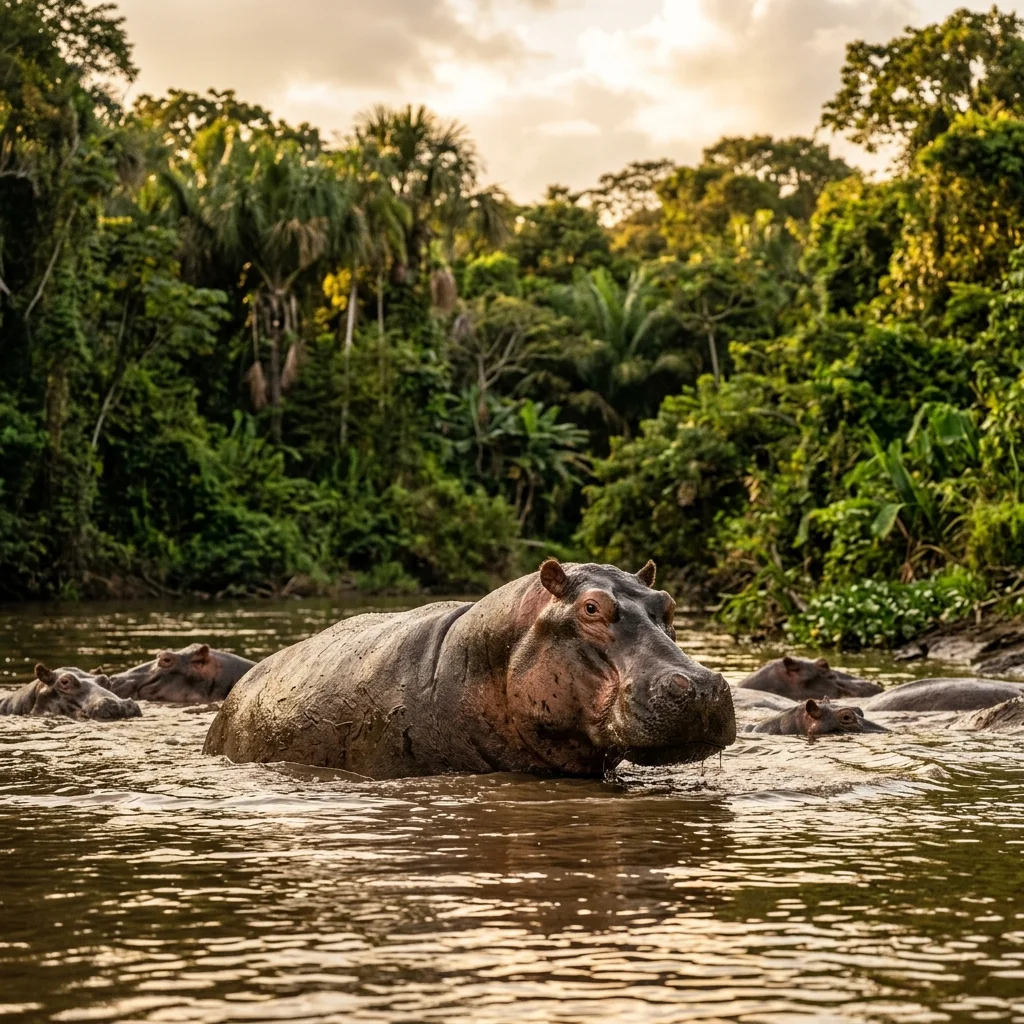
The hippopotamus is frequently underestimated, but it's one of the most dangerous animals in Africa. An adult male weighs between 1,500 and 3,200 kg, possesses jaws that open to 150 degrees, and canines that can reach 50 cm in length. Its bite force is estimated at 1,800 PSI — enough to split a crocodile in half.
The Nile crocodile can weigh up to 750 kg and possesses the strongest bite of any living animal: about 3,700 PSI. Its teeth are designed to grab and not let go, and its "death roll" can dismember large prey.
Despite the crocodile's superior bite, the hippo wins this battle in the vast majority of encounters. The hippo's skin is up to 5 cm thick and extremely resistant to penetration. The crocodile's teeth, designed for gripping, have difficulty piercing this natural armor.
There are documented videos of hippos attacking crocodiles, biting them in half with their enormous canines. Hippos are extremely territorial in water and don't tolerate the presence of crocodiles in their territory. Crocodiles, in turn, have learned to avoid adult hippos.
Winner: Hippopotamus. Its combination of size, natural armor, devastating jaws, and aggressive temperament makes it superior to the crocodile in direct combat.
Battle 3: Bengal Tiger vs Grizzly Bear
The Bengal tiger is the largest cat in the world (along with the Siberian tiger). A male can weigh up to 260 kg, possesses 10 cm claws, and a bite force of 1,050 PSI. It's a solitary predator, agile and extremely powerful.
The grizzly bear can weigh up to 680 kg, possesses 15 cm claws, and a bite force of 1,160 PSI. Its layer of fat and muscle functions as natural armor.
In nature, tigers and bears encounter each other in Russia and India. Records show that the outcome depends heavily on the size of the individuals. Tigers are more agile and possess more refined hunting techniques — they target the neck for a fatal bite. Bears are stronger in brute force and can absorb more damage.
Field studies in Russia show that Siberian tigers occasionally hunt brown bears, especially during hibernation. However, large grizzly bears can kill tigers in direct confrontations. The tiger's advantage lies in speed and technique; the bear's in size and endurance.
Winner: Technical draw. Depends on the size of the individuals and circumstances. A large tiger can kill a medium bear, and vice versa. On average, the grizzly bear has a slight advantage due to superior size.
Battle 4: Orca vs Great White Shark
The orca (killer whale) is the apex predator of the ocean food chain. An adult male can measure 9 meters and weigh 6,000 kg. It possesses intelligence comparable to primates, hunts in groups with coordinated strategies, and has an estimated bite force of 19,000 PSI.
The great white shark can measure up to 6 meters and weigh 2,200 kg. It has 300 serrated teeth, electromagnetic senses to detect prey, and an attack speed of up to 40 km/h.
This battle isn't theoretical — it happens in nature. In 1997, researchers off the California coast documented an orca killing a 3-meter great white shark. The orca flipped the shark upside down, inducing a state of paralysis called "tonic immobility," and then devoured it, eating only the nutrient-rich liver.
Since then, multiple incidents have been documented in South Africa, where a pair of orcas known as "Port" and "Starboard" has systematically hunted great white sharks, causing the disappearance of these sharks from entire coastal areas.
Winner: Orca. Superior in size, intelligence, strength, and strategy. The great white shark, despite being fearsome, is prey for the orca.
Battle 5: African Buffalo vs Lion
The African buffalo (Cape buffalo) weighs between 500 and 900 kg, possesses massive horns that form a bony "shield" on top of its head, and is known for its extremely aggressive temperament. It's responsible for more human deaths in Africa than any other large herbivore.
Lions hunt buffalo regularly, but it's one of the most dangerous hunts they face. An adult buffalo can kill a lion with a horn strike, and buffalo are known for returning to rescue herd members captured by lions.
There are famous videos showing buffalo herds attacking lions to save a calf, hurling the cats through the air with their horns. In individual combat, an adult male buffalo can defeat a solitary lion. Lions need at least 4 to 6 individuals to safely bring down an adult buffalo.
Winner: In individual combat, the buffalo has the advantage. In groups, lions win through coordination. But the buffalo is one of the few herbivores that can kill a lion in direct combat.
Battle 6: Rhinoceros vs Hippopotamus
Two of Africa's most dangerous animals in a direct confrontation. The white rhinoceros can weigh up to 2,300 kg and possesses a front horn up to 1.5 meters long. The hippopotamus weighs up to 3,200 kg and possesses 50 cm canines with a 1,800 PSI bite.
In nature, these encounters are rare but documented. The rhinoceros has the advantage of its horn — a devastating piercing weapon — and extremely thick skin. The hippopotamus has the advantage of size, bite, and aggressiveness in water.
On land, the rhinoceros has a slight advantage: it's faster (can run at 50 km/h versus the hippo's 30 km/h) and its horn can cause fatal injuries. In water, the hippopotamus dominates completely.
Winner: Draw, depending on terrain. On land, slight advantage for the rhinoceros. In water, clear victory for the hippopotamus.
Battle 7: Golden Eagle vs Wolf
The golden eagle is one of the most powerful birds of prey in the world. With a wingspan of up to 2.3 meters, talons with a force of 400 PSI (stronger than a rottweiler's bite), and dive speeds of up to 320 km/h, it's an aerial hunting machine.
In Mongolia, golden eagles are trained to hunt wolves — and they succeed. Their talons can pierce a wolf's skull, and the speed of the dive generates devastating impact force. There are records of golden eagles killing adult wolves, deer, and even mountain goats.
However, an adult wolf on flat terrain, aware of the eagle's presence, can defend itself. Wolves are intelligent and can dodge aerial attacks. The eagle needs the element of surprise to win.
Winner: Golden eagle with element of surprise. Wolf in prolonged ground combat.
Battle 8: Gorilla vs Leopard
The mountain gorilla is the largest living primate. A male silverback can weigh 220 kg and possesses an estimated strength 10 times that of an adult human. Its arms can exert a pulling force of more than 800 kg.
The leopard weighs between 30 and 90 kg, is extremely agile, and possesses a powerful bite for its size. Leopards are known for hunting prey much larger than themselves.
In nature, leopards occasionally attack gorillas — but almost exclusively females and young. An adult silverback is too formidable an opponent. With powerful arms, hands that can grip, and crushing brute force, the gorilla can break the leopard's bones.
Winner: Gorilla silverback. The leopard is more agile, but the gorilla is simply too strong to be defeated in direct combat.
The Grand Ranking: Who Is the Strongest of All?
After analyzing all the battles, we can create a ranking of the most powerful animals on the planet, considering strength, natural weaponry, endurance, and combat capability:
1. African Elephant — The undisputed king of the land. No terrestrial animal can defeat it in individual combat. Weight up to 7 tons, lethal tusks, powerful trunk, and superior intelligence.
2. Orca — The supreme predator of the oceans. Exceptional intelligence, coordinated group hunting, devastating bite force. Even great white sharks flee from them.
3. Hippopotamus — The most dangerous animal in Africa. Kills more humans than lions and crocodiles combined. Jaws that split crocodiles in half.
4. Rhinoceros — Nature's armored tank. Devastating horn, impenetrable skin, and surprising speed for its size.
5. African Buffalo — The herbivore that lions fear. Aggressive, vengeful, and capable of killing predators with ease.
6. Grizzly Bear — Unmatched brute force among terrestrial carnivores. 15 cm claws and extraordinary endurance.
7. Bengal Tiger — The largest and most powerful cat. Perfect combination of strength, speed, and hunting technique.
8. Gorilla Silverback — The strongest primate. Arms that can break bones with ease and intelligence to use the environment to its advantage.
9. Nile Crocodile — The strongest bite of any living animal. A perfect ambush predator that has survived for 200 million years.
10. Lion — The "king of the jungle" is actually a social predator that depends on the group. Individually, it loses to several animals on this list.
The Truth About Power in the Animal Kingdom
What these battles teach us is that size matters — a lot. The most powerful animals are, almost without exception, the largest. The African elephant, at 7 tons, is virtually invincible on land. The orca, at 6 tons with superior intelligence, dominates the oceans.
But size isn't everything. The hippopotamus, despite being smaller than the elephant, is more dangerous to humans because of its unpredictable temperament. The tiger, smaller than the bear, can defeat it through technique. The golden eagle, weighing only 6 kg, can kill a 50 kg wolf.
In the end, the most powerful animal on the planet is none of those listed above. It's Homo sapiens — the human being. With intelligence, tools, and social organization, we dominate every ecosystem on the planet. But that's a story for another article.
Frequently Asked Questions
What is the most powerful predator on Earth?
The orca (killer whale) is often considered the most powerful predator on Earth. Orcas hunt great white sharks, blue whale calves, and even adult sperm whales. They use sophisticated group hunting strategies and have no natural predators. On land, the polar bear is the largest terrestrial predator, while the Nile crocodile has the strongest bite force of any living animal at 22,000 newtons. In terms of pound-for-pound strength, the mantis shrimp delivers the most powerful strike relative to its size.
Could a gorilla beat a lion in a fight?
This is one of the most debated hypothetical animal fights. A silverback gorilla can weigh up to 230 kg with incredible upper body strength (estimated 10x human strength). However, a male lion weighs up to 250 kg, has 7.5 cm claws, powerful jaws, and is an experienced killer. Most zoologists believe the lion would win due to its predatory instincts, weapons (claws and teeth), and fighting experience. The gorilla's intelligence and strength wouldn't compensate for the lion's natural killing ability.
What animal has the strongest bite?
The saltwater crocodile has the strongest measured bite force at approximately 16,000-22,000 newtons. The Nile crocodile is close behind. Among mammals, the hippopotamus has the strongest bite at about 8,100 newtons. The great white shark bites with approximately 18,000 newtons. For extinct animals, Tyrannosaurus rex is estimated at 35,000-57,000 newtons. The tiny trap-jaw ant has the fastest bite in the animal kingdom, closing its mandibles at 230 km/h.
Are humans apex predators?
Technically, humans are apex predators — we sit at the top of the food chain with no natural predators. However, our position is entirely due to technology and intelligence, not physical ability. Without tools, humans are relatively weak predators. A 2013 study placed humans at a trophic level of 2.21 (similar to pigs and anchovies) based on diet alone. Our true predatory advantage is our brain: the ability to create weapons, coordinate hunts, and modify environments.
Sources: National Geographic, BBC Earth, field studies published in Journal of Zoology, Animal Behaviour, and Behavioral Ecology. Bite force data based on published scientific measurements.
Read also: