And the most delicious detail: this is the same company that:
- Failed to prevent Facebook from being used to organize a genocide in Myanmar
- Failed to stop Instagram from destroying teenagers' self-esteem (as revealed by Meta's own internal research)
- Failed to halt fake news on WhatsApp that influenced elections in dozens of countries
- Failed to make the Metaverse work after spending $46 billion on it
- Failed to prevent its platform from becoming the largest vehicle for vaccine misinformation during the pandemic
But now, now for sure, they'll get it right. Because this time it's different. This time it's $135 billion. And if there's one thing Meta's history has taught us, it's that throwing money at problems always works. Right? Right?
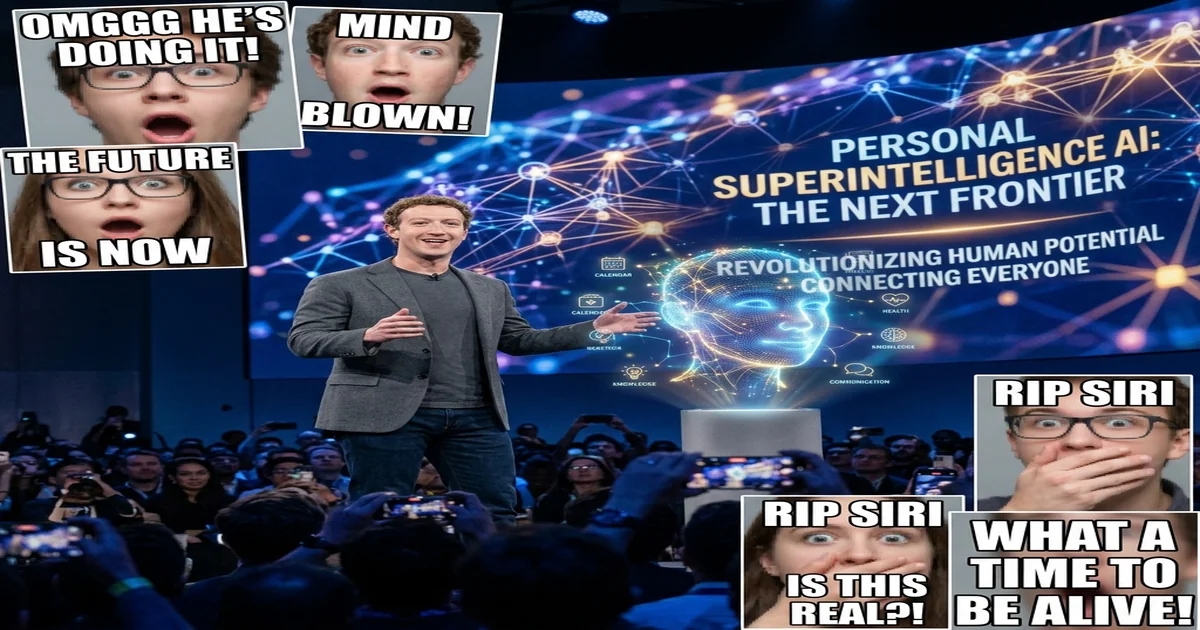
The internet, with its supernatural ability to transform any corporate statement into comedic content, did not disappoint. Within 48 hours of Zuckerberg's announcement, social media (ironically, including Meta's own platforms) was flooded with memes that perfectly captured the absurdity of the situation.
Picture a visual timeline in the style of the "evolution of man," but instead of showing the transition from ape to Homo sapiens, it shows the evolution of Zuckerberg's promises:
- 2004: "I'll connect Harvard students" (simple stick figure)
- 2012: "I'll connect the entire world" (bigger figure)
- 2016: "I'll connect the entire world... to misinformation" (figure with suspicious look)
- 2021: "I'll put everyone in the Metaverse" (figure with ridiculous VR goggles)
- 2026: "I'll give superintelligence to billions" (figure transformed into giant robot)
- 2030: "I'll replace humanity" (figure has disappeared, only the robot remains)
The final caption: "From 'The Facebook' to 'The Skynet' in 26 years. Any% speedrun."
This meme captures the increasingly megalomaniacal trajectory of Zuckerberg's ambitions. Each promise is exponentially grander than the last, while the problems from previous promises remain spectacularly unresolved. It's like a student who fails basic math but announces they'll solve the Riemann Hypothesis next semester. The internet loved it because it summarizes in six panels what tech analysts take 5,000-word articles to explain: Zuckerberg has a chronic problem of promising the impossible while failing to deliver the basics.
The meme shows a fictional Meta tech support conversation in 2027:
User: My personal superintelligence has a problem.
Meta Support: What's the issue?
User: It solved the Navier-Stokes equation, proved Goldbach's Conjecture, and developed a unified theory of quantum physics and gravity. But when my aunt shared that "drinking lemon water cures cancer," the superintelligence agreed and sent the recipe to 47 family group chats.
Meta Support: That's a feature, not a bug.
User: ...
Meta Support: Would you like to rate this support experience? ⭐⭐⭐⭐⭐
This meme is brilliant because it attacks Meta's Achilles' heel: the company has never managed — or never wanted — to solve the misinformation problem on its platforms. The joke suggests that even a superintelligence created by Meta would inherit the corporate DNA of prioritizing engagement over truth. After all, a piece of fake news that generates 47 shares is, from Meta's algorithm perspective, a resounding success. The meme went especially viral in Latin America, where family WhatsApp groups are legendary for their ability to transform any absurdity into "verified information from my cousin who's a nurse."
The format is a fictional professional resume for Mark Zuckerberg:
MARK ZUCKERBERG
CEO, Meta Platforms Inc.
PROFESSIONAL EXPERIENCE
Connecting People (2004-2016)
- Result: People connected to misinformation ✅
Protecting User Data (2016-2018)
- Result: Cambridge Analytica ✅
Saving Democracy (2018-2020)
- Result: Platform used to manipulate elections in 50+ countries ✅
Protecting Teenagers (2020-2021)
- Result: Instagram causes depression in 1 in 3 teens (Meta's own internal research) ✅
Building the Metaverse (2021-2024)
- Result: $46 billion spent, 0 people living there ✅
Giving Superintelligence to Billions (2026-???)
SKILLS: Spending money, ignoring consequences, wearing gray t-shirts
REFERENCES: Available upon subpoena
The internet deeply identified with this meme because it works as a comedic dossier of every time Meta promised something grand and delivered something catastrophic. The pattern is so consistent it's become a ready-made joke: every time Zuckerberg announces something new, the internet's first reaction is to ask "what's going to go wrong this time?" And the answer, historically, is "everything."
The meme shows two panels side by side. In the first, a family staring at their electricity bill in despair, with a staggering amount due. In the second, a Meta data center glowing like an entire city at night, with the caption: "1 gigawatt — enough energy to power 750,000 homes, but Meta needs it to teach an AI to generate WhatsApp stickers."
Below, the phrase: "Zuckerberg burning a city's worth of energy to create superintelligence while I can't afford my electric bill."
This meme struck a nerve because it connects the abstract investment of billions of dollars with the concrete reality of people struggling to keep their lights on. The idea that the energy equivalent of 750,000 homes is being used to train AI models — while millions of people worldwide live without electricity — is the kind of contrast that transforms outrage into viral humor. The meme was particularly popular in Latin America and Africa, where energy crises are an everyday reality.
The viralization of memes about Zuckerberg's superintelligence wasn't accidental. It follows a pattern that social scientists and digital culture researchers identify as "technological dissonance humor" — when the gap between technological promise and lived reality becomes so vast that the only possible reaction is laughter.
Irony is the primary fuel. Zuckerberg isn't just any CEO making grand promises — he's the CEO whose company has a documented, investigated, and fined track record of causing social harm on a global scale. When he promises "superintelligence for billions," the internet automatically translates it to "another thing that's going to go wrong on a planetary scale."
Research from the Pew Research Center in 2025 shows that only 26% of Americans trust Meta to handle artificial intelligence responsibly. That means 3 out of 4 people hear Zuckerberg talk about superintelligence and think: "oh no, not again."
The numbers are so absurd they become comedic on their own. When someone says "$135 billion," the human brain can't process that amount in any meaningful way. So the internet does what it does best: translates it into absurd comparisons.
- $135 billion = 27 billion Big Macs
- $135 billion = 1 billion iPhones
- $135 billion = paying off the external debt of 40 African countries
- $135 billion = funding NASA for 5 years
- $135 billion = buying Twitter 2.5 times (and Elon Musk overpaid)
Each comparison generates a new meme, and each meme generates more comedic outrage, creating a self-feeding viral cycle.
There's an element that cannot be ignored: Mark Zuckerberg is, himself, a walking meme. From his testimony before the U.S. Senate in 2018 — where he drank water like an alien trying to imitate human behavior — to the photos of him surfing with white sunscreen covering his face, Zuckerberg has become the archetype of the tech billionaire disconnected from reality.
When this specific character announces he's going to give "personal superintelligence" to billions of people, the internet doesn't need much creative effort. The joke writes itself. It's as if the universe were writing comedy scripts and using Zuckerberg as an involuntary protagonist.
Behind the memes and jokes, there's a genuine reflection that deserves attention. The internet's reaction to Zuckerberg's promise reveals something profound about our relationship with technology in 2026.
We live in the era of tech promise fatigue. Over the past 10 years, we've been told that:
- Blockchain would revolutionize everything (it didn't)
- The Metaverse would replace reality (it didn't)
- Self-driving cars would be everywhere by 2025 (they aren't)
- Web3 would democratize the internet (it didn't)
- NFTs would change art forever (they became a joke)
Each unfulfilled promise increases collective cynicism. When Zuckerberg announces "superintelligence for billions," the default reaction isn't excitement — it's skepticism armed with humor. The internet has learned, the hard way, that promises from tech billionaires should be treated with the same level of trust as newspaper horoscopes: fun to read, dangerous to take seriously.
The fundamental problem isn't the technology — it's who's behind it. A survey from the Edelman Trust Barometer in 2026 revealed that tech companies are the least trusted sector among global consumers, with Meta consistently at the bottom of the rankings.
When the least trusted company in the least trusted sector of the economy promises to deliver the most powerful technology in human history to billions of people, the natural reaction is: "Who's going to oversee this?"
And the answer, based on Meta's track record, is: nobody. Or, at best, an internal ethics committee that will be ignored as soon as engagement numbers start dropping.
There's a fascinating philosophical paradox in Zuckerberg's promise. If Meta actually manages to create personal superintelligence and distribute it to billions of people, we'll face two equally terrifying possibilities:
It works: Billions of people with access to superhuman intelligence, controlled by a single private company with a track record of prioritizing profit over social well-being.
It doesn't work: Another $135 billion wasted on an empty promise, while real problems like climate change, inequality, and hunger remain unsolved.
In both scenarios, the internet will make memes. Because, at the end of the day, humor is humanity's last line of defense against the absurd — and few things are more absurd than a billionaire in a gray t-shirt promising to give cognitive superpowers to a planet that still hasn't learned to check sources before sharing fake news.
Let's, for a moment, abandon the sarcasm and consider the remote possibility that Zuckerberg is right. What if Meta actually manages to create and distribute personal superintelligence?
Experts are divided. Yann LeCun, Meta's own head of AI, argues that human-level (and eventually superhuman) artificial intelligence is inevitable, and that it's better to be developed by companies that make it widely available than by governments or corporations that keep it secret.
On the other hand, researchers like Stuart Russell from UC Berkeley warn that distributing superintelligence without adequate controls would be like "giving nuclear weapons to every person on the planet and hoping nobody pushes the button."
The truth, as always, is probably somewhere in the middle — but the internet has no patience for nuance. And when the choice is between a 50-page balanced analysis and a 5-second meme, the meme always wins.
If we look at Meta's AI investments over the past few years, the pattern is clear:
| Year |
AI Investment |
Main Result |
| 2023 |
$28 billion |
LLaMA 2 (open source model) |
| 2024 |
$42 billion |
LLaMA 3, Meta AI Assistant |
| 2025 |
$65 billion |
Meta AI across all products |
| 2026 |
$115-135 billion |
"Personal superintelligence" |
The escalation is dizzying. In three years, the investment has quintupled. If this curve continues, by 2028 Meta will be spending more on AI than Argentina's GDP. The question isn't whether Meta has the money to try — it clearly does. The question is whether money alone solves the problem.
And the history of technology teaches us it doesn't. The Metaverse cost $46 billion and flopped. Google spent billions on Google+ and shut it down. Microsoft invested fortunes in Windows Phone and gave up. Money buys servers, not wisdom.
At the end of the day, Zuckerberg's promise to give personal superintelligence to billions of people is the kind of statement that could only exist in 2026 — an era where tech billionaires make promises that sound like science fiction with the same casualness they use to order a coffee.
The internet reacted the only way it knows how: with memes, sarcasm, and a healthy dose of skepticism. And perhaps that's the smartest possible reaction. Because in a world where the company that couldn't fix fake news wants to give cognitive superpowers to billions of people, laughing is the only act of resistance that doesn't require a superintelligence to execute.
Meanwhile, in some family WhatsApp group somewhere, your aunt is sharing that "Zuckerberg is going to put a chip in everyone's head" — and, for the first time in history, she might not be completely wrong.
If you enjoyed this satirical analysis, also check out our article about the dangerous AI and useless meetings memes and discover why AI should replace politicians according to the internet.