
Zoonoses and Pandemics: The Next Global Threat Is Already Forming — And We Are Accelerating the Process
Date: March 7, 2026
Reading time: 25 minutes
Emoji: 🦠
COVID-19 was not the first pandemic of animal origin — and it certainly won't be the last. In fact, approximately 75% of all emerging infectious diseases in humans are zoonoses — diseases that jump from animals to people. HIV, Ebola, SARS, MERS, Zika, avian influenza H5N1, and the SARS-CoV-2 virus that caused the COVID-19 pandemic are all examples of pathogens that crossed the species barrier. In March 2026, while the world still grapples with the economic and social consequences of COVID-19, new outbreaks of avian influenza H5N1 in mammals in Japan, the United States, and Europe are alarming virologists and epidemiologists worldwide. The question is not whether there will be another pandemic, but when — and how prepared we will be when it arrives. This article explores in depth what zoonoses are, why they are becoming more frequent, and what science and governments are doing to prevent the next global pandemic catastrophe.
What Are Zoonoses and Why Are They So Dangerous?
The Bridge Between Animals and Humans
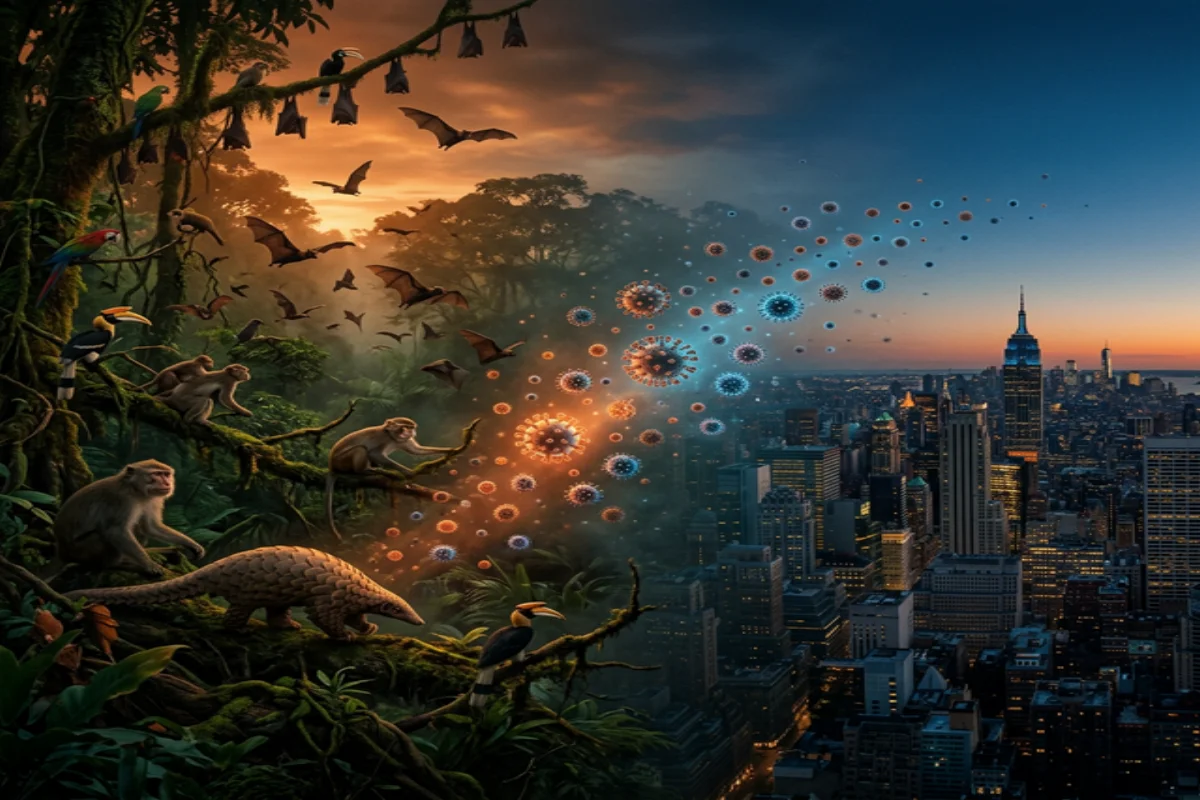
A zoonosis is any disease or infection naturally transmissible from vertebrate animals to humans. The process by which an animal pathogen "jumps" to humans is called a spillover, and it happens when humans come into close contact with animals carrying viruses, bacteria, or parasites to which our immune system has never been exposed and has no pre-existing defense against. Zoonoses represent one of the greatest and most persistent threats to global public health because pathogens that jump between species frequently encounter a human population completely without immunity, allowing extraordinarily rapid and potentially catastrophic spread across communities, countries, and continents.
The numbers are alarming and revealing of the scale of the problem:
- 75% of all emerging infectious diseases in humans are of animal origin
- 60% of all known human infectious diseases are zoonotic
- More than 1.7 million unknown viruses are estimated to exist in mammals and birds around the world — of these, scientists estimate that between 631,000 and 827,000 have the biological potential to cross the species barrier and infect humans, although only a tiny fraction have been identified and characterized
- 3 to 4 new zoonotic diseases emerge every year, a pace that has been accelerating significantly and consistently in recent decades, driven by habitat destruction and climate change
The Greatest Zoonotic Pandemics in History
The history of humanity is profoundly marked by pandemics of animal origin. Each one transformed civilizations, economies, and even the trajectory of human evolution:
| Pandemic | Period | Animal Origin | Estimated Deaths |
|---|---|---|---|
| Black Death | 1347-1353 | Rat fleas (bacterium Yersinia pestis) | 75-200 million |
| Spanish Flu | 1918-1920 | Birds (H1N1 virus) | 50-100 million |
| HIV/AIDS | 1981-present | Chimpanzees (SIV → HIV) | 40+ million |
| SARS | 2002-2004 | Bats → civets | 774 |
| H1N1 (Swine Flu) | 2009-2010 | Pigs (recombinant H1N1 virus) | 151,000-575,000 |
| MERS | 2012-present | Bats → dromedary camels | 935+ |
| Ebola (West Africa) | 2014-2016 | Fruit bats | 11,325 |
| COVID-19 | 2019-present | Bats (possibly via pangolins) | 7+ million (official) |
Why Are Zoonoses Increasing?
Deforestation: Opening Pandora's Box
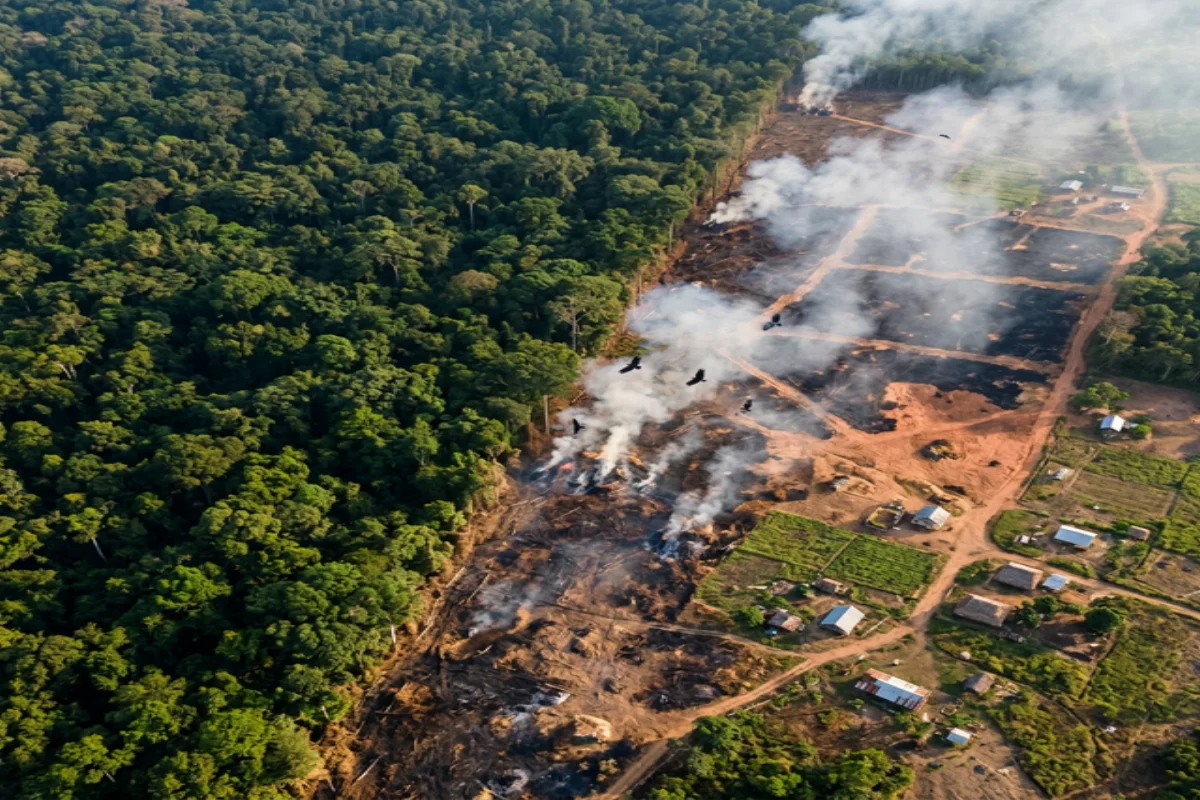
Deforestation is the primary factor driving the increase in global zoonoses. When we destroy tropical forests, we are not just eliminating habitats — we are displacing millions of wild animals carrying unknown viruses and forcing them to migrate to areas inhabited by humans and domestic animals. Studies published in the journal Nature demonstrated that recently deforested areas have rates of emerging zoonotic diseases up to 250% higher than areas with intact forest cover.
The mechanism works like this: in an intact forest, viruses circulate among their natural hosts in ecological balance. Bats, rodents, primates, and other mammals have carried these pathogens for millions of years, with mutual adaptations that keep the viruses in check. When the forest is destroyed through logging, mining, agricultural expansion, or cattle ranching, these animals lose their natural habitat and move closer to farms, villages, and cities, creating an unprecedented contact zone between wildlife and vulnerable human populations. Furthermore, generalist species — such as rats, bats, and certain birds — are those that best adapt to degraded and fragmented environments and, coincidentally, are precisely those carrying the most pathogens transmissible to humans. This creates a dangerous feedback loop: the more habitat we destroy, the more we concentrate virus-carrying animals near human settlements, exponentially increasing the probability of the next devastating spillover event.
Live Animal Markets: Viral Mixing Cauldrons
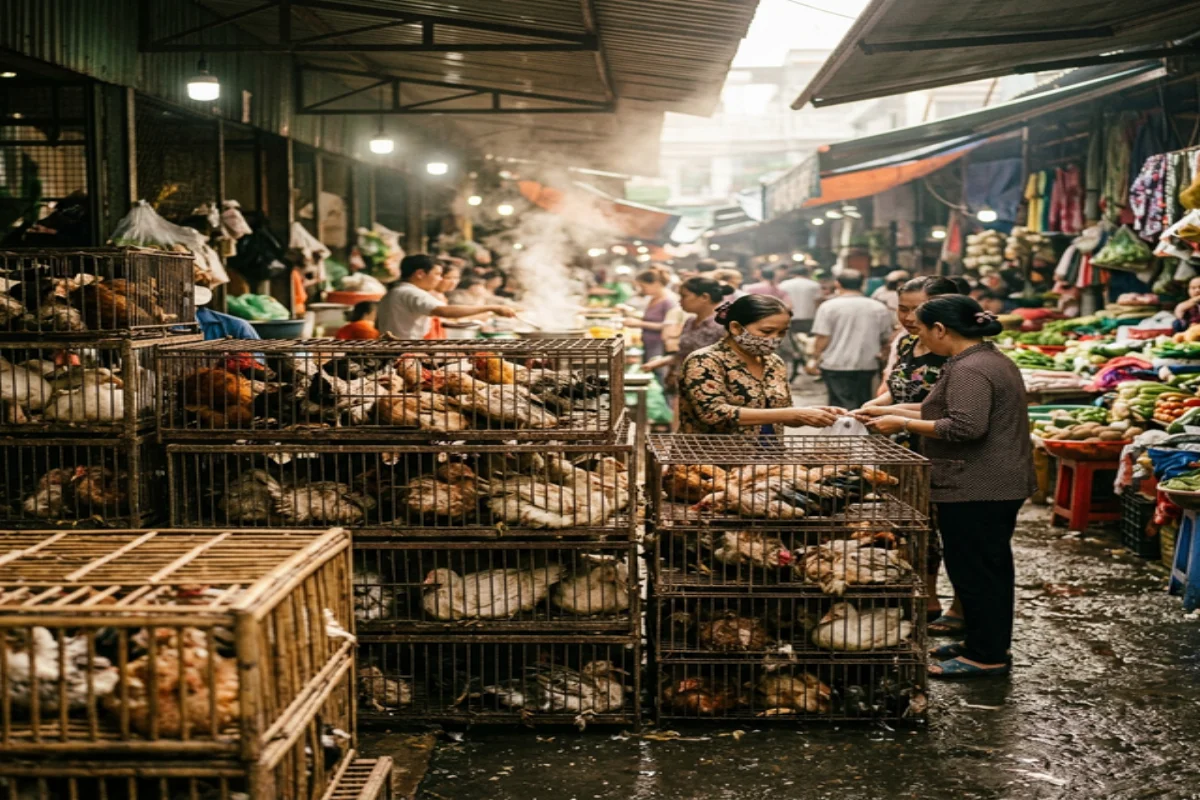
Live animal markets (wet markets) in Asia, Africa, and South America are environments that virologists consider true "viral mixing cauldrons." In these markets, species that would never coexist in nature — bats, pangolins, civets, snakes, domestic and wild poultry — are confined in cages stacked on top of each other, in precarious hygiene conditions, under extreme stress, and in proximity to hundreds of daily human buyers. These conditions are ideal for what scientists call "viral reassortment" — when two different viruses infect the same animal and exchange genetic material, potentially creating a new strain capable of infecting humans with lethal efficiency.
The Huanan market in Wuhan, China, where the first COVID-19 cases were detected in December 2019, is the most notorious example. Environmental samples collected from the market revealed SARS-CoV-2 RNA on surfaces near stalls selling live wild animals. Although the exact origin of SARS-CoV-2 remains debated — between the natural spillover hypothesis and the laboratory leak hypothesis — the scientific consensus is that live animal markets represent an unacceptable pandemic risk. After the pandemic, China temporarily closed wild animal markets, but many reopened under minimal regulation, and the illegal wildlife trade continues to flourish in dozens of countries worldwide.
Climate Change: Expanding Risk Zones
Climate change is dramatically expanding the geographic zones where vector-borne zoonotic diseases (such as those transmitted by mosquitoes and ticks) can permanently establish themselves. Dengue, once restricted to tropical regions, now reaches southern Europe (with autochthonous transmission recorded in France, Spain, and Italy), parts of the United States, and subtropical regions that a decade ago were considered disease-free. Malaria is advancing to higher altitudes in African mountains, threatening populations that have never had exposure to the parasite and therefore lack partial immunity. West Nile fever has spread throughout North America and Europe, with human cases recorded in more than 40 countries. Lyme disease, transmitted by ticks, is expanding to increasingly higher latitudes as winters become shorter and milder.
Rising global average temperatures not only expand the habitat of transmitting vectors but also alter the migration patterns of wild birds — the largest natural reservoirs of highly pathogenic influenza viruses. With altered migratory routes, virus-carrying birds are coming into contact with domestic poultry populations in regions that historically were not affected, creating new opportunities for the genetic reassortment that could generate pandemic strains.
The Current Threat: Avian Flu H5N1 — The Virus That Never Sleeps
Why Scientists Are Worried in 2026

In January 2026, Japan confirmed massive outbreaks of H5N1 avian influenza in 47 poultry farms across 23 prefectures, resulting in the culling of more than 17 million birds — a record for the country and an economic devastation for the Japanese poultry industry. But what truly alarmed the scientific community was not the outbreaks in birds — it was the detection of H5N1 in mammals across multiple continents simultaneously. In the United States, the virus was detected in domestic cats, seals, sea lions, and most alarmingly and without precedent, in dairy cattle in more than 10 American states, with confirmed transmission to farm workers who had direct contact with contaminated milk.
The history of H5N1 is long and terrifying. The virus was first identified in humans in Hong Kong in 1997, when it infected 18 people and killed 6 — a case fatality rate of 33%. Since then, the virus has evolved into diverse lineages, continuously circulating in wild and domestic bird populations across Asia, Europe, and Africa. Each year, H5N1 produces massive avian outbreaks, and the scientific community obsessively monitors its mutations, knowing that just a few specific genetic changes could transform it into the most devastating pandemic threat humanity has ever faced.
H5N1 is particularly concerning for several specific reasons that virologists consider alarming:
- Extremely high fatality rate: In infected humans, H5N1's historical mortality rate is approximately 52% — compared to less than 1% for SARS-CoV-2. If it acquires the ability for efficient human-to-human transmission, H5N1 would be catastrophically more deadly than COVID-19, potentially killing hundreds of millions of people within months
- Ongoing mutations: Genomic analyses revealed that H5N1 strains circulating in American cattle have already acquired mutations in the PB2 gene (specifically the E627K mutation) that facilitate replication in mammalian cells at 37°C — human body temperature. This specific mutation has been identified as one of the "pandemic markers" by the world's leading virology laboratories
- Mammal-to-mammal transmission: The detection of the virus in dairy cattle and its subsequent transmission to humans demonstrates that H5N1 is progressively adapting to mammalian hosts, a crucial step on the pathway to sustained human-to-human transmission. Each mammalian infection is an opportunity for the virus to acquire further adaptations
- Absence of immunity: No living person has significant natural immunity to H5N1 — a scenario of universal susceptibility similar to what preceded the 1918 Spanish Flu, which killed between 50 and 100 million people in a world of only 1.8 billion inhabitants
What Are We Doing to Prepare?
The One Health Approach
The international scientific community has adopted the concept of "One Health" — the understanding that human, animal, and environmental health are profoundly interconnected and inseparable. Instead of treating zoonotic outbreaks as isolated public health problems, the One Health approach seeks to proactively monitor animal virus reservoirs, detect dangerous mutations before they cause outbreaks in humans, and address the root causes driving the increase in zoonoses — such as deforestation, wildlife trade, and intensive animal farming.
In practice, the One Health approach means that veterinarians, physicians, ecologists, epidemiologists, and biologists work together in multidisciplinary teams to monitor the interface between wildlife, domestic animals, and human populations. For example, when bats in a recently deforested region present new viruses, One Health teams collect samples, sequence the viral genome, assess the spillover risk, and alert local health authorities — all before any human is infected. In 2026, more than 70 countries have implemented national One Health programs, and the WHO, FAO, and WOAH (World Organisation for Animal Health) coordinate a joint global initiative with an annual budget of $800 million.
Global Genomic Surveillance

Since COVID-19, global viral genomic sequencing capacity has expanded dramatically and radically transformed our capacity for early detection. Networks such as GISAID (Global Initiative on Sharing All Influenza Data) monitor in real time the genetic evolution of influenza viruses, coronaviruses, and other potentially pandemic pathogens. In 2026, more than 180 countries participate in WHO-coordinated genomic surveillance programs, sharing viral sequences within hours of detecting a new outbreak.
Platform Vaccines: Ready in 100 Days
One of the most valuable lessons from COVID-19 was the demonstration that mRNA technology can produce vaccines in record time. The "100 Days Mission" — a global initiative led by CEPI (Coalition for Epidemic Preparedness Innovations) — seeks to develop the capability to have safe and effective vaccines ready for mass distribution within just 100 days of identifying a new pandemic pathogen. In 2026, candidate vaccines against H5N1 based on mRNA have already been developed by Moderna and BioNTech and are in advanced stages of clinical trials, ready to be manufactured at industrial scale if necessary.
The WHO Pandemic Treaty
Since 2022, WHO member states have been negotiating an international Pandemic Treaty — a binding agreement that would establish global rules for sharing viral samples, equitable distribution of vaccines, strengthening health systems, and funding epidemiological surveillance. In March 2026, negotiations remain complex and politically sensitive, with tensions between developed and developing countries over vaccine intellectual property and access to antiviral medications.
How to Prevent the Next Pandemic
Preventing future pandemics requires coordinated actions on multiple fronts simultaneously. Scientists have identified the following fundamental strategic priorities:
- Stop tropical deforestation: Every hectare of protected forest is a physical barrier between wild viral reservoirs and vulnerable human populations. Investment in forest conservation is orders of magnitude cheaper than the cost of fighting a pandemic
- Regulate live animal markets: Implementation of rigorous sanitary standards, mandatory species separation, complete supply chain traceability, and permanent veterinary surveillance in all live animal markets
- Invest in genomic surveillance: Expansion of real-time viral sequencing networks, especially in tropical regions with high biodiversity where spillover risk is greatest, with focus on the interface between wildlife and animal farming
- Reduce intensive animal farming: Industrial farms with millions of animals confined in minimal spaces are ideal incubators for the evolution of highly pathogenic viruses. Transitioning to more sustainable farming systems with lower animal density is a public health priority
- Fund broad-spectrum antiviral research: Development of medications capable of treating multiple viral families simultaneously, providing a line of defense even against completely unknown viruses
- Strengthen health systems in developing countries: The majority of spillover events occur in tropical regions of countries with precarious health infrastructure. Investing in hospitals, diagnostic laboratories, and training healthcare professionals in these regions is the first line of defense against emerging pandemics
- Educate rural populations: Community education programs about the risks of contact with wildlife, consumption of bushmeat, and handling of dead animals can significantly reduce spillover risk in forest frontier communities
Conclusion: Nature Collects Its Interest
The history of pandemics teaches a consistent and undeniable lesson: the more we interfere with natural ecosystems, the more we expose ourselves to pathogens to which we have no immunity. COVID-19 cost the world more than 7 million officially confirmed lives (real estimates based on excess mortality exceed 20 million), trillions of dollars in global economic losses, and years of human development lost in education, mental health, and poverty reduction. Health systems collapsed under the weight of unprecedented demand, supply chains were disrupted on a global scale never before seen, and hundreds of millions were pushed into food insecurity and extreme poverty. And the next pandemic could be significantly worse and more devastating — especially if it involves a pathogen combining the transmissibility of SARS-CoV-2 with the lethality of H5N1.
But we are no longer defenseless. The revolution in genomics, in mRNA vaccine technology, in digital epidemiological surveillance powered by artificial intelligence, and in international scientific cooperation gives us tools unprecedented in all of human history to detect, respond to, and contain future pandemic threats before they spiral out of control. The fundamental question is whether we will have the political will, the financial discipline, and the international coordination necessary to consistently invest in prevention — or whether we will wait, once again, for disaster to arrive before reacting belatedly, paying an infinitely greater price in lives, livelihoods, and human progress.
As Dr. Tedros Adhanom, WHO Director-General, has said: "The COVID-19 pandemic was not the Big One. It was a rehearsal. The next pathogen could be more transmissible, more lethal, and find a world that chose to forget the lessons it learned through so much suffering."
Sources and References
- WHO — Zoonoses — Zoonotic disease data
- CDC — One Health — One Health approach
- Nature — Deforestation and disease — Deforestation and emerging diseases
- CEPI — 100 Days Mission — Vaccines in 100 days
- GISAID — Global viral genomic surveillance
- Science — H5N1 evolution — Avian flu evolution


