
Tsunamis: The 10 Most Devastating in History — And Why the Next One Could Be Even Worse
Date: March 7, 2026
Reading time: 28 minutes
Emoji: 🌊
On December 26, 2004, the ocean receded hundreds of meters from Thailand's beaches. Tourists took photos of the strange phenomenon. Minutes later, a 30-meter wall of water swept everything — and everyone — in its path. More than 227,000 people died that day, across 14 different countries, making the Indian Ocean tsunami the deadliest natural disaster of the 21st century. But that was just one of many times the sea transformed into an apocalyptic monster. This article dives into the most devastating tsunamis in human history, the science that explains them, and why experts warn that the next great tsunami could be the most destructive ever recorded.
What Is a Tsunami? The Science of Destruction
The word "tsunami" comes from the Japanese 津波 — literally "harbor wave." Unlike common waves caused by wind, tsunamis are generated by massive displacements of the ocean floor, usually caused by submarine earthquakes, volcanic eruptions, or underwater landslides.
The Physics of Killer Waves
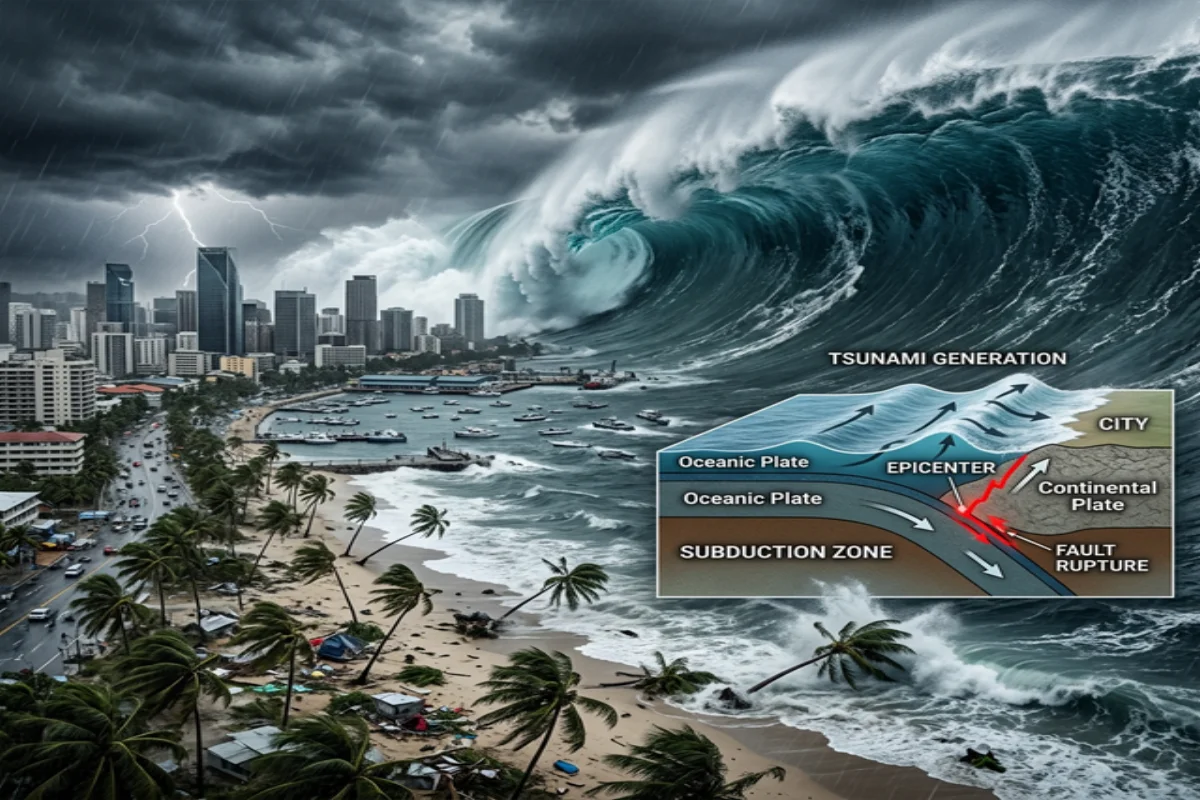
What makes tsunamis so deadly is the combination of speed, energy, and unpredictable behavior:
| Characteristic | Deep Sea | Near Coast |
|---|---|---|
| Speed | 700-900 km/h (airplane speed) | 30-50 km/h |
| Wave height | 30 cm to 1 meter (imperceptible) | 10 to 40+ meters |
| Wavelength | 100-200 km | Compresses enormously |
| Energy | Distributed throughout the water column | Concentrated at the surface |
The key to understanding the devastation is this: a tsunami is not a "wave" in the conventional sense of the term. It is the entire ocean itself advancing over land with colossal and relentless force. When the water reaches the coast, it's not just the crest — it's kilometers of water pushing forward, carrying everything in its path. A tsunami wave of just 1 meter in height can already knock down an adult and sweep away cars. At 10 meters, it destroys concrete buildings.
Types of Events That Generate Tsunamis
There are four main mechanisms that can generate tsunamis:
- Tectonic earthquakes (90% of cases): When tectonic plates shift abruptly on the ocean floor, displacing billions of tonnes of water
- Submarine volcanic eruptions: Like the eruption of Krakatoa in 1883 or Hunga Tonga in 2022
- Submarine landslides: Large masses of sediment sliding on the seafloor
- Asteroid impacts: Theoretically possible but not recorded in human history
The 10 Most Devastating Tsunamis in History
1. Indian Ocean Tsunami — December 26, 2004 (227,898 dead)
The deadliest natural disaster of the 21st century came without any warning. At 7:58 AM, a magnitude 9.1 earthquake — the third most powerful ever recorded — ruptured a 1,300 km fault on the Indian Ocean floor, 30 km off the northern coast of Sumatra.
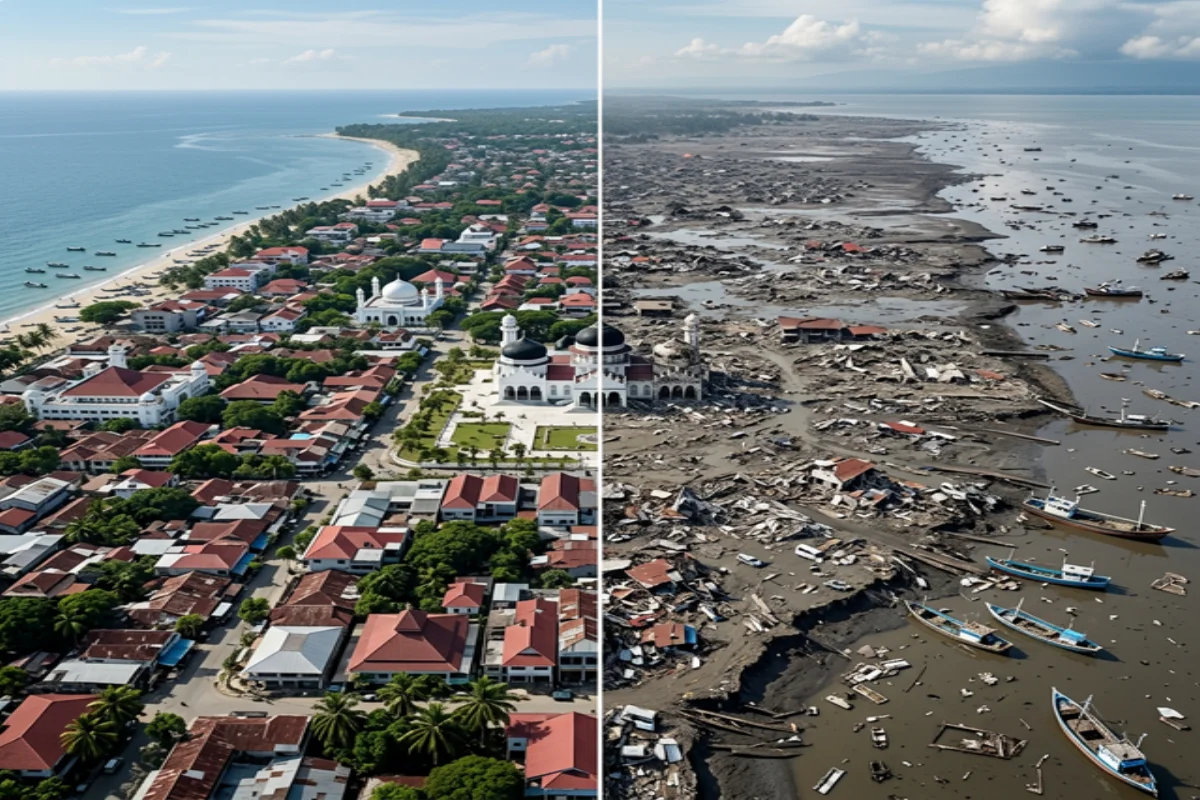
The numbers are terrifying:
- Indonesia: 167,736 dead — waves up to 30 meters hit Banda Aceh within 15 minutes
- Sri Lanka: 35,322 dead — the tsunami crossed the ocean in 2 hours
- India: 16,269 dead — waves devastated Tamil Nadu and the Andaman Islands
- Thailand: 8,345 dead — tourists from 37 nationalities among the victims
- Others: Somalia, Maldives, Malaysia, Myanmar, Tanzania, Seychelles, Bangladesh... 14 countries in total
The tsunami traveled to the east coast of Africa, more than 8,000 km from the epicenter, still killing 289 people in Somalia. The energy released by the earthquake equaled 23,000 Hiroshima bombs. The entire planet vibrated — seismographs recorded the waves on every continent.
What made this tsunami so deadly was not just its magnitude — it was the complete absence of a warning system. While the Pacific Ocean had the Pacific Tsunami Warning Center since 1949, the Indian Ocean had no system whatsoever. Result: thousands died hours after the earthquake, when there was more than enough time for evacuation.
2. Tōhoku Tsunami, Japan — March 11, 2011 (19,759 dead)
Japan is the world's most prepared nation for tsunamis. It had 10-meter concrete seawalls along the coast, regular evacuation drills, and the planet's most sophisticated warning system. The country had spent decades and billions of dollars building what many considered an impenetrable defense against the sea. None of it was enough.
The magnitude 9.0 earthquake generated waves exceeding 40 meters at some points — four times the height of the barriers designed to protect coastal cities. The city of Minamisanriku was simply wiped off the map, with over 800 of its 17,000 residents killed in minutes. But the horror didn't stop with the waves: the tsunami struck the Fukushima Daiichi nuclear power plant, overwhelming backup generators and cooling systems, causing the worst nuclear catastrophe since Chernobyl.
Lasting legacy:
- 470,000 people evacuated from their homes, many never to return
- Three nuclear reactors in meltdown (level 7 — maximum on the INES scale)
- US$ 235 billion in damages — the most expensive natural disaster in history
- Radioactive contamination still affecting the region in 2026, with contaminated water being released into the Pacific
- Japan shut down all 54 nuclear plants for years, fundamentally shifting the nation's energy policy
3. Lisbon Earthquake and Tsunami — November 1, 1755 (60,000-100,000 dead)
On All Saints' Day, when Lisbon's magnificent churches were packed with devout worshippers, an earthquake estimated between 8.5 and 9.0 destroyed the Portuguese capital in a matter of minutes. The ornate cathedrals and palaces that had made Lisbon one of Europe's wealthiest cities collapsed onto their congregations, killing thousands instantly. But the earthquake's destruction was just the beginning — 40 minutes later, three giant waves up to 20 meters high invaded central Lisbon, sweeping away thousands who had fled to the open areas of the port seeking safety.
To complete the apocalypse, fires spread through the destroyed city, burning for five days and consuming what little remained standing. The disaster destroyed 85% of Lisbon's buildings, along with priceless libraries, art collections, and historical archives. It profoundly shocked European philosophical thought — Voltaire wrote "Candide" partly in response to the disaster, questioning the idea that "we live in the best of all possible worlds." The Marquis of Pombal's reconstruction efforts essentially created modern urban planning and earthquake engineering.
4. Krakatoa Tsunamis — August 27, 1883 (36,000 dead)
The eruption of the Krakatoa volcano in the Sunda Strait, Indonesia, was one of the most violent ever recorded. The final explosion was heard 4,800 km away — in Alice Springs, Australia — and is considered the loudest sound in human history. The blast had a force equivalent to 200 megatons of TNT, about 13,000 times the atomic bomb dropped on Hiroshima. Barometric pressure waves circled the Earth three and a half times.
The eruption generated waves up to 30 meters that devastated more than 300 villages on the coasts of Java and Sumatra. The island of Krakatoa was destroyed — two-thirds of its landmass vanished beneath the waves. Volcanic dust ejected into the atmosphere caused spectacular blood-red sunsets around the world for months, inspiring artists including Edvard Munch, whose painting "The Scream" may have been influenced by those otherworldly crimson skies. Global temperatures dropped 1.2°C the following year due to the volcanic aerosols blocking sunlight.
5. Messina Tsunami, Italy — December 28, 1908 (80,000-200,000 dead)
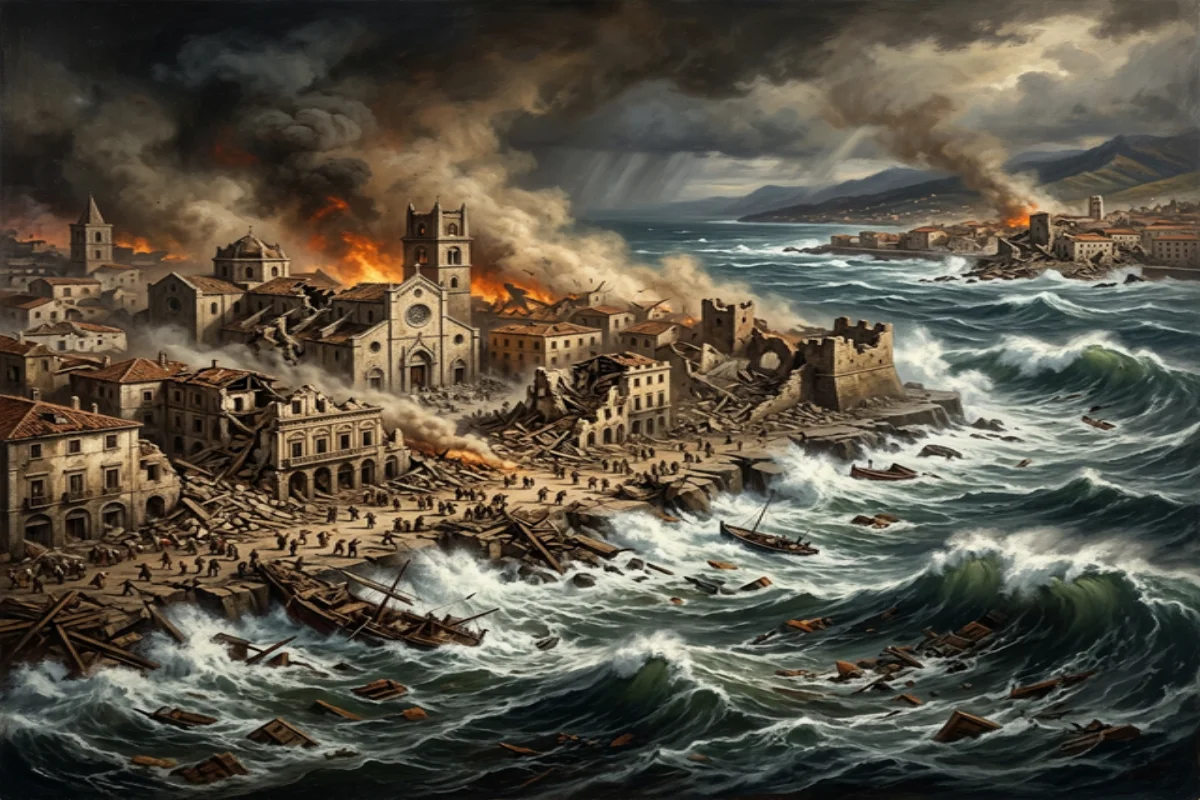
A magnitude 7.1 earthquake generated 12-meter waves that devastated the cities of Messina and Reggio Calabria in the Strait of Messina. The combination of earthquake and tsunami destroyed 90% of Messina's buildings. Death toll estimates vary enormously — from 80,000 to 200,000 — because the city's complete records were destroyed along with it. It remains one of the worst natural disasters in European history.
6. Arica Tsunami — August 13, 1868 (25,000 dead)
A massive magnitude 9.0 earthquake on the coast of Peru (now Chile) generated waves up to 21 meters that devastated the South American coast and traveled across the Pacific. The city of Arica was completely destroyed. The waves reached Hawaii, Japan, Australia, and New Zealand. An American warship, the USS Wateree, was carried 400 meters inland and deposited in the desert, where it remained as a monument for decades.
7. Sanriku Tsunami, Japan — June 15, 1896 (22,000 dead)
Known as the Meiji-Sanriku tsunami, this event is notable because the earthquake that generated it (magnitude 7.2) was relatively weak and barely felt by the coastal population. But the waves reached up to 38 meters — among the highest ever recorded. Entire fishing villages were completely eliminated. The disaster led Japan to begin its first systematic research on tsunami prevention.
8. Papua New Guinea Tsunami — July 17, 1998 (2,200 dead)
A magnitude 7.0 earthquake triggered a submarine landslide that generated 15-meter waves, devastating three villages on the north coast of Papua New Guinea. Despite the relatively lower death toll compared to other major tsunamis, this event was crucial for science: it demonstrated that tsunamis generated by landslides can be as devastating as those generated by earthquakes, fundamentally changing risk models.
9. Chile Tsunami — May 22, 1960 (2,231 dead)
The largest earthquake ever recorded — magnitude 9.5 — generated a tsunami that devastated the Chilean coast and traveled across the entire Pacific Ocean. Ten-meter waves hit Hawaii 15 hours later, killing 61 people in Hilo. The tsunami continued to Japan, where it killed 142 people more than 17,000 km from the epicenter, and reached the Philippines, New Zealand, and Alaska. The event conclusively and tragically demonstrated that a tsunami can cross the world's largest ocean and still be extraordinarily lethal on the other side — no Pacific coastline is truly safe when a mega-earthquake occurs.
10. Palu Tsunami, Indonesia — September 28, 2018 (4,340 dead)
A magnitude 7.5 earthquake generated waves up to 11 meters in Palu Bay, Sulawesi. The event was particularly tragic because the tsunami warning was issued — and then canceled just 34 minutes after the earthquake, before the waves reached the coast. Beyond the tsunami, the earthquake caused soil liquefaction in several neighborhoods, where houses simply sank into the ground. The disaster exposed serious flaws in Indonesia's warning system.
Why the Next Great Tsunami Could Be the Worst
Coastal Megacities at Risk
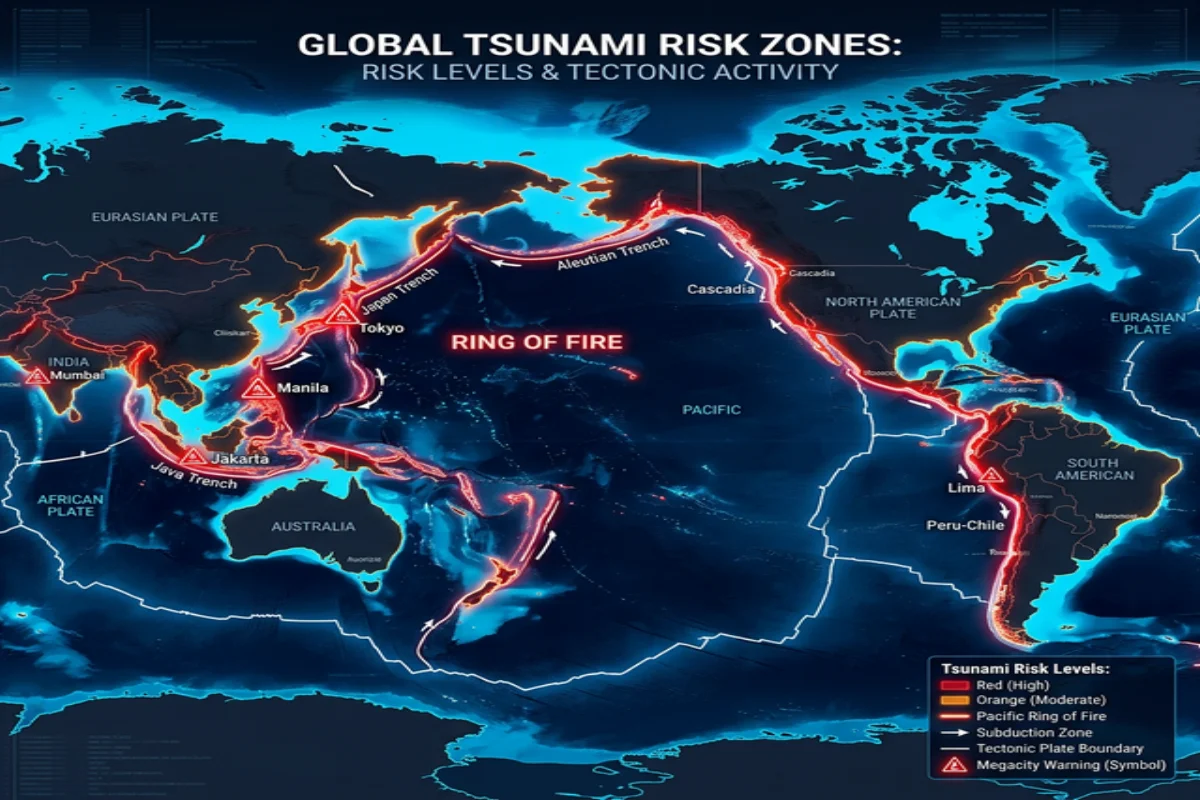
In 2026, more than 1 billion people live in coastal zones vulnerable to tsunamis. Megacities like Tokyo, Manila, Jakarta, Mumbai, and Lima are all in active subduction zones. The accelerated urbanization of recent decades has placed unprecedented human concentrations in risk areas:
| City | Country | Population at Risk | Last Major Threat |
|---|---|---|---|
| Tokyo-Yokohama | Japan | 38 million | 2011 (Tōhoku) |
| Manila | Philippines | 28 million | Manila Trench |
| Jakarta | Indonesia | 35 million | 2018 (Sunda Strait) |
| Mumbai | India | 21 million | 2004 (indirectly) |
| Lima | Peru | 11 million | 2007 (magnitude 8.0) |
The Cascade Effect of Global Warming
Global warming is amplifying tsunami risk in ways few understand:
- Sea level rise: Every centimeter of rise means tsunami waves penetrate further inland. The projected 30-60 cm rise by 2100 could double the area affected by tsunamis in many regions.
- Glacier melting: Glacier retreat can destabilize mountain slopes, causing massive landslides in fjords — as nearly happened in Karrat Fjord, Greenland, in 2017, generating a 90-meter tsunami.
- Ice shelf collapse: Antarctic and Greenland melting could generate tsunamis if large ice masses fall into the ocean.
- Subsea permafrost methane: Warming can destabilize methane hydrates on the ocean floor, causing submarine landslides.
The Most Feared Scenario: Atlantic Mega-Tsunami
The Cumbre Vieja volcano on La Palma island (Canary Islands) is considered by some scientists capable of generating an Atlantic mega-tsunami. If an entire flank of the volcano — estimated at 500 cubic kilometers of rock — collapsed into the ocean, 25-meter waves could hit the US East Coast within 6 to 8 hours. Coastal cities from Boston to Miami would face catastrophic damage. The 2021 eruption reignited concerns, though most scientists consider the scenario unlikely in the short term. However, the geological evidence suggests that such flank collapses have occurred repeatedly throughout the Canary Islands' volcanic history.
Warning Systems: The Technology That Saves Lives
After the 2004 disaster, the world invested heavily in tsunami warning systems:
The Current Global System
- Pacific Tsunami Warning Center (PTWC): Has monitored the Pacific since 1949, significantly expanded after 2004
- Indian Ocean Tsunami Warning System (IOTWS): Created in 2006, with DART buoys spread across the Indian Ocean
- DART Buoys (Deep-ocean Assessment and Reporting of Tsunamis): Sensors on the ocean floor that detect pressure changes caused by tsunami waves
- UNESCO/IOC: Coordinates 4 regional systems covering all oceans
- Warning signals: Coastal sirens, cell phone alerts, emergency radio and TV
Dangerous Limitations
Despite advances, critical gaps remain in 2026:
- Local tsunamis: For near-coast earthquakes, waves can arrive in less than 10 minutes — before any warning is issued
- Developing countries: Many coastal nations in Africa and Southeast Asia still lack adequate warning infrastructure
- Alert fatigue: In regions with frequent warnings, populations may ignore alerts, as occurred in Palu in 2018
- Premature cancellations: The premature cancellation of the Palu warning cost thousands of lives
The New Frontier: AI and Real-Time Detection
In 2026, artificial intelligence is being applied to improve tsunami prediction:
- Google DeepMind AI models: Can predict tsunami propagation 1,000 times faster than traditional models
- Submarine acoustic sensors: Detect tsunami waves through changes in underwater sound, offering faster alerts
- GNSS satellites: Real-time GPS measurements of ocean floor deformation
- Neural networks: Analyze seismic data to distinguish tsunamigenic from non-tsunamigenic earthquakes in seconds
How to Survive a Tsunami: Survival Guide
If you live in or travel to coastal regions, knowing these signs could save your life:
Natural Warning Signs
- Unusual ocean retreat: If the ocean recedes hundreds of meters, RUN to high ground
- Strong earthquake near the coast: If you feel an earthquake lasting more than 20 seconds, evacuate the coastal zone immediately
- Strange ocean noise: A roaring sound from the sea may precede the wave
- Animal behavior: Animals frequently flee before tsunamis — observe them
Evacuation Rules
- Up or in: Climb at least 30 meters above sea level or go to the third floor or higher of a resistant concrete building
- Don't go back: The first wave isn't always the largest — subsequent waves can be bigger and arrive hours later
- Don't stay to film: The priority is survival, not documentation
- Know the routes: Before you need them, identify evacuation routes and high ground in your area
Lessons the Sea Has Taught Us
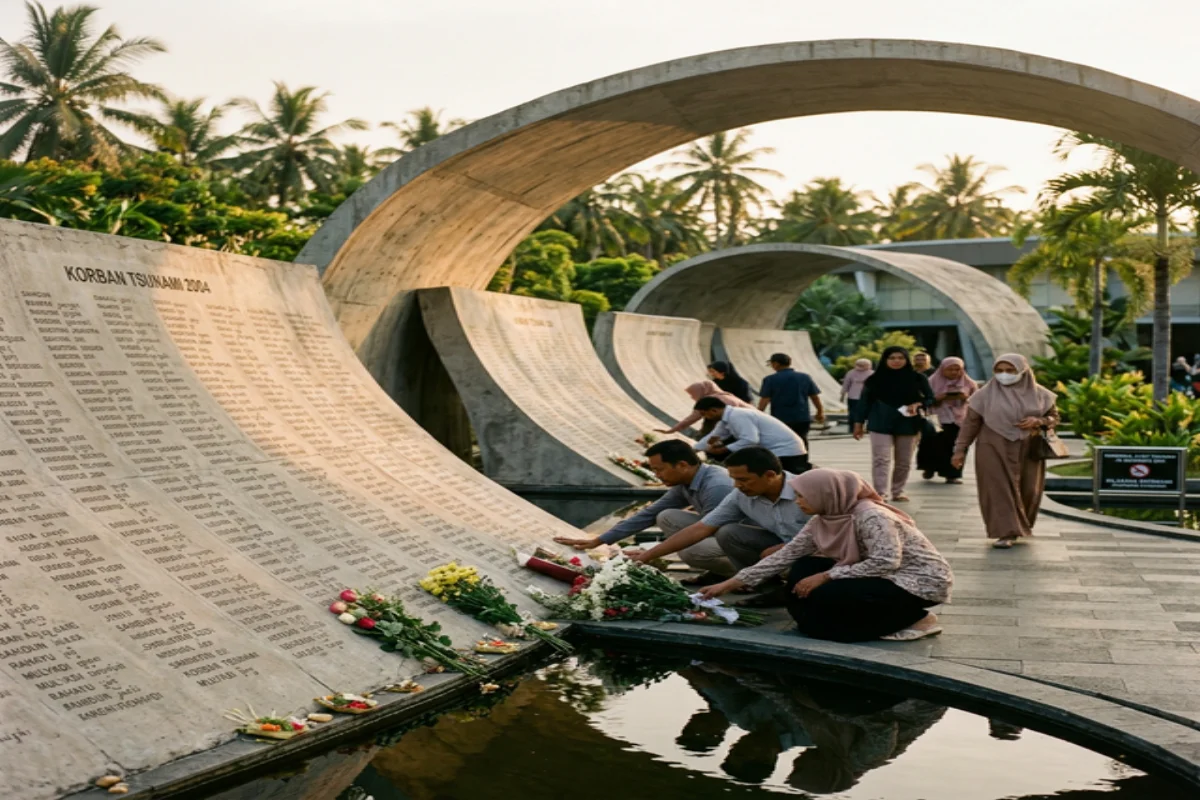
Each tsunami taught humanity something:
- 1755 (Lisbon): Birth of modern seismology and anti-seismic engineering
- 1896 (Sanriku): First systematic prevention research in Japan
- 1960 (Chile): Creation of Pacific warning systems
- 2004 (Indian Ocean): Warning system extended to all oceans
- 2011 (Japan): Global reassessment of coastal nuclear risks and barrier redesign
- 2018 (Palu): Reformulation of warning cancellation protocols
The most important lesson of all is simple: the ocean does not forgive complacency. Tsunamis are, by nature, rare events — and that rarity is precisely what makes them so dangerous. Communities forget, barriers age, warning systems are underfunded. And then the sea rises again.
On a planet where global warming is raising sea levels, destabilizing glaciers, and concentrating ever-larger populations in coastal zones, the question is not whether there will be another great tsunami — it's when. And whether we'll be prepared when it arrives.
Sources and References
- NOAA — National Geophysical Data Center — Historical tsunami database
- USGS — Earthquake Hazards Program — Global seismic monitoring
- UNESCO/IOC — Tsunami Warning Systems — International warning coordination
- Pacific Tsunami Warning Center — Pacific warning center
- Geoscience Australia — 2004 Indian Ocean tsunami data
- Japan Meteorological Agency — Japanese warning system


