
100 Robotaxis Stop Dead in the Middle of Traffic in Wuhan: The Day AI Froze an Entire City
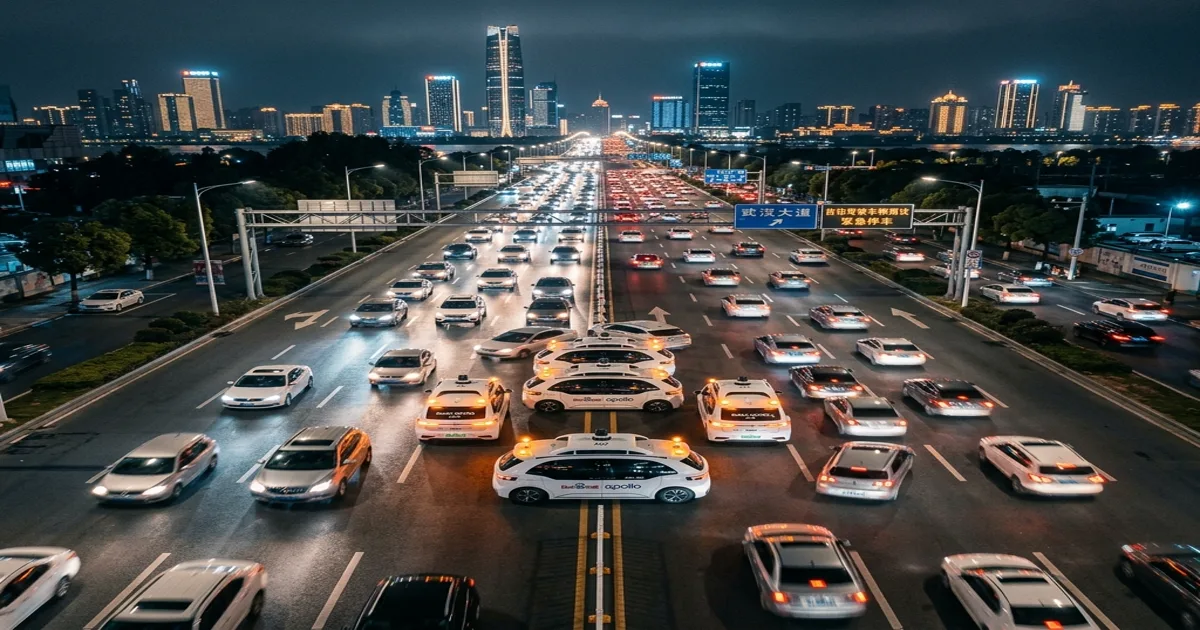
On the morning of March 28, 2026, one of the most disturbing scenes in the history of autonomous vehicles unfolded on the streets of Wuhan, China. More than 100 Baidu Apollo Go robotaxis — vehicles without human drivers, operating entirely by artificial intelligence — stopped simultaneously in the middle of some of the city's busiest avenues, blocking traffic, trapping passengers inside and generating a traffic chaos that took more than 3 hours to be resolved.
The vehicles, white sedans equipped with cameras, LiDAR sensors and radars that make up the Baidu Apollo Go fleet, simply froze. No warning. No prior notice. No emergency maneuver. They stopped as if someone had hit a cosmic "pause" button.
What Happened: The Chronology of Failure
| Time (CST) | Event |
|---|---|
| 08:42 | First reports of stopped robotaxis on Luoyu Road |
| 08:45 | Traffic monitoring system detects anomaly in 47 vehicles |
| 08:50 | More than 100 vehicles confirmed stopped simultaneously |
| 08:55 | First passengers begin calling emergency services |
| 09:10 | Baidu releases initial statement acknowledging "system instability" |
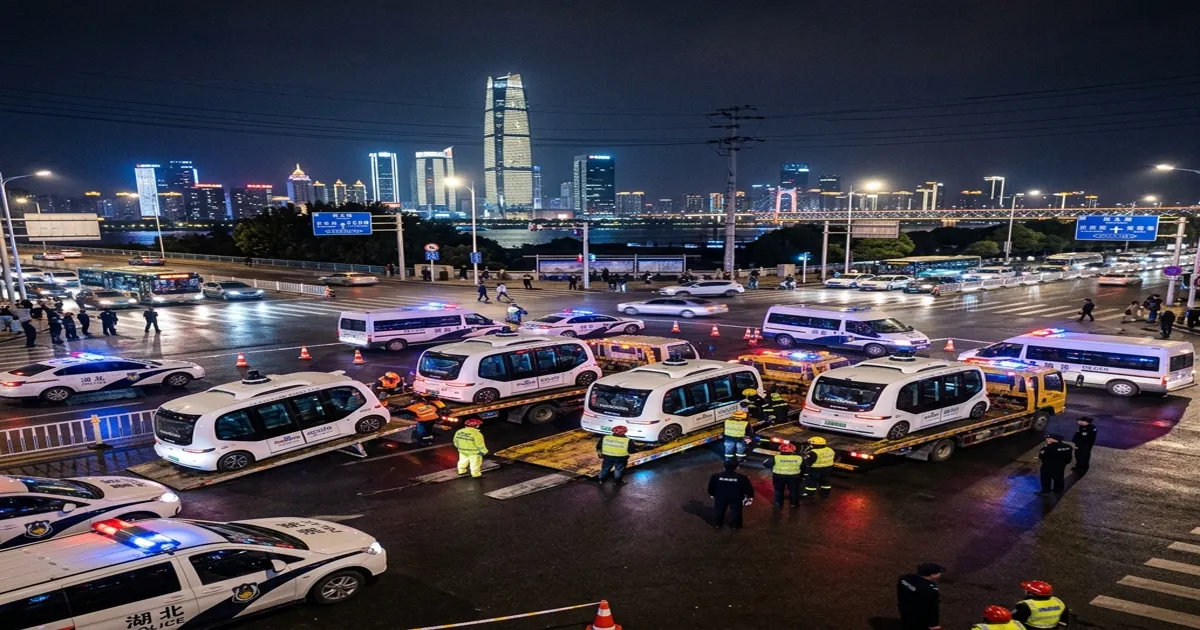
| 09:30 | Municipal traffic crews begin manually towing vehicles |
| 10:15 | Baidu sends recovery teams with physical override keys |
| 11:47 | Last vehicle removed from public roads |
The incident was not an isolated event on a quiet street. It occurred during morning rush hour, on some of Wuhan's most important avenues, including Luoyu Road, Zhongnan Road and Jianshe Avenue — arteries that carry hundreds of thousands of vehicles daily.
Trapped Passengers: 2 Hours Inside a Motionless Car
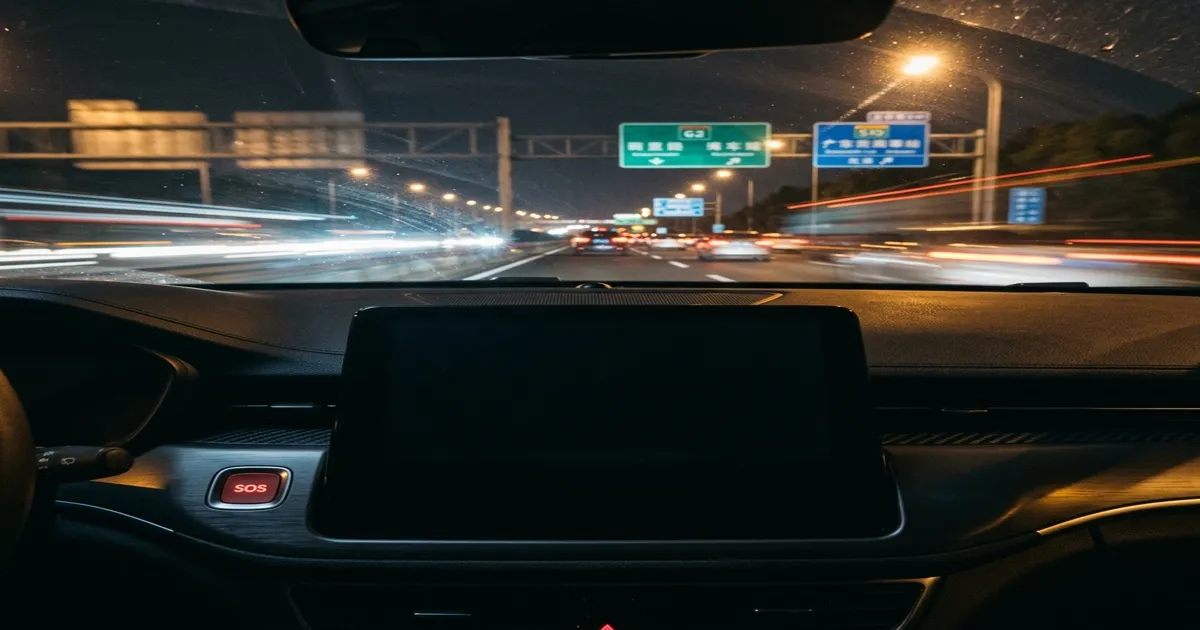
The most terrifying aspect of the incident wasn't the traffic chaos — it was the situation of the passengers trapped inside the vehicles. When Baidu's robotaxis stop due to a system failure, the doors do not automatically unlock. This means that passengers found themselves trapped inside motionless vehicles, in the middle of traffic, with no human driver to help.
Reports shared on Weibo (China's social media platform) showed video of passengers desperately banging on the windows:
Passenger Testimonies
- Liu Wei, 34, office worker: "I was on my way to work. The car stopped in the middle of the avenue and simply... nothing. No message on the screen, no voice, nothing. I was trapped for 47 minutes until someone from Baidu came to open the door from outside."
- Zhang Mei, 28, teacher: "The screen said 'System Restarting'. It said that for an hour and twenty minutes. I started running out of breath because I didn't know if the air conditioning would stop too."
- Chen Hong, 52, merchant: "I called 119 (emergency) and they told me they were already receiving dozens of calls about the same problem. Think about that: dozens of people trapped inside cars on the street."
Baidu claims the emergency door release mechanism should allow passengers to unlock from the inside, but several passengers reported the mechanism did not work or was "too difficult to find" in a panic situation.
The Cause: What Went Wrong
Baidu released an initial statement attributing the failure to "instability in the cloud computing infrastructure that supports the autonomous navigation system." In other words: the vehicles' remote server suffered a failure, and without the server, the cars simply didn't know what to do.
The Centralized Architecture Problem
Baidu's Apollo Go robotaxis operate on a hybrid architecture: part of the driving intelligence runs locally in the vehicle (perception, immediate obstacles), but the strategic route planning and complex traffic decisions are processed in the cloud. When the cloud server fails, the vehicle enters "safe mode" — which, in this case, meant stopping completely.
This is the fundamental difference between a human driver and an AI: when a human driver's GPS fails, they continue driving using common sense, visual memory and traffic signs. When a robotaxi's "brain" fails, the car becomes a 1.5-ton steel paperweight in the middle of the road.
Cascading Failure
Investigation suggests the failure was cascading: a problem in one of Baidu's data centers triggered a failover to the backup server, which was already operating at near capacity due to morning rush hour traffic volume. With the backup overloaded, both systems crashed simultaneously — taking every connected vehicle down at the same time.
Wuhan: The World Capital of Robotaxis
To understand the scale of this incident, it's necessary to understand Wuhan's position in the autonomous vehicle world. The city, known to most Westerners as the epicenter of the COVID-19 pandemic, reinvented itself as China's Silicon Valley for autonomous vehicles.
Numbers That Impress
| Indicator | Value |
|---|---|
| Operational Baidu Apollo Go vehicles in Wuhan | 500+ |
| Daily trips (2025) | 5,000+ |
| Accumulated trips since 2022 | 4+ million |
| Operational area | 3,000 km² |
| Passengers served | 1+ million |
Wuhan is the first city in the world to have a fully commercial robotaxi operation without a safety driver present in the vehicle. Since 2023, Apollo Go vehicles have operated completely without a human driver, with only remote supervision from a monitoring center.
Global Implications: Who Regulates AI on the Streets?
The Wuhan incident raises fundamental questions about the regulation of autonomous vehicles worldwide.
China vs. USA: Two Approaches
| Aspect | China | United States |
|---|---|---|
| Regulation | Centralized, government-driven | State-by-state, fragmented |
| Testing speed | Faster, less red tape | Slower, more bureaucratic |
| Scale | Wuhan already has 500+ robotaxis | San Francisco has ~300 (Waymo + Cruise) |
| Public accountability | Limited, controlled media | Open, constant media scrutiny |
| Incident response | Quick but opaque | Slow but transparent |
The regulatory question is clear: if an AI car injures someone, who is responsible? The manufacturer? The software programmer? The city that authorized the service? There is no universal answer — and the Wuhan incident makes this question more urgent than ever.
The Reaction of Competitors
The incident was closely watched by direct competitors:
Waymo (Google/Alphabet) — Released a statement saying its systems operate on a "decentralized architecture" where the vehicle can drive independently for extended periods without cloud connectivity. However, Waymo has had its own incidents in San Francisco, including vehicles blocking fire trucks and entering construction zones.
Tesla — Elon Musk used the incident to promote Tesla's Full Self-Driving approach, which operates entirely on local processing. However, Tesla's system is classified as Level 2 (driver assistance), while Baidu operates at Level 4 (full automation in restricted areas).
What This Means for the Future
The Wuhan incident will likely accelerate three trends:
- Redundant architecture: Regulators will require that autonomous vehicles can operate safely for at least 30 minutes without cloud connectivity
- Emergency door release standards: International standards for emergency passenger egress will be created or strengthened
- Incident transparency: Governments will demand real-time reporting of autonomous vehicle failures, similar to aviation incident reporting
The autonomous vehicle industry is at a critical inflection point. Baidu's failure in Wuhan doesn't mean the technology doesn't work — it means the technology needs more robust fail-safes, better redundancy, and much more regulatory oversight before it can scale safely.
FAQ
How many robotaxis are operating in Wuhan?
Baidu has more than 500 Apollo Go vehicles operating in Wuhan, making it the world's largest fully autonomous robotaxi fleet. The vehicles cover an operational area of approximately 3,000 km² and complete more than 5,000 daily trips. Since operations began in 2022, the fleet has completed more than 4 million trips carrying over 1 million unique passengers.
Is it safe to ride in a robotaxi?
Statistically, autonomous vehicles have a lower accident rate per kilometer than human drivers. However, the Wuhan incident highlights that "safe" doesn't just mean "doesn't crash" — it also means "doesn't trap passengers," "doesn't block emergency vehicles," and "fails gracefully." The technology is still evolving, and incidents like this are part of the learning process.
Could this happen with Waymo or Tesla?
Each company has different failure modes. Waymo uses a more decentralized architecture that reduces cloud dependency, but has had incidents with vehicles stopping unexpectedly in San Francisco. Tesla's system requires constant human oversight. No autonomous vehicle system is immune to failure — the question is how well the system handles failure when it occurs.
Will this incident stop the robotaxi industry?
Unlikely. The autonomous vehicle industry represents hundreds of billions of dollars in investment and is considered strategically important by both the US and Chinese governments. What this incident will do is accelerate regulation and force manufacturers to implement better safety redundancies.
Sources and References
- Baidu — Official incident report, March 28, 2026
- Wuhan Municipal Transportation Bureau — Traffic incident report
- Reuters — "Over 100 Baidu robotaxis stop simultaneously in Wuhan" — March 28, 2026
- South China Morning Post — "Passengers trapped as robotaxi fleet freezes in Wuhan" — March 29, 2026
- Bloomberg — "Baidu shares drop 8% after Wuhan robotaxi incident" — March 29, 2026
- SAE International — J3016 Standard: Levels of Driving Automation


