
In March 2026, Google searches for "World War III" exploded +1700% in a single week. It wasn't mass hysteria — it was a rational reaction to a cascade of events that pushed the planet to its highest level of military tension since the Cuban Missile Crisis in 1962. With coordinated US attacks on Iran, Chinese military exercises around Taiwan, oil above $130 per barrel and gold hitting an all-time record, the question the world is asking is: are we on the brink of a global war?
In this investigative article, we will analyze each front of tension fueling the fear of a world conflict, separate facts from panic, and show how these crises connect to form an unprecedented geopolitical scenario in the modern era.
The Trigger: Operation "Epic Fury" in the Middle East
The Death of Iran's Supreme Leader
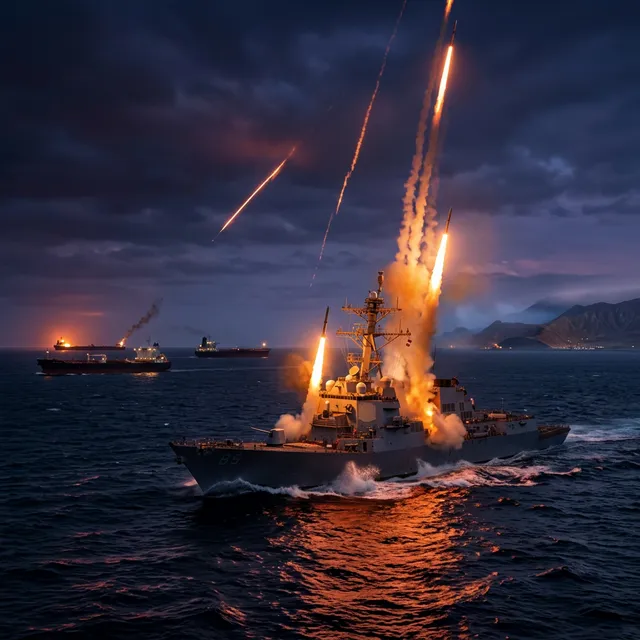
On February 28, 2026, the United States and Israel executed Operation "Roaring Lion" — a coordinated and massive attack against Iranian military installations that resulted in the death of Supreme Leader Ali Khamenei. It was the most dramatic moment in US-Iran relations since the Iranian Revolution of 1979.
Iran's response was immediate and brutal. On March 1, 2026, Tehran fired 708 projectiles against six Persian Gulf nations — the United Arab Emirates, Bahrain, Kuwait, Qatar, Saudi Arabia and Oman — plus Israel. It was the largest Iranian military retaliation in history.
Operation Epic Fury by the Numbers
The military campaign was in its eighth day on March 8, 2026, projected to last 4 to 6 weeks:
| Metric | Data |
|---|---|
| Joint strikes recorded | 900+ |
| Estimated deaths (all sides) | 4,000+ (1,000+ Iranians, 3,000+ coalition military) |
| Iranian ships sunk | 43 |
| Iranian retaliatory projectiles | 708 |
| Countries hit by retaliation | 7 (6 Gulf + Israel) |
The Strait of Hormuz — through which 21% of the world's oil passes — was partially disrupted, triggering the worst energy crisis since the oil shocks of the 1970s.
The Taiwan Question: China's Red Line
While the world focused on the Middle East, tensions in the Pacific reached alarming levels. The Taiwan question — which China considers an "inalienable part" of its territory — became the second front of a possible global conflagration.
The Silent Siege
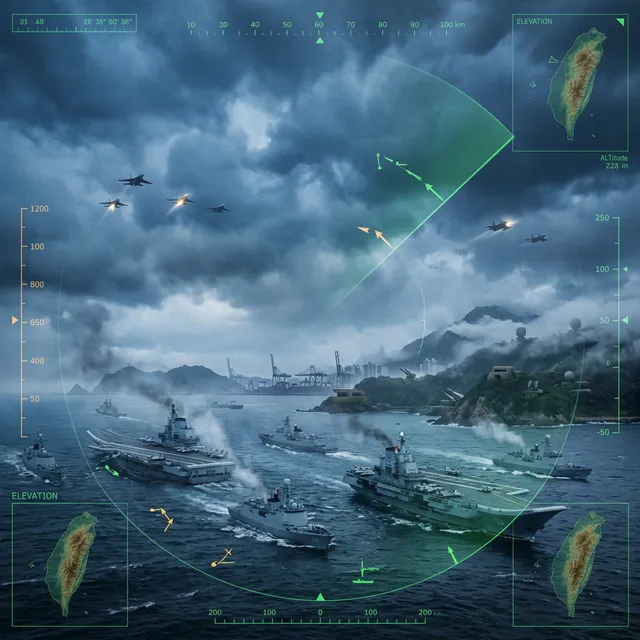
The People's Liberation Army (PLA) intensified its siege and naval blockade exercises around Taiwan, transforming what were once occasional demonstrations into routine operations to control airspace and maritime routes. US military analysts describe these exercises as "rehearsals for an actual invasion."
In March 2026, an intriguing piece of data emerged: there was a reduction in the presence of Chinese military aircraft detected near Taiwan. Far from being a sign of détente, analysts interpret this change as a possible phase transition — from demonstrations of force to actual operational preparation.
The number of Chinese warships around the island, however, remained similar to the previous year, maintaining constant pressure.
American Weapons in Taiwan
The US didn't stand idle. In March 2026, the delivery of 108 M1A2T Abrams tanks to the Taiwanese Army was being completed — the largest transfer of American armored vehicles to the island in decades. All units are expected to be combat-ready before the end of 2026.
The US National Defense Authorization Act for 2026 significantly expanded weapons shipments to Taiwan, including coastal defense missile systems, surveillance drones and electronic warfare equipment.
Wang Yi's Words
Chinese Foreign Minister Wang Yi reaffirmed in March 2026 that "no one and no force" can separate Taiwan from China, adding that "those who follow the correct path prosper, those who oppose it perish." At the same time, paradoxically, he declared that China and the US should seek "mutual respect and peaceful coexistence" — a message analysts interpret as an attempt to avoid escalation while maintaining a firm position.
The Economic Factor: Oil, Gold and Market Fear
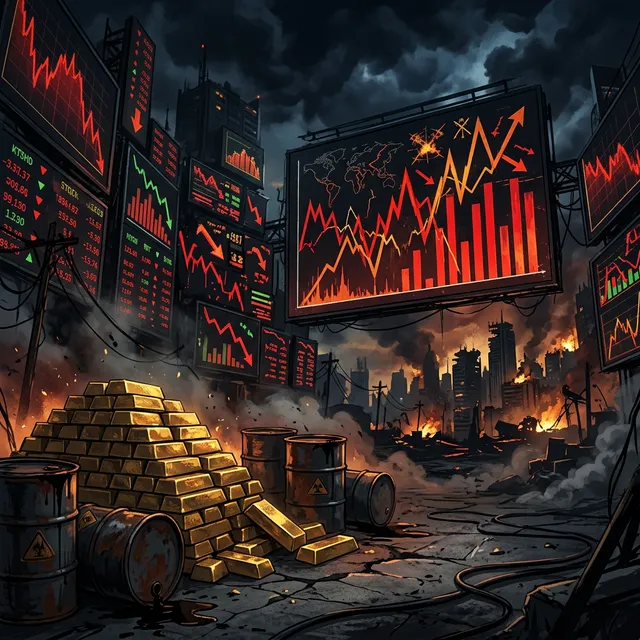
The geopolitical tensions of 2026 didn't stay confined to battlefields. They hit the global economy head-on, creating a perfect storm of financial instability.
Oil at $130+
With the Strait of Hormuz partially blocked and Iranian production compromised, Brent crude surpassed $130 per barrel in March 2026 — the highest value since the 2022 crisis caused by the Ukraine invasion. For oil-importing countries like Brazil, the impact is direct: rising fuel prices, inflation and exchange rate pressure.
Gold Hits All-Time Record
Gold reached $5,412.30 per ounce on COMEX on March 5, 2026 — an absolute record reflecting the rush for safe assets. Silver followed, hitting $67 per ounce. Massive gold purchases by central banks (over 1,000 tonnes per year since 2022) had already signaled a structural transition, but the 2026 conflict dramatically accelerated this trend.
For Brazilian investors, the scenario created what experts call a "double hedge": when gold rises +55% in dollars and the Brazilian real devalues simultaneously, the gain in reais can exceed +70%.
Bitcoin: From Euphoria to Panic
Bitcoin, which hit its all-time high of $126,000 in October 2025, suffered a brutal crash. In February 2026, during the most intense week of the Iranian conflict, it dropped to $62,500 — a 50% loss. The "Fear & Greed" index hit 10 (Extreme Fear). By March, it partially recovered to the $72,000-74,000 range with the return of institutional investors.
BRICS and the New Order: The End of Dollar Dominance?
The 2026 crises accelerated a trend that was already gaining momentum: the de-dollarization of the global economy. The BRICS bloc — expanded to include Saudi Arabia, Iran, UAE, Ethiopia and Egypt — is building a financial infrastructure as an alternative to the Western system.
The Petro-Yuan Advances
In 2026, 40% of Saudi oil sales to China are settled in yuan. The 50-year petrodollar agreement between the US and Saudi Arabia (1974) expired in January 2025 and was not renewed on the same exclusive terms.
Alternatives to SWIFT
The migration of transactions to CIPS (China) and SPFS (Russia) accelerated, with Global South nations seeking protection against the risk of sanctions. The mBridge project — a multilateral digital currency (CBDC) platform — saw digital yuan transactions grow 340% in 2025.
American Debt
US national debt reached $36 trillion in March 2026, increasing the vulnerability of the dollar's "exorbitant privilege." Analysts at Goldman Sachs and JP Morgan are publicly questioning whether the US can sustain its military spending without compromising dollar stability.
Central Bank Gold Purchases
The gold rush is not casual. Since 2022, central banks worldwide have been buying record amounts of the precious metal, signaling a structural shift in global financial architecture:
| Country | Gold Purchases (2024-2026) | Total Reserves |
|---|---|---|
| China (PBoC) | +540 tonnes | 2,715 tonnes |
| India (RBI) | +210 tonnes | 1,048 tonnes |
| Turkey | +180 tonnes | — |
| Saudi Arabia | +120 tonnes (est.) | — |
This massive gold accumulation by BRICS nations is no coincidence. It is a deliberate diversification strategy to reduce dependence on the US dollar — sustained by the belief that the US-led financial system is becoming a risk, not a protection.
The European Front: Ukraine — The Conflict That Won't End
While the world's eyes turn to the Middle East and the Pacific, Europe continues to deal with the Russia-Ukraine conflict, now in its fourth year. The war in Ukraine, which many predicted would end quickly, has transformed into a trench stalemate consuming military and economic resources on both sides. Over 500,000 casualties have been reported across both armies, with civilian deaths estimated in the tens of thousands. Entire cities have been reduced to rubble, and millions of refugees have resettled across Europe, straining social services and fueling political tensions in host countries.
NATO expanded its presence in Eastern Europe, with permanent bases in Poland, the Baltic states and Romania. Finland and Sweden, now full members of the alliance, significantly reinforced the northern border with Russia. The alliance's military spending has surged past $1.2 trillion collectively, with Germany alone committing to a permanent defense budget above 2.5% of GDP — a dramatic shift from its post-World War II pacifist stance.
Russia, in turn, responded by strengthening its military partnership with China. The joint Sino-Russian exercises in 2025 and 2026 reached an unprecedented level of integration — leading analysts to compare the relationship with the formal military alliances that preceded both world wars. A dangerous new dimension has emerged in this confrontation: cyber warfare. Both sides have deployed increasingly sophisticated digital attacks against critical infrastructure, financial systems, energy grids and communications networks, creating what international security experts now call "the invisible front" — a theater of operations where attacks can be launched anonymously and damage can be catastrophic without a single shot being fired.
The danger of this front lies not in the conflict itself, but in diplomatic fatigue. After years of war, both Ukraine and Russia find themselves trapped in positions from which it is politically impossible to retreat. And each month of war increases the risk of escalation — whether by deliberate decision or by accident. The specter of tactical nuclear weapons, explicitly raised by Russian military doctrine revised in 2024, hangs over every major battlefield advance.
Will a Third World War Happen?
This is the question everyone is asking — and the answer, as always in geopolitics, is complex.
Factors That Increase the Risk
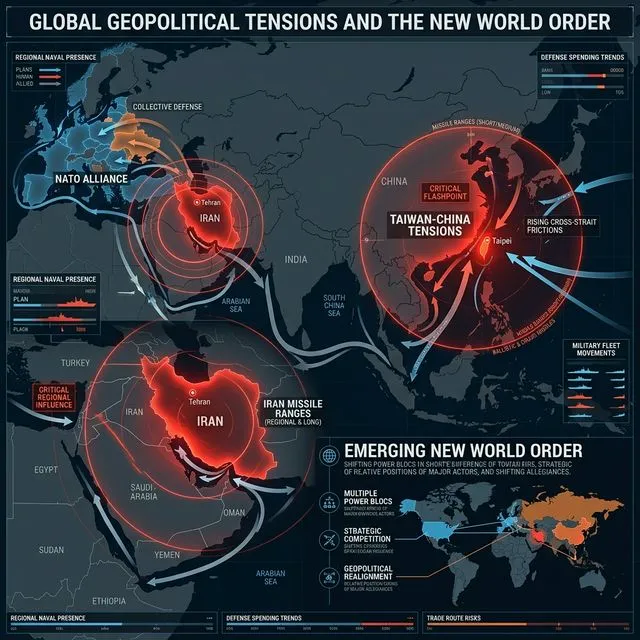
- Multiple active fronts: Middle East (Iran), Pacific (China-Taiwan) and Europe (Ukraine) — three military theaters active simultaneously. It's the first time since World War II that so many fronts are heated at the same time.
- Nuclear weapons: China, the US, Russia, Israel, India and Pakistan possess atomic arsenals. Escalation on any front carries nuclear risk. Russia's nuclear doctrine, revised in 2024, lowered the threshold for tactical weapons use.
- Cross alliances: NATO, the US-Japan-Australia-Korea alliance system (AUKUS and Quad), and the China-Russia partnership create a web where a local conflict can quickly become global — exactly as happened in 1914.
- Economic pressure: sanctions, trade wars and control of energy resources create incentives for military action. History shows that economic embargoes frequently precede armed conflicts.
- Arms race: global military spending reached $2.4 trillion in 2025 — a historic record. China, the US and Russia lead this race with massive investments in hypersonics, military AI and naval capability.
Factors That Reduce the Risk
- Mutually assured destruction (MAD): the nuclear arsenals of major players remain the greatest inhibitor of direct conflict between great powers. No rational leader would choose a scenario where their own nation would be destroyed.
- Economic interdependence: China and the US are each other's largest trading partners — a war would destroy both economies. In 2025 alone, bilateral trade exceeded $700 billion.
- Active diplomacy: despite aggressive rhetoric, diplomatic channels between Washington and Beijing remain open. Wang Yi spoke of a "historic year" for relations, and the military hotline between the two countries was re-established in November 2025.
- Historical lessons: leaders on both sides study the mistakes of 1914 and 1939 — and know that world wars rarely benefit their instigators. World War I destroyed four empires; World War II nearly destroyed the world.
The Most Likely Scenario
The majority of defense and international relations analysts converge on a scenario of "permanent tension without total escalation" — similar to the Cold War. Localized conflicts (like in Iran) continue, but the nuclear red line prevents escalation to a truly world war.
The greatest risk is not a deliberate decision to go to war, but an accident or miscalculation — a downed plane, a ship hit by mistake, a misinterpreted communication — that triggers a spiral of retaliations before diplomacy can intervene. Military historians point out that many of history's great conflicts began with minor incidents that spiraled out of control: the assassination of Archduke Franz Ferdinand in 1914, the "temporary" invasion of Poland in 1939.
What Does Brazil Have to Do with This?
Brazil, although geographically distant from the conflicts, is directly impacted by the global tensions of 2026:
- Oil and Pre-salt: as a major producer (the pre-salt produces over 3 million barrels/day) and consumer, Brazil benefits from high export prices but suffers from internal fuel inflation that pressures the cost of living for the entire population.
- Agribusiness: the country is the world's largest exporter of soybeans, meat, coffee and sugar — commodities that appreciate during global crises. In 2026, Brazilian agricultural exports are expected to exceed $180 billion, driven by instability in traditional markets.
- BRICS and protagonism: as a founding member of BRICS, Brazil is positioned to benefit from the new multilateral financial architecture. Brazil's G20 presidency in 2024 and its rapprochement with expanded BRICS positioned the country as a natural mediator between the major powers.
- Exchange rate and investments: the devaluation of the real against the dollar during crises amplifies both the benefits of exports and the costs of imports. Gold and commodities become natural protections for Brazilian investors.
- Diplomacy and mediation: Brazil's tradition of non-alignment and mediation can become a valuable strategic asset in an increasingly polarized world. The Itamaraty has been sought by both sides to facilitate informal dialogues.
- Defense and Gripen: Brazil is assembling its first F-39 Gripen supersonic fighters, a R$36 billion investment that gains urgency in the context of global tensions.
Conclusion: The World on a Tightrope
March 2026 will go down in history as one of the most tense moments in modern geopolitics. The +1700% increase in searches for "World War III" reflects real anxiety, based on real events, with real consequences for billions of people.
The good news — if we can call it that — is that nuclear deterrence mechanisms and economic interdependence continue to function as brakes against total escalation. The bad news is that these brakes depend on rational leaders making rational decisions in moments of extreme pressure. And history teaches us that rationality doesn't always prevail.
The truth is that the world of 2026 is no longer moving toward stability. It is moving toward a new normal — where permanent tensions, arms races and resource disputes are the everyday landscape. The question is no longer "will there be a Third World War?" — it's "how will we coexist in a world where that possibility is never completely off the table?" This is the defining challenge of our generation, and how we answer it will shape the century to come.
What we can state with certainty is that the old world — the one where the US was the unquestioned power, where the dollar was the only reserve currency, and where diplomacy was enough to resolve crises — that world is already over. What is being born in its place doesn't yet have a name, but its birth pains are being felt at every gas station, every supermarket and every newspaper headline around the planet. For the ordinary citizen, what remains is vigilance, quality information and the hope that reason will prevail over impulse — because never in modern history has so much been at stake for so many people at the same time.
Sources and References
- Revista Oeste — China and Taiwan: tensions in 2026
- CNN Brazil — US and Pacific posture in 2026
- Brasil de Fato — Geopolitics and risks of global conflict
- InfoMoney — China and US: diplomacy and trade 2026
- RTP — Wang Yi on Taiwan and Sino-American relations
- Zona Militar — M1A2T Abrams tanks for Taiwan
- CGTN — China and US peaceful coexistence
- TradingView — Geopolitical analysis and markets 2026
- SwissInfo — Chinese military activities around Taiwan
- Correio do Povo — Reduction of Chinese aircraft near Taiwan
Last updated: March 10, 2026


