
Simulation Theory: The Scientific Evidence, Antarctica's Mystery, and the Question That Could Change Everything — Do We Live in a Matrix?
Date: March 6, 2026
Reading time: 30 minutes
Emoji: 🔮
What if everything you see, touch, smell, and feel isn't real? What if the entire universe — from the most distant galaxies to the most intimate thoughts in your mind — is merely a simulation running on an incomprehensibly powerful computer? The idea seems absurd. It seems like science fiction. But a growing number of physicists, philosophers, mathematicians, and computer engineers claim it's not only plausible — it may be the most logical explanation for several phenomena that conventional science cannot explain. And most disturbingly: there may be clues hidden in the most inaccessible place on Earth — Antarctica.
Bostrom's Argument: The Philosophical Foundation
It all begins with an academic paper published in 2003 by Swedish philosopher Nick Bostrom of the University of Oxford. Titled "Are You Living in a Computer Simulation?", the paper presents a devastatingly simple logical reasoning that became known as the Simulation Argument.
Bostrom's Trilemma
Bostrom argues that at least one of the following three statements must be true:
- Advanced civilizations invariably go extinct before reaching the technological capability to create reality simulations
- Advanced civilizations that SURVIVE lose all interest in creating ancestor simulations
- We are almost certainly living in a simulation
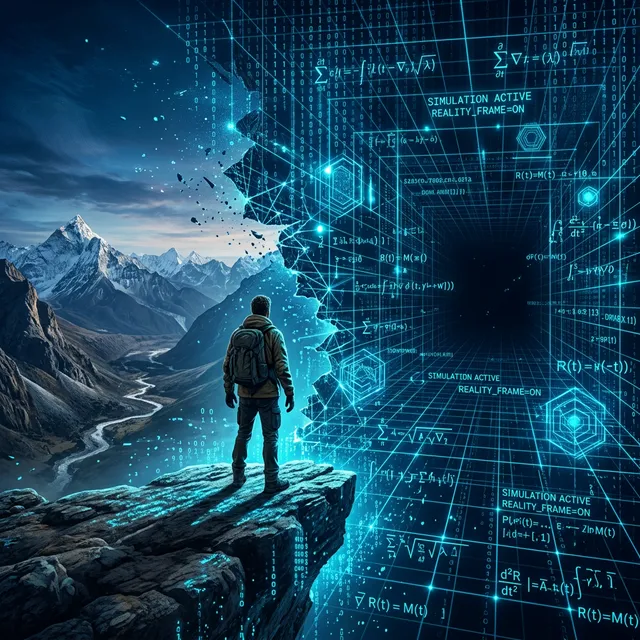
The logic is elegant: if someday some civilization (possibly even ours, in the distant future) develops the ability to simulate consciousnesses — and if that civilization has even the slightest interest in doing so — then the number of "simulated people" will be astronomically greater than the number of "real" people. Therefore, statistically, any individual consciousness has an overwhelming probability of being simulated, not real.
The Academic Reaction
Bostrom's paper was not dismissed as eccentric philosophy. On the contrary: it was published in the prestigious Philosophical Quarterly, accumulated thousands of academic citations, and sparked a debate that persists to this day in philosophy, physics, and computer science departments at universities like MIT, Stanford, Oxford, Cambridge, and Caltech.
Bostrom himself doesn't claim we live in a simulation. He says the probability is approximately 20-50% — a margin that, coming from one of the world's most respected analytical philosophers, is genuinely disturbing.
The Quantum Physics Evidence
If the simulation hypothesis were purely philosophical, it could perhaps be dismissed. But what made this idea particularly disturbing over the past two decades is that several quantum physics phenomena behave exactly as one would expect from a computational system.
1. The Double-Slit Experiment: On-Demand Rendering
The double-slit experiment is, in the opinion of many physicists, the strangest experiment ever performed. When subatomic particles (like photons or electrons) are fired at a barrier with two slits:
- Without observation: Particles behave like waves, passing through both slits simultaneously and creating an interference pattern on the detection screen
- With observation: When a detector is added to "see" which slit each particle passes through, they suddenly behave like particles, passing through one slit or the other, and the interference pattern disappears
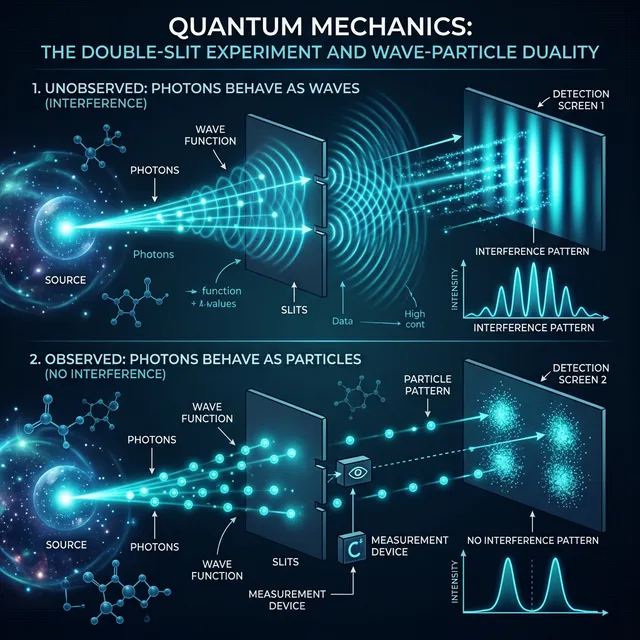
From the simulation perspective, this phenomenon has a disturbingly simple explanation: the system only "renders" reality in detail when someone is looking. It's exactly like a modern video game, which doesn't process complete 3D graphics for areas the player isn't viewing — a technique known as on-demand rendering or lazy rendering.
Physicist John Wheeler (1911-2008), one of the greatest physicists of the 20th century and coiner of the term "black hole," took this idea to its extreme with his concept of the "participatory universe": reality, according to Wheeler, doesn't exist in a defined state until it's observed. Observation doesn't merely reveal reality — it creates it.
2. Quantum Entanglement: Shared Variables
Quantum entanglement — what Einstein called "spooky action at a distance" — is another phenomenon that fits perfectly into a computational hypothesis.
Two entangled particles share information instantaneously, regardless of the distance separating them — even if they're on opposite sides of the universe. This apparently violates the speed of light limit, which should be the maximum speed of information transmission.
From the simulation perspective: if both particles are merely data in the same database, there is no real distance between them. Changing one variable automatically changes the other, because they are references to the same data object — like two links pointing to the same file on a computer.
3. The Planck Constant: Minimum Resolution
The Planck constant defines the smallest unit of energy, time, and space that can exist in the universe. Below these scales, reality ceases to be continuous and becomes "granular" — divided into discrete packets called quanta.
| Planck Unit | Value | Computational Analogy |
|---|---|---|
| Planck length | 1.6 × 10⁻³⁵ m | Reality's pixel |
| Planck time | 5.4 × 10⁻⁴⁴ s | Universe's frame rate |
| Planck energy | 1.96 × 10⁹ J | Minimum processing unit |
If the universe were truly continuous (infinitely subdivisible), there would be no need for a minimum limit. But if it's a simulation, there must be a maximum resolution — just as any computer screen has a finite number of pixels.
4. Cosmic Speed Limit: The Speed of Light
The speed of light (299,792,458 m/s) is the absolute speed limit in the universe. Nothing — not information, not matter, not energy — can exceed it. Why does such a specific and absolute limit exist?
In a simulation: every computational system has a maximum processing speed. The speed of light would simply be the "clock speed" of the processor running our simulation — the maximum rate at which information can be propagated within the system.
Antarctica: The Forbidden Continent
Of all places on Earth, Antarctica is perhaps the most mysterious — and the most relevant to the simulation hypothesis. An entire continent covered by up to 4.8 km of ice, where no country has sovereignty (at least officially), and whose access has been rigidly controlled by international treaties since 1959.
The Antarctic Treaty: Planned Isolation?
The Antarctic Treaty, signed in 1959 by 12 nations (and now ratified by 54), prohibits:
- Military activity
- Mining and resource exploitation
- Nuclear testing
- Unrestricted access by ordinary citizens

For proponents of simulation theory, Antarctica's isolation is suggestive. If the universe were a simulation, it would be logical for its "boundaries" or "edges" to be made inaccessible — exactly like map boundaries in a video game are blocked by invisible barriers, impassable mountains, or infinite waters.
Gravitational Anomalies
In 2006, NASA's GRACE satellite (Gravity Recovery and Climate Experiment) detected a massive gravitational anomaly beneath the ice of eastern Antarctica — the so-called Wilkes Land Anomaly. The region shows a gravitational depression consistent with an impact crater approximately 480 km in diameter, supposedly formed 250 million years ago.
However, some researchers outside the academic mainstream speculate that the anomaly could be something very different — an artificial structure, an inconsistency in the terrain's "rendering," or even a zone where the simulation operates with slightly different parameters.
Lake Vostok: A Sealed World
Lake Vostok, the world's largest subglacial lake, has been sealed beneath 3.7 km of Antarctic ice for at least 15 million years. When Russian scientists finally drilled down to its waters in 2012, they discovered microbiological life forms that exist nowhere else on the planet.
From the simulation perspective: environments sealed for millions of years containing unique life forms could be test modules — regions where the simulation experiments with biological variations without affecting the simulation's "main ecosystem."
Bostrom's Argument Revisited: Updated Probabilities
Since Bostrom's original 2003 article, several high-caliber researchers have weighed in on the question:
Who Believes (or Seriously Considers)
| Person | Position | Opinion |
|---|---|---|
| Elon Musk | CEO Tesla/SpaceX | "The chance we're NOT in a simulation is one in billions" |
| Neil deGrasse Tyson | Astrophysicist | Assigns 50% probability to the hypothesis |
| S. James Gates Jr. | Theoretical physicist (UMD) | Found error-correcting codes embedded in supersymmetry equations |
| David Chalmers | Philosopher (NYU) | "There is no way to prove we are not in a simulation" |
| Rizwan Virk | Author of The Simulation Hypothesis | "We are 10-50 years from creating our own convincing simulations" |
| Max Tegmark | Physicist (MIT) | "The universe is a mathematical structure" — consistent with simulation |
Who Is Skeptical
| Person | Position | Objection |
|---|---|---|
| Sabine Hossenfelder | Theoretical physicist | "There is no testable empirical evidence; it's not science" |
| Sean Carroll | Physicist (Johns Hopkins) | "The hypothesis is non-falsifiable, therefore not scientific" |
| Lisa Randall | Physicist (Harvard) | "I see no reason an advanced civilization would simulate reality" |
| Michio Kaku | Physicist (CUNY) | "Possible but highly unlikely with known technology" |
Arguments For: Why It Could Be True
1. The Universe Obeys Mathematical Laws
The universe is governed by precise mathematical equations. A computer program, by definition, operates according to mathematical rules. If our universe is governed by mathematics, it is, in essence, a program.
2. Reality Is Discrete, Not Continuous
As discussed with Planck constants, reality has a "minimum resolution." This is exactly what would be expected from a digital system — and opposite to what would be expected from a continuous, analog reality.
3. Computational Power Is Growing Exponentially
Moore's Law has held for over 50 years. In 2026, ordinary smartphones have more processing power than the supercomputers of 2000. If this trend continues for a few more centuries, future computers would have enough power to simulate entire universes with molecular detail.
4. We Already Create Simulations
Games like No Man's Sky procedurally generate entire universes — with trillions of planets, each with unique geology, atmosphere, flora, and fauna. In 2026, AI simulations already demonstrate emergent behaviors their creators didn't program.
Arguments Against: Why It Could Be Illusion
1. The Computational Resources Argument
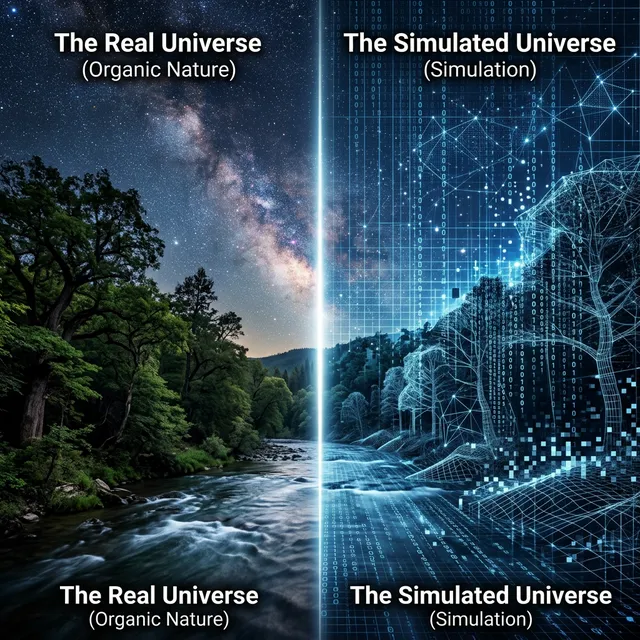
Physicist Seth Lloyd (MIT) calculated that simulating the observable universe — with its ~10⁸⁰ particles — would require a computer with at least 10⁹⁰ operations per second. This exceeds the capability of any conceivable computer.
Counter-argument: The simulation doesn't need to process the entire universe simultaneously. Like a video game, it can render only the part being "observed."
2. The Infinite Regression Problem
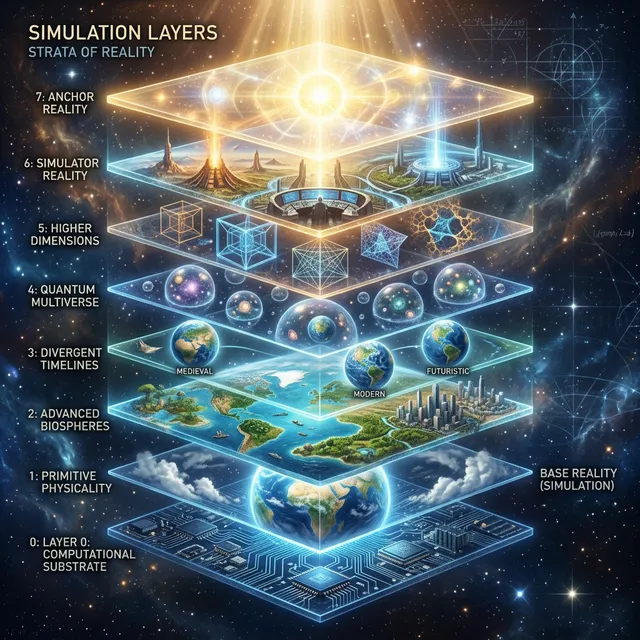
If we live in a simulation, who simulates the simulators? This creates an infinite chain — the famous turtles all the way down problem.
Counter-argument: At some point, a "base reality" must exist — a level that is not simulated. We simply aren't at that level.
3. The Consciousness Question
Can a computer truly generate consciousness? If consciousness requires something beyond computation (what philosopher David Chalmers calls "the hard problem of consciousness"), then a simulation could never produce it.
Counter-argument: If we are simulated, our "experience of consciousness" is also simulated. We are not truly conscious — merely programmed to believe we are.
4. The Non-Falsifiability Problem
The strongest scientific argument against the hypothesis is that it is non-falsifiable: there currently exists no experiment that could prove we do NOT live in a simulation.
Counter-argument: Non-falsifiability doesn't mean it's false. Many hypotheses in physics (like the multiverse) are equally untestable with current technology.
The Verdict: Truth or Fiction?
After examining all evidence, arguments, and counter-arguments, the honest answer is: we don't know — and perhaps we never will.
The simulation hypothesis is not a scientific theory in the strict sense — it's a metaphysical hypothesis that raises profound questions about the nature of reality, consciousness, and the universe. The parallels with quantum physics are genuinely intriguing. The philosophical arguments are logically sound. But the absence of a definitive test keeps it in the realm of speculation — elegant, fascinating, but speculation.
What is undeniable is that the question has changed how we think about reality. It forced physicists to reconsider what "reality" actually means. It inspired philosophers to revisit questions dating back to Plato and his Allegory of the Cave. And, perhaps most importantly, it reminded us of a fundamental truth: no matter how advanced human knowledge becomes, there will always be mysteries greater than our ability to comprehend them.
Whether we live in a simulation or not, the universe remains — in all its beauty, complexity, and mystery — worthy of being explored, studied, and admired.
Sources and References
- Bostrom, N. (2003). "Are You Living in a Computer Simulation?" — Philosophical Quarterly — Original paper
- NASA — GRACE Mission — Data on Antarctic gravitational anomalies
- MIT Technology Review — Coverage on computational limits and simulation
- Scientific American — Articles on quantum mechanics and reality
- Nature Physics — Publications on simulation hypothesis tests
- Oxford University — Future of Humanity Institute — Nick Bostrom's research


