
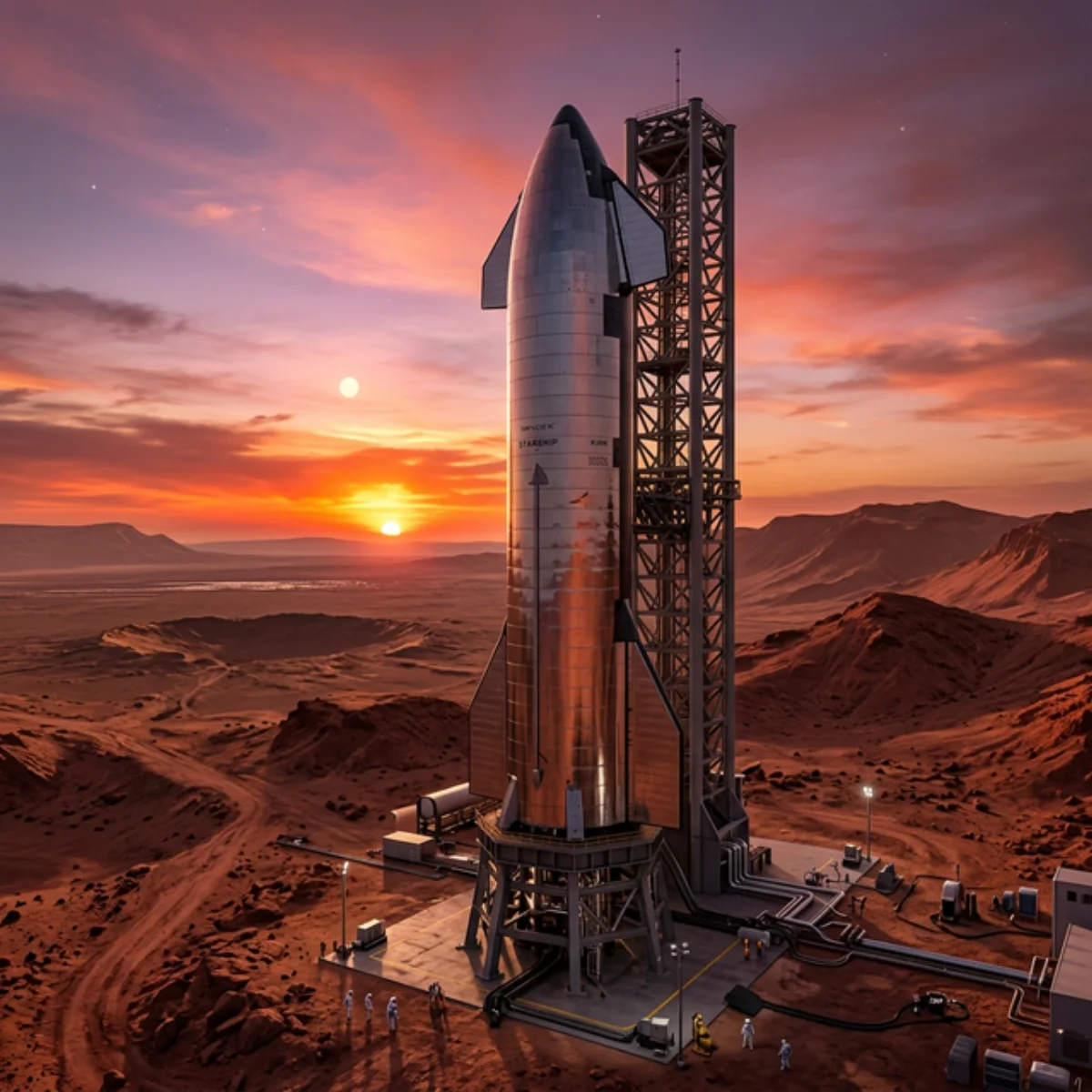
In 2026, humanity will take the boldest step in its space history. SpaceX plans to send at least 5 uncrewed Starship vessels to Mars during the 2026 launch window — the orbital opportunity that occurs every 26 months when Earth and Mars align for the most efficient journey possible.
The 2026 Launch Window: Why Now?
| Aspect | Data |
|---|---|
| Launch window | August-October 2026 |
| Earth-Mars distance (minimum) | ~55 million km |
| Travel time | 6-9 months |
| Estimated arrival | February-April 2027 |
| Ships planned | 5 Starships (uncrewed) |
The Starship: The Largest Rocket Ever Built
Technical Specifications
| Component | Specification |
|---|---|
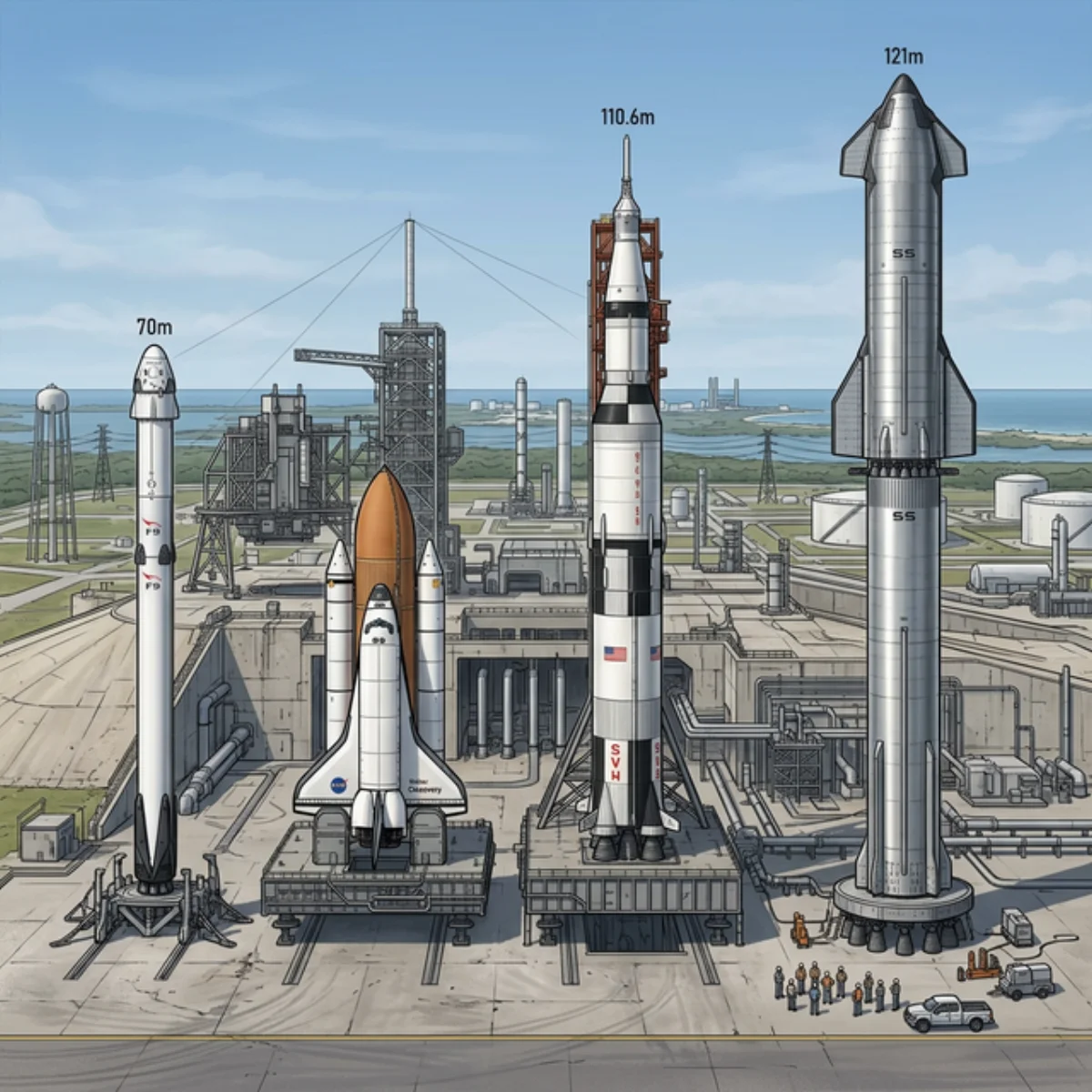
| Total height | 121 meters (Starship + Super Heavy) |
| Diameter | 9 meters |
| Total thrust (liftoff) | ~74,300 kN (33 Raptor engines) |
| Payload to LEO | ~150 tons |
| Payload to Mars | ~100 tons |
| Propellant | Liquid methane (CH₄) + Liquid oxygen (LOX) |
| Reusable | 100% — both booster and ship |
| Cost per launch (target) | $10 million (vs $1.5 billion NASA SLS) |
Comparison with Other Rockets
| Rocket | Height | Thrust | Payload to LEO | Cost/Launch | Status |
|---|---|---|---|---|---|
| SpaceX Starship | 121m | 74,300 kN | 150 tons | ~$10M | Advanced testing |
| Saturn V | 111m | 34,020 kN | 130 tons | ~$1.16B (adjusted) | Retired (1973) |
| SLS | 98m | 39,100 kN | 95 tons | ~$2.2B | Operational |
| Falcon Heavy | 70m | 22,819 kN | 64 tons | ~$97M | Operational |
What the 5 Ships Will Carry to Mars
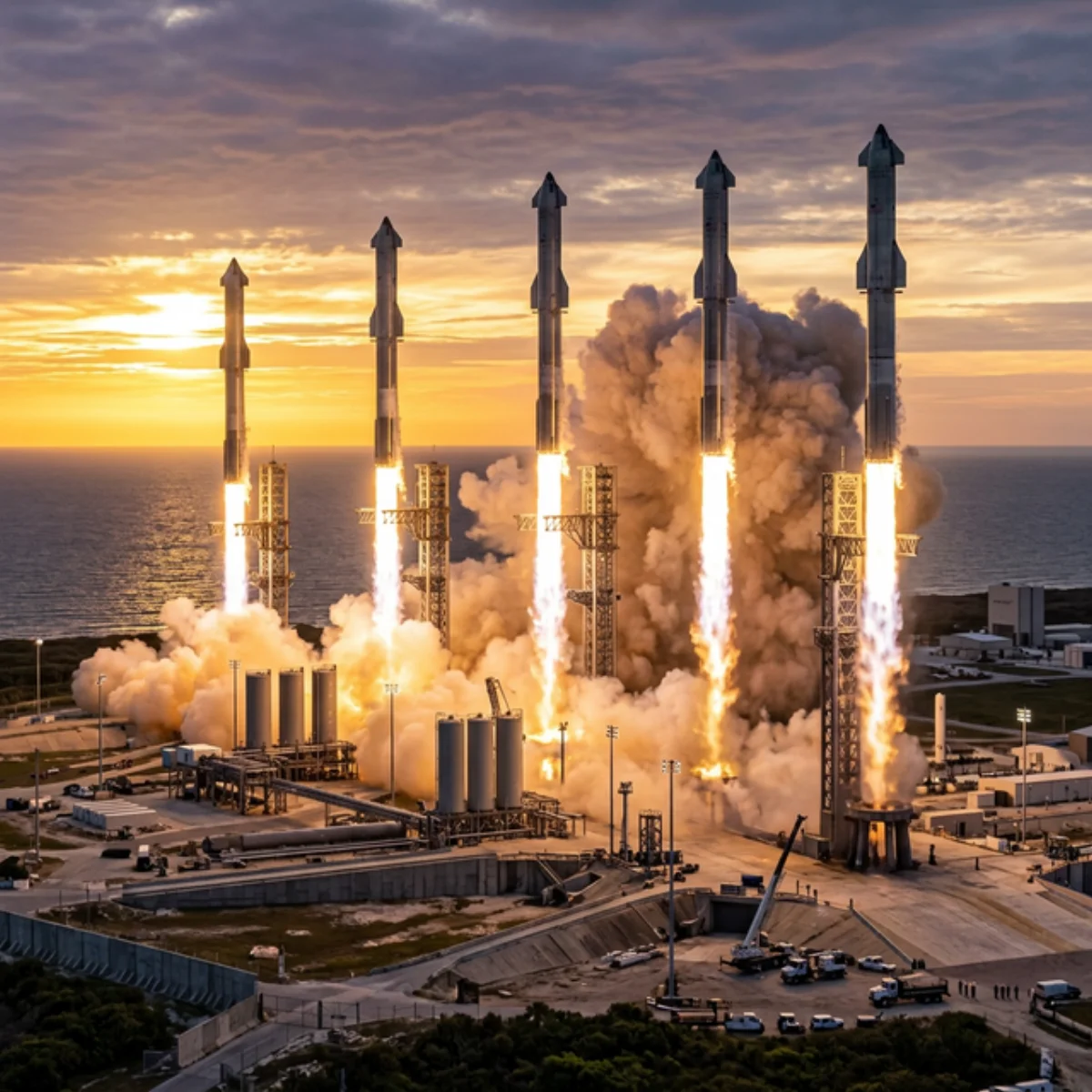
| Ship | Primary Objective | Cargo |
|---|---|---|
| Starship 1 | Mars landing test | Navigation, atmospheric sensors, cameras |
| Starship 2 | Fuel production (ISRU) | Sabatier plant for methane/oxygen from Martian resources |
| Starship 3 | Energy and communications | Solar panels, batteries, Earth communication relay |
| Starship 4 | Construction equipment | Rovers, aerial drones, excavation equipment |
| Starship 5 | Robots and supplies | Tesla Optimus robots, inflatable habitat, initial supplies |
The 7 Greatest Mission Challenges
1. Landing on Mars
Mars has an atmosphere 100x thinner than Earth's, creating the "7 minutes of terror" — with 20+ minute communication delay to Earth.
2. Cosmic Radiation
| Trip Phase | Radiation Dose | Risk |
|---|---|---|
| Travel (6-9 months) | ~300 mSv | Equivalent to 150 chest X-rays |
| Mars surface (18 months) | ~200 mSv | No protective magnetic field |
| Total round trip | ~660 mSv | Above NASA career limit |
3. In-Situ Fuel Production (ISRU)
Process: CO₂ (Mars atmosphere) + H₂O (subsurface ice) → CH₄ (methane) + O₂ (oxygen)
4-7. Communication delay, Martian dust, reduced gravity, astronomical costs
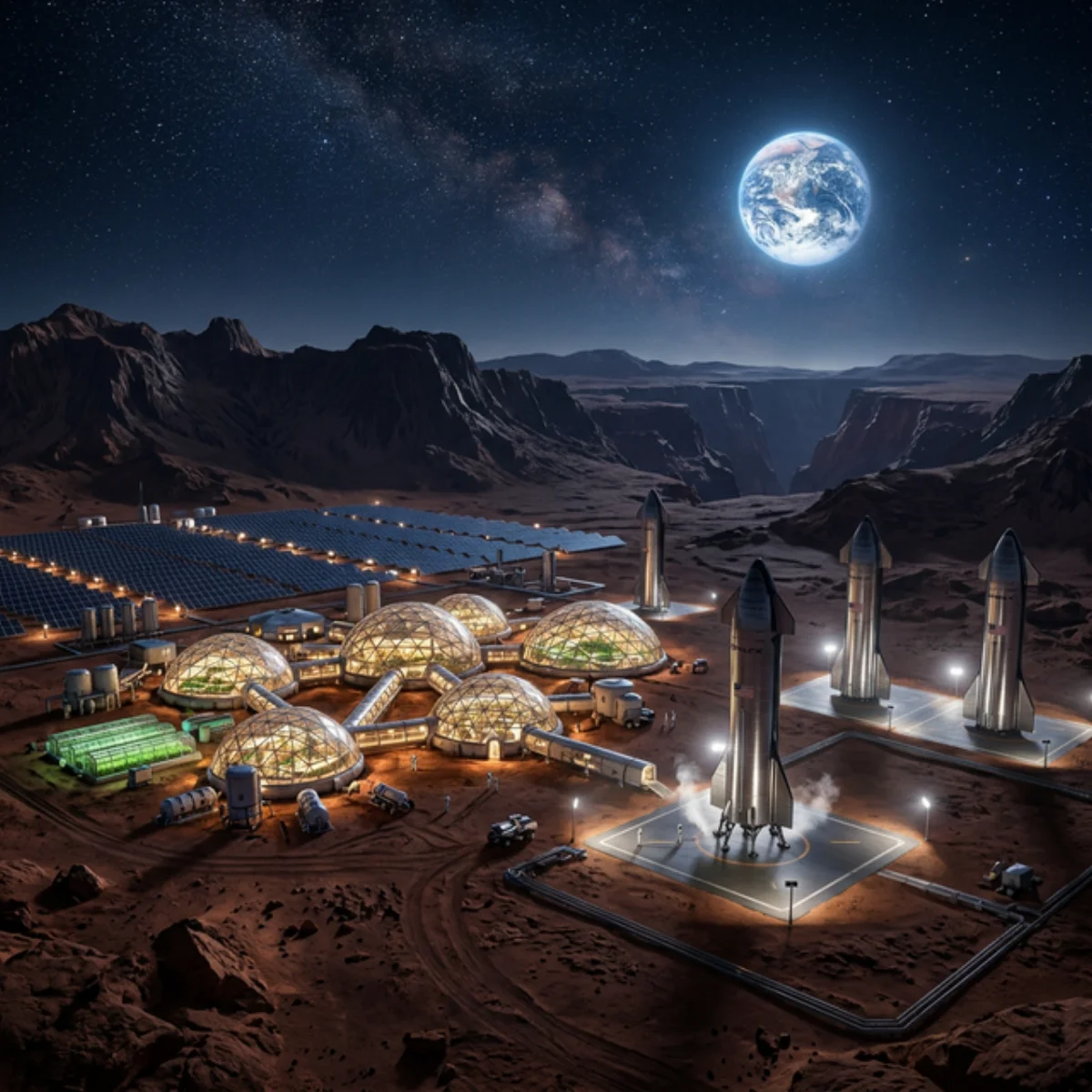
The Long-Term Vision: Mars Colonization
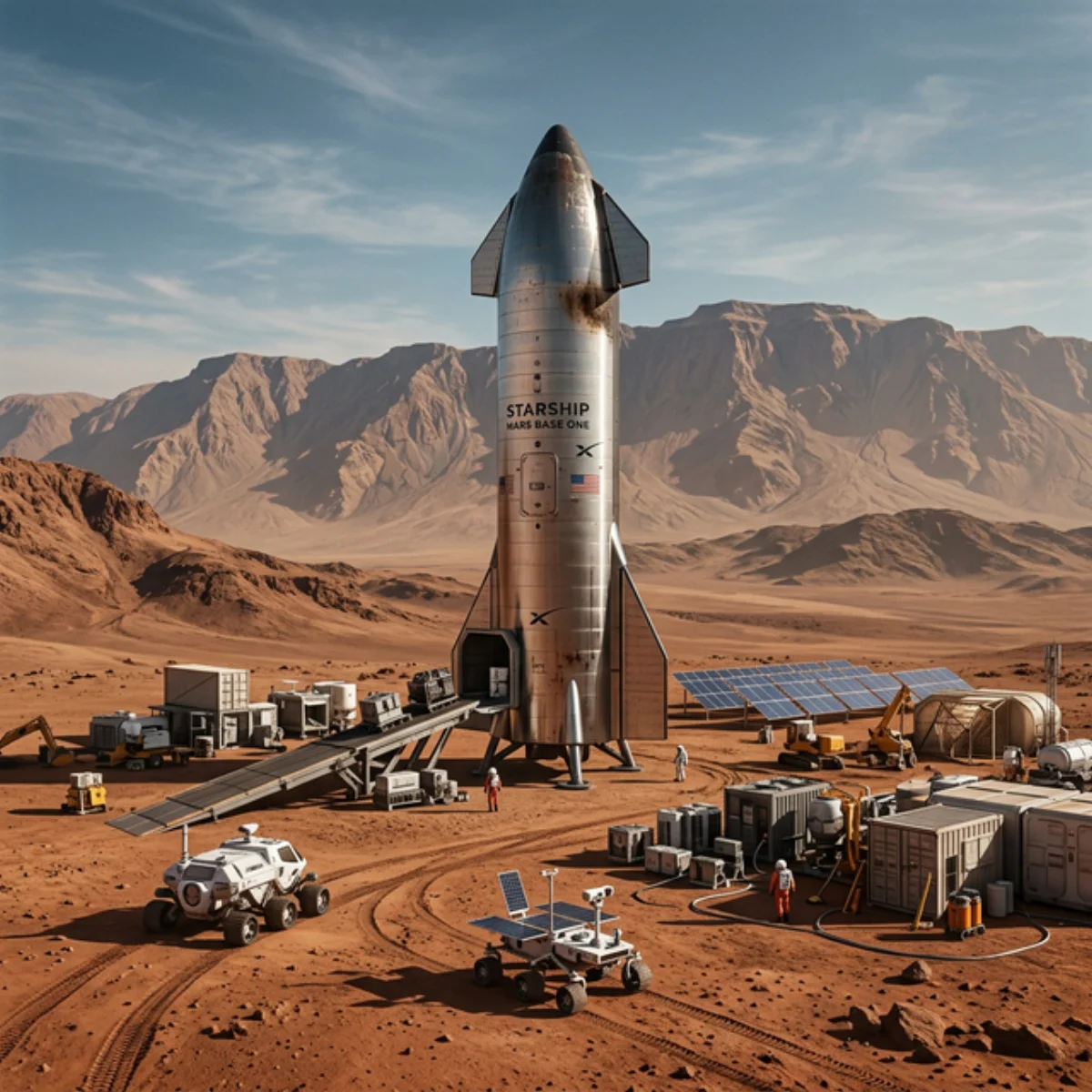
| Phase | Period | Objective |
|---|---|---|
| Phase 1 | 2026-2027 | Uncrewed missions, landing test |
| Phase 2 | 2028-2030 | First human on Mars |
| Phase 3 | 2030-2035 | Semi-permanent Mars base |
| Phase 4 | 2035-2040 | Fuel production at scale |
| Phase 5 | 2040-2050 | Mars city, 1 million inhabitants |
The Competition
| Organization | Mission | Period | Type |
|---|---|---|---|
| NASA | Mars Sample Return | 2026-2028 | Sample return |
| ESA | ExoMars Rosalind Franklin | 2028 | Drilling rover |
| CNSA (China) | Tianwen-3 | 2028-2031 | Sample return |
| Blue Origin | Concept | 2030+ | Cargo transport |
The Space Tourism Economy
Who Can Go to Space in 2026?
| Company | Type of Flight | Price (2026) | Duration | Passengers to Date |
|---|---|---|---|---|
| SpaceX (Starship) | Orbital | $50M+ | Days-weeks | 12 |
| Blue Origin | Suborbital (10 min) | ~$250K | 11 min | 40+ |
| Virgin Galactic | Suborbital | ~$450K | 90 min | 80+ |
| Axiom Space | ISS stays | ~$55M | 10 days | 12 |
| SpaceX (Dragon) | Orbital tourism | $50M+ | 3-5 days | 8 |
The Starship Revolution
What makes Starship revolutionary is not just its size — it is designed to be fully reusable, fundamentally changing the economics of space access:
| Metric | Falcon 9 | Starship | Improvement |
|---|---|---|---|
| Payload to LEO | 22.8 tons | 150+ tons | 6.5x |
| Cost per kg | $2,720 | ~$100 (target) | 27x cheaper |
| Reusability | First stage only | Full vehicle | Total |
| Volume | 4m diameter | 9m diameter | 5x |
If SpaceX achieves the $100/kg target, it would cost approximately $10,000 to send a person to orbit — roughly the price of a business class transatlantic flight. This single metric could transform space from a billionaire luxury into something accessible to the middle class within a generation.
The Mars Colonization Challenge
Why Mars?
- Day length: 24.6 hours (almost identical to Earth)
- Tilt: 25° (seasons similar to Earth)
- Water: Confirmed ice deposits at both poles and subsurface
- Resources: CO2 atmosphere can produce oxygen and fuel (ISRU)
- Gravity: 38% of Earth — enough to potentially support human health
The Challenges Nobody Talks About
- Radiation: Mars lacks a magnetosphere — settlers receive 50x more radiation than Earthlings
- Gravity effects: 38% gravity may cause bone loss, vision problems, and cardiovascular changes
- Psychological: 6-month journey + isolation + communication delay (4-24 min)
- Supply chain: A broken critical component means waiting 2+ years for replacement
- Governance: Who makes laws on Mars? No international framework exists
- Return trip: Currently impossible — first settlers would be permanent
Musk Timeline vs. Reality
| Musk Prediction | Predicted Date | Actual Status (2026) |
|---|---|---|
| Starship orbital | 2022 | ✅ Achieved 2024 |
| Cargo to Mars | 2024 | ❌ Delayed to 2028+ |
| Humans to Mars | 2026 | ❌ No realistic date |
| Mars city (1M people) | 2050 | Extremely ambitious |
International Space Competition
The New Space Race
| Country/Agency | Moon Plans | Mars Plans | Annual Budget |
|---|---|---|---|
| NASA (USA) | Artemis III: 2026 Moon landing | Mars sample return 2033 | $25B |
| China (CNSA) | Chang-e 7/8: 2026-2028 | Crewed Mars 2033 | $14B (est.) |
| ESA (Europe) | ExoMars rover 2028 | Supporting role | $7.5B |
| India (ISRO) | Chandrayaan-4: 2027 | Mangalyaan-2: 2028 | $2B |
| Japan (JAXA) | SLIM follow-up missions | MMX (Phobos sample) | $3B |
China is the most serious competitor to American space dominance. In 2026, they plan to launch the next module of their Tiangong space station and continue lunar surface mapping for a planned crewed landing by 2030. The parallel US-China space race is eerily reminiscent of the Cold War era — but with commercial companies adding an entirely new dimension.
The Economics of Space
Space is becoming a trillion-dollar industry. Morgan Stanley projects the global space economy will reach USD 1.8 trillion by 2035, up from USD 469 billion in 2024. Satellite internet (Starlink, Project Kuiper), space manufacturing (zero-gravity pharmaceuticals), asteroid mining, and space solar power are all attracting massive investment.
SpaceX alone is valued at approximately USD 250 billion in 2026, making it one of the ten most valuable private companies on Earth. But it is not alone. Blue Origin, Rocket Lab, Relativity Space, and dozens of startups are competing to reduce launch costs and open new markets. The democratization of space access is creating opportunities that were science fiction a decade ago — and the next decade promises even more radical transformation.
Conclusion: Humanity's Greatest Leap
When the first Starship lands on Mars — if it lands — it will be the most significant moment in human exploration since Neil Armstrong stepped on the Moon in 1969. Elon Musk is betting his entire fortune on the idea that humanity needs to be multiplanetary to survive.
Either way, the show will be unforgettable.


