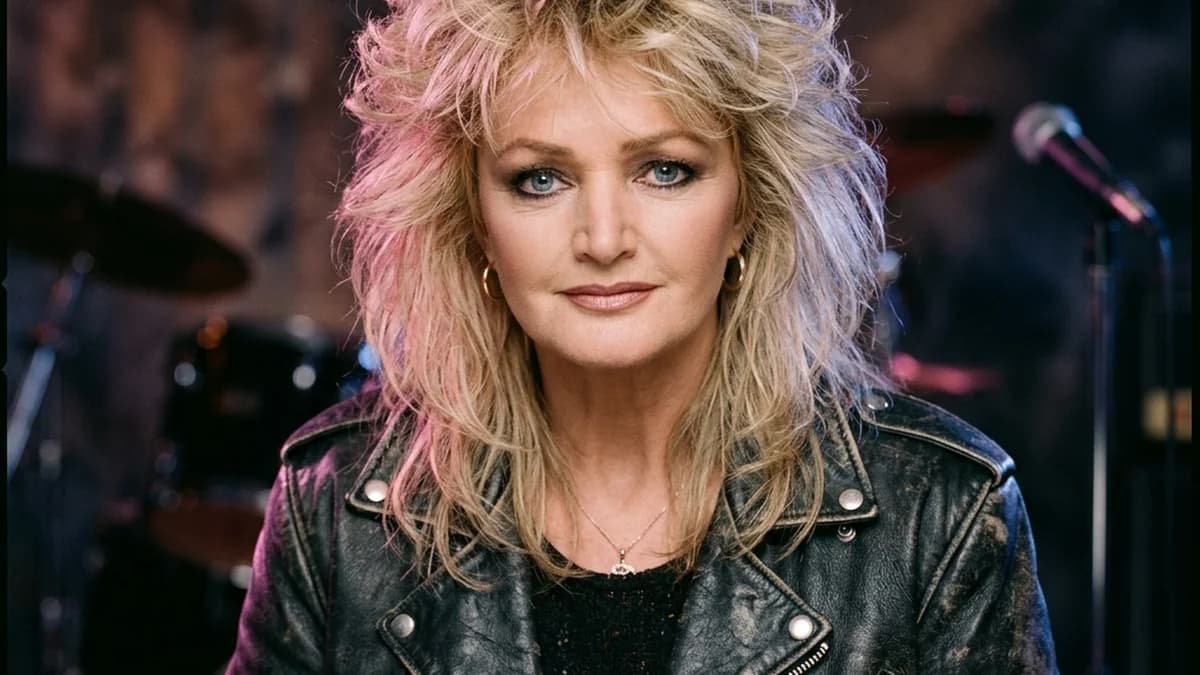
Robert Duvall (1931-2026): The Silent Giant of Hollywood 🎬
Robert Selden Duvall passed away peacefully on February 15, 2026, at the age of 95, at his home in Middleburg, Virginia, surrounded by family. His wife, Luciana Pedraza, announced his death, saying he departed "surrounded by love and comfort." No specific cause was disclosed, but his advanced age suggests natural causes.
With more than 140 films across seven decades of career, Duvall was, for many critics and colleagues, simply the best actor Hollywood has ever seen. Not the most famous, not the most handsome, not the most charismatic — but the most consistently brilliant, film after film, role after role. When Robert Duvall appeared on screen, you did not see Robert Duvall. You saw the character. And that is the definition of greatness in acting.

📋 Complete Profile
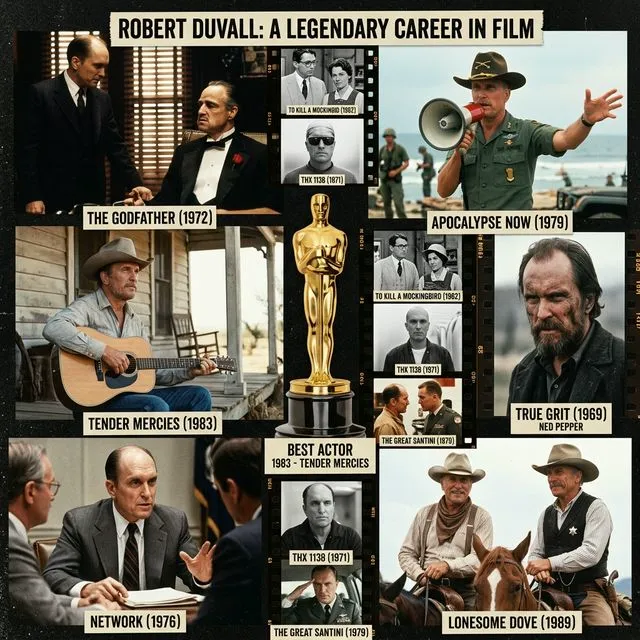
| Detail | Info |
|---|---|
| Full name | Robert Selden Duvall |
| Born | January 5, 1931, San Diego, California 🇺🇸 |
| Died | February 15, 2026 (age 95) |
| Wife | Luciana Pedraza (married since 2005, 4th marriage) |
| Children | No biological children |
| Best Actor Oscar | Tender Mercies (1984) |
| Oscar nominations | 7 total (4 Actor, 2 Supporting Actor, 1 as Producer) |
| Education | Principia College, The Neighborhood Playhouse |
| Acting training | Studied under Sanford Meisner |
| Military service | U.S. Army (Korea, 1953-54) |
🎒 Childhood and Training
Duvall was born in San Diego, California, the son of an American Navy admiral. He grew up in a military family, moving frequently across the United States. He graduated from Principia College in Illinois in 1953 and served in the U.S. Army during the Korean War.
After military service, he moved to New York to study acting at The Neighborhood Playhouse School of the Theatre, where he was a student of the legendary Sanford Meisner — one of the most influential acting teachers in American history. The Meisner technique, focused on organic reactions and emotional truth, became the foundation of Duvall's style: extreme naturalism, without showmanship, but with devastating emotional depth.
In New York, Duvall shared an apartment with two other unknown young actors who would become legends: Gene Hackman and Dustin Hoffman. The three were too poor to eat well, but rich enough in talent to change cinema forever. They attended classes together, ran lines in their cramped apartment, and pushed each other to improve. This period of struggle and camaraderie shaped all three actors profoundly.
🎬 The Legendary Filmography
The Roles That Defined Cinema
| Film | Year | Role | Why It Is Legendary |
|---|---|---|---|
| To Kill a Mockingbird | 1962 | Boo Radley | First film role — 6 minutes on screen that are unforgettable |
| The Godfather | 1972 | Tom Hagen | The Irish consigliere of the Corleones — pure ice |
| The Godfather Part II | 1974 | Tom Hagen | Continued the perfection of the first |
| Apocalypse Now | 1979 | Lt. Col. Kilgore | "I love the smell of napalm in the morning" — one of the most quoted lines in history |
| Tender Mercies | 1983 | Mac Sledge | 🏆 BEST ACTOR OSCAR — country singer seeking redemption |
| The Apostle | 1997 | Sonny Dewey | Directed, produced and starred — personal masterpiece |
| Lonesome Dove | 1989 | Augustus McCrae | Epic miniseries — considered his finest work by many |
The Godfather: Tom Hagen
When Francis Ford Coppola cast Duvall as Tom Hagen in The Godfather (1972), he created one of the most memorable consiglieri in cinema. Hagen was the Corleone family lawyer — adopted as a child, loyal to the death, ice-cold in negotiations but human in his emotions. Duvall built the character with a quietness that contrasted perfectly with the explosiveness of James Caan (Sonny) and the intensity of Al Pacino (Michael).
The film grossed over $290 million at the time (equivalent to more than $1.8 billion today) and won the Best Picture Oscar. Duvall was nominated for the Best Supporting Actor Oscar — the first of his seven nominations. His portrayal of Hagen remains a masterclass in restraint, showing how a character can dominate scenes through stillness rather than volume.
Apocalypse Now: "I Love the Smell of Napalm in the Morning"
In Apocalypse Now (1979) by Francis Ford Coppola, Duvall played Lieutenant Colonel Bill Kilgore, a surf-obsessed officer who commands air strikes to the sound of Wagner. His appearance in the film lasts only about 15 minutes, but it is so powerful that it dominates the viewer's memory.
The line "I love the smell of napalm in the morning... smells like victory" is one of the most quoted phrases in cinema history and perfectly captures the madness and dehumanization of war. Duvall improvised part of his scenes, including gestures and intonations that Coppola kept in the final cut. The helicopter attack sequence, with Wagner's "Ride of the Valkyries" blasting from speakers, remains one of the most iconic scenes ever filmed.
Tender Mercies: The Deserved Oscar
In 1984, Duvall finally won the Best Actor Oscar for Tender Mercies, directed by Bruce Beresford. He played Mac Sledge, an alcoholic country singer who finds redemption through the love of a widow and her son. The film is quiet, delicate, almost whispered — and every second pulses with emotional truth.
Duvall learned to sing country music for the role and performed all the musical numbers himself. His preparation was so meticulous that professional Nashville musicians were impressed by his authenticity. The film earned just $8 million at the box office but became a critical darling and cemented Duvall's reputation as an actor who chose art over commerce.
Lonesome Dove: Augustus McCrae
For many fans and critics, Duvall's definitive role was not in any film — it was in the miniseries Lonesome Dove (1989), where he played Augustus "Gus" McCrae, a charismatic, philosophical, and irresistible former Texas Ranger. Based on Larry McMurtry's novel, the four-episode series is frequently cited as the best miniseries ever produced in American television. Duvall won an Emmy for this role.
McCrae was the perfect vehicle for Duvall's talents: a man of action who was also a man of words, capable of both tenderness and violence, humor and melancholy. The chemistry between Duvall and Tommy Lee Jones (who played Woodrow Call) was electric, creating one of the great screen partnerships in television history.
The Apostle: A Personal Masterpiece
Perhaps the most personal project of Duvall's career was The Apostle (1997), which he wrote, directed, produced, and starred in. He played Euliss "Sonny" Dewey, a charismatic Pentecostal preacher from Texas who commits a violent act and flees to Louisiana, where he reinvents himself as "The Apostle E.F." The film took Duvall over a decade to bring to the screen, and he financed much of it himself when studios refused to back it.
For the role, Duvall spent years attending Pentecostal services across the American South, studying the rhythms of preaching, the ecstasy of worship, and the complex relationship between faith and human frailty. The result was a performance of extraordinary authenticity that earned him his sixth Oscar nomination.
🏆 Awards and Nominations
| Award | Year | Category | Film |
|---|---|---|---|
| Oscar — Best Actor 🏆 | 1984 | Won | Tender Mercies |
| Oscar — Best Supporting Actor | 1973 | Nominated | The Godfather |
| Oscar — Best Actor | 1980 | Nominated | The Great Santini |
| Oscar — Best Actor | 1999 | Nominated | The Apostle |
| Oscar — Best Supporting Actor | 2000 | Nominated | A Civil Action |
| Emmy 🏆 | 1989 | Won | Lonesome Dove |
| Golden Globe 🏆 | Multiple | Won | Various films |
| BAFTA | Multiple | Nominated | Apocalypse Now, The Godfather |
| SAG Life Achievement Award 🏆 | 2019 | Lifetime achievement | — |
🎭 The Duvall Method: Total Transformation
What separated Duvall from his contemporaries was his absolute commitment to the truth of the character. He was not a "Method Actor" in the stereotypical sense — he did not stay in character 24 hours a day like Daniel Day-Lewis. His approach was different and, in many ways, more impressive:
For each role, Duvall lived in the character's world:
- For The Apostle (1997), he traveled across the American South attending Pentecostal services for months
- For Tender Mercies, he lived in Texas and learned to play country guitar and sing
- For Lonesome Dove, he studied the life of 19th-century cowboys and learned to ride like a professional rancher
- For Stalin (1992), he studied historical documents for months and learned Stalin's Georgian accent
Colleagues spoke about him:
"Robert Duvall is the best actor in America. No one comes close." — Marlon Brando
"He is the actor we all dream of being." — Sean Penn
"Bobby is simply the most honest person in front of a camera." — Francis Ford Coppola
💬 Tributes After His Death
After the announcement of his death, Hollywood erupted in tributes:
- Al Pacino: "Robert Duvall was my partner, my brother in arms in the Corleones. American cinema does not exist without him."
- Steven Spielberg: "We have lost a titan. Robert Duvall was the embodiment of what acting should be."
- Francis Ford Coppola: "Bobby was my favorite actor. Always was. Always will be. Cinema has lost its soul."
- Martin Scorsese: "An artist without equal. Every frame with Robert Duvall contains more truth than most entire films."
- Tommy Lee Jones: "My friend and partner in so many adventures. He taught me what it means to be an actor."
🐎 Personal Life: The Gentleman Cowboy
Off screen, Duvall was a gentleman of the countryside. He lived for decades in Middleburg, Virginia, a rural town where he raised cattle and horses. He was passionate about Argentine tango — he danced regularly and even produced a documentary about the subject called Assassination Tango (2002), which he also directed and starred in.
He married four times. His first wife was Barbara Benjamin (1964-1975), followed by Gail Youngs (1982-1986) and Sharon Brophy (1991-1995). His last wife, Luciana Pedraza, was an Argentine woman 41 years his junior, whom he met at a bakery in Buenos Aires. They had been together since 1996 and married in 2005. Duvall never had biological children, but he was a close and active stepfather.
Curiously, despite being a living legend of cinema, Duvall lived an extremely simple life — without ostentation, without scandals, without drama. In a Hollywood full of excess, he was the opposite: a dedicated professional who went home, took care of the horses, and danced tango with his wife. He was known for his generosity to young actors and his willingness to mentor those who showed genuine dedication to the craft.
📊 Robert Duvall in Numbers
| Statistic | Number |
|---|---|
| Films in career | 140+ |
| Decades of career | 7 (1960s-2020s) |
| Oscar nominations | 7 |
| Oscars won | 1 |
| Emmys won | 1 |
| Age in last role | 92 years |
🎥 The Later Years and Final Roles
Even in his later years, Duvall continued to deliver remarkable performances. In The Judge (2014), he starred alongside Robert Downey Jr. as an aging judge with a complicated relationship with his lawyer son. The film earned Duvall his seventh Oscar nomination at the age of 83, making him one of the oldest nominees in Academy history. His scenes with Downey Jr. crackled with tension and unspoken emotion, proving that age had only deepened his abilities.
His final screen appearance was in Hustle (2022), where he played a retired basketball scout. Even at 91, his screen presence was undeniable — a testament to a lifetime of dedication to his craft. Directors who worked with him in his later years consistently noted that he brought the same level of preparation and intensity that he had shown decades earlier.
Throughout the 2000s and 2010s, Duvall appeared in films like Open Range (2003) with Kevin Costner, Thank You for Smoking (2005), Get Low (2009), and Jack Reacher (2012) with Tom Cruise. Each performance, regardless of the film's overall quality, showcased an actor who refused to coast on his reputation. In Get Low, he delivered one of his most underrated performances as a hermit who plans his own funeral party, bringing quiet humor and deep sadness to a character that could have been a caricature in lesser hands.
Duvall was also a vocal advocate for American independent cinema. He frequently accepted roles in low-budget films that interested him artistically, even when he could have earned far more in studio productions. This generosity of spirit and commitment to art over commerce made him a respected figure not just as an actor, but as a complete artist dedicated to the craft above all else.
🌟 Cultural Impact and Influence
Robert Duvall's influence on American cinema extends far beyond his individual performances. He was part of a generation of actors — alongside Pacino, De Niro, Hackman, and Hoffman — who transformed Hollywood in the 1970s, bringing a new level of realism and emotional depth to mainstream filmmaking.
His approach to acting influenced countless performers who came after him. Actors like Philip Seymour Hoffman, Christian Bale, and Joaquin Phoenix have all cited Duvall as a major influence on their work. His ability to disappear completely into a role while maintaining emotional accessibility became a template for serious screen acting.
Beyond acting, Duvall was also a significant figure as a filmmaker. The Apostle proved that an actor could create deeply personal, artistically uncompromising work outside the studio system. The film's success inspired other actors to pursue passion projects and demonstrated that audiences were hungry for authentic storytelling.
Frequently Asked Questions
What did Robert Duvall die of?
He died on February 15, 2026, at the age of 95, in Middleburg, Virginia. Natural causes were presumed given his advanced age.
How many Oscars did Robert Duvall win?
One Best Actor Oscar for Tender Mercies (1984). He had 7 nominations in total, including for The Godfather, Apocalypse Now, and The Apostle.
What was his most famous role?
It is debated: Tom Hagen in The Godfather, Kilgore in Apocalypse Now, or Augustus McCrae in Lonesome Dove. All are considered legendary performances.
Did Robert Duvall have children?
He had no biological children. He married 4 times, the last being to Luciana Pedraza, an Argentine woman.
By Hercules Gobbi — Cinema and tributes.
Last updated: February 17, 2026
#RobertDuvall #RIP #Hollywood #TheGodfather #ApocalypseNow #Oscar #ClassicCinema #Legacy