Jesse Jackson (1941-2026): "Keep Hope Alive" — The Hope That Never Died ✊
Reverend Jesse Louis Jackson Sr. passed away on February 17, 2026, at the age of 84, due to progressive supranuclear palsy (PSP), a rare degenerative neurological disease. He had already been battling Parkinson's disease since 2017, when he publicly revealed his diagnosis.
With his death, the world loses one of the last giants of the American civil rights movement — and the man who, decades before Barack Obama, showed the world that an African American could be president of the United States. His entire life was dedicated to a simple but monumental cause: equality, justice and hope for all.
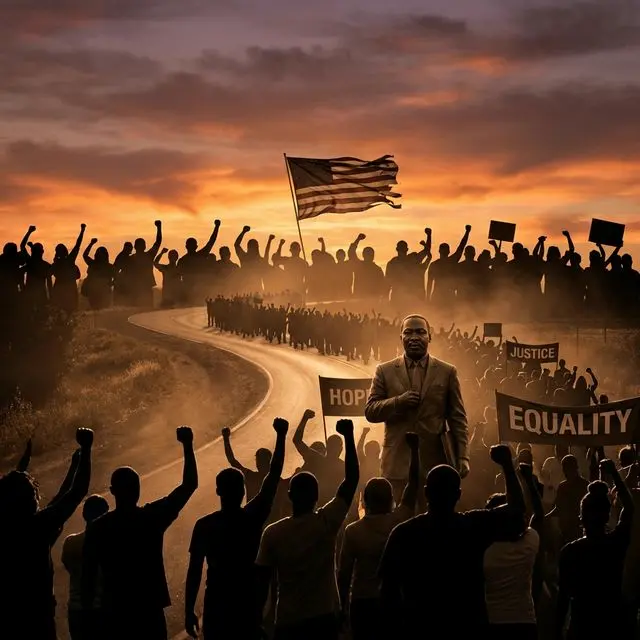
📋 Complete Profile
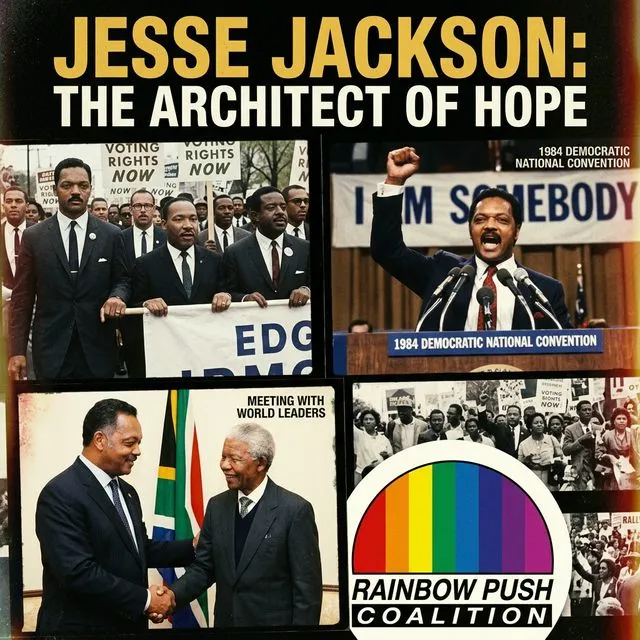
| Detail | Info |
|---|---|
| Full name | Jesse Louis Jackson Sr. |
| Born | October 8, 1941, Greenville, South Carolina 🇺🇸 |
| Died | February 17, 2026 (age 84) |
| Cause of death | Progressive supranuclear palsy (PSP) |
| Wife | Jacqueline Lavinia Brown (married since 1962) |
| Children | 5 children, including Jesse Jackson Jr. (former congressman) |
| Organization | Rainbow PUSH Coalition (founder) |
| Famous quote | "Keep Hope Alive" |
| Highest honor | Presidential Medal of Freedom (2000) |
| Education | North Carolina A&T, Chicago Theological Seminary |
🎒 Childhood and Education: Born Into Segregation
Jesse Jackson was born in Greenville, South Carolina, at the height of the Jim Crow era — a system of laws and customs that kept Black and white Americans segregated in every aspect of life. Born out of wedlock, he was raised by his mother, Helen Burns, and his stepfather, Charles Henry Jackson, whose surname he adopted.
From childhood, Jackson experienced the brutality of racial segregation firsthand. He couldn't drink from the same fountain as white children, couldn't sit in certain seats on the bus, and the city's public library was off-limits to Black people. These formative experiences shaped the man who would dedicate his entire life to fighting inequality.
In school, he excelled as an athlete (he was a quarterback in football) and as a speaker. He received an athletic scholarship to the University of Illinois but transferred to North Carolina A&T State University, a historically Black university, where he graduated in sociology in 1964. It was there that he became actively involved in the civil rights movement, organizing sit-ins at segregated restaurants and marches for equality.
Jackson later studied at the Chicago Theological Seminary, where he was ordained as a Baptist minister in 1968 — just months before the assassination of Martin Luther King Jr.
✊ With Martin Luther King Jr.: The Protégé
Jesse Jackson's relationship with Dr. Martin Luther King Jr. was fundamental in shaping the leader he would become. Jackson joined the Southern Christian Leadership Conference (SCLC) in the 1960s, working directly with King on his civil rights campaigns.
King quickly recognized Jackson's charisma and organizational ability, appointing him leader of Operation Breadbasket in 1966 — an innovative economic empowerment program that pressured white businesses to hire and do business with African Americans. The program was a remarkable success, negotiating agreements with major supermarket chains and companies that opened thousands of jobs for the Black community.
The Day That Changed Everything: April 4, 1968
Jesse Jackson was at the Lorraine Motel in Memphis, Tennessee, when Martin Luther King Jr. was assassinated on April 4, 1968. He was one of the members of King's closest circle on that fateful day. The experience marked Jackson profoundly and reinforced his determination to continue the fight that King had begun.
After King's assassination, Jackson became one of the most prominent voices of the civil rights movement, carrying his mentor's legacy into the following decades — adapting it for new struggles and new contexts.
🏛️ Building a Movement: Operation PUSH and Rainbow Coalition
After King's death, Jackson founded his own organizations to channel the energy of the civil rights movement into concrete action:
| Organization | Year | Mission |
|---|---|---|
| Operation PUSH | 1971 | "People United to Serve Humanity" — Economic empowerment, education and opportunity for Black communities |
| National Rainbow Coalition | 1984 | Progressive multiracial politics — uniting Black, Latino, Asian, Native American, women, LGBTQ+ and workers |
| Rainbow PUSH Coalition | 1996 | Merger of both organizations — the largest civil rights organization led by an African American |
Operation PUSH was revolutionary. Jackson didn't fight only for legal rights — he understood that real equality required economic power. The organization pressured American corporations to diversify their boards, hire minorities and do business with Black-owned companies. The results were tangible: billions of dollars in contracts and jobs directed to historically marginalized communities.
The Rainbow Coalition expanded the movement's scope, creating the vision of a multiracial coalition where all minorities would fight together for justice. Jackson coined the metaphor: "America is not a blanket woven from one thread, one color, one cloth. It is a quilt — many patches, many pieces, stitched together by a common thread."
🗳️ Presidential Campaigns: Breaking Barriers
Jesse Jackson's presidential candidacies were transformative moments in American politics.
1984: The First Run
| Aspect | Details |
|---|---|
| Result | 3rd place in Democratic primaries |
| Votes | 3.5 million — historic for a Black candidate |
| Delegates | 358 |
| Impact | Demonstrated that a Black candidate could be nationally competitive |
Jackson ran on a progressive platform: end apartheid in South Africa, reduce military spending, universal healthcare, workers' rights. Although he wasn't the nominee (Walter Mondale won the primary), the campaign stood out for registering over one million new Black voters and for placing racial justice issues at the center of the national debate.
1988: The Historic Campaign
| Aspect | Details |
|---|---|
| Result | 2nd place in primaries (behind Michael Dukakis) |
| Votes | 6.9 million — nearly double 1984! |
| Delegates | 1,218 |
| States won | 11 states + Washington D.C. + Puerto Rico + Virgin Islands |
| Impact | The most competitive campaign by a Black candidate until Obama in 2008 |
The 1988 campaign was phenomenal. Jackson won 11 states, including Michigan, and briefly led the race. His speech at the Democratic National Convention that year — where he coined the battle cry "Keep Hope Alive" — is considered one of the greatest political speeches in American history.
Jackson's electoral legacy is indisputable: without his 1984 and 1988 campaigns, Barack Obama likely would not have been elected president in 2008. Jackson paved the road, registered millions of voters and proved that America was ready — or at least moving toward — a Black president.
🌍 International Diplomacy: The Negotiator
Jackson didn't limit his work to American borders. He engaged in diplomatic missions that governments couldn't or wouldn't undertake:
- 1984: Traveled to Syria and personally negotiated with President Hafez al-Assad for the release of Lieutenant Robert Goodman, an American pilot shot down over Lebanon
- 1990: Negotiated the release of hundreds of American and foreign hostages held in Iraq and Kuwait during the Persian Gulf crisis, flying to Baghdad when the American government refused to negotiate
- 1999: Traveled to Yugoslavia during the Kosovo War and secured the release of three captured American soldiers
- Anti-apartheid: Led international campaigns against apartheid in South Africa, supporting Nelson Mandela years before the American government did the same
- Middle East: Consistently advocated for a peaceful solution to the Israeli-Palestinian conflict
🏅 Honors and Controversies
| Award/Recognition | Year |
|---|---|
| Presidential Medal of Freedom | 2000 (awarded by Bill Clinton) |
| NAACP Spingarn Medal | For lifetime achievement in civil rights |
| Presidential candidate in 2 elections | 1984 and 1988 |
| Registered millions of new voters | Decades of registration campaigns |
| 40 honorary doctorates | From universities around the world |
Like every public figure of great stature, Jackson also faced controversies — including an extramarital affair revealed in 2001 that resulted in a child born out of wedlock. He publicly acknowledged the mistake and asked for forgiveness. Critics also questioned his role on the day of King's assassination. But even his detractors recognize the magnitude of his contribution to civil rights.
💔 The Final Years
| Date | Event |
|---|---|
| 2017 | Revealed Parkinson's disease diagnosis |
| August 2024 | Appeared at the Democratic National Convention, still politically active |
| April 2025 | Diagnosed with progressive supranuclear palsy (PSP) |
| November 2025 | Hospitalized — family reported condition had stabilized |
| February 17, 2026 | Passed away at age 84 |
Even while ill, Jackson continued fighting. He appeared at protests against police racism, spoke at civil rights events and kept his voice active — though weaker — against injustice. His last significant public appearance was at the 2024 Democratic Convention, where he received a standing ovation from thousands of delegates.
📺 Impact on Culture and Media
Jesse Jackson was not just a political leader — he became a cultural figure who transcended the civil rights movement. His presence in American media was constant for over five decades, and his influence extended far beyond podiums and marches.
On Television and Film
Jackson was one of the first Black leaders to understand the power of mass media. He hosted the program "Both Sides with Jesse Jackson" on CNN in the 1990s, becoming one of the few African Americans to have an interview show on a major TV network. His ability to articulate complex issues of race and social justice for mainstream audiences helped shape the American public debate.
In popular culture, Jackson was referenced and parodied countless times. He appeared as himself on shows like Saturday Night Live, The Simpsons and South Park. While some portrayals were satirical, they demonstrated his cultural relevance — you only get parodied when you're important enough to be recognized by everyone.
The Rhetorical Legacy
Jackson was an extraordinary orator, heir to the tradition of Black Baptist preachers from the American South. His speeches combined musical cadence, rhythmic repetition and powerful metaphors. Beyond "Keep Hope Alive," he coined phrases that entered the American political vocabulary:
- "I am somebody" — an affirmation of dignity that became a mantra of Black empowerment
- "It's not the bark of the dog that bites, it's the dog that bites" — about the difference between rhetoric and action
- "Your children need your presence more than your presents" — about responsible fatherhood
Influence on Following Generations
Jackson's impact can be measured by the careers he inspired. Barack Obama publicly acknowledged that his 1984 and 1988 campaigns were fundamental in making the election of a Black president possible in 2008. Kamala Harris, the first Black and Asian-descent vice president, cited Jackson as one of her political inspirations. Cory Booker, Stacey Abrams and dozens of other Black political leaders grew up watching Jackson challenge the establishment and proving it was possible.
In the corporate world, Jackson's campaigns for diversity in American companies in the 1980s and 1990s planted the seeds of what we now know as DEI (Diversity, Equity and Inclusion) programs. Before those acronyms existed, Jackson was already pressuring corporations to diversify their boards and hire Black executives.
🌎 The Historical Context: Why Jackson Matters
To understand the magnitude of Jesse Jackson, you need to understand the America he lived in. When he was born in 1941, racial segregation was law in much of the United States. Black people couldn't vote in many Southern states, couldn't attend the same schools as white people, and lynchings were a brutal and frequent reality.
Jackson lived through the transition from segregated America to the America that elected a Black president. He didn't just witness this transformation — he was one of its principal architects. From Operation Breadbasket in the 1960s to presidential campaigns in the 1980s, from the Rainbow Coalition in the 1990s to supporting Obama in the 2000s, Jackson was at the center of every significant advance in American civil rights for over half a century.
His death in 2026 marks the end of an era. With Jackson, the last of the great leaders who marched alongside Martin Luther King Jr. and who dedicated their entire lives — not just a moment, not just a cause — to the fight for racial equality in America has departed.
💬 "Keep Hope Alive" — The Legacy
The phrase that defined Jesse Jackson — and that defined an entire movement. Born in segregated South Carolina, raised in poverty, he could have been just another victim of a system designed to oppress him. Instead, he became one of the most influential men in America without ever holding elected office.
Jackson taught us that hope is not passivity — it is action. That protesting is patriotism. That the fight for equality never ends, even when your body no longer allows you to march. That all people — Black, white, Latino, Asian, Indigenous — deserve dignity, opportunity and respect.
The Reverend has departed. But his hope? That lives on — in every march, every protest, every young activist who refuses to accept injustice as inevitable. ✊
❓ Frequently Asked Questions
What did Jesse Jackson die of?
Progressive supranuclear palsy (PSP), a rare neurological disease. He had also been battling Parkinson's since 2017. He passed away on February 17, 2026, at age 84.
What was Jesse Jackson's relationship with Martin Luther King Jr.?
Jackson was a direct protégé of MLK, working with him at the SCLC and as leader of Operation Breadbasket. He was at the Lorraine Motel when King was assassinated in 1968.
Was Jesse Jackson president?
No. He ran in the Democratic primaries in 1984 (3rd place) and 1988 (2nd place) but was never the nominee. His campaigns, however, paved the way for Barack Obama's election in 2008.
What was the Rainbow PUSH Coalition?
The Rainbow PUSH Coalition was created in 1996 through the merger of Operation PUSH (1971) and the National Rainbow Coalition (1984). The organization fights for economic empowerment, racial equality and social justice, pressuring American corporations to diversify their ranks and do business with minority-owned companies. Under Jackson's leadership, the organization negotiated billions of dollars in contracts and opportunities for historically marginalized communities.
What was Jesse Jackson's most famous speech?
His speech at the 1988 Democratic National Convention, where he coined the battle cry "Keep Hope Alive." The speech is considered one of the greatest in American political history, combining personal narrative, appeal for multiracial unity and a vision of social justice that moved millions of Americans.
By Hercules Gobbi — Historical and cultural analysis.
Last updated: February 17, 2026
#JesseJackson #CivilRights #RIP #KeepHopeAlive #MartinLutherKingJr #RainbowPUSH #History #PopCulture