
Giant Freshwater Reservoir Discovered Under America's Saltiest Lake
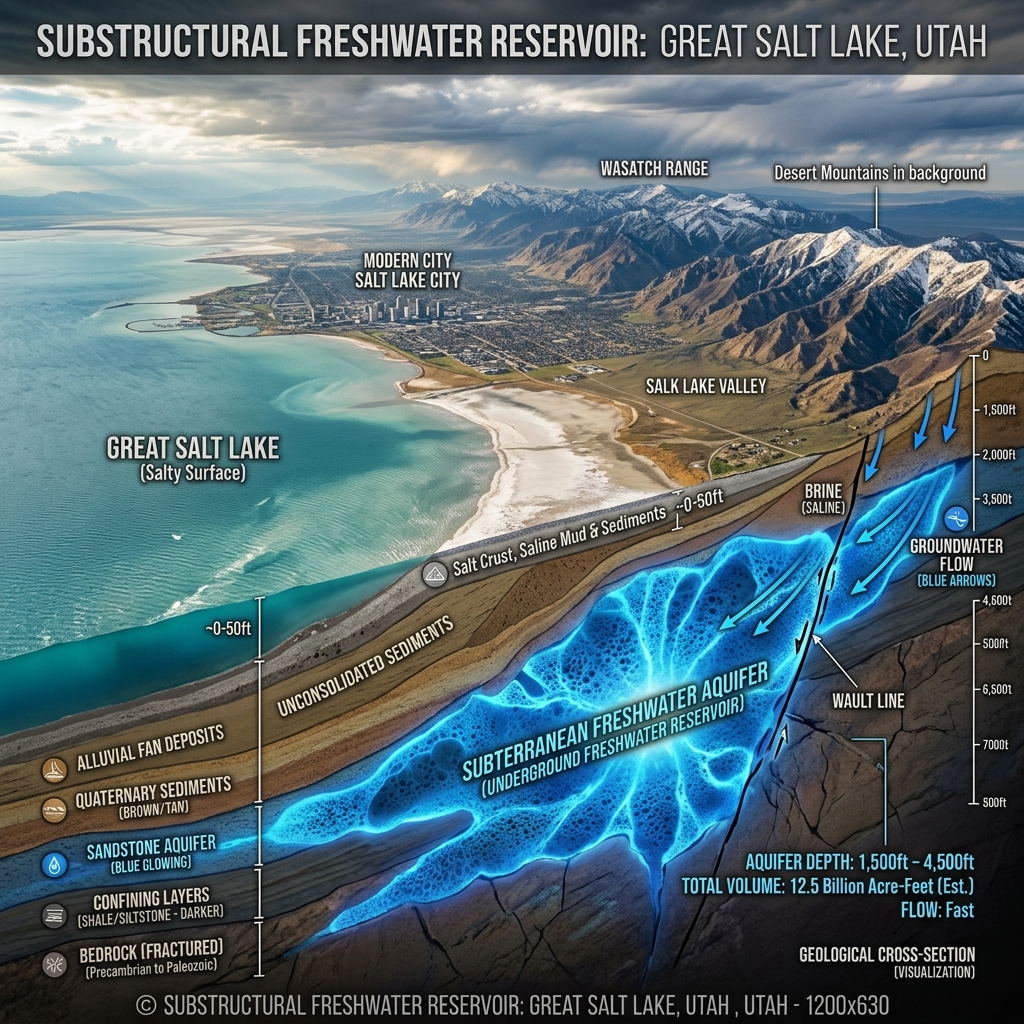
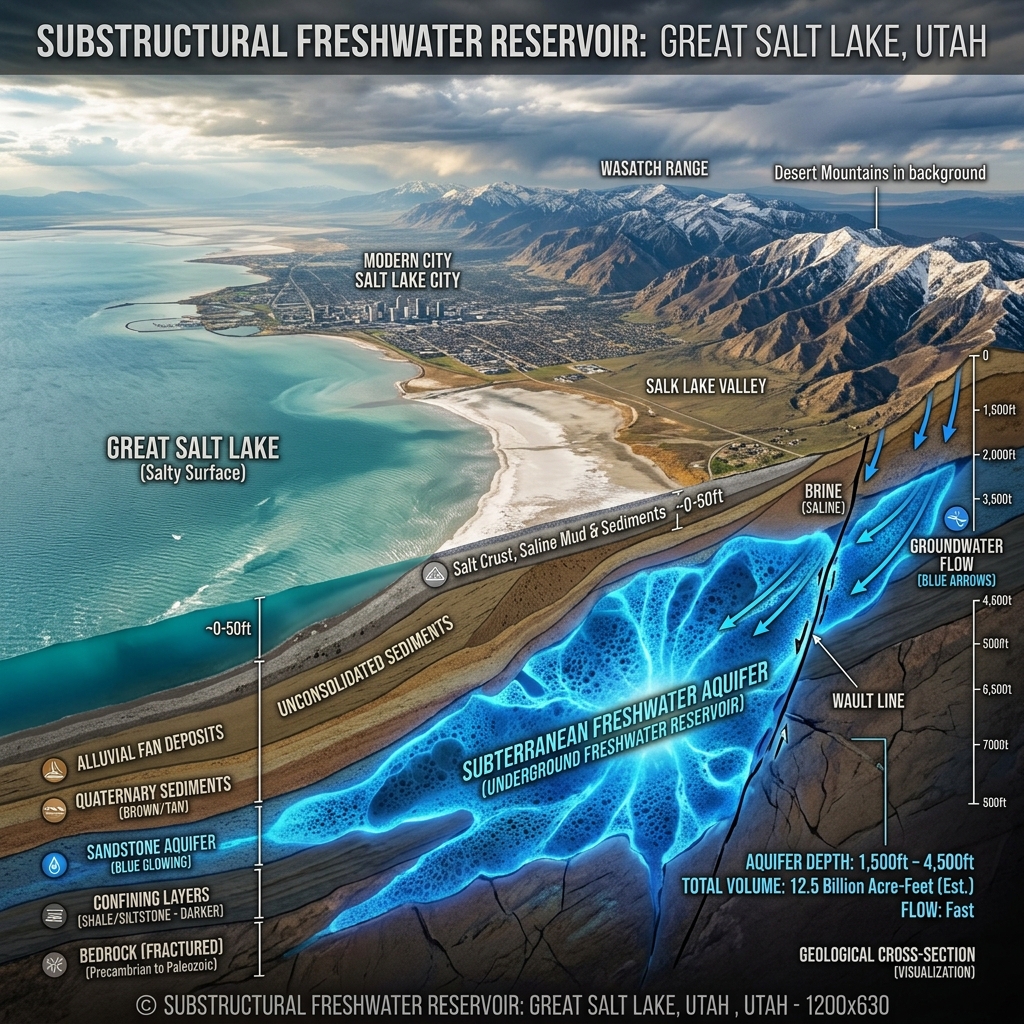
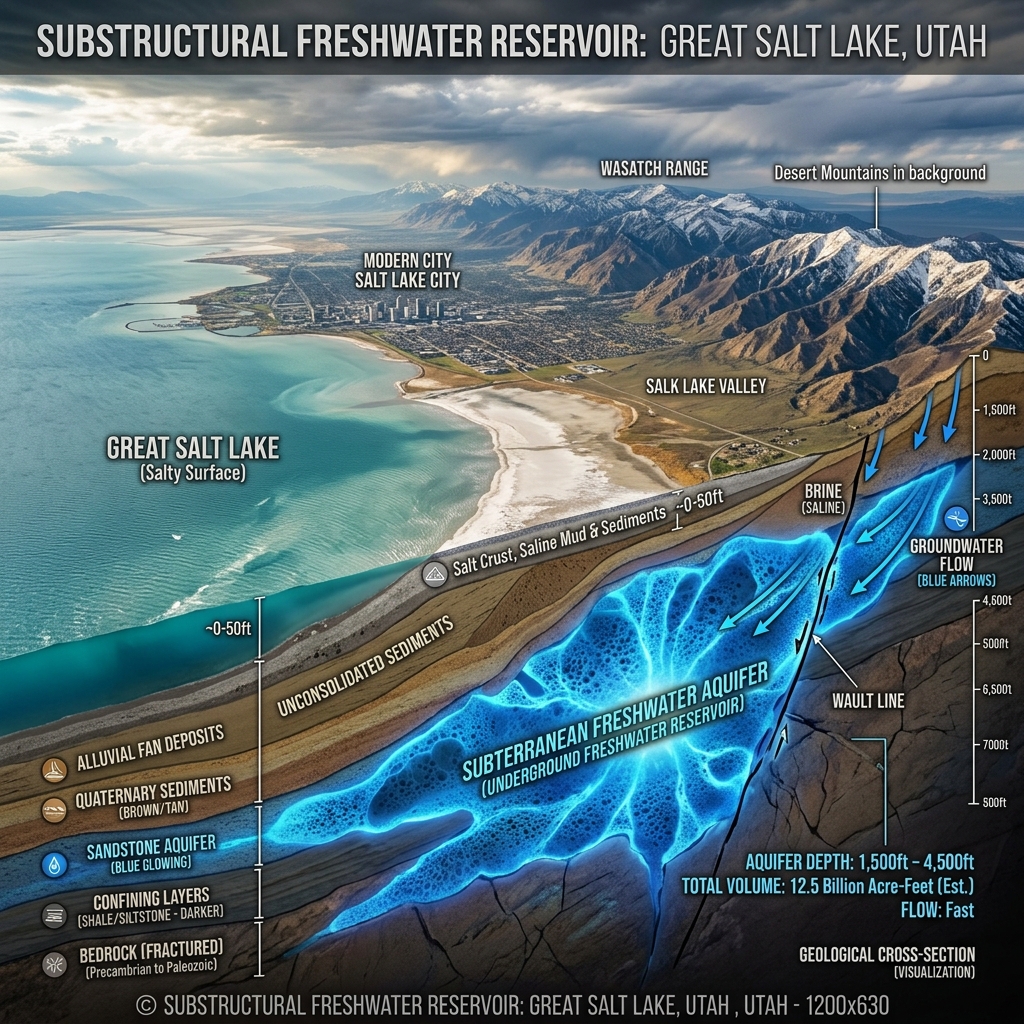
At 4 kilometers deep, beneath a surface so salty that no fish survives, scientists have just found one of the largest freshwater reservoirs ever documented in North America. The paradox is almost poetic: the Great Salt Lake of Utah — famous for being the largest hypersaline lake in the Western Hemisphere — hides beneath its bed a reserve of pure water that has been there for millennia, silently fed by the Wasatch Mountains.
The discovery, published in February 2026 in Scientific Reports, was made by researchers from the University of Utah using airborne electromagnetic surveys — a technology that literally involves flying over the lake in a helicopter, firing electromagnetic pulses into the ground and "reading" the responses from geological layers below.
The results reveal porous sediments saturated with freshwater extending to 3 to 4 kilometers in depth beneath the lake's eastern margin, in the regions of Farmington Bay and Antelope Island. And here's the most provocative detail: the researchers mapped only a fraction of the total lake. The actual reservoir may be significantly larger.
The Great Salt Lake: A Giant in Agony
To understand the importance of this discovery, one must know the crisis the Great Salt Lake faces. The lake has lost 73% of its water volume since 1987. In 2022, it hit its lowest level ever recorded, exposing vast stretches of dry lake bed — and with it, an invisible threat: toxic dust contaminated with arsenic and mercury that can be carried by wind to Salt Lake City, home to 1.2 million people.
Crisis numbers
| Indicator | 1987 | 2022 (minimum) | 2026 |
|---|---|---|---|
| Surface area | 8,549 km² | 2,650 km² | ~3,100 km² |
| Elevation | 1,283.5 m | 1,277.5 m | ~1,278.8 m |
| Estimated volume | 26.7 km³ | 7.4 km³ | ~9 km³ |
| Salinity | 15% | 19% | ~17.5% |
The primary cause is the diversion of tributary rivers for agricultural irrigation and urban consumption. The Bear River, Weber River, and Jordan River — which historically fed the lake — have had their flows reduced by 50-70% over the past 40 years.
The Discovery: How They Did It
The helicopter that "sees" underground water
The University of Utah team used a technique called AEM (Airborne Electromagnetic Survey). The equipment works like this:
- A helicopter-mounted transmitter emits electromagnetic pulses toward the ground
- The waves penetrate hundreds to thousands of meters into the subsurface
- A receiver on the helicopter measures the reflected electromagnetic field
- Electrical conductivity reveals material composition: saltwater conducts very well, freshwater moderately, dry rock barely at all
Using this technique, researchers created a three-dimensional map of the subsurface beneath the Great Salt Lake, clearly differentiating the salty surface water from the deep freshwater.
What they found
Below the salty surface, the mapping revealed an unexpected geological structure: the bedrock presents a deep depression — like an underground valley — creating enormous space filled with porous sediments saturated with freshwater.
The freshwater was found at depths of 3 to 4 km in the surveyed areas. The team estimates this water has accumulated over thousands of years, fed by infiltration from the Wasatch Mountains.
The clue that led to the discovery
What initially caught the researchers' attention was the presence of "phragmites mounds" — isolated clusters of reeds (Phragmites australis) growing on the exposed lake bed. These reeds need freshwater to survive. Their spontaneous growth in a hypersaline environment suggested freshwater was rising to the surface from an underground source — exactly what the survey confirmed.
How Much Water Are We Talking About?
The researchers are cautious in their estimates, as only a fraction of the eastern margin was mapped. But preliminary numbers are impressive: the mapped area suggests a freshwater volume potentially comparable to several years of Utah's consumption.
For context:
| Water source | Approximate volume |
|---|---|
| Great Salt Lake (surface) | ~9 km³ (saltwater) |
| Lake Michigan (comparison) | 4,920 km³ (freshwater) |
| Utah annual consumption | ~4.5 km³ |
| Ogallala Aquifer (total) | ~3,608 km³ |
| Discovered reservoir (partial est.) | Significant (to be quantified) |
The Global Context: The American West Is Drying
The discovery gains urgency in the context of the megadrought affecting the Western United States. This drought, which began in 2000 and has persisted for 26 years, is the most severe in at least 1,200 years, according to tree-ring data published in Nature Climate Change.
Other lakes and reservoirs in crisis
- Lake Mead (Nevada/Arizona): Level dropped 50 meters since 2000, threatening water supply for Las Vegas, Phoenix, and Los Angeles
- Lake Powell (Utah/Arizona): Hit "dead pool" in 2023 and hasn't fully recovered
- Colorado River: The 1922 compact that divided the river's water among 7 states and Mexico was based on data from an abnormally wet period
Water rights and politics
The discovery raises immediate legal and political questions:
- Water rights: Who "owns" an underground reservoir extending beneath a public lake?
- Extraction vs. conservation: Pumping water from 3-4 km deep is technically possible but expensive, and recharge from long-term sedimentation is slow
- Lake impact: If the underground freshwater partially sustained the lake bed ecosystem, its extraction could accelerate the Great Salt Lake's degradation
AEM Technology: How a Helicopter Changed Hydrology
The use of airborne electromagnetic surveying is revolutionizing how scientists map underground water resources. Traditional groundwater prospecting relied on exploratory drilling — an expensive, slow, and invasive method providing point data. An exploratory well can cost between $50,000 and $500,000 and reveals information only about the geology immediately around the hole.
AEM, conversely, allows mapping hundreds of square kilometers in days. The equipment transmits pulses that penetrate up to several kilometers into the subsurface.
The cost-benefit
The Great Salt Lake AEM survey cost approximately $500,000 — a tiny fraction of what drilling dozens of exploratory wells would cost. And AEM provides a continuous three-dimensional map, not isolated points.
This cost-benefit ratio is particularly relevant for developing countries facing water crises. The UN Environment Programme (UNEP) has funded AEM surveys in 12 African countries since 2018, resulting in discovery of previously unknown aquifers in Kenya, Ethiopia, Somalia, and Mozambique.
Implications for 21st Century Water Management
The discovery arrives at a critical moment. The UN estimates that 2.3 billion people live in water-stressed countries, and this number should reach 3.5 billion by 2030. Meanwhile, global freshwater demand grows 1% annually.
"Invisible water" could change the game
Geohydrologists call "invisible water" the underground water resources that don't appear on traditional maps. An estimated 23 million km³ of underground freshwater exists on the planet — approximately 100 times the volume of all surface lakes and rivers combined.
The problem was never the lack of freshwater on the planet — it was the lack of technology to find it and access it sustainably. Discoveries like Utah's suggest that available water resources may be significantly larger than current models assume.
But the keyword is sustainable. Pumping water accumulated over millennia without understanding recharge rates is a recipe for disaster — as happened with the Ogallala Aquifer, which feeds agriculture across the Great Plains and is being drained 6 times faster than it naturally recharges.
FAQ — Frequently Asked Questions
Can the reservoir water be used for human consumption?
In principle, yes. Deep underground freshwater is generally of excellent quality, having undergone natural filtration through rock and sediment layers over thousands of years. However, before any use, comprehensive chemical analyses, environmental impact studies, and development of pumping infrastructure at 3-4 km depth would be needed — technically possible but costly, similar to oil well drilling technology.
Could extracting this water cause subsidence (ground sinking)?
This is a legitimate concern. Extracting large volumes of groundwater can cause sediment compaction and surface subsidence — as happened in Mexico City (which sank up to 50 cm/year in some areas). The extreme depth of this reservoir (3-4 km) may reduce the risk of measurable surface subsidence, but geomechanical models would be needed to confirm.
Could other salt lakes worldwide have similar reservoirs?
This is a real possibility. Salt lakes in endorheic basins (without ocean outlet) frequently exist in geological regions with complex underground structures. The Dead Sea (Israel/Jordan), Lake Urmia (Iran), and the Aral Sea (Kazakhstan/Uzbekistan) — all in severe water crisis — could be candidates for similar AEM surveys. The technology is relatively accessible (~$50,000/day of operation), and the potential information justifies the investment.
How long has this water been accumulating?
Researchers estimate the reservoir water is thousands to tens of thousands of years old, gradually accumulated through rainwater infiltration and snowmelt from the Wasatch Mountains. Isotopic analyses (carbon-14 and tritium) will determine the exact age, which is crucial for estimating recharge rates and sustainability of any future use.
Sources and References
- University of Utah — "Freshwater Reservoir Discovered Beneath Great Salt Lake" — Scientific Reports, February 2026
- SciTechDaily — "Massive Freshwater Reservoir Found Under World's Saltiest Lake" — March 2026
- Futurism — "Scientists find enormous freshwater reservoir beneath Great Salt Lake" — February 2026
- ScienceAlert — "Freshwater at depths extending to 3-4 km identified under Great Salt Lake" — February 2026
- U.S. Geological Survey (USGS) — "Great Salt Lake Water Level Data 2000-2026"


