
World Happiness Report 2026: Social Media Is Destroying a Generation's Mental Health
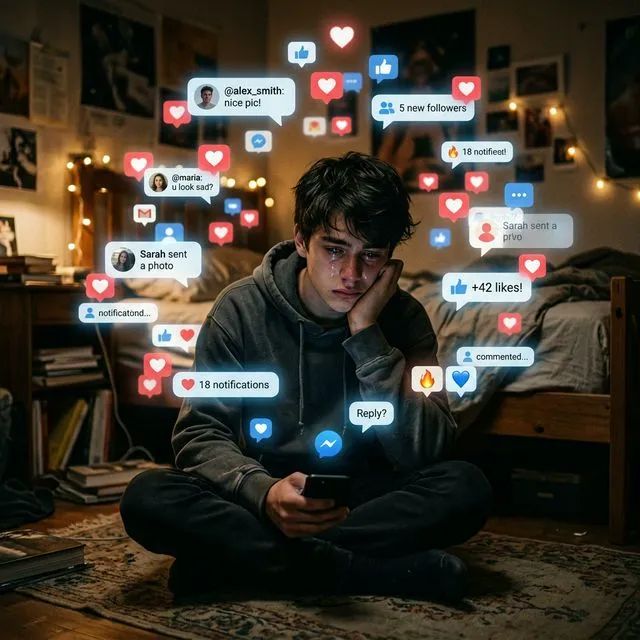
March 20, 2026 — International Day of Happiness. The date should be a celebration. Instead, this year's World Happiness Report delivers a brutal diagnosis: humanity is becoming unhappier, and the main culprit has an icon on your phone.
For the first time in 14 editions of the report, the analysis dedicates an entire chapter to the impact of social media on global mental health — and the results are devastating.
The Data Nobody Wanted to See
The World Happiness Report is published by the UN Sustainable Development Solutions Network (UN SDSN), with data from Gallup surveys in 143 countries, covering 98% of the world's population. This isn't guesswork. These are numbers.
The 2026 Rankings: Who's Happy (and Who Isn't)
| Rank | Country | Score (0-10) | Change vs 2025 |
|---|---|---|---|
| 1 | 🇫🇮 Finland | 7.74 | = (9th consecutive year) |
| 2 | 🇩🇰 Denmark | 7.58 | ↑1 |
| 3 | 🇮🇸 Iceland | 7.53 | ↓1 |
| 4 | 🇨🇭 Switzerland | 7.47 | = |
| 5 | 🇳🇱 Netherlands | 7.41 | ↑1 |
| 49 | 🇧🇷 Brazil | 6.27 | ↓3 |
| 141 | 🇦🇫 Afghanistan | 1.72 | ↓2 |
| 142 | 🇱🇧 Lebanon | 1.65 | ↓4 |
| 143 | 🇸🇾 Syria | 1.38 | new entry |
The Bombshell Finding: The "Social Media Effect"
Chapter 5, titled "The Social Media Paradox: Connection, Comparison, and the Collapse of Wellbeing", presents data from a mega-study with 2.1 million respondents across 78 countries between 2020 and 2025.
Key conclusions:
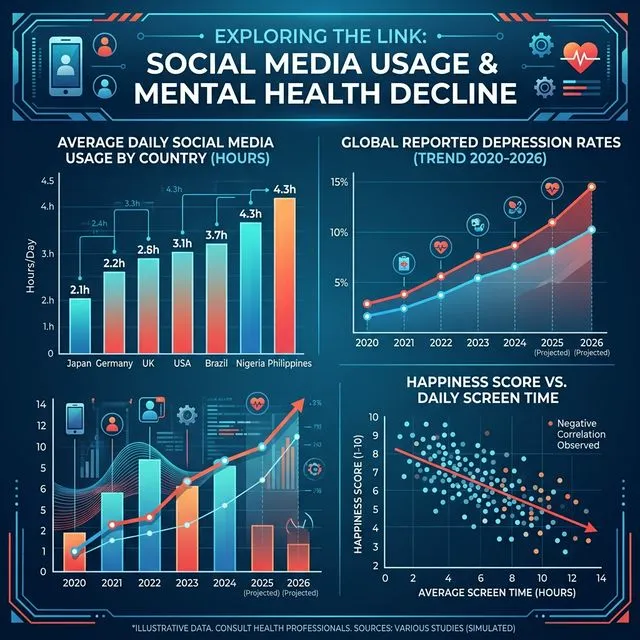
Young people aged 15-24 who use social media more than 3 hours daily have a 47% higher risk of developing depressive symptoms compared to those using less than 1 hour.
For every additional hour of daily social media use, life satisfaction drops by an average of 0.18 points on the WHO-5 scale (0-10).
Instagram is the platform most associated with body image issues and anxiety.
TikTok is most associated with attention deficit and reduced capacity for sustained concentration.
The effect is strongest in middle-income countries — including Brazil, Mexico, Turkey, Indonesia, and the Philippines — where usage is intense but mental health systems are precarious.
The Silent Epidemic: Numbers That Hurt
Global Mental Health in 2026
| Indicator | Youth (15-24) | Adults (25-64) | Change vs 2020 |
|---|---|---|---|
| Diagnosed depression | 18.3% | 11.2% | +67% (youth) |
| Clinical anxiety | 22.1% | 14.7% | +54% (youth) |
| Suicidal ideation | 8.9% | 3.4% | +38% (youth) |
| Chronic loneliness | 41% | 22% | +89% (youth) |
| Average daily social media use | 4h42min | 2h18min | +31% (youth) |
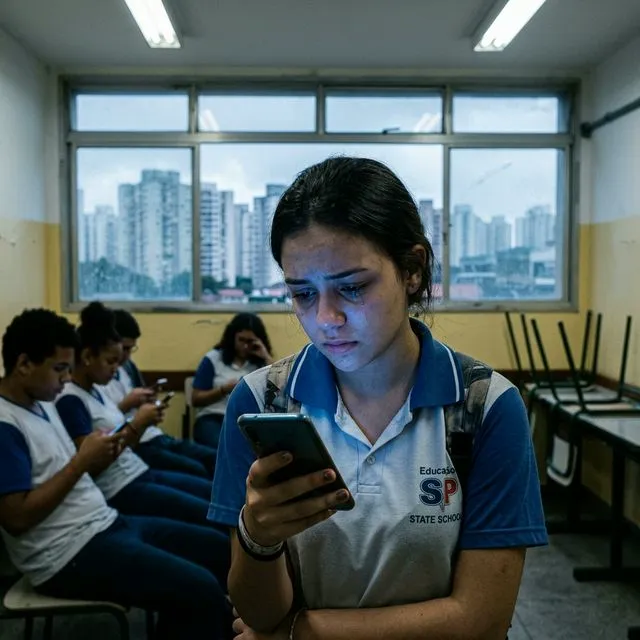
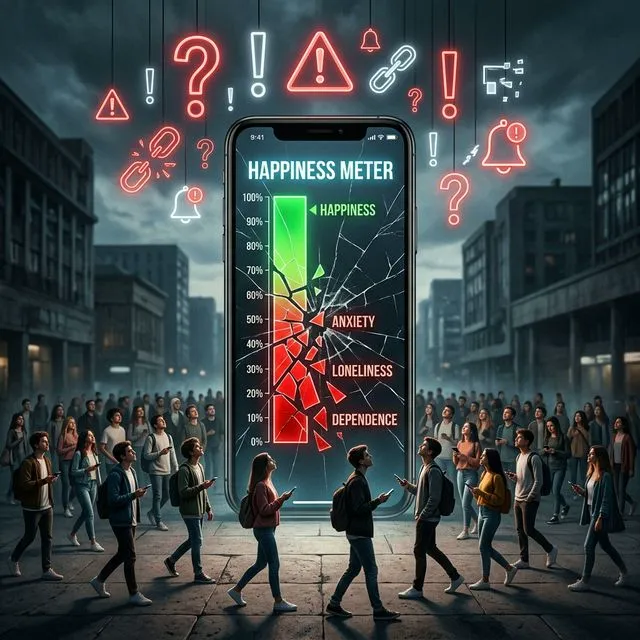
41% of young people between 15 and 24 feel chronically lonely. In an era of 5 billion internet users, nearly half the world's youth feels alone.
Social psychologist Jonathan Haidt, author of The Anxious Generation, describes the phenomenon as "the Great Rewiring of Childhood": between 2010 and 2015, childhood based on outdoor play was replaced by childhood based on screens. The consequences are showing up now.
Why Social Media Makes Us Unhappy: The Science
It's not lack of willpower. It's design. Social media platforms were engineered to be addictive, and the side effect of that addiction is unhappiness.
The 4 Mechanisms of Harm
1. Perpetual Social Comparison
Humans naturally compare themselves with peers — it's evolutionary. But social media puts you in comparison with 7 billion curated highlights. You compare your real life with everyone else's edited life. Guaranteed result: "my life is worse."
2. Dopamine Slot Machine
Every notification, like, and comment triggers a micro-dose of dopamine. The same mechanism as slot machines. The infinite scroll feed is the digital equivalent of a gambling machine that never stops.
3. Attention Fragmentation
Humans need periods of deep thought to process emotions, solve problems, and create meaning. Social media fragments attention into 15-60 second blocks. Result: inability to process complex emotions.
4. Cyberbullying and Cancel Culture
38% of young people have been targets of cyberbullying (UNESCO 2025 data). The permanence of online content means trauma is accessible 24 hours, forever. There's no escape.
What the Happiest Countries Do Differently
| Factor | Finland | Brazil | Difference |
|---|---|---|---|
| Trust in government | 68% | 12% | -56 pp |
| Social support network | 95% | 61% | -34 pp |
| Daily social media use | 1h52min | 3h37min | +1h45min |

What to Do: Report Recommendations
The report's 8 main recommendations:
- Ban push notifications for under-16s
- Ban algorithmic feeds for minors — showing only chronological content
- Create mandatory "Digital Literacy" in elementary schools
- Require mental health audits for platforms with 100M+ users
- Fund independent research on AI and algorithms' cognitive impact
- Expand public mental health access
- Implement "ethical design" — ban dark patterns in apps for minors
- Create institutional "digital disconnection days"
The Uncomfortable Question
The report ends with a question that should haunt the entire tech industry:
"If a chemical substance caused the same effects on children's and adolescents' mental health that social media has been shown to cause, it would be immediately banned. Why do we accept this from a screen?"
The Impact on the Workplace
The mental health crisis doesn't stop at the office door. It walks in, sits down, and destroys productivity.
The Corporate Costs
The report includes, for the first time, economic impact estimates:
- Productivity loss from social media-related mental health issues: $1.3 trillion globally in 2025 (WHO)
- Absenteeism: employees with excessive social media use miss an average of 8.5 more days per year
- Presenteeism (present but unproductive): workers who check social media more than 30 times daily lose 2.1 hours of productivity per day
- Turnover: companies report Gen Z employees with digital burnout resign 2.3x more than colleagues with moderate social media use
Companies That Changed Course
Some corporations have started to act:
- SAP: implemented "quiet hours" (no internal notifications) between 12-2pm and after 6pm. Result: 19% increase in employee satisfaction and 12% in productivity.
- Patagonia: banned social media on corporate devices and offers paid quarterly "digital detox retreats."
- Unilever: adopted a "Slack-free Friday" policy — no internal messages on Fridays, promoting deep, focused work.
- Basecamp: eliminated all social media integration from internal tools and reported a 23% improvement in employee focus metrics.
The McKinsey Global Institute estimates that companies implementing comprehensive digital wellness programs see an average ROI of $4.20 for every $1 invested — primarily through reduced turnover and increased engagement.
The Digital Detox Movement
While governments legislate slowly, a counterculture is growing from the ground up.
Global Trends
The "Dumbphone Movement" (basic phone movement) has gained surprising momentum in 2025-2026:
- Feature phone sales (phones without apps) grew 47% in Europe and 31% in the US among 18-30 year-olds
- The Light Phone brand (minimalist phone, only calls and texts) sold 2.3 million units in 2025 — a record
- In Japan, the concept of "Digital Minimalism" (coined by Cal Newport) became mandatory curriculum in 200 schools
- In South Korea, digital detox clinics treated 48,000 patients in 2025 — triple from 2023
- In the US, the "Phone-Free Schools" movement has been adopted by over 3,000 school districts, with students reporting improved concentration and social skills
The Rise of Analog Activities
A parallel trend is emerging: young people are actively seeking analog experiences:
- Board game sales increased 34% globally in 2025 (Hasbro/Mattel data)
- Book sales (physical, not e-books) reached a 15-year high, particularly among 18-30 year-olds
- Film photography experienced a revival, with Kodak reporting 400% growth in film sales since 2019
- "No-phone dinner" restaurants in New York, London, and Tokyo charge premium prices and have months-long waitlists
- Handwritten letter services like LettrLove and Penify saw 800% user growth in 2025
The Nordic Approach
The happiest countries don't just regulate — they actively build alternatives:
- Finland: mandates 15 minutes of outdoor play for every 45 minutes of class, even in -20°C weather. Finnish children average only 1h22min of daily screen time — the lowest in the OECD.
- Denmark: the concept of "hygge" (cozy togetherness) is culturally embedded and explicitly anti-digital. Danish families report spending 2.3x more time in face-to-face social activities than the OECD average.
- Iceland: the "Youth in Iceland" program, started in 2000, reduced teen substance abuse by offering organized sports and arts. The same model is now being applied to digital overuse, with remarkable results.
The Final Paradox
The report closes with a revealing paradox: the countries that regulate social media the most are the same ones that lead the happiness ranking. Finland, Denmark, Norway, Iceland — all have implemented significant restrictions on minor social media use, invested in digital education, and prioritized face-to-face contact over virtual interaction.
The correlation is not coincidence. It's causation. And science finally has the data to prove it.
The question is no longer "whether" social media harms mental health. The question now is: how much longer will we accept this?
FAQ
Should I delete my social media?
The report doesn't recommend total elimination, but conscious use: maximum 30-60 minutes daily, disable push notifications, never use social media 1 hour before bed, and prefer direct interactions (messages) over passive feed consumption.
Should children have smartphones?
The report supports the US Surgeon General's recommendation (2024): no social media for children under 13, limited and monitored use between 13-16, and gradual freedom from 16.
Can platforms be held liable?
Legally, the trend is yes. Meta faces lawsuits in 42 US states. The EU implemented fines up to 6% of global revenue for Digital Services Act violations.
Do social media cause depression, or do depressed people use more social media?
The report directly addresses this with causality studies (not just correlation). Randomized controlled trials in 12 countries showed that reducing social media use to 30 min/day for 3 weeks produced significant improvements in depression, anxiety, and loneliness — indicating the relationship is largely causal.
Which country improved the most in the ranking?
Costa Rica rose 7 positions (from 23rd to 16th), attributed to a national community mental health program and the "Pura Vida" culture — a life philosophy that prioritizes in-person relationships and contact with nature.
Can technology itself be part of the solution?
Paradoxically, yes. Apps like Forest (gamifies phone-free time), Opal (blocks distracting apps), and BeReal (encourages authentic posting) represent a growing "tech for wellbeing" movement. The key distinction is whether technology is designed to capture attention or to enhance real-life experience.
What's the economic case for action?
The WHO estimates that every $1 invested in mental health treatment returns $4 in improved health and productivity. Countries that have invested heavily in public mental health (like Australia's "Better Access" program) have seen measurable improvements in national wellbeing scores within 3-5 years.
Is social media really worse than TV was for previous generations?
Yes, according to the data. The key difference is interactivity and personalization. Television was passive and broadcast the same content to everyone. Social media algorithms create personalized echo chambers that amplify insecurity, comparison, and fear of missing out (FOMO). Additionally, TV had natural breaks; social media's infinite scroll is specifically designed to prevent disengagement. Studies show that the dopamine response from social media validation (likes, comments) is 2-3x stronger than the passive entertainment response from watching television.
What role does AI play in making social media more harmful?
The report devotes an entire chapter to AI-driven content curation. The core finding: AI recommendation algorithms have become so sophisticated that they can identify and exploit individual psychological vulnerabilities. For a teenager with body image issues, the algorithm will surface increasingly extreme content about weight and appearance. For someone with anxiety, it will surface alarming news and worst-case scenarios. The report calls this "algorithmic radicalization of vulnerability" — and argues it represents a fundamentally new threat to mental health that didn't exist even five years ago.
How does Brazil rank specifically?
Brazil ranked 49th overall (down from 44th in 2025), with particularly concerning scores in digital wellbeing. Brazilian teenagers average 4h12min of daily social media use — one of the highest globally. The country lacks comprehensive digital education programs, and the regulatory framework for platform accountability is still in early development. However, Brazil scored relatively well in social connection and community bonds, suggesting that its strong cultural emphasis on family and friendship provides some protection against the worst effects of digital isolation.
Sources and References
- World Happiness Report 2026 — UN SDSN / Gallup World Poll
- Jonathan Haidt — The Anxious Generation (Penguin Press, 2024)
- Meta Internal Research — Instagram and Teen Mental Health (2021-2025)
- Pew Research Center — "Teens, Social Media and Technology 2025"
- WHO — Global Health Estimates: Suicide Data 2025
- Microsoft Attention Spans Research (2024 update)
- UNICEF — "The State of the World's Children: Digital Childhoods" (2025)
- Cal Newport — Digital Minimalism (Portfolio, 2019)
- McKinsey Global Institute — "Workplace Mental Health and Productivity" (2025)
- European Union — Digital Services Act 2.0 Implementation Report
- US Surgeon General — Advisory on Social Media and Youth Mental Health (2024)


