
The "Jerk" Method: The New Science That Can Predict Volcanic Eruptions Hours Early
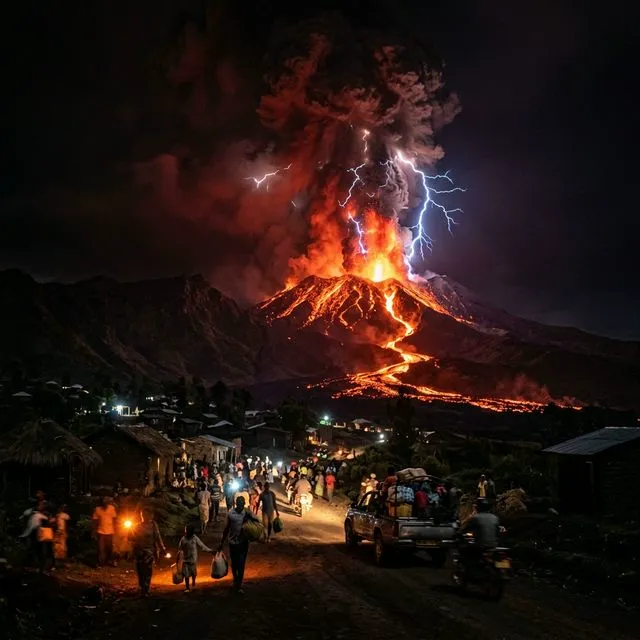
On March 1, 2019, the Piton de la Fournaise volcano on the French island of Réunion in the Indian Ocean was preparing for an eruption. Seismographs around the volcano were picking up the usual tremors — but an experimental algorithm detected something conventional instruments didn't see: a subtle change in the ground's acceleration rate, so delicate it was invisible to the naked eye in the data. Seven hours later, the volcano erupted exactly as the algorithm predicted. That algorithm is called "Jerk" — and a study published in March 2026 in the journal Science demonstrates it can predict volcanic eruptions with up to 8 hours advance notice and 85% accuracy. If it works at a global scale, it could save the lives of over 800 million people living in the danger zones of active volcanoes.
The search for a reliable volcanic prediction method dates back centuries. Unlike earthquakes — which, to this day, remain essentially unpredictable — volcanic eruptions offer precursor signs that could theoretically be read with enough advance notice to evacuate entire populations. The problem has always been separating those signs from the background noise of normal seismic activity. The Jerk method promises to be the missing key to solving this enigma.
What Is "Jerk"?
The Physics Behind the Name
In physics, "jerk" is the rate of change of acceleration — that is, the second derivative of velocity, and the third derivative of position. If position is "where you are," velocity is "how fast you move," acceleration is "how quickly that speed changes," and jerk is "how quickly the acceleration changes."
To better understand, imagine you're inside a car. When the car is stopped, your position is fixed. When it starts moving, there's velocity. When the driver presses the accelerator, there's acceleration — you feel your body being pushed back into the seat. But jerk is the exact moment the driver presses the accelerator: not the acceleration itself, but the change in acceleration. It's that instant when the car goes from "moving smoothly" to "accelerating hard." That moment of transition is what scientists are measuring in the Earth's crust.
| Quantity | Definition | Analogy | Unit |
|---|---|---|---|
| Position | Where the ground is | Car stopped | meters (m) |
| Velocity | How fast the ground moves | Car going 60 km/h | m/s |
| Acceleration | How fast velocity changes | Car accelerating | m/s² |
| Jerk | How fast acceleration changes | The "stomp" on the gas | m/s³ |
Why Jerk Is Different
In the volcanic context, jerk detects the exact moment magma changes behavior: when it goes from "slowly flowing underground" to "pushing with increasing force toward the surface." It's this change in regime — imperceptible in conventional velocity and acceleration data — that the method captures.
Traditional volcanic monitoring methods focus on more "raw" signals: seismic tremors (frequency and amplitude), ground deformation (measured by GPS and InSAR), and gas emissions (SO₂ and CO₂). These indicators are valuable but suffer from a fundamental problem: they measure states, not transitions. A volcano can show intense tremors for months without erupting, or can explode with relatively few prior signs.
Jerk, on the other hand, measures exactly the transition — the moment the volcano's internal dynamics qualitatively change. In mathematical terms, it's like the difference between knowing a river is flowing fast (velocity) and detecting the instant it starts to accelerate non-linearly, indicating that a dam upstream is about to break.
The History of Volcanic Prediction
Centuries of Attempts and Failures
Humanity has been trying to predict volcanic eruptions since antiquity. The Romans noticed animals fleeing Vesuvius before eruptions — an observation that, while anecdotal, contains a grain of truth, since many animals are sensitive to changes in air composition. However, this "prediction" was never reliable enough to base evacuations on.
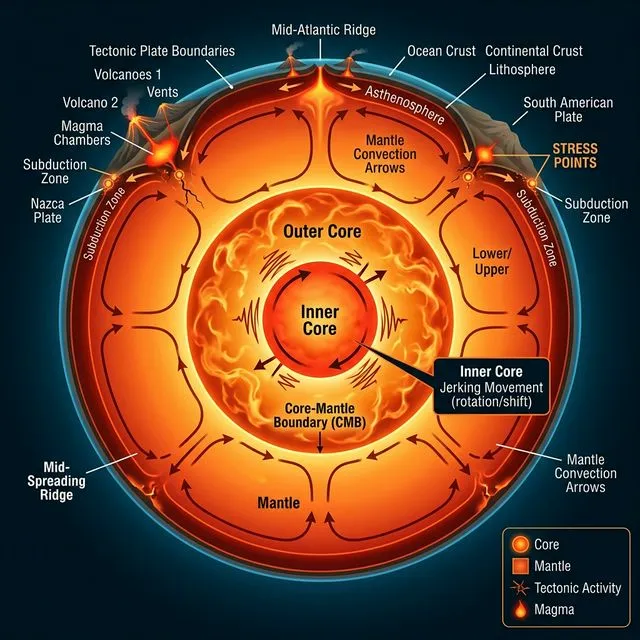
Modern scientific monitoring began in the early 20th century, with the installation of the first seismographs on active volcanoes. The eruption of Mont Pelée in Martinique (1902), which killed 30,000 people in seconds, was a catalyst — it showed the world that the lack of warning systems cost lives on an industrial scale.
Since then, volcanology has evolved enormously. Modern volcanologists rely on seismograph networks, GPS deformation sensors, gas spectrometers, thermal cameras, observation satellites, and even drones equipped with LIDAR sensors. Even so, the rate of reliable prediction remained frustratingly low. A 2018 study published in the Journal of Volcanology and Geothermal Research estimated that only 30-50% of eruptions are predicted with enough advance notice to allow organized evacuation.
The False Alarm Problem
Just as serious as not predicting an eruption is generating false alarms. Each unnecessary evacuation costs millions of dollars, generates distrust in the population, and can lead governments to ignore future alerts — with fatal consequences. The most emblematic case is Mount Pinatubo in the Philippines (1991): the eruption was correctly predicted and 58,000 people were evacuated, saving tens of thousands of lives. But the evacuation only worked because scientists had weeks of clear data pointing to an imminent eruption — a luxury most volcanic events don't offer.
How It Works in Practice
The Algorithm in 4 Steps
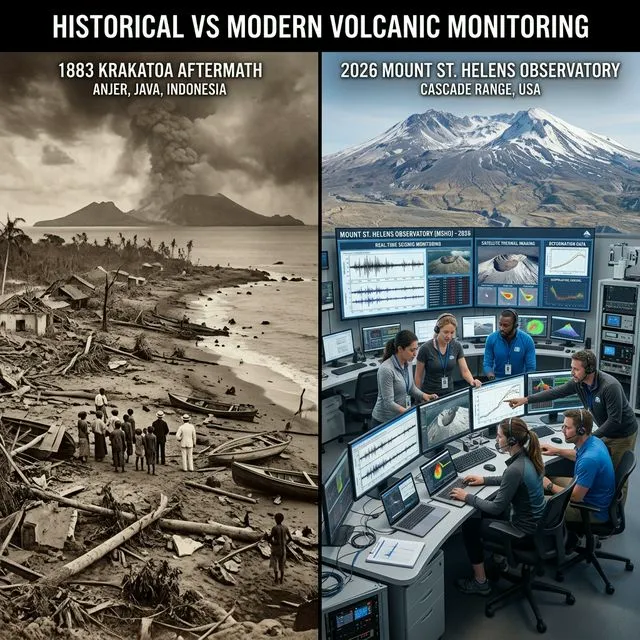
The Jerk method, as described in the study published in Science, follows a precise data processing sequence:
Continuous data collection: High-sensitivity seismographs installed around the volcano continuously measure ground movement, generating thousands of measurements per second. Unlike conventional seismographs that focus on discrete events (earthquakes), the Jerk system processes the continuous stream of micro-vibrations.
Real-time jerk calculation: The algorithm calculates the third derivative of position data — extracting the "jerk" from background seismic noise. This step is computationally intense: it requires processors capable of performing trillions of operations per second to keep up with the real-time data stream, which only became feasible with recent advances in GPU parallel processing.
Statistical threshold anomaly detection: When jerk exceeds a specific statistical threshold — carefully calibrated for each volcano based on its eruptive history — the system automatically generates an alert. Calibration involves analyzing decades of seismic data to determine "normal behavior" versus "pre-eruptive behavior" for each volcano, a task requiring months of computational work for each new volcano added to the system.
Eruption time estimation: Based on the intensity, duration, and temporal pattern of the jerk signal, the algorithm estimates the probable time until eruption (typically between 2 and 8 hours). The stronger and more sustained the jerk signal, the more imminent the eruption — allowing emergency managers to decide between "elevated monitoring" and "immediate evacuation."
The Importance of Real-Time Processing
A crucial technical detail that differentiates the Jerk method from previous approaches is the need for real-time processing. Previous studies that attempted to detect eruption precursor signals generally did so retrospectively — analyzing data after the eruption had already occurred. This is relatively easy: knowing that an eruption occurred at a certain time, one can search through prior data looking for patterns.
The real challenge is detecting these patterns in real time, while the volcano is still "deciding" whether or not to erupt. The Jerk method overcomes this barrier using adaptive signal processing techniques that continuously adjust their parameters based on the current background noise level — effectively "listening" to the volcano in real time and adapting to current conditions.
Results at Piton de la Fournaise
The study tested the algorithm retrospectively on 57 historical eruptions of Piton de la Fournaise recorded between 2003 and 2023 — an ideal volcano for testing because it is one of the most active and best-monitored in the world, with a dense network of 20 seismographs covering all flanks:
| Metric | Result | Comparison with traditional method |
|---|---|---|
| Correctly predicted eruptions | 49/57 (85.9%) | ~42% with traditional methods |
| Average advance notice | 5.3 hours | 1-2 hours (when detected) |
| Maximum advance notice | 8.1 hours | 4 hours (exceptional) |
| False positives | 7 (12.3%) | ~25% with traditional methods |
| False negatives | 8 (14.1%) | ~58% with traditional methods |
The 85.9% accuracy rate may not seem perfect — but in the field of volcanic prediction, where traditional methods have 30-50% accuracy rates with useful advance notice, it's a revolution. More importantly: the false negatives (unpredicted eruptions) mainly corresponded to small-magnitude events that wouldn't represent significant risk to populations.
Why This Matters
800 Million People at Risk
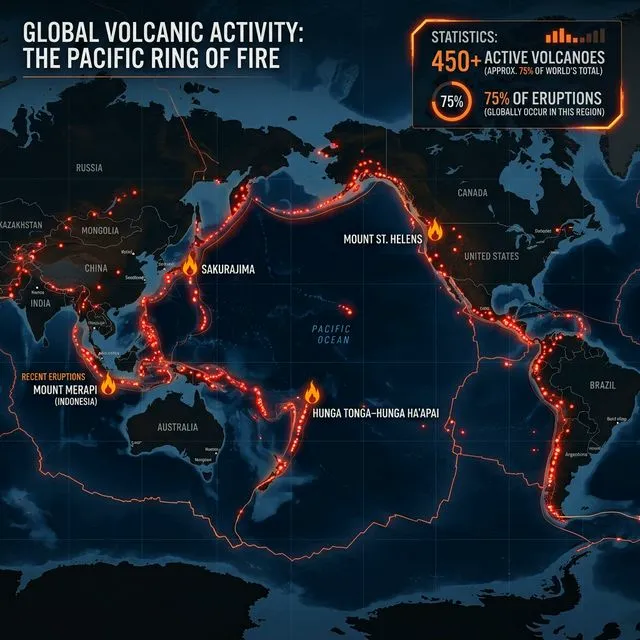
According to the Smithsonian Institution's Global Volcanism Program, there are approximately 1,500 active volcanoes in the world — and about 800 million people live within 100 km of one. The most dangerous include volcanoes located in densely populated areas, where an unwarned eruption could cause humanitarian catastrophe:
| Volcano | Location | Population at Risk | Last Significant Eruption |
|---|---|---|---|
| Vesuvius | Naples, Italy | 3 million | 1944 |
| Popocatépetl | Mexico City | 25+ million (wide radius) | Continuously active |
| Mount Rainier | Seattle, USA | 3.5 million | 1894 |
| Merapi | Java, Indonesia | 1+ million | 2010 (353 deaths) |
| Sakurajima | Kagoshima, Japan | 600,000 | Continuously active |
| Nyiragongo | Goma, D.R. Congo | 2 million | 2021 (32 deaths) |
| Taal | Manila, Philippines | 6+ million (wide radius) | 2020 |
For these populations, 5-8 hours advance notice is the difference between organized evacuation and catastrophe. The eruption of Vesuvius in 79 AD killed over 2,000 people in Pompeii because there was no sufficient warning. The eruption of Mont Pelée in 1902 vaporized the city of Saint-Pierre in Martinique, killing 30,000 in minutes — there were premonitory signs for days, but authorities refused to evacuate because an election was scheduled for the following week. With the Jerk method, science offers a tool that can take this decision out of politicians' hands and place it on objective grounds.
Recent Eruptions That Could Have Been Avoided
Over the past 25 years, several eruptions killed hundreds of people without adequate warning:
- Nevado del Ruiz, Colombia (1985): A relatively small eruption generated lahars (volcanic mudflows) that destroyed the city of Armero, killing 23,000 people. Scientists had warned about the risk weeks earlier, but authorities didn't evacuate.
- Mount Ontake, Japan (2014): A phreatic eruption (without visible magma) caught 250 hikers by surprise, killing 63 — Japan's worst volcanic tragedy in nearly a century.
- Volcán de Fuego, Guatemala (2018): Pyroclastic flows killed 190 people and left hundreds missing. Many victims were caught at home, without time to evacuate.
- Hunga Tonga-Hunga Ha'apai, Tonga (2022): The most powerful submarine eruption in 140 years generated tsunamis that reached as far as Peru. Three dead and massive infrastructure damage to Tonga.
In several of these cases, the Jerk method could have provided critical hours of advance notice — enough time to evacuate the highest-risk areas.
The Economic Cost of Eruptions
Beyond the humanitarian cost, volcanic eruptions generate colossal economic impacts. The eruption of Eyjafjallajökull in Iceland in 2010 — a relatively small eruption — closed European airspace for six days, canceling over 100,000 flights and causing $5 billion in damages to the global economy. A major eruption from one of the volcanoes listed above could cause trillions of dollars in damages.
The investment needed to implement the Jerk method globally is estimated at $200-300 million — a tiny fraction of the potential cost of a single poorly managed eruption.
Limitations and Challenges
What the Method Can't Do
The Jerk method is not infallible, and the researchers themselves are emphatic in listing its limitations:
Mandatory individual calibration: Each volcano has unique seismic behavior — the algorithm needs to be calibrated with specific historical data for each one. For well-monitored volcanoes (like those in Japan, Iceland, and Hawaii), this is feasible. For volcanoes in developing countries with poor monitoring, it may take years to accumulate sufficient data.
False positives and alarm fatigue: 12% of false alerts may seem acceptable in statistical terms, but in practice they can cause "alarm fatigue" — the population may stop responding to alerts after unnecessary evacuations. This psychological effect is well documented: after three or four consecutive false alarms, the compliance rate (people who actually evacuate) drops below 50%.
Volcanoes without historical data: Many dangerous volcanoes in developing countries have poor or nonexistent seismic monitoring. Implementing the Jerk method in these locations requires not only installing equipment but also accumulating years of reference data before the system becomes operational.
Phreatic and sudden eruptions: Some eruptions occur without the typical seismic patterns that jerk detects. Phreatic eruptions (caused by superheated water, not ascending magma) can occur with only minutes of warning, as happened at Mount Ontake in 2014. The Jerk method, relying on magma movement signals, is less effective in these scenarios.
Telecommunications infrastructure: Even if the system detects an imminent eruption, the information needs to reach affected populations in time. In many remote volcanic regions, telecommunications infrastructure is insufficient to disseminate emergency alerts in minutes.
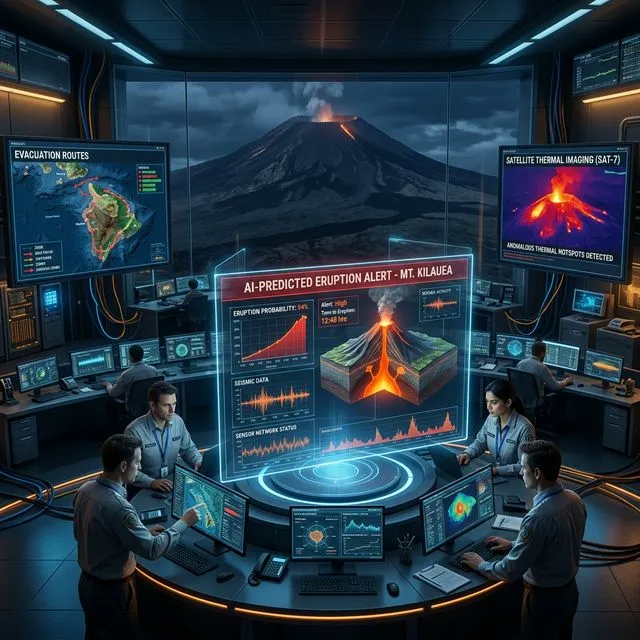
The Next Step: AI + Jerk + Satellites
The Convergence of Technologies
Researchers are already working on the next generation of the system, integrating the Jerk method with multiple data sources and artificial intelligence:
Satellite data (InSAR): Millimetric measurement of ground deformation via synthetic aperture radar interferometry. When combined with seismic jerk, this data allows three-dimensional mapping of magma movement beneath the surface.
Satellite gas spectroscopy: Satellites like ESA's Sentinel-5P and NASA's TEMPO measure atmospheric concentrations of SO₂ and CO₂ with spatial resolution of a few kilometers. Increases in these emissions, when correlated with jerk anomalies, dramatically strengthen prediction confidence.
Machine learning models: Neural networks trained on historical eruption data from dozens of volcanoes can identify precursor patterns that are invisible even to human experts. The combination of jerk + satellite + AI should raise the accuracy rate above 95% and expand the prediction window to 12-24 hours.
Hydrological and geochemical data: Changes in temperature and chemical composition of thermal springs near volcanoes are complementary indicators that can be integrated into the alert system.
Global Implementation
The project to bring the Jerk method to a global operational level involves a partnership between UNESCO, the World Meteorological Organization (WMO), and volcanological observatories in 23 countries. The goal is to have 50 of the world's most dangerous volcanoes equipped with the system by 2030, with gradual expansion to cover all 1,500 active volcanoes by 2040.
Frequently Asked Questions (FAQ)
Can the Jerk method predict earthquakes?
Not directly. Tectonic earthquakes (non-volcanic) occur through different processes and don't present the same precursor signals detectable by jerk. However, the method's mathematical principles are being explored for instability analysis in geological faults, with promising preliminary results. Researchers at the University of Tokyo published a 2025 pilot study applying jerk analysis to seismograph data in subduction zones in Japan, with encouraging but still far from volcanology-level reliability.
Is there an app that warns about eruptions using the Jerk method?
Not yet. The method is in the academic validation phase and there is no commercial or governmental product that uses it operationally. Operational alert systems using jerk should begin to appear from 2028, initially for well-monitored volcanoes in G7 countries. Researchers expect that by 2030, volcanological observatories in at least 23 countries will have incorporated the method into their monitoring routines. Apps for ordinary citizens will likely come later, integrated into existing national disaster alert systems.
Does Brazil have active volcanoes?
Continental Brazil has no active volcanoes because it sits in the center of the South American tectonic plate, far from subduction zones where volcanoes form. However, the Fernando de Noronha archipelago and the Trindade and Martim Vaz islands are of relatively recent volcanic origin in geological terms. More relevant for Brazil are the indirect consequences of major global eruptions — such as climate impacts (volcanic winter reducing harvests), aviation (ash closing international air routes), and the economy (global supply chain disruption).
What's the difference between the Jerk method and USGS alerts?
The USGS (United States Geological Survey) uses a combination of traditional methods (seismicity, deformation, gases) to classify alert levels for American volcanoes in four categories: Normal, Advisory, Watch, and Warning. The Jerk method would complement this system, adding a more precise temporal prediction layer. While the USGS might say "this volcano is at Watch level," Jerk could add "and we estimate the eruption will occur in 4-6 hours." This temporal information is what current systems lack to enable efficient evacuations.
How much does it cost to implement the Jerk method on a volcano?
Costs vary enormously depending on existing infrastructure. For a volcano that already has a dense network of modern seismographs (like Kilauea in Hawaii or Etna in Italy), the cost is essentially software and processing — estimated at $500,000 to $1 million for calibration and implementation. For volcanoes in developing countries without even basic seismographs, the total cost (equipment + installation + calibration + training) can reach $5-10 million per volcano. Even so, it's a minuscule investment compared to the human and economic cost of an unpredicted eruption.
Does the method work for supervolcanoes like Yellowstone?
Theoretically, yes — but with important caveats. Supervolcanoes like Yellowstone, Lake Toba (Indonesia), and Campi Flegrei (Italy) operate on very different geological timescales from conventional volcanoes. A Yellowstone eruption could be preceded by decades or centuries of precursor signals, and jerk would detect only the final phase — probably the last days or weeks before a cataclysmic eruption. However, even a few days of warning would be infinitely better than no warning for an event that could affect the entire Northern Hemisphere.
Which volcanoes will be the first to receive the Jerk system?
According to the implementation plan published by the researchers, the first 10 priority volcanoes include: Piton de la Fournaise (Réunion, already operational), Etna (Italy), Kilauea (USA), Merapi (Indonesia), Sakurajima (Japan), Popocatépetl (Mexico), Cotopaxi (Ecuador), Nyiragongo (D.R. Congo), Campi Flegrei (Italy), and Taal (Philippines). The selection prioritizes volcanoes that combine high population risk with reasonable monitoring infrastructure, allowing relatively quick implementation.
Volcanoes and Brazil: An Indirect but Real Risk
Brazil Has No Active Volcanoes — But It's Not Immune
Continental Brazil has no active volcanoes because it's located in the center of the South American tectonic plate, far from subduction zones where volcanoes form. However, this doesn't mean the country is immune to the effects of global volcanic eruptions.
The eruption of Eyjafjallajökull in Iceland in 2010 demonstrated that a relatively small eruption, thousands of kilometers away, can affect global air traffic — and Brazil, as South America's aviation hub, would be directly impacted by similar events. A large-scale eruption of an Andean volcano (like Cotopaxi in Ecuador or Villarrica in Chile) could generate ash clouds affecting Brazilian airspace.
More concerning is the climate impact of super-eruptions. If the Yellowstone supervolcano (USA) were to erupt (extremely low probability, but not zero), the ash and sulfuric gases launched into the stratosphere could cause a global "volcanic winter," reducing the planet's average temperature by 5-10°C for several years. The impact on Brazilian agriculture — especially soybean, corn, and coffee production — would be devastating, potentially causing continental-scale famine.
The Jerk method, by improving our ability to predict eruptions hours or days in advance, contributes to global preparation against these scenarios. Even if Brazil doesn't evacuate populations from volcanic zones, the country benefits enormously from alert systems that allow air traffic rerouting, supply chain preparation, and activation of agricultural contingency plans.
Volcanism in Brazil's Past
While Brazil has no active volcanoes today, Brazilian territory was once the site of intense volcanic activity in the geological past. The Serra Geral Formation, covering parts of São Paulo, Paraná, Santa Catarina, and Rio Grande do Sul, is the result of one of the largest volcanic events in Earth's history: the Cretaceous basalt flood, about 130 million years ago, which covered over 1.2 million km² with lava. This same volcanic activity created the Guarani Aquifer, one of the world's largest underground freshwater reserves.
Comparison With Other Prediction Methods
Traditional Methods vs. Jerk
To contextualize the Jerk method's importance, it's useful to compare it with existing volcanic prediction techniques:
| Method | Type | Advance Notice | Accuracy | Cost |
|---|---|---|---|---|
| Conventional seismicity | Seismic | Hours to days | 30-50% | Low |
| GPS/InSAR deformation | Geodetic | Days to weeks | 40-60% | Medium |
| Gas emissions (SO₂/CO₂) | Geochemical | Hours to days | 35-55% | Medium |
| Thermal spring temperature | Geothermal | Days to weeks | 25-40% | Low |
| Visual observation/drones | Visual | Minutes to hours | Variable | High |
| Jerk Method | Advanced seismic | 2-8 hours | 85% | Medium |
| Jerk + AI + satellite | Multimodal | 12-24 hours (est.) | >95% (est.) | High |
What makes the Jerk method particularly attractive is that it can be implemented using the seismic infrastructure already existing at many volcanoes. There's no need to install new types of sensors — just updating the processing software of seismographs already in operation. This drastically reduces cost and implementation time compared to methods requiring GPS networks, gas spectrometers, or satellite data access.
The Role of Artificial Intelligence
Integrating the Jerk method with artificial intelligence is not just an incremental improvement — it's a qualitative shift in approach. Modern AI systems, especially deep neural networks trained on time series, can identify patterns in jerk data that are invisible to conventional statistical analysis.
For example, a neural network trained with data from hundreds of eruptions could learn that a particular "shape" of jerk signal — with specific peaks at certain frequencies and of certain duration — corresponds to an imminent eruption with 98% probability, while a slightly different shape represents only normal activity. This type of pattern recognition is precisely what AI does better than humans.
Researchers at the University of Cambridge are already training deep learning models with data from 37 globally monitored volcanoes, including Kilauea (Hawaii), Etna (Italy), Sakurajima (Japan), and Piton de la Fournaise (Réunion). The expectation is that the first operational prototypes of Jerk+AI systems will be available by 2028.
Conclusion
The Jerk method is one of those scientific innovations that, a decade from now, may seem obvious — "of course we should have been measuring the third derivative of ground displacement." But as with all great ideas, it needed someone to look at familiar data in a completely new way.
The beauty of the method lies in its mathematical elegance: instead of trying to detect more signals or install more sensors, it extracts information that was always in the data — hidden in the third derivative, which no one had previously thought to systematically calculate for volcanological purposes.
If the technology proves as reliable on global volcanoes as it was at Piton de la Fournaise, we'll be facing one of the most significant advances in natural disaster prevention since the invention of the modern seismograph. For the 800 million people living in the shadow of active volcanoes, jerk may literally be the difference between life and death.
The science of volcanic prediction has lived through decades of frustrations and broken promises. The Jerk method is not a magic solution — but it is, without doubt, the most significant step we've taken toward a world where volcanic eruptions are no longer synonymous with inevitable catastrophe.


