
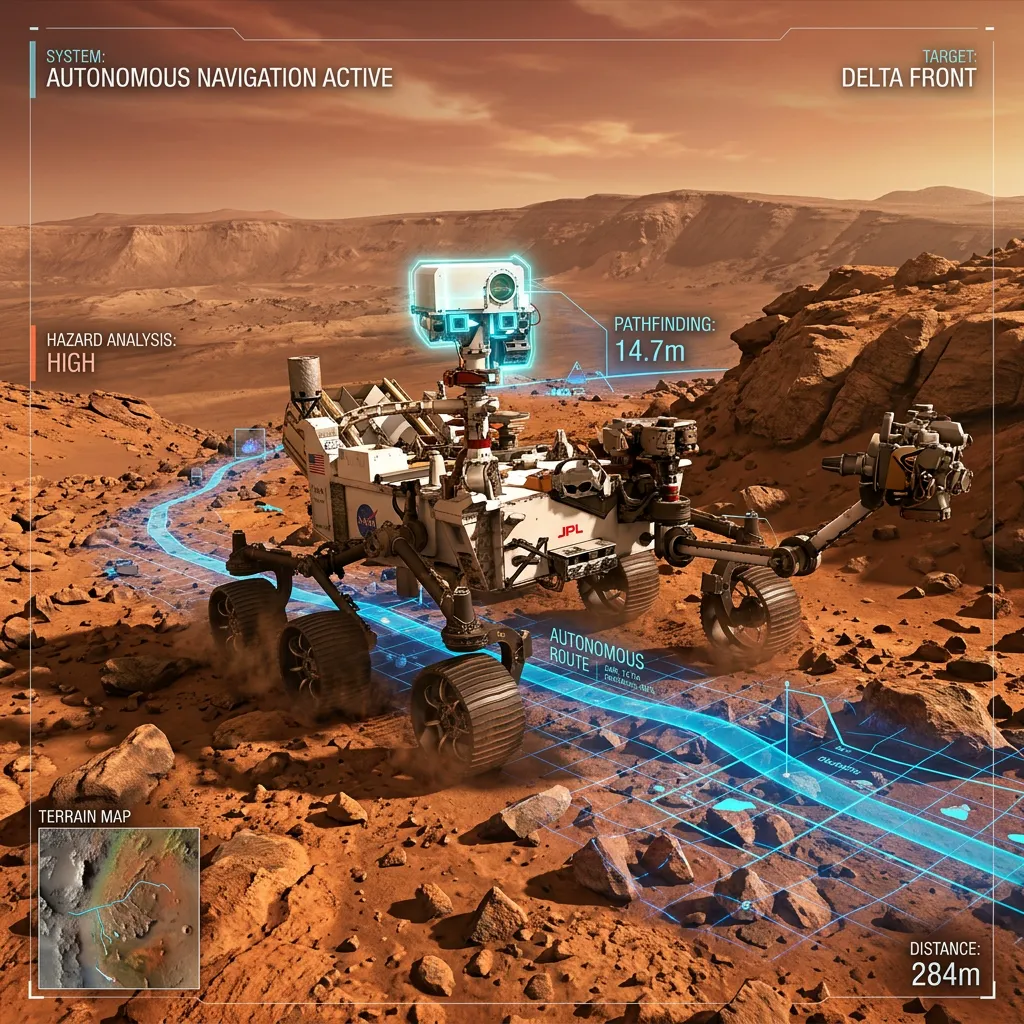
225 million kilometers from Earth, on the orange and rocky ground of Jezero Crater on Mars, a 1,025 kg robot has just done something no machine had ever done on another planet: think for itself. The Perseverance rover, NASA's US$ 2.7 billion jewel of the Martian exploration program, received in March 2026 a software update that activated an artificial intelligence system capable of analyzing terrain in real time, identifying obstacles, planning alternative routes, and executing complex maneuvers — all without waiting for a single command from Earth.
The system, internally named by the JPL (Jet Propulsion Laboratory) team as AutoNav 3.0, is not an incremental improvement. It's a paradigm shift in planetary robotic exploration. Until now, Mars rovers operated under a command-and-wait model: the team in Pasadena, California, analyzed images sent by the rover, planned a route, transmitted commands, and the rover executed them. The problem? Communication between Earth and Mars takes between 4 and 24 minutes in each direction, depending on the planets' orbital positions. A simple request to "turn left" can take nearly 50 minutes between sending, processing, and confirmation.
With AutoNav 3.0, Perseverance now drives like an experienced driver on an unknown road — evaluating, deciding, and acting in real time.
How the Perseverance's Artificial Brain Works
The Perseverance's hardware hasn't changed — after all, swapping parts on Mars isn't exactly an option. The entire advance is purely software: a package of machine learning algorithms that was developed, trained, and tested over 3 years at JPL before being transmitted to the rover via satellite communication.
AutoNav 3.0 Architecture:
| Component | Function | Difference vs. Previous Version |
|---|---|---|
| Navcam cameras (stereo) | Captures stereoscopic pair every 3.5 seconds | Same cameras, 5x faster processing |
| 3D terrain map | Builds three-dimensional model of surroundings | 2cm resolution (previously 10cm) |
| Obstacle classifier (AI) | Identifies rocks, soft sand, craters, slopes | Neural network trained on 42 million images |
| Route planner | Calculates best path considering safety and efficiency | Evaluates 350 candidate routes vs. 15 before |
| Maneuver executor | Controls speed, direction, and wheel articulation | Max speed raised from 120m/h to 340m/h |
| Health monitor | Continuously checks mechanical and energy integrity | Self-diagnosis every 10 seconds |
The Perseverance's central processor is a RAD750 — a BAE Systems chip with the raw power of a 1998 home computer (200 MHz, 256 MB RAM). Yes, humanity's most advanced rover runs on hardware that your 2016 smartphone would ridicule. But the RAD750 has one advantage no commercial chip possesses: it's radiation-hardened, resisting bombardment from cosmic rays and solar particles that would destroy any ordinary processor within weeks.
The JPL team managed to run deep learning algorithms on this limited hardware through a technique called model quantization — compressing neural networks with billions of parameters (which would normally require NVIDIA A100 GPUs) into optimized versions that fit in 256 MB RAM and run on 200 MHz processors without significant loss of precision.
"Running a computer vision neural network on a RAD750 is like playing Elden Ring on a Game Boy Color," joked Dr. Vandi Verma, chief mobility engineer for Perseverance at JPL. "Except that if the game crashes, you lose a US$ 2.7 billion rover instead of just your save game."
The Results: Perseverance Is Driving 5x Faster
The first weeks of operation with AutoNav 3.0 active have already produced impressive results. Data shared by NASA shows:
Performance metrics (March 2026):
| Metric | Before (AutoNav 2.0) | After (AutoNav 3.0) | Improvement |
|---|---|---|---|
| Average daily distance | 120 meters | 590 meters | 4.9x |
| Maximum cruising speed | 120 m/h | 340 m/h | 2.8x |
| Time stopped waiting for commands | ~65% of day | ~12% of day | 81% less |
| Autonomous obstacle avoidance events | 3-5 per day | 25-40 per day | 8x more decisions |
| Safety stop events | 8 in 30 days | 2 in 30 days (false positives) | 75% safer |
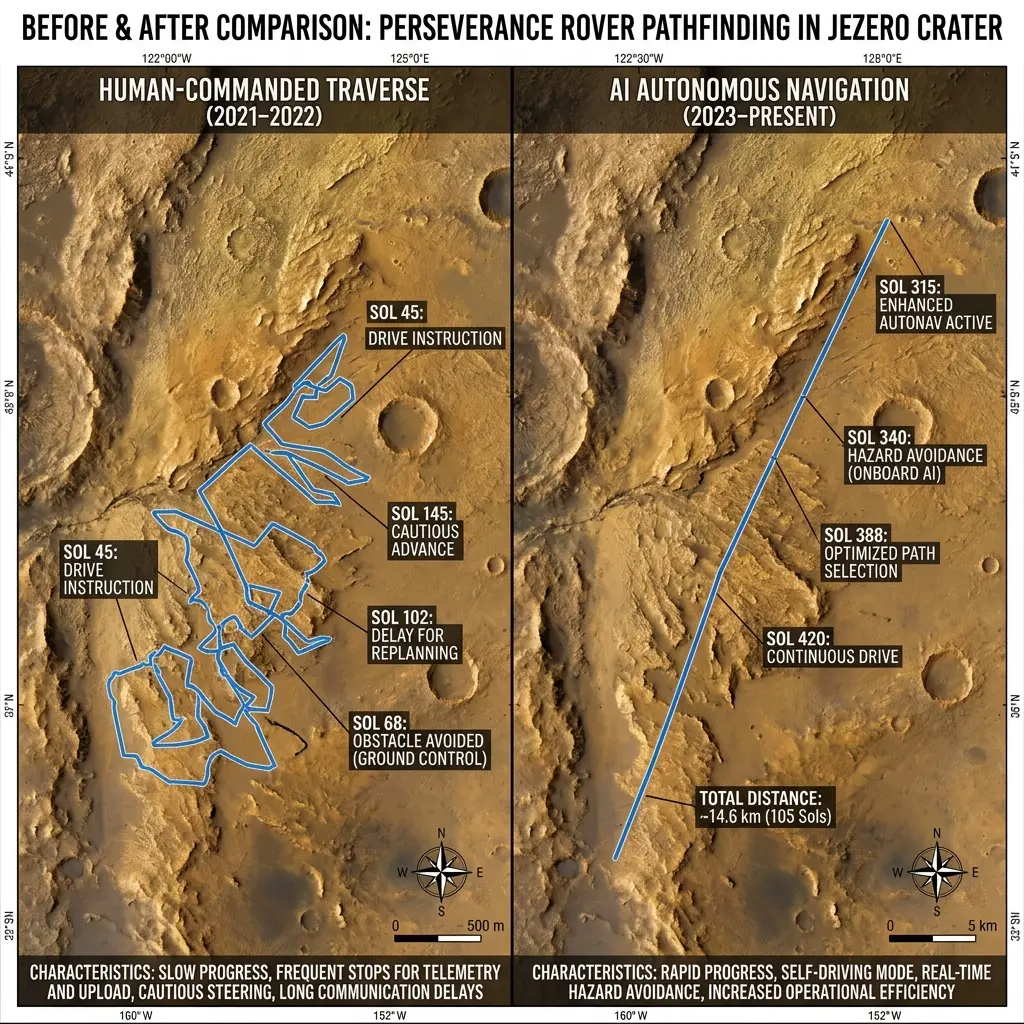
| Terrain covered (total since update) | - | 14.7 km in 25 days | Record |
The most impressive number is the average daily distance: from 120 meters (equivalent to traversing a football field per day) to 590 meters. In terms of scientific exploration, this means Perseverance can cover in one month the same terrain that previously would have taken nearly five months. Areas that would be "too far" or "too risky" to justify weeks of cautious driving are now within reach in just a few days.
On March 14, 2026, the rover broke its own record by traveling 1,108 meters in a single Martian sol (a Martian day lasts 24 hours and 37 minutes) — more than any rover had ever traveled in a day in the history of Mars exploration.
The 24-Minute Problem: Why AI Is Essential on Mars
To understand why this update is so transformative, one must grasp the logistical nightmare of controlling a robot millions of kilometers away.
The speed of light — the absolute speed limit of communication in the universe — means a signal sent from Earth to Mars takes between 3 minutes and 22 seconds (when the planets are closest) and 24 minutes and 19 seconds (when farthest apart). In March 2026, latency is approximately 14 minutes in each direction.
This creates an absurd situation: imagine you're driving a car, but between turning the steering wheel and seeing the result on the road, 28 minutes pass. Now imagine the "road" is an alien desert dotted with sharp rocks, quicksand, invisible craters, and treacherous slopes that could permanently tip a US$ 2.7 billion vehicle.
The operational flow before AutoNav 3.0:
- Sol N, morning: Perseverance transmits panoramic images of surroundings → 14 min to reach Earth
- Sol N, afternoon: JPL team analyzes images, plans safe route → 2-4 hours
- Sol N, late afternoon: Route commands transmitted → 14 min to reach Mars
- Sol N+1, morning: Perseverance executes planned route → travels 50-200 meters
- Sol N+1, afternoon: Transmits new images → cycle restarts
This model meant that of every 24 Martian hours, the rover spent less than 35% of the time actually moving. The rest was waiting. With AutoNav 3.0, the rover decides on its own and can move during nearly all available sunlight.
When the AI Made a Decision That Humans Would Have Avoided
One of the most fascinating accounts from the first month of operation with AutoNav 3.0 involves an incident on March 18, 2026, when the rover encountered a densely grouped field of rocks blocking its planned route toward a geologically interesting outcrop on the southern rim of Jezero.
The JPL team, upon analyzing the images, classified the area as "impassable" and prepared an alternative route that would circumvent the rock field — adding 2.3 km and 4-5 days to the journey. But before the detour commands could be transmitted, AutoNav 3.0 had already analyzed the terrain, identified a 72-centimeter-wide corridor between four large rocks (the Perseverance is 2.7 meters wide, but each wheel articulates independently), and calculated it could traverse the field in a 47-minute maneuver with 8.5 cm clearance on each side.
The rover executed the maneuver. Perfectly. Saving 4 days of travel.
"When I saw the telemetry data, I had two simultaneous feelings," Dr. Verma recounted. "Absolute pride that the software worked exactly as planned. And a chill realizing that our rover had just made a decision that we, as humans, would have avoided. The AI calculated the risk was acceptable. We probably would have been too conservative."
This episode raised a philosophical question the mission team is debating internally: at what point should a rover's AI be authorized to disagree with human decisions? Currently, AutoNav 3.0 operates within parameters defined by the team (maximum speed, maximum incline, minimum safety margin), but within those limits, it's free to make any route decision. The question is whether those limits should be expanded as the AI proves its competence.
Implications for the Future: From Earth to Mars, and Beyond
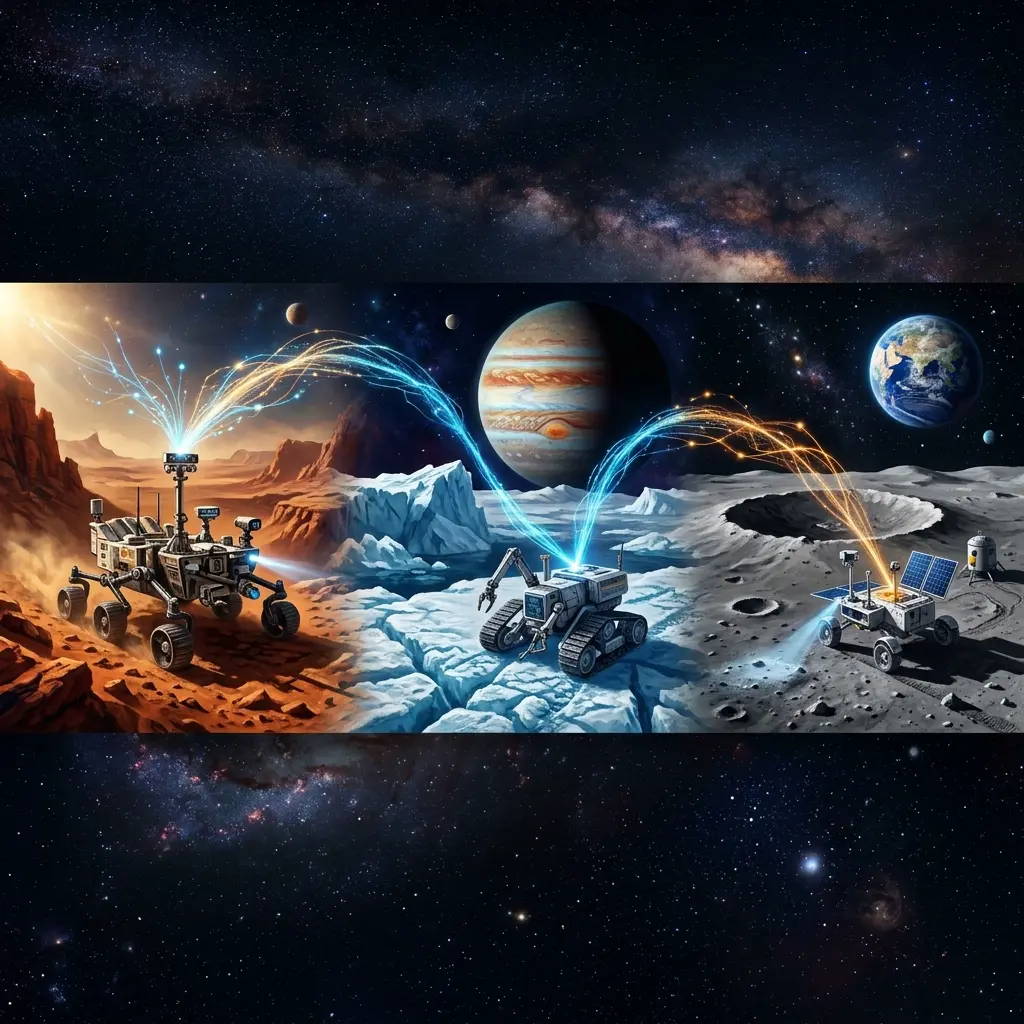
AutoNav 3.0 is not an isolated demonstration — it's a direct precursor to the technology that will be needed for human missions to Mars, exploratory robots on icy moons like Europa (Jupiter) and Enceladus (Saturn), and even autonomous lunar bases in the Artemis program.
Future applications of planetary navigation AI:
1. Mars Sample Return Mission (2028-2031): NASA and ESA plan to send two additional rovers to Mars to collect samples left by Perseverance and launch them into orbit for return to Earth. These rovers will need even more sophisticated autonomous navigation to locate 30+ sample tubes scattered across Jezero Crater.
2. Robots on Europa's surface: Jupiter's moon Europa has an underground ocean that may harbor life. Any exploratory robot would have communication latency of 35-52 minutes with Earth — making remote control practically impossible. Autonomous AI isn't a luxury; it's an absolute necessity.
3. Artemis Lunar Base: NASA's lunar base program envisions infrastructure (habitats, power plants, laboratories) built and maintained by autonomous robots before astronauts arrive. AutoNav 3.0's navigation and decision-making AI is the first step in this technology.
4. Terrestrial Rovers: More immediately, autonomous navigation technology is being licensed for terrestrial applications: autonomous mining vehicles, search-and-rescue robots in disaster zones, and delivery drones in difficult terrain.
The AI That Works 225 Million km Away Is More Reliable Than Your Car's
There's a delicious irony in the current state of artificial intelligence: the AI of a rover on Mars, operating with 1998 hardware and 256 MB of memory, can navigate autonomously with an error rate near zero on completely unknown alien terrain. Meanwhile, companies with billions of dollars and the most advanced technology on the planet — Tesla, Waymo, Cruise — still struggle to make autonomous cars work reliably on paved California streets with detailed maps, GPS, lidar, and high-definition cameras.
The explanation is simultaneously simple and profound: Mars is paradoxically easier for AI than terrestrial streets. On Mars, there are no unpredictable pedestrians, idiosyncratic cyclists, drunk drivers, children chasing balls, or broken traffic lights. The terrain is challenging, but predictable: rocks, sand, craters. There are no human surprises.
This raises an important reflection about the future of AI: perhaps the ultimate challenge of artificial intelligence isn't operating in extreme environments like Mars or the ocean floor. The real challenge is dealing with the only truly unpredictable thing in the universe: us.
The Accumulated Legacy: From Sojourner to AutoNav 3.0
Perseverance didn't emerge from nothing. Each of NASA's Mars rovers was a step on the ladder of planetary robotic autonomy, and understanding this progression reveals how far we've come in less than three decades:
Mars rover evolution:
| Rover | Year | Mass | Autonomy rate | Total distance |
|---|---|---|---|---|
| Sojourner | 1997 | 11.5 kg | 0% (100% telecommanded) | 100 meters |
| Spirit | 2004 | 185 kg | ~5% (avoided simple obstacles) | 7.73 km |
| Opportunity | 2004 | 185 kg | ~10% (basic AutoNav 1.0) | 45.16 km (record) |
| Curiosity | 2012 | 899 kg | ~25% (AutoNav 2.0) | 32+ km (still active) |
| Perseverance | 2021 | 1,025 kg | ~85% (AutoNav 3.0) | 29+ km (accelerating) |
In 1997, Sojourner — the size of a microwave oven — needed an explicit command for every centimeter it moved. In 2026, Perseverance crosses rock fields alone while the JPL team has coffee. In 29 years, we went from total human control to near-total machine autonomy. If this curve continues, rovers in the 2040s could be indistinguishable from biological explorers in terms of independent decision-making capacity.
Most poetically, the name Perseverance — chosen by Alexander Mather, a 13-year-old student from Virginia, in a national contest — perfectly captures not just the rover's determination, but humanity's own determination in its interplanetary quest. To persevere is exactly what we've done: from 100 telecommanded meters in 1997 to AI autonomous navigation in 2026. What seemed like science fiction has become routine engineering.
FAQ — Frequently Asked Questions
Can Perseverance now completely ignore commands from Earth?
No. AutoNav 3.0 operates within parameters defined by the team (maximum speed, incline, safety margin). The team can deactivate autonomous mode or send priority commands at any time. The AI makes tactical decisions, not strategic ones.
How is it possible to run AI on 1998 hardware?
Through model quantization and AI compression techniques. Neural networks that would normally require powerful GPUs are optimized to run on processors with minimal resources, sacrificing training speed (done on Earth) but maintaining inference precision (executed on Mars).
Does this mean future rovers won't need human control?
Partially. The trend is for rovers at more distant destinations (Europa, Enceladus, Titan) to operate with near-total autonomy due to extreme communication latency. But human oversight will remain essential for scientific decisions — where to dig, what to analyze, which samples to prioritize.
Is the technology being used on Earth?
Yes. JPL is already licensing adapted versions of AutoNav for autonomous mining, search-and-rescue robotics, and drone navigation in GPS-denied terrain. Motiv Space Systems, a JPL partner, is the primary commercial integrator of the technology.
How much did developing AutoNav 3.0 cost?
NASA invested approximately US$ 47 million over 3 years in the system's development. Considering it can extend the effective lifespan of the Perseverance mission (originally planned for 2 years, now in its 5th operational year), the return on investment is considered exceptional.
Sources and References
- NASA JPL: "Perseverance AutoNav 3.0: Autonomous Navigation Update" — March 2026
- Dr. Vandi Verma, Chief Mobility Engineer for Perseverance, JPL
- Nature Robotics: "Deep Learning on Radiation-Hardened Processors for Planetary Exploration" — March 2026
- IEEE Robotics & Automation: "Model Quantization for Resource-Constrained Autonomous Navigation" — 2025
- NASA Mars Exploration Program: Mission Status Reports — March 2026
- BAE Systems: RAD750 Radiation-Hardened Processor Specifications


