
Arctic Permafrost Melts and Releases Carbon and Ancient Viruses: Scientists Warn of 'Climate Time Bomb'
Beneath the frozen soils of the Arctic — in Siberia, Alaska, Canada and Scandinavia — lies one of the most dangerous climate time bombs on the planet. The permafrost, ground that has been continuously frozen for at least two consecutive years (and in many cases for decades of thousands of years), is melting at unprecedented rates.
And what it's releasing is terrifying: greenhouse gases buried since the last Ice Age, ancient microorganisms that have been dormant for millennia, and levels of mercury and radioactive waste that nobody expected to find.
An international study published in Nature Climate Change in March 2026 revealed that the Arctic permafrost is thawing 70% faster than models predicted just five years ago — and the consequences could be catastrophic for the entire planet.
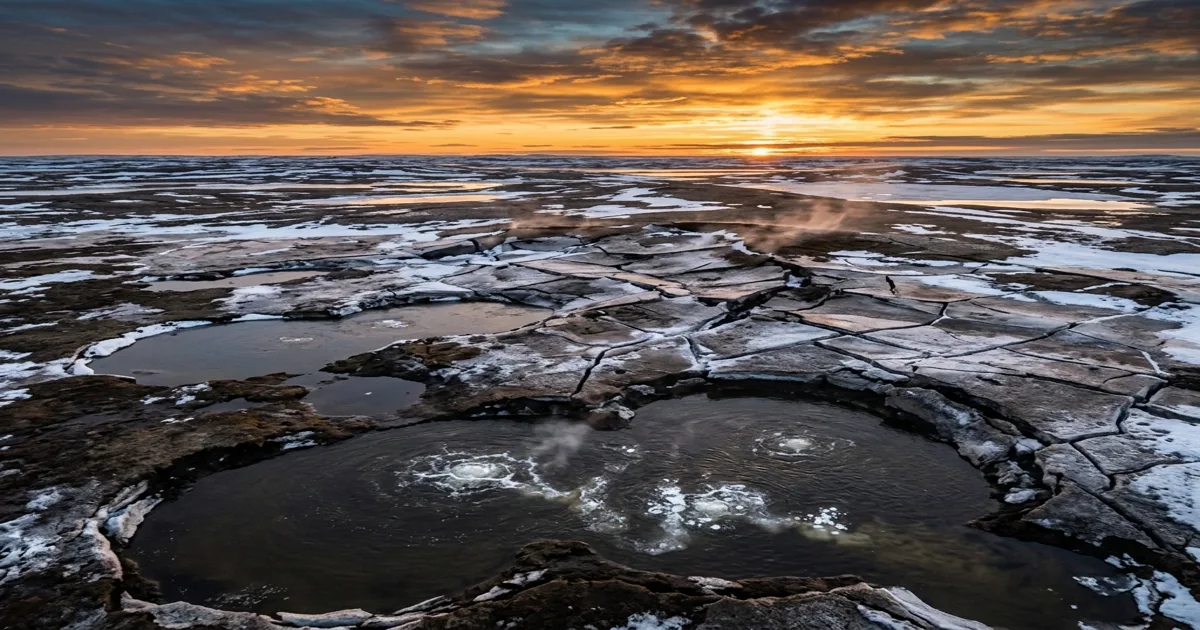
What Is Permafrost?
Permafrost is ground — soil, rock and organic matter — that remains at or below 0°C for at least two consecutive years. In practice, much of the Arctic permafrost has been frozen for tens of thousands of years, some dating back to the Pleistocene epoch (up to 2.6 million years ago).
Key Numbers
| Indicator | Value |
|---|---|
| Total permafrost area | 23 million km² (15% of Earth's land surface) |
| Estimated carbon stored | 1,500 billion tons |
| Comparison with atmosphere | 2x the total carbon currently in the atmosphere |
| Estimated methane stored | 50-100 billion tons |
| Depth of deepest permafrost | 1,500 meters (in Siberia) |
| Age of oldest permafrost | ~2.6 million years |
The 1,500 billion tons of carbon stored in permafrost is the number that terrifies climate scientists. To put it in perspective: all of humanity emits approximately 40 billion tons of CO₂ per year. The permafrost contains enough carbon to represent 37 years of human emissions — and it's starting to be released.
What's Being Released
Greenhouse Gases
When permafrost thaws, the organic matter trapped within it — leaves, roots, animal remains, bacteria — begins to decompose. This decomposition releases two powerful greenhouse gases:
- Carbon dioxide (CO₂): Released when decomposition occurs in the presence of oxygen (aerobic conditions)
- Methane (CH₄): Released when decomposition occurs without oxygen (anaerobic conditions, such as beneath lakes and wetlands). Methane is 80 times more potent than CO₂ as a greenhouse gas over a 20-year period
The 2026 Nature study estimates that thawing permafrost is already releasing 1.5 to 2.3 billion tons of CO₂ equivalent per year — roughly equal to the annual emissions of India, the world's third-largest emitter.
Ancient Viruses and Bacteria
In 2023, French researchers led by Jean-Michel Claverie at Aix-Marseille University revived a 48,500-year-old virus from Siberian permafrost. The virus, named Pandoravirus, was still infectious after being frozen for nearly 50 millennia.
This wasn't an isolated discovery. Since 2014, researchers have revived multiple ancient viruses from permafrost, including:
- Pithovirus sibericum (30,000 years old) — revived in 2014
- Mollivirus sibericum (30,000 years old) — revived in 2015
- Multiple Pandoravirus strains (up to 48,500 years old) — revived in 2023
The concern isn't just about ancient viruses. Permafrost in Siberia holds the buried remains of people and animals who died from smallpox and anthrax in previous centuries. In 2016, an anthrax outbreak in Siberia's Yamal Peninsula killed a 12-year-old boy and infected 72 people — the source was traced to a 75-year-old infected reindeer carcass that emerged from thawing permafrost.
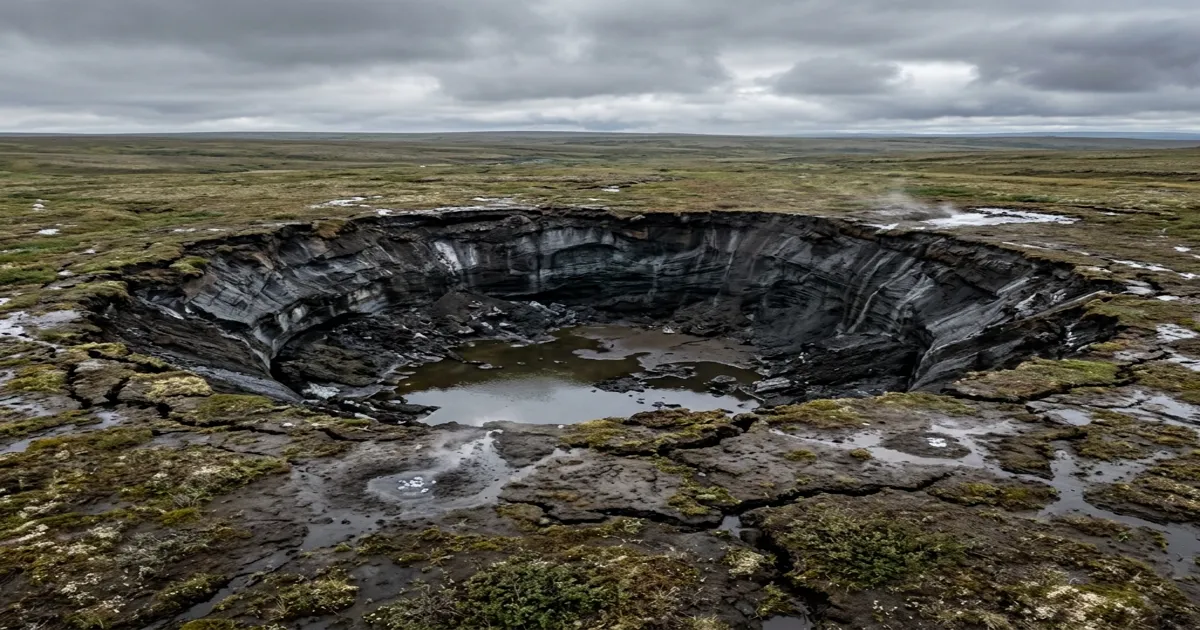
The Feedback Loop: Why This Gets Worse
The most dangerous aspect of permafrost thaw is the positive feedback loop: thawing releases greenhouse gases, which accelerate warming, which causes more thawing, which releases more gases. This cycle is self-reinforcing and, beyond a certain point, becomes essentially irreversible on human timescales.
The Tipping Point
Climate scientists have identified permafrost as one of the planet's critical "tipping points" — thresholds beyond which changes become self-sustaining regardless of human action. The current scientific consensus suggests that if global temperatures exceed 2°C above pre-industrial levels, the permafrost carbon feedback will accelerate dramatically.
In March 2026, the global average temperature had already reached 1.45°C above pre-industrial levels.
Infrastructure Collapse
The consequences of permafrost thaw aren't just atmospheric — they're structural. Cities, roads, pipelines and military installations built on permafrost are literally sinking as the ground beneath them becomes unstable.
Russia's Infrastructure Crisis
- 80% of buildings in some Russian Arctic cities show signs of structural damage from permafrost degradation
- The city of Norilsk (population 175,000) is experiencing widespread foundation failures
- Trans-Siberian pipeline sections are under constant repair due to ground subsidence
- Estimated cost of permafrost-related infrastructure damage in Russia: US$67 billion by 2050
Alaska's Challenges
- 100+ communities in Alaska face erosion and flooding linked to permafrost thaw
- The Dalton Highway requires annual emergency repairs costing millions
- Several military installations have reported structural issues
Mercury: The Hidden Danger
A study published in Geophysical Research Letters revealed that Arctic permafrost contains approximately 793,000 tons of mercury — nearly twice the amount found in all other soils, the atmosphere and the oceans combined.
As permafrost thaws, this mercury enters waterways, gets absorbed by fish and enters the food chain — a particular threat to Indigenous communities in the Arctic who rely on traditional diets of fish and marine mammals.
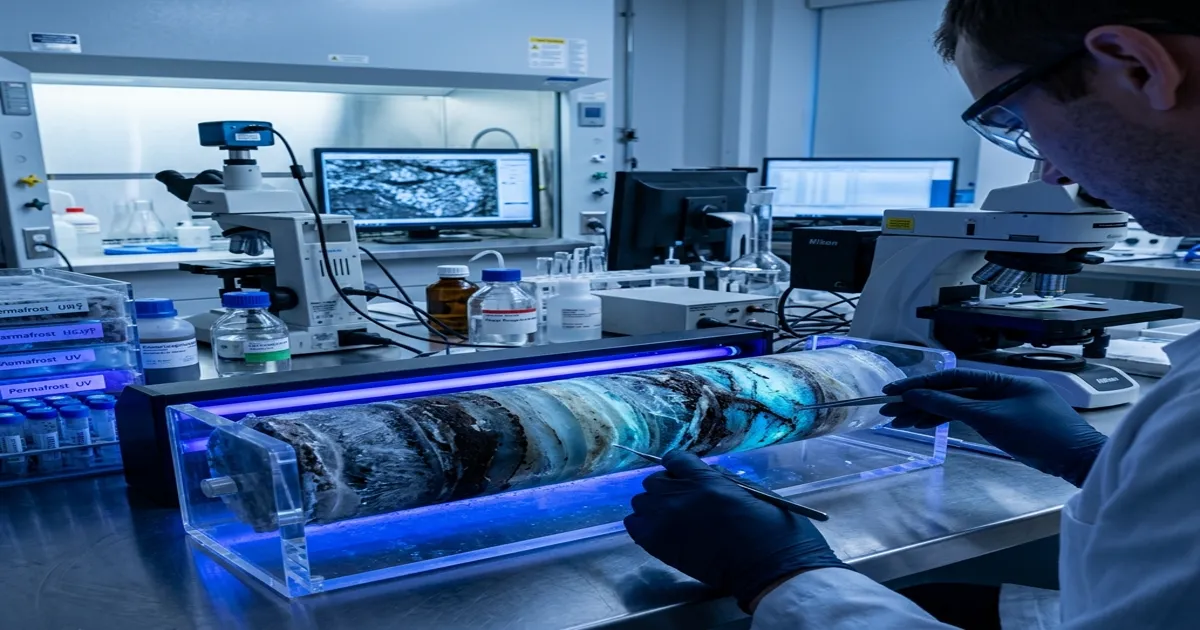
What Can Be Done?
Immediate Actions
- Deep emissions cuts: The most effective way to slow permafrost thaw is to limit global warming to below 2°C
- Permafrost monitoring networks: Expand real-time monitoring of permafrost temperatures and greenhouse gas emissions
- Pandemic preparedness: Develop protocols for responding to potential pathogen release from permafrost
- Infrastructure adaptation: Develop new construction technologies for permafrost regions
Experimental Approaches
Scientists are exploring unconventional methods to slow permafrost thaw:
- Pleistocene Park (Siberia): An experiment reintroducing large herbivores (bison, horses) to compact snow and keep permafrost cold
- Artificial permafrost cooling: Using thermosiphon technology to actively cool permafrost in critical infrastructure areas
- Carbon capture from permafrost emissions: Proposals for large-scale methane capture systems in wetland areas
FAQ
Is permafrost really thawing faster than predicted?
Yes. The March 2026 Nature Climate Change study compared actual measurements from 2015-2025 with model predictions made in 2020. The conclusion was stark: permafrost is thawing 70% faster than the most commonly used models predicted. The main reasons for the discrepancy are underestimation of the effects of summer heat waves and ocean warming on coastal permafrost.
Can ancient viruses cause a pandemic?
The risk is real but difficult to quantify. The viruses revived so far have been types that infect amoebas, not humans. However, permafrost also contains the remains of people and animals who died from known dangerous pathogens. The combination of pathogen survival capability and human exposure through thawing creates a non-zero pandemic risk that epidemiologists take seriously.
How much carbon will permafrost release?
Under current warming trajectories, models project permafrost will release between 100 and 200 billion tons of carbon by 2100 — equivalent to approximately 250-500 billion tons of CO₂. This would make permafrost the equivalent of another major industrial country in terms of emissions, but one that can't be regulated or shut down.
Can we refreeze permafrost?
Not at scale with current technology. Some experimental projects (like the Pleistocene Park) are attempting local-scale permafrost preservation, but the only truly effective way to prevent widespread permafrost thaw is to limit global warming through emissions reductions. Once permafrost passes certain thawing thresholds, refreezing becomes essentially impossible on human timescales.
Sources and References
- Nature Climate Change — "Arctic permafrost thaw rates exceed model projections by 70%" — March 2026
- Claverie et al. — "Revival of ancient viruses from Siberian permafrost" — PNAS, 2023
- IPCC — Special Report on the Ocean and Cryosphere, updated 2025
- Geophysical Research Letters — "Mercury stored in Arctic permafrost" — 2024
- NOAA — Arctic Report Card 2025
- Russian Academy of Sciences — Permafrost infrastructure impact assessments, 2025


