
An international team of archaeologists has just announced a discovery that could rewrite one of the most fundamental chapters of human history: symbolic marks found in European caves, dated to at least 40,000 years ago, appear to represent a form of proto-writing — pushing the origins of written communication 35,000 years earlier than the traditional narrative suggests. The study, published in March 2026 in the Cambridge Archaeological Journal, analyzes recurring patterns of symbols found in more than 30 archaeological sites across France, Spain, and Germany, revealing a notation system far more sophisticated than previously imagined.
The Discovery That Changes Everything
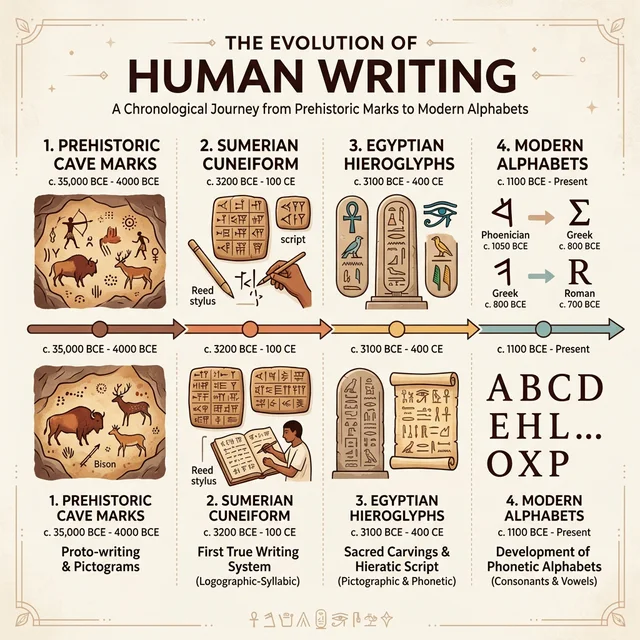
Until now, the official history stated that writing was independently invented in two or three locations: in Sumer (modern Iraq) around 3,400 BCE with cuneiform, in Egypt at approximately the same time with hieroglyphs, and possibly in China around 1,200 BCE with oracle bone characters. This narrative placed the invention of writing at only 5,000-5,500 years ago.
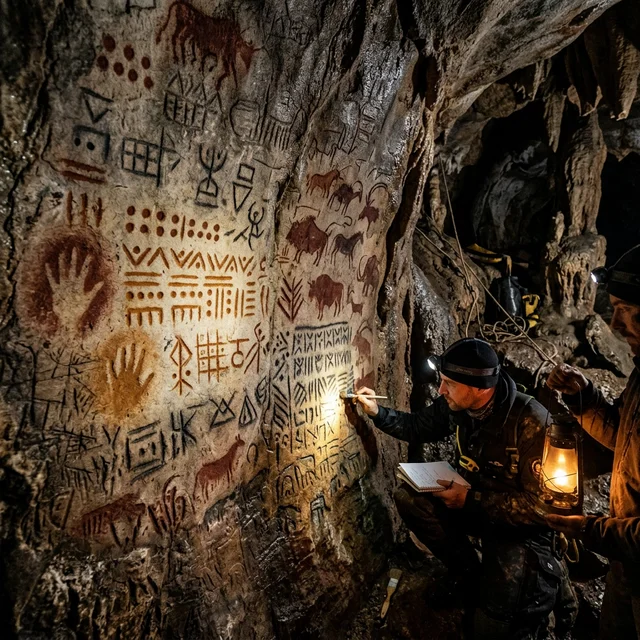
The new research fundamentally challenges this chronology. The archaeologists, led by Dr. Genevieve von Petzinger from the University of Victoria (Canada), identified 32 distinct types of geometric signs that repeatedly appear on Upper Paleolithic cave walls, dated between 40,000 and 12,000 years ago.
The 32 Universal Signs
What makes this discovery extraordinary is that these signs aren't random. They include:
- Parallel lines: Found in 79% of analyzed sites
- Grouped dots: In 62% of sites
- Spirals: In 41% of sites
- X-shaped signs: In 38% of sites
- Negative hands: In 36% of sites
- Triangles: In 34% of sites
- Pentagonal shapes: In 23% of sites
- Zigzags: In 19% of sites
The geographic and temporal distribution of these signs suggests they weren't decorative or accidental, but rather elements of a communication system shared among human groups across thousands of years and thousands of kilometers.
What Is Proto-Writing
To understand why this discovery is so significant, we need to distinguish between different levels of symbolic representation:
| Level | Type | Example | When |
|---|---|---|---|
| 1 | Random marks | Bone scratches | 500,000+ years |
| 2 | Figurative art | Animal paintings | 45,000 years |
| 3 | Abstract symbols | Patterned lines and dots | 40,000 years (new discovery) |
| 4 | Proto-writing | Notation systems | 10,000-8,000 years |
| 5 | Complete writing | Cuneiform, hieroglyphs | 5,500 years |
| 6 | Alphabet | Phoenician, Greek | 3,000 years |
The 2026 discovery fills a crucial gap between levels 2 and 4, suggesting that our Paleolithic ancestors were much closer to formal writing than academia recognized.
The Difference Between Art and Writing
A central question in the debate is: when does art become writing? The researchers propose three criteria:
- Convention: The same symbols must appear at multiple sites, indicating a shared social convention
- Patterned repetition: The symbols must appear in recurring combinations, suggesting "grammar" or syntax
- Abstraction: The signs must be geometric and abstract, not direct representations of natural objects
The 32 identified signs satisfy all three criteria — placing them firmly in the proto-writing category.
How the Marks Were Dated
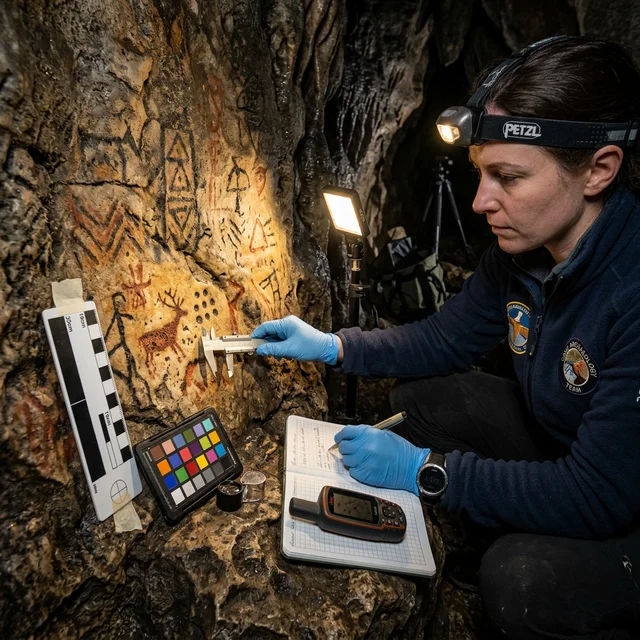
Dating cave art is one of archaeology's most difficult challenges. The researchers used a combination of techniques:
- Uranium-thorium dating (U-Th): Analysis of mineral deposits formed over the paintings, providing a minimum age
- Carbon-14 (C-14): When pigments contain organic material (charcoal)
- Thermoluminescence: Dating of nearby sediments
- Comparative style: Comparison with other already-dated sites
The oldest dates — 40,200 ± 400 years — come from El Castillo Cave in Cantabria (Spain) and Chauvet Cave in France. These caves contain some of the world's most impressive examples of cave art, but the geometric symbols accompanying them were largely ignored by academia until now.
What the Symbols Mean

This is the million-dollar question — and the answer is: we don't know for certain. But researchers have hypotheses based on statistical analysis and cross-site comparison.
Main Hypotheses
- Counting system: Lines and dots may represent counts of hunted animals, lunar cycles, or seasons
- Territory markers: Some signs consistently appear at cave entrances, suggesting a "signaling" function
- Astronomical record: Spirals and grouped dots may represent primitive astronomical observations
- Inter-group communication: Same signs at locations separated by hundreds of kilometers suggest shared "visual vocabulary"
- Ritual notation: In many sites, symbols appear near animal depictions in unusual positions, suggesting ritual context
Implications for Understanding the Human Mind
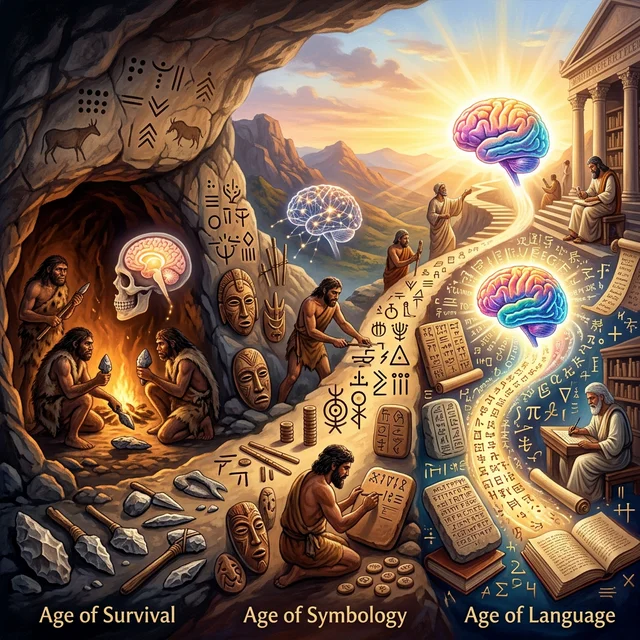
The discovery has profound implications for our understanding of the cognitive revolution — the moment when Homo sapiens developed symbolic thinking, the capacity that distinguishes us from all other species.
The Neanderthal Connection
A fascinating question raised by the research is whether Neanderthals also created abstract symbols. In 2018, a team published evidence in Science that cave paintings in Spain — including lines and dots — were made 65,000 years ago, before Homo sapiens arrived in Europe. If confirmed, this suggests symbolic thinking isn't exclusive to our species.
However, the 2026 research shows the 32 patterned signs are found only in contexts associated with Homo sapiens, not Neanderthals. This suggests that while Neanderthals may have made occasional symbolic marks, our ancestors took this ability to a completely different level of systematization and complexity.
Comparison with Other Primates
| Capability | Chimpanzees | Homo erectus | Neanderthals | H. sapiens (40,000 yrs) | Modern humans |
|---|---|---|---|---|---|
| Tool use | Yes | Yes | Yes | Yes | Yes |
| Vocal communication | Basic | Likely | Yes | Yes | Yes |
| Figurative art | No | No | Possible | Yes | Yes |
| Abstract symbols | No | No | Debatable | Yes | Yes |
| Proto-writing | No | No | No | Possible | Yes |
| Formal writing | No | No | No | No | Yes (5,500 yrs) |
The Cognitive Revolution: When the Human Brain Changed Forever
The existence of proto-writing 40,000 years ago is intimately linked to the concept of the Cognitive Revolution — a diffuse period between 70,000 and 30,000 years ago when human behavior underwent a radical transformation. Before this period, Homo sapiens had existed for hundreds of thousands of years but produced simple tools with no significant regional variation.
Something changed. And archaeologists fiercely debate what:
Genetic Hypothesis
A random mutation in the FOXP2 gene (associated with language) or in other regulatory genes may have given certain groups of Homo sapiens superior cognitive abilities — especially for symbolic thinking and complex language. This advantage would have spread rapidly through natural selection.
Cultural Hypothesis
There was no significant biological change — what changed were social conditions. Population density increases allowed larger social networks, faster cultural accumulation, and accelerated innovation. Proto-writing would be a product of this cultural acceleration, not a new biological capacity.
Mixed Hypothesis (Most Accepted)
Most researchers today believe in a combination: subtle neurological changes (possibly in connectivity between brain regions) created the potential for symbolic thinking, which was then catalyzed by environmental and social pressures during the Upper Paleolithic in Europe.
The discovery of the 32 standardized signs strengthens the mixed hypothesis, demonstrating that complex symbolic thinking was already present 40,000 years ago but limited in scope — suggesting a biological capacity not yet fully exploited culturally.
Dating Techniques: How Do We Know It's 40,000 Years Old?
A legitimate question: how do scientists know the age of these marks? Several techniques are used together:
Radiocarbon dating (C-14): Measures the ratio of carbon-14 to carbon-12 in organic materials. Works up to ~50,000 years. Charcoal-based paints used in some cave paintings can be dated directly.
Uranium-thorium dating (U-Th): Measures uranium decay into thorium in calcite deposits that form over (or under) paintings. Can date materials up to 500,000 years old.
Thermoluminescence (TL): Measures accumulated radiation in quartz crystals within sediments covering the marks. More accumulated radiation equals older sediment.
Stratigraphy: The soil layer where marks are found is compared with other layers of known age, establishing relative chronology.
The 2026 research primarily used U-Th on calcite crusts over engravings, providing extremely reliable minimum dates. At some sites, like Chauvet (France), U-Th dates were independently confirmed by C-14, reinforcing result reliability.
Artificial Intelligence in Archaeology
An innovative aspect of the 2026 research was the use of machine learning algorithms to identify and classify geometric signs. Traditional archaeologists had manually cataloged marks at hundreds of sites over decades, but the data volume was overwhelming.
The team used:
- Convolutional neural networks (CNNs) trained with thousands of high-resolution images to automatically identify the 32 standardized signs in photographs of cave walls
- Cluster analysis to group sites with similar sign distributions, revealing regional "visual dialects"
- 3D photogrammetric processing to create digital models of cave surfaces, enabling analysis of marks invisible to the naked eye under certain lighting conditions
- Spectral analysis using multispectral imaging to distinguish between paints and natural mineral deposits
This approach was essential for discovering that the 32 signs weren't random — they followed statistical patterns indicating intentional convention, not casual production.
Global Impact: Rewriting Prehistory
The implications of this discovery extend far beyond Europe:
- Africa: Blombos Cave (South Africa) contains geometric marks on ochre dated to 77,000 years. If these signs follow the same principles as the 32 European signs, the proto-writing system may have African origins, migrating with Homo sapiens when they left Africa
- Asia: Cave paintings in Indonesia (Sulawesi, ~45,000 years) and India include similar geometric signs, suggesting a universal cognitive capacity
- Americas: Sites in Brazil (Serra da Capivara, with controversial dates up to 25,000 years) and Argentina (Cueva de las Manos, ~9,000 years) contain geometric marks that may belong to independent symbolic traditions
- Australia: Aboriginal Australian rock art, with dates up to 65,000 years, possibly represents the world's oldest continuous artistic tradition
If proto-writing developed independently on multiple continents, this suggests that the capacity for symbolic thinking is a universal characteristic of Homo sapiens — not an isolated cultural accident.
The Neanderthal Debate: Were We the Only Ones?
One of the most intense debates generated by this research is whether Neanderthals also possessed the capacity for symbolic thinking. Recent evidence suggests Neanderthals created cave art in some Spanish caves over 65,000 years ago — before Homo sapiens arrived in Europe.
However, the 2026 research shows that the 32 standardized signs are found exclusively in Homo sapiens contexts, not Neanderthal ones. This suggests that while Neanderthals may have made occasional symbolic marks, our ancestors took this capacity to a completely different level of systematization and complexity.
Key differences between Neanderthal and Homo sapiens symbolism include:
- Standardization: Neanderthals produced unique marks, while our ancestors repeated the same 32 signs across sites separated by thousands of kilometers
- Frequency: Neanderthal symbolic marks are extremely rare, while Homo sapiens sites contained hundreds of marks
- Complexity: Homo sapiens signs show combinations and sequences suggesting visual grammar, absent in Neanderthal marks
- Context: Our ancestors' signs appear in contexts suggesting ritual, teaching, and communication — not just individual expression
The Evolution of Language: From Gesture to Symbol
The proto-writing from 40,000 years ago didn't emerge in a vacuum. It resulted from a long evolutionary chain of communication that likely followed this sequence:
- Gestural communication (2-3 million years ago): Early hominids used gestures and facial expressions, as current primates do
- Proto-linguistic vocalizations (500,000-200,000 years ago): Sounds with rudimentary meaning, possibly similar to modern primate alarm calls
- Complex spoken language (100,000-70,000 years ago): Development of grammar, syntax, and extensive vocabulary
- Symbolic marks (77,000-40,000 years ago): Externalization of symbolic thinking into permanent media — marks on ochre, bones, and cave walls
- Systematized proto-writing (~40,000 years ago): The 32 standardized signs discovered in 2026
- Formal writing (~5,500 years ago): Cuneiform, hieroglyphs, and other complete speech representation systems
Each stage built on the previous one, and proto-writing represents a crucial missing link in our understanding of how humans transitioned from oral communication to written civilization.
Impact on Museums and Education
This discovery is already transforming how museums worldwide present human prehistory:
- The British Museum announced a new gallery dedicated to "The First Communicators," scheduled for 2027
- The Louvre will revise its writing chronology to include Paleolithic proto-writing
- The Smithsonian launched a virtual reality program allowing visitors to "tour" the caves of Chauvet and Lascaux to see the signs in their original context
- Universities worldwide are updating archaeology and linguistics curricula to reflect this paradigm shift
For the scientific community, this discovery reaffirms the importance of archaeology in a world increasingly dominated by exact sciences and technology.
Frequently Asked Questions
Does this mean writing is 40,000 years old? Not exactly. Formal writing (with grammar, syntax, and complete speech representation) is ~5,500 years old. But proto-writing — symbolic notation systems — may be 40,000 years old.
Why did this discovery take so long? The geometric signs were treated as "decoration" for decades. It took systematic statistical analysis of dozens of sites to reveal the patterns.
Do other animals make symbolic marks? No non-human animal produces recurring abstract symbols across multiple locations. This behavior appears uniquely human.
How does this relate to spoken language? Proto-writing likely co-evolved with spoken language. Both require symbolic thinking — the ability to use a signal (auditory or visual) to represent an abstract concept.
Are there similar sites outside Europe? Yes. Sites in South Africa (Blombos Cave, ~77,000 years) show geometric marks on ochre, and in Indonesia (Sulawesi, ~45,000 years) there's cave art with symbolic elements.
Conclusion: Humanity Wrote Before Writing
The discovery that our ancestors used symbolic communication systems 40,000 years ago is more than an academic curiosity — it's a redefinition of the very essence of what makes us human. The ability to externalize thoughts into permanent symbols wasn't born "ready-made" in Sumer 5 millennia ago. It was gestated, slowly, over tens of thousands of years, in dark caves illuminated by torches.
The first writers weren't Sumerian scribes — they were Paleolithic artists who looked at the world and decided to record it. And that impulse — to mark, to communicate, to be remembered — is perhaps the most profoundly human characteristic there is.
Sources and References
- Cambridge Archaeological Journal. "Systematic Analysis of Upper Paleolithic Geometric Signs." March 2026.
- von Petzinger, G. "The First Signs: Unlocking the Mysteries of the World's Oldest Symbols." Atria Books, 2016.
- Hoffmann, D.L. et al. "U-Th dating of carbonate crusts reveals Neandertal origin of Iberian cave art." Science, 2018.
- Henshilwood, C.S. et al. "An abstract drawing from the 73,000-year-old levels at Blombos Cave." Nature, 2018.


