
On March 23, 2026 — World Meteorological Day — the World Meteorological Organization (WMO) released the most alarming report ever published on the state of Earth's climate. The 56-page document, titled "State of the Global Climate 2025," confirms what scientists had been fearing: not only was 2025 the hottest year in history, but the entire decade of 2015-2025 was, without exception, the hottest since instrumental measurements began in 1850.
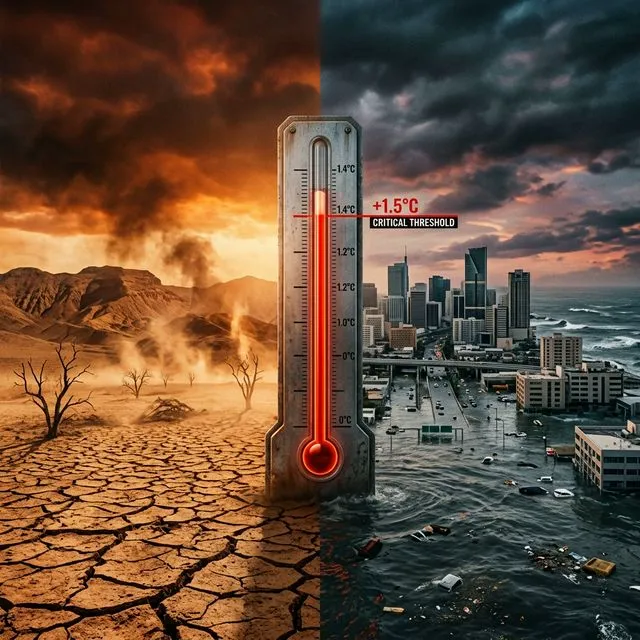
The defining number: global average temperature in 2025 was 1.55°C above the pre-industrial average (1850-1900). For the first time, an entire year exceeded the 1.5°C threshold established by the Paris Agreement as the "safe" warming limit. UN Secretary-General António Guterres called the report "a death certificate for climate inaction."
The Alarming Numbers
Record Temperatures
| Year | Anomaly (vs. pre-industrial) | Ranking |
|---|---|---|
| 2025 | +1.55°C | 1st hottest |
| 2024 | +1.45°C | 2nd hottest |
| 2023 | +1.40°C | 3rd hottest |
| 2020 | +1.27°C | 4th hottest |
Since 2015, no year has fallen below +1.0°C above the pre-industrial baseline.
Oceans in Fever
Oceans reached the highest average surface temperature ever recorded: 17.12°C in August 2025. The fourth global mass coral bleaching event affected 77% of monitored reefs. The Great Barrier Reef lost 34% of its cover between 2023-2025. Sea levels rose 4.77 mm in 2025 — double the 1990s rate.
Ice in Collapse
Arctic sea ice in September 2025 was the second lowest in history. The Thwaites Glacier in West Antarctica — nicknamed the "Doomsday Glacier" — continues retreating at 2 km per year. Complete collapse would raise sea levels 65 centimeters globally.

Real-World Impacts in 2025
- Heatwaves in India: temperatures of 51.3°C in Rajasthan, over 600 confirmed deaths
- Amazon drought: Rio Negro in Manaus reached the lowest level in 122 years of measurement
- Canadian and Siberian wildfires: 18 million hectares burned
- Hurricane Milton (Cat 5) devastated the US Gulf Coast with 280 km/h winds
Munich Re calculated climate-related natural disasters caused $380 billion in economic losses in 2025 — a new record.
What 1.5°C Exceeded Means
| Threshold | Consequences |
|---|---|
| 1.5°C | 70-90% of corals die; current extreme events |
| 2.0°C | Arctic ice disappears in summer; +10cm sea level |
| 2.5°C | Amazon at risk of becoming savanna; global megadroughts |
| 3.0°C | Glacier collapse; +50cm sea level; mass migrations |

FAQ
Has 1.5°C been exceeded — is it over?
The Paris Agreement's 1.5°C refers to multi-decade averages, not single years. The current trend indicates the 20-year average will exceed 1.5°C before 2035.
Is warming caused by El Niño or humans?
Both. El Niño 2023-2024 contributed 0.1-0.2°C. The remainder (1.3°C) is attributed to human greenhouse gas emissions.
Is Brazil affected?
Directly. The 2025 Amazon drought (Rio Negro at lowest level in 122 years) is a direct symptom.
Sources and References
- WMO — "State of the Global Climate 2025" (March 23, 2026)
- IPCC — Sixth Assessment Report (AR6), Synthesis 2023
- Munich Re — NatCatSERVICE Annual Review 2025
- NASA GISS — Global Temperature Analysis 2025


