
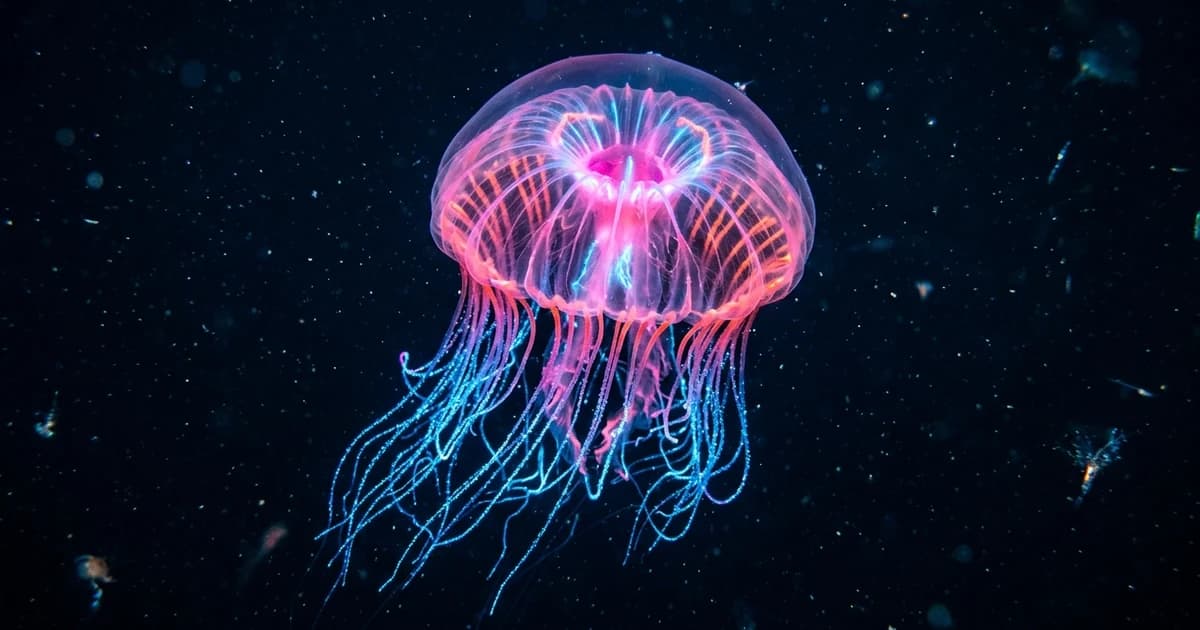
9 New Giant Jellyfish Species Discovered Off the Brazilian Coast
Date: July 18, 2026
Read Time: 8 minutes
Emoji: 🪼
In mid-2026, an oceanographic exploration in the South Atlantic revealed fascinating secrets in the Brazilian midwater zone. The research vessel R/V Falkor (too), operated by the Schmidt Ocean Institute, conducted an in-depth study resulting in the discovery of nine new species of giant jellyfish. This scientific milestone redefines our understanding of deep-sea biodiversity and reveals the presence of rich ecosystems in Brazilian waters.

The marine expedition focused on exploring regions that had never been analyzed before by oceanographers. These deep waters hide a diverse array of life forms that play essential roles in the ocean's ecological balance. The discovery has already sparked intense interest from global institutions dedicated to preserving marine life.
The findings surprised the global scientific community due to the colossal size of some specimens floating in abyssal depths. Modern robotic equipment searched marine expanses previously untouched by humans, capturing high-definition images and unique biological signatures. Scientists confirmed that the Brazilian coastline shelters a biological variety far superior to what was originally estimated.
What Happened
During an intensive two-week scientific expedition in the tropical South Atlantic Ocean, researchers mapped the wildlife present in the mesopelagic zone. Aboard the modern research vessel R/V Falkor (too), the international team of scientists identified and described thirty-one new forms of deep-sea life. Among this impressive set of new biological discoveries, the presence of nine giant jellyfish species immediately captured the interest of specialists.
Using the remotely operated vehicle (ROV) SuBastian, the team managed to guide ultra-high-fidelity cameras through the perpetual darkness at depths ranging from 200 to over 1,000 meters. The expedition also documented fascinating predatory behaviors that had never been recorded by human lenses in the Southern Hemisphere. A striking example was the detailed recording of a deep-sea pelagic octopus feeding eagerly on a glowing red jellyfish 800 meters below the surface.
Furthermore, biologists carried out genetic sequencing directly on board the vessel, accelerating the taxonomic cataloging process. This advanced method allowed the team to immediately rule out the possibility that the creatures belonged to groups already described in other oceans. This discovery draws incredible parallels with other remarkable marine investigations of gelatinous beings, such as the new species of giant red jellyfish in the Arctic Ocean.
The nine classified organisms stand out for presenting body structures highly specialized to withstand immense pressure and the absence of sunlight. Many of these new species have extensible tentacles that can exceed several meters in length, serving as efficient capture nets in the marine void. Some exhibit vibrant bioluminescence, producing pulses of blue and green light that serve both to attract scarce prey and to mislead fast predators.
Context and History
The exploration of the deep ocean has always run into severe logistical limitations and the physical fragility of the collected animals. Traditionally, conventional trawling nets destroyed a large portion of soft-bodied and gelatinous organisms when bringing them to the surface, preventing their proper scientific description. The mesopelagic zone, although representing the largest habitable biome on our planet, remains largely unexplored precisely because of this great sampling difficulty.
To mitigate this historical problem, the 2026 expedition employed revolutionary optical technologies that do not require the physical capture of the species. The main highlight was an innovative 3D microscope nicknamed 'Squid', capable of analyzing the cells of floating living organisms in real time. This new approach avoided the biological stress and destruction of fragile animals, providing detailed three-dimensional cellular images in a completely non-invasive way.

Before this mission by the Schmidt Ocean Institute, knowledge of jellyfish off the Brazilian coast was limited to shallow-water studies. The national deep basins were viewed as biodiversity deserts due to the scarcity of systematic research. This innovative exploration proved that the South Atlantic hides secrets as fascinating as the discovery of a prehistoric creature in a tropical lake in Indonesia.
Impact on the Population
Although these creatures inhabit the deep ocean, the health of the mesopelagic zone directly impacts the lives of human populations on the continent. This immense ecosystem acts as a biological pump for the planet, being responsible for the absorption and storage of billions of tons of atmospheric carbon every year. Without the perfect balance provided by jellyfish and other gelatinous predators, climate change could accelerate severely, affecting coastal cities and Brazilian artisanal fishing.
In addition to their crucial climatic role, the newly discovered species possess molecular compounds of immense value for the advancement of medicine. Marine bioluminescence has already inspired revolutionary tumor diagnosis tools in recent decades, and these new jellyfish may contain unprecedented biochemical secrets. The discovery stimulates the development of national biotechnology and attracts global investments to laboratories and researchers based in Brazil.
| Class/Group | Number of New Species | Bioluminescence | Depth Range | Key Characteristic |
|---|---|---|---|---|
| Jellyfish (Scyphozoa) | 9 | Yes (Intense) | 300 - 1000 meters | Gigantic tentacles and translucent body |
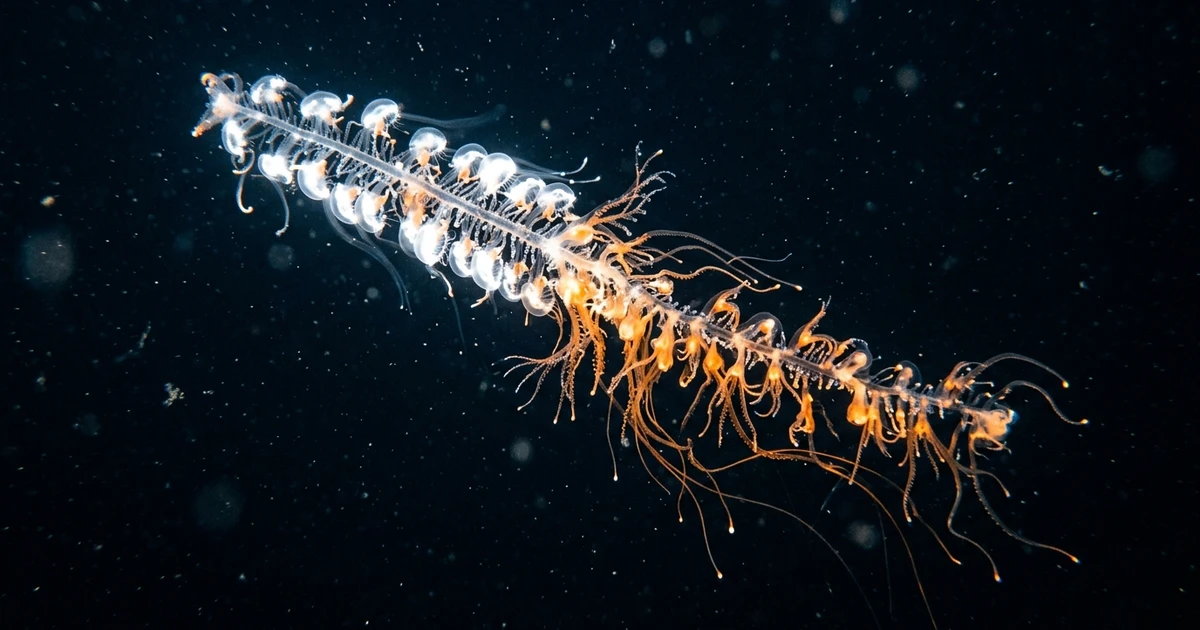
| Siphonophores (Siphonophorae) | 7 | Yes (Blue-green) | 200 - 900 meters | Organisms in connected linear colonies |
| Ctenophores (Ctenophora) | 7 | Yes (Diffuse) | 400 - 1000 meters | Combs of cilia that refract light into rainbows |
| Larvaceans (Appendicularia) | 4 | No (Absent) | 200 - 700 meters | Disposable mucus nets to capture debris |
| Marine Worms (Polychaeta) | 1 | Yes (Localized) | 600 - 900 meters | Fine and transparent body bristle in web |
The preservation of these deep species also depends on strengthening public policies aimed at monitoring and regulating human activities, such as submarine mineral exploration. Mining projects on the ocean floor can severely disrupt the upper midwater layers with plumes of toxic sediments. Thus, the official cataloging of these nine species serves as a scientific shield for the creation of new marine conservation units in the country.
What Those Involved Say
The chief scientist of the international expedition, Dr. Karen Osborn, affiliated with the prestigious Smithsonian National Museum of Natural History, expressed deep scientific enthusiasm about the research results. She stated that the speed of genomic and structural identification of the new jellyfish sets a new gold standard for ocean sciences. Osborn highlighted that the tropical South Atlantic has proven to be a true evolutionary nursery for gelatinous species of colossal proportions.
On the part of Brazilian institutions, Professor Renato Mitsuo Nagata, from the renowned Institute of Oceanography at the Federal University of Rio Grande (FURG), celebrated the international partnership. Nagata stressed that the active participation of local scientists consolidates Brazil's role in leading deep-sea biological research in Latin America. He also reinforced the need for continuous government support to maintain and advance national marine biology laboratories.
Postdoctoral researcher at FURG, Julieta Cebuhar, also commented on the innovative behavior of pelagic octopuses preying on jellyfish at extreme depths. Cebuhar stated that observing these events live demonstrates that the deep-sea food web is much more interconnected and active than old models suggested. She explained that these direct interactions prove that biological energy flows rapidly between the surface and the depths of the ocean.
Next Steps
Following the conclusion of field activities, the multidisciplinary team began the laboratory phase of detailed analysis of the genetic data and images obtained. The formal taxonomic descriptions and the official naming of each of the nine new giant jellyfish will be published in high-impact global journals by the end of 2026. This rigorous validation process will guarantee global recognition of the discoveries by the academic community.
The Schmidt Ocean Institute also plans to return to the same coastal region of Brazil in a new round of scientific expeditions scheduled for 2027. The main objective will be to investigate whether the newly discovered species migrate vertically throughout the day to feed or if they remain stationary. This new monitoring phase will help uncover the daily habits of these fascinating creatures and their ecological role in the South Atlantic.
Additionally, Brazilian researchers intend to expand graduate programs focused specifically on the autonomous exploration of deep marine environments. It is hoped that new technological partnerships with the shipping industry will allow the manufacturing of national optical sensors based on the prototypes of imported three-dimensional microscopes. This scientific sovereignty will help the country lead new discoveries without depending exclusively on equipment from abroad.
Closing
The historic revelation of nine new species of giant jellyfish along the coast of Brazil reinforces the incalculable wealth contained in national blue waters. This achievement demonstrates that science and technology, when aligned with international cooperation, can unveil mysteries that have remained hidden for millennia. The preservation of the deep ocean emerges as an essential collective commitment to ensure the survival of extraordinary species and maintain a healthy global climate balance.
As humanity moves toward the sustainable exploration of the seas, knowledge and respect for these abyssal ecosystems must guide all future economic decisions. Protecting the enigmatic midwater zone is preserving the very ecological engine of our planet. May these new and mysterious giant Brazilian jellyfish serve as a permanent beacon of inspiration and marine conservation.