
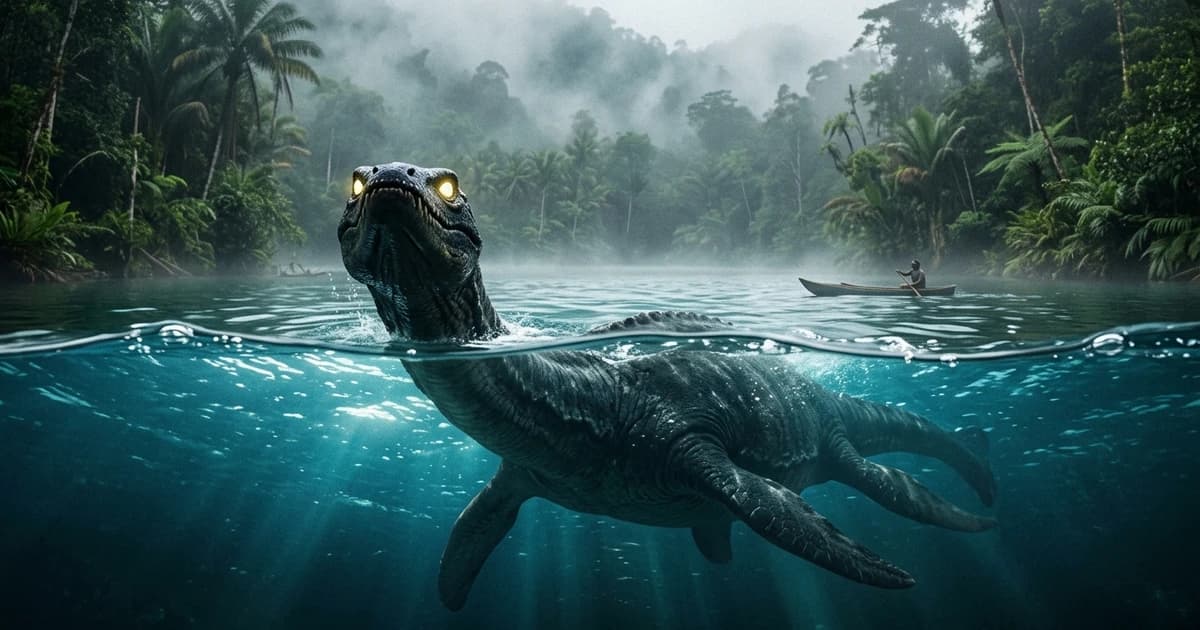
The Discovery of a Prehistoric Creature in a Tropical Indonesian Lake
On July 15, 2026, an international biological expedition operating in the depths of a remote Indonesian lake revealed one of the most extraordinary scientific discoveries of this century. A dedicated, multidisciplinary team of scientists found irrefutable physical evidence of a prehistoric reptile actively inhabiting the deep, dark waters of Sulawesi. This official announcement immediately shocked the global scientific community and reignited intense debates about unexplored prehistoric refuges remaining on Earth.
This incredible creature, which closely resembles ancient Mesozoic marine reptiles, has survived for generations in an extremely isolated aquatic ecosystem of volcanic origin. This deep, vertical lake environment served as a highly protected, natural ecological sanctuary for millions of years. The monumental discovery raises profound questions about the structural limits of modern zoological exploration and the adaptive resilience of wildlife.
The historic revelation of this enigmatic animal occurred in a year already filled with major milestones for the biological sciences. Recently, the scientific community was astonished by the discovery of a giant Dragon's Eye jellyfish in the Arctic Ocean of 2026. These consecutive discoveries demonstrate that deep water bodies, whether freezing polar oceans or tropical lakes, continue to conceal our planet's deepest evolutionary secrets.
The Mystery of Sulawesi's Volcanic Lake
The dramatic setting for this fascinating discovery is Lake Matano, widely recognized as one of the deepest and most mysterious lakes in Southeast Asia. With an impressive maximum depth of over 590 meters, the lake lies within an active tectonic fault line surrounded by dense, inaccessible tropical rainforests. The lower water layers of this geological formation are completely anoxic, meaning they lack dissolved oxygen and have remained undisturbed for thousands of years.
Local indigenous populations have long shared oral legends about a massive, serpentine creature inhabiting the dark depths of the central lake. However, Western researchers historically dismissed these traditional stories as mere cultural myths or misidentifications of large pythons swimming across marginal waters. The definitive scientific confirmation of this entirely new prehistoric reptile species has completely transformed how researchers view these regional legends.
The Limnological Expedition and the First Sighting
The expedition responsible for the find, named IndoLake 2026, united Indonesian, French, and American researchers in a collaborative exploration effort. The primary goal of this scientific team was to collect deep sediment cores and study iron-reducing bacteria on the lake bed. During the third day of surveying the central trench, high-frequency side-scan sonar detected an unusual biological disturbance in the transitional water column.
The definitive breakthrough occurred when a local fisherman found a recently deceased male specimen floating near an isolated rocky cove. The scientific team acted quickly to retrieve the carcass and transport it to a floating laboratory equipped for urgent necropsies. The excellent preservation of the body in the cold, deep waters allowed for highly detailed pathological, anatomical, and molecular analyses.
Anatomical Characteristics of Pseudotylosaurus indonesiensis
The prehistoric reptile was officially named Pseudotylosaurus indonesiensis due to its striking morphological similarities to Mesozoic mosasaurs. The recovered specimen measures 4.5 meters from its elongated snout to the very tip of its laterally flattened tail. Its thick, scaly skin is dark charcoal-grey on the back, with pale yellowish spots on the belly providing effective countershading camouflage.
The animal's skull features backward-curving conical teeth designed specifically for capturing the hard-scaled fish native to the lake. Its limbs have evolved into short, muscular flippers with mobile joints very similar to those of modern sea turtles. The eyes are exceptionally large and protected by a thick nictitating membrane that improves visual acuity in the dark, murky depths.
Comparison with Other Living Fossils and Famous Cryptids
The discovery of the Sulawesi reptile generated immediate comparisons to global cryptid legends and other species considered evolutionary relics. To position Pseudotylosaurus indonesiensis among known living fossils, researchers developed a detailed comparative analysis. This framework evaluates physical dimensions, geographic distribution, and official scientific recognition status across several famous examples.
The physical existence of this species differs fundamentally from unverified rumors of creatures like the Loch Ness Monster. While traditional cryptids lack solid physical evidence, the Indonesian reptile has sequenced genetic material and physical specimens preserved in museums. This discovery offers new perspectives that complement other aquatic research, such as the new species of giant red jellyfish in the Arctic Ocean of 2026.

| Creature Name | Location | Estimated Size | Discovery/Sighting Type | Scientific Status |
|---|---|---|---|---|
| Pseudotylosaurus indonesiensis | Lake Matano, Indonesia | 4.5 meters | Carcass Retrieval and ROV Video | Confirmed (Described in 2026) |
| Loch Ness Monster | Loch Ness, Scotland | 8 - 15 meters | Visual Sightings and Sonar | Unconfirmed (Urban Legend) |
| Coelacanth | Western Indian Ocean | 1.8 meters | Capture by Local Fishermen | Confirmed (Active Living Fossil) |
| Champy Monster | Lake Champlain, USA/Canada | 5 - 9 meters | Photographs and Sightings | Unconfirmed (Cryptid) |
| Chinese Alligator | Yangtze River, China | 1.5 - 2.1 meters | Direct Observation | Confirmed (Endangered Species) |
Paleontological Implications and the Extinction Paradox
From a paleontological standpoint, the persistence of Pseudotylosaurus indonesiensis raises revolutionary hypotheses about the Cretaceous-Paleogene extinction event. Traditionally, scientists believed the asteroid impact eliminated all giant marine reptiles and non-avian dinosaurs globally. The survival of a mosasaur lineage adapted to freshwater suggests some continental lake ecosystems functioned as vital thermal refuges during the catastrophe.
The geographical isolation of Sulawesi Island, which never had land bridges to neighboring continents, reinforced this unique evolutionary barrier. The region's fauna, known as the Wallacea Zone, is globally famous for its high degree of endemism and primitive species. The presence of this reptile in Lake Matano is the most dramatic expression of Sulawesi's prolonged ecological isolation.
Conservation Challenges of the Reptile's Habitat
Preserving this sensitive ecosystem has become an urgent international priority for global environmental conservation organizations. Lake Matano is surrounded by rich deposits of nickel and industrial minerals, attracting major open-cast mining activities nearby. Runoff containing heavy metals and chemical residues from these mines directly threatens the stability of the deep lake waters.
The Indonesian government has announced a provisional conservation zone covering over 60 percent of Lake Matano's area. This emergency measure strictly limits industrial operations, commercial net fishing, and unregulated recreational diving. The international conservation community is currently raising multilateral funds to support active ranger patrols along the lake's tributaries and shores.
Next Steps in Scientific Investigation
Biologists plan to launch a comprehensive passive acoustic telemetry program to track the remaining live specimens in the lake. Installing stationary hydrophones on the lake floor will record low-frequency vocalizations emitted by the creatures at night. This acoustic data will be critical for estimating the exact population size inhabiting the deep, dark trenches.
Full genomic sequencing using tissue from the recovered specimen is currently underway in collaboration with European research institutes. Scientists aim to identify the specific genes responsible for the reptile's adaptation to low-oxygen environments in the deep waters. Additionally, extracting sediment cores from the lake bed will help map the historical presence of the species over millennia.
Final Reflections
The discovery of Pseudotylosaurus indonesiensis serves as a powerful reminder of how much of the biosphere remains unknown to science. Our oceans, dense rainforests, and deep lakes still hide evolutionary mysteries that challenge established scientific assumptions. Protecting these fragile, untouched environments is essential to preserve the rich, ancient tapestry of life on our planet.
This lake reptile survived silently for millions of years, outlasting global cataclysms and severe ice ages that destroyed other megafauna. It would be a profound tragedy if this resilient prehistoric predator disappeared within decades due to uncontrolled industrial growth. The responsibility for its survival in the depths of Sulawesi now lies entirely in our hands and current ecological choices.
Analytical Framework and Measurement Baselines for Creature Name
Examining the practical ramifications of The Discovery of a Prehistoric Creature in a Tropical Indonesian Lake reveals that integrating dataset records for prehistoric reptile indonesia with the findings presented in The Mystery of Sulawesi's Volcanic Lake uncovers decisive dynamics governing Creature Name. Empirical thresholds such as 2026 confirm that the transition observed in Pseudotylosaurus indonesiensis reflects measurable physical and institutional drivers rather than isolated fluctuations within mundo animal. Consequently, sustained longitudinal monitoring of pseudotylosaurus indonesiensis and Loch Ness Monster builds an indispensable evidentiary foundation for refining technical decision-making around lake matano.
At the intersection of The Limnological Expedition and the First Sighting and the ongoing evolution of lake matano, the combined dynamics of Loch Ness Monster and Coelacanth deliver objective answers to long-standing technical questions in mundo animal. Empirical logs tied to 2026 indicate that maintaining stability in Champy Monster requires strict synchronization with the operational thresholds defined for living fossil and Anatomical Characteristics of Pseudotylosaurus indonesiensis. This chain of verifiable evidence surrounding Chinese Alligator reinforces the reliability of medium-term projections established by domain researchers.