
CERN Discovers New Subatomic Particle Ξcc⁺: What This Changes About Our Understanding of the Universe
March 2026. Beneath the border between France and Switzerland, 100 meters underground, the largest scientific instrument ever built by humanity has just made another discovery that promises to rewrite physics textbooks. The Large Hadron Collider (LHC) at CERN — a 27-kilometer circular tunnel where protons are accelerated to 99.9999% the speed of light — has detected a new subatomic particle that challenges our understanding of matter.
Its name is Ξcc⁺ — pronounced "Xi-cc-plus" — and while it may seem like just another notation in the Greek alphabet soup of physics, this discovery has profound implications for our understanding of the universe. Imagine finding a new type of "building block" in reality's construction — a block no one had seen before, but that theory predicted should exist.
What Is the Ξcc⁺?
To understand what makes the Ξcc⁺ so special, we first need to understand how matter is built at the most fundamental level.
The Building Blocks of the Universe
Everything around you — your body, your phone, the air you breathe, the stars in the sky — is made of atoms. Atoms are composed of three types of particles: protons (positive charge), neutrons (no charge), and electrons (negative charge).
But protons and neutrons aren't fundamental. They're made of even smaller particles called quarks, held together by the strong force — one of the four fundamental forces of nature, mediated by particles called gluons.
There are six types (or "flavors") of quarks:
- Up (u) — the lightest
- Down (d) — second lightest
- Strange (s) — strange
- Charm (c) — charmed
- Bottom (b) — bottom
- Top (t) — the heaviest
A normal proton is composed of two up quarks and one down quark (uud). A neutron is two down quarks and one up quark (udd). Simple, elegant, stable.
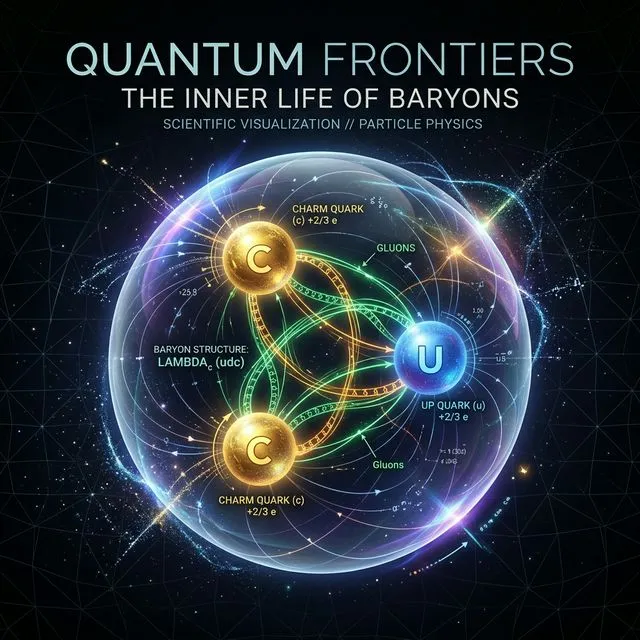
What Makes the Ξcc⁺ Different
The Ξcc⁺ is a doubly charmed baryon — a particle composed of two charm quarks and one down quark (ccd). This makes it fundamentally different from all the "normal" matter we encounter in everyday life.
Here are the numbers:
| Property | Proton (p) | Ξcc⁺ |
|---|---|---|
| Composition | 2 up + 1 down | 2 charm + 1 down |
| Mass | 938 MeV/c² | ~3,621 MeV/c² |
| Relative weight | 1x | ~3.9x heavier |
| Charge | +1 | +1 |
| Stability | Stable (billions of years) | Unstable (~0.0001 seconds) |
The particle is nearly 4 times heavier than a proton, which is extraordinary. For an analogy: imagine discovering that there's a version of a construction brick that weighs 4 times more but is the same size. That would completely change engineering — and in the case of physics, it completely changes our understanding of how the strong force operates.
How the Discovery Was Made
The LHCb: The Detector That Sees the Invisible
The discovery was made at the LHCb (Large Hadron Collider beauty) experiment — one of the four major detectors installed along the LHC ring. The LHCb is specifically designed to study particles containing heavy quarks (charm and bottom).
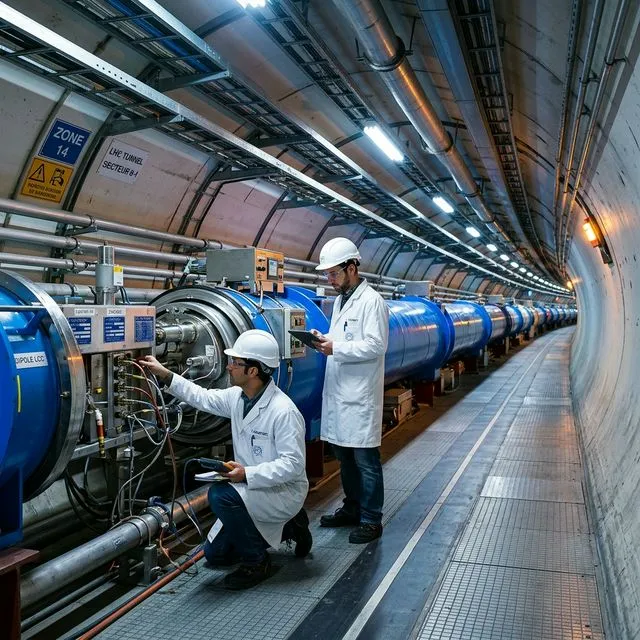
The detector works like this:
- Collision: Protons are accelerated in opposite directions and collided at energies of 13.6 TeV (tera-electron-volts)
- Creation: The collision energy transforms into matter (Einstein's E=mc²), producing thousands of particles in each collision
- Detection: Ultra-precise sensors track the trajectory, speed, and charge of each particle produced
- Analysis: Artificial intelligence algorithms filter billions of events to identify rare patterns
The Ξcc⁺ was found by analyzing the decay products of specific collisions. Since the particle lives only a fraction of a second before decomposing into lighter particles, physicists had to reconstruct its existence from the "debris" it left behind — like a detective reconstructing a car from pieces scattered after a crash.
Run 3: The Upgrade That Changed Everything
The discovery was only possible thanks to Run 3 of the LHC — the third round of operations that began in 2022 and included significant upgrades to the LHCb detector. The upgraded detector can process 30 MHz of collisions — 30 million collisions per second — with reconstruction efficiency five times greater than the previous version.
Why Does This Matter?
1. Testing the Standard Model with Extreme Precision
The Standard Model of particle physics is the most well-tested theory in the history of science. It predicts the existence of all known fundamental particles and how they interact. The existence of the Ξcc⁺ was predicted by the Standard Model — but its exact mass, lifetime, and decay properties provide crucial tests of the theory.
If there are discrepancies — even small ones — this could point to physics beyond the Standard Model, such as supersymmetry, extra dimensions, or new forces of nature.
2. Understanding the Strong Force
The strong force is, ironically, the least understood of the fundamental forces. The Ξcc⁺ offers a unique situation: with two heavy quarks (charm) and one light (down), physicists can observe how the strong force behaves in a regime where a light quark orbits a pair of heavy quarks. This is analogous to studying a planetary system with two suns and one planet.
3. Exotic Matter and Neutron Stars
In the cores of neutron stars — ultra-dense stellar corpses where a teaspoon of material weighs about 5.5 billion tons — conditions are so extreme that charm quarks can be naturally produced. Understanding particles like the Ξcc⁺ could help astrophysicists model what happens inside these impossible stars.
4. The Search for Dark Matter
While the Ξcc⁺ itself is not dark matter, studying it deepens our understanding of quantum chromodynamics (QCD). A more precise QCD could help identify discrepancies pointing to unknown particles, including potential dark matter candidates.
CERN: The Cathedral of Modern Science
Impressive Numbers
- LHC tunnel: 27 km in circumference
- Depth: 50-175 meters underground
- Temperature: -271.3°C (colder than deep space)
- Superconducting magnets: 9,593
- Collisions per second: ~1 billion
- Data generated: ~1 petabyte per day
- Member states: 23
- Scientists involved: ~17,000 from 110 nationalities
- Annual operating cost: ~1 billion Swiss francs
Discoveries That Changed the World
- 1983: W and Z bosons
- 2012: Higgs boson (the "God particle")
- 1989: Invention of the World Wide Web (yes, the internet was invented at CERN!)
- 2015-2022: Dozens of exotic hadrons, including pentaquarks and tetraquarks
- 2026: Ξcc⁺ — the doubly charmed baryon
The Future: What Comes Next?
Future Circular Collider (FCC)
CERN is already planning the LHC's successor: the Future Circular Collider (FCC), a 91-kilometer ring that would reach energies of 100 TeV — seven times more than the current LHC.
Artificial Intelligence in Physics
AI is revolutionizing data analysis at CERN. Deep learning algorithms can now identify patterns in collision data that would be impossible to detect with traditional methods. The discovery of the Ξcc⁺ was partly enabled by neural networks trained to recognize extremely rare decay signatures.
Why You Should Care
When electrons were discovered in 1897, nobody imagined that 50 years later they'd be the foundation of all electronics. When Einstein published E=mc² in 1905, nobody foresaw nuclear energy. When CERN created the World Wide Web in 1989, nobody predicted smartphones and social media.
Today's fundamental science is tomorrow's revolutionary technology.
As Einstein himself said: "If we knew what we were doing, we wouldn't call it research."
FAQ — Frequently Asked Questions
What is the Ξcc⁺ particle?
The Ξcc⁺ (Xi-cc-plus) is a doubly charmed baryon — a particle composed of two charm quarks and one down quark. It's nearly 4 times heavier than a proton and exists for only a fraction of a second.
Where was it discovered?
At the LHCb experiment at CERN's Large Hadron Collider (LHC), on the border between France and Switzerland.
Why is this discovery important?
It allows testing the Standard Model with precision, better understanding the strong nuclear force, and has implications for studying neutron stars and dark matter.
Does the Ξcc⁺ have any practical applications?
Not directly, at the moment. But fundamental discoveries have historically led to revolutionary technologies.
What is the LHC?
The Large Hadron Collider is the world's largest particle accelerator: a 27-km circular tunnel where protons are collided at near-light speeds to create new particles.
Sources: CERN Press Release, Science Daily, Physical Review Letters, The Guardian Science, Nature Physics


