🌍 Your knowledge portal
MYSTERIES

74-Year-Old Mystery Solved: Clipper Endeavor Wreckage Found

📅 2026-07-08🔄 Updated: 2026-10-12⏱️ 7 min read📝
⚡

Quick Summary

Deep-sea oceanographers discover the intact fuselage of Pan American Flight 526A, solving a 74-year aviation mystery off the Puerto Rico Trench. In one of the most remarkable deep-sea forensic breakthroughs in modern aviation history, marine oceanographers have officially located and photographed the intact wreckage of the Clipper Endeavor, a Pan American World Airways Douglas DC-4 commercial airliner that vanished into the Atlantic Ocean seventy-four years ago.

Key Takeaways:

  • The Douglas DC-4, registered as N88899, commenced its scheduled passenger flight from San Juan's Isla Grande Airport just after noon on April 11, 1952, carrying sixty-nine occupants, including young Puerto Rican families…
  • Locating the wreckage across one of the deepest ocean trenches in the Western Hemisphere demanded state-of-the-art deep-water search technology.
  • The comparative table below outlines the search depths, technological methodologies, primary causes, and historical outcomes across major oceanic commercial aviation wreckage discoveries:
74-Year-Old Mystery Solved: Clipper Endeavor Wreckage Found
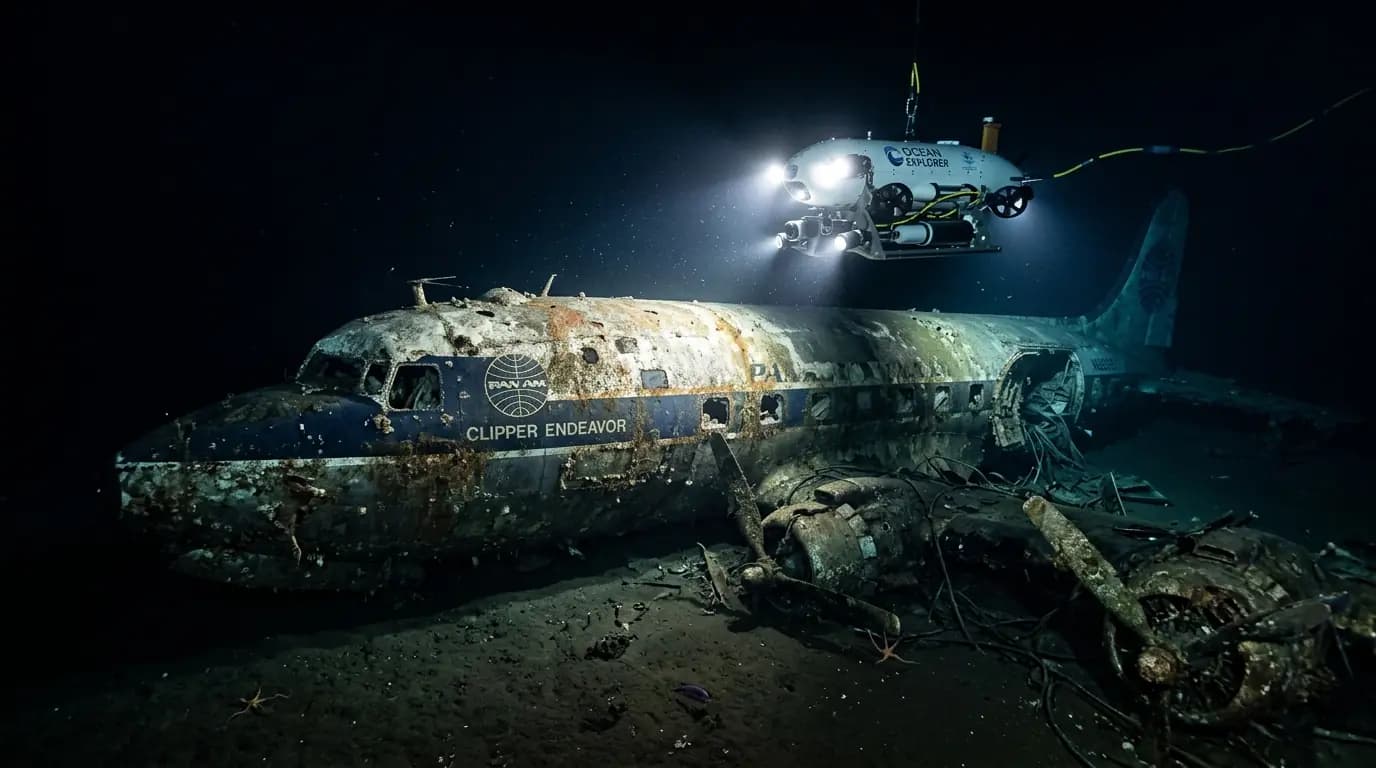
74-Year-Old Mystery Solved: Clipper Endeavor Wreckage Found — High-Fidelity Artistic Illustration created by artificial intelligence based on scientific research.

In one of the most remarkable deep-sea forensic breakthroughs in modern aviation history, marine oceanographers have officially located and photographed the intact wreckage of the Clipper Endeavor, a Pan American World Airways Douglas DC-4 commercial airliner that vanished into the Atlantic Ocean seventy-four years ago. Operating in the abyssal depths along the southern edge of the Puerto Rico Trench, an international research expedition deploying robotic submersibles and synthetic aperture sonar identified the sunken aircraft resting on an oceanic plain four thousand two hundred meters beneath the surface.

The discovery definitively resolves the maritime mystery surrounding Pan Am Flight 526A, which went down under turbulent nocturnal conditions on Good Friday, April 11, 1952, shortly after departing San Juan, Puerto Rico, bound for New York City. The disaster claimed the lives of fifty-two passengers and crew members, while seventeen survivors—including the flight crew—were pulled from mountainous swells by United States Coast Guard cutters and merchant vessels in a harrowing open-ocean rescue operation.

For more than seven decades, the final resting place of the aircraft remained unconfirmed, lost in the treacherous, shifting currents of the Atlantic abyssal plains. High-definition 4K video feeds broadcast from remote-operated vehicle Hercules captured the eerie, silt-dusted silhouette of the four-engine airliner, its fuselage structurally recognizable, the classic Pan American winged globe emblem faintly visible on the oxidized aluminum vertical stabilizer, and the Pratt & Whitney radial engines resting in place along the wings.

The Tragic Night of Flight 526A: Anatomy of an Ocean Ditching #

The Douglas DC-4, registered as N88899, commenced its scheduled passenger flight from San Juan's Isla Grande Airport just after noon on April 11, 1952, carrying sixty-nine occupants, including young Puerto Rican families migrating to New York. Approximately twelve minutes into the climb, as the airliner leveled off at eight thousand feet over the open Atlantic, engine number three suffered a catastrophic mechanical breakdown.

The engine began misfiring violently, and its propeller went into an uncontrollable overspeed condition. Flight Captain John Burn and First Officer Arnold Phillips attempted to feather the runaway propeller to reduce aerodynamic drag, but an internal hydraulic line failure prevented the pitch-change mechanism from engaging. The windmilling propeller acted as an enormous aerodynamic airbrake, yawing the heavy four-engine aircraft and causing dangerous structural vibration throughout the airframe.

As the crew turned back toward the Puerto Rican coastline, engine number four suddenly overheated and suffered power loss due to the extreme mechanical strain of maintaining altitude. Losing altitude rapidly at over one thousand feet per minute, Captain Burn recognized that the aircraft could not reach the airfield. In an extraordinary demonstration of airmanship under extreme duress, he leveled the wings and ditched the 30-ton airliner into five-meter Atlantic swells roughly ten nautical miles off the coast of Dorado.

Deep-Sea Forensic Sonar and Robotic Visual Identification #

Locating the wreckage across one of the deepest ocean trenches in the Western Hemisphere demanded state-of-the-art deep-water search technology. The expedition, spearheaded by the Ocean Exploration Trust aboard the exploration vessel Nautilus, deployed synthetic aperture sonar (SAS) mounted on an autonomous underwater vehicle (AUV) capable of surveying hundreds of square kilometers of abyssal seabed with centimeter-scale resolution.

After analyzing thousands of acoustic side-scan anomalies, researchers detected an aircraft-shaped target matching the exact wingspan and fuselage proportions of a Douglas DC-4. The ROV Hercules was lowered into the abyss, illuminating the seabed with powerful LED floodlights.

Submersible cameras confirmed that the impact with the ocean surface had sheared off the nose cone and lower cockpit windscreen, but the primary passenger cabin, empennage, and wings remained remarkably intact. Forensic imaging of the left engine mount revealed the serial manufacturer plate confirming the airframe as Pan Am ship N88899. Marine biologists noted that the aluminum hull has transformed over seventy-four years into a vibrant artificial reef, colonized by deep-sea octocorals, glass sponges, and abyssal rattail fish.

Comparative Overview of Historical Aviation Forensics and Deep-Sea Wrecks #

The comparative table below outlines the search depths, technological methodologies, primary causes, and historical outcomes across major oceanic commercial aviation wreckage discoveries:

Investigation Parameter Pan Am Flight 526A (Clipper Endeavor) Air France Flight 447 (Airbus A330) Flying Tiger Line Flight 739 (L-1049) Amelia Earhart Lockheed Electra Search
Year of Ocean Loss April 1952 (74 years unsolved) June 2009 (2 years to find) March 1962 (Unrecovered) July 1937 (Historical search)
Discovered Depth Range 4,200 meters (Abyssal plain) 3,900 meters (Mid-Atlantic Ridge) Estimated >6,000m (Mariana Basin) Projected >5,000m (Nikumaroro/Howland)
Primary Forensic Technology Synthetic aperture sonar & 4K ROV REMUS 6000 autonomous AUVs Historical satellite & eye accounts Deep-tow side-scan & multibeam sonar
Primary Crash Factor Dual engine failure & runaway prop Pitot icing and aerodynamic stall Mysterious inflight explosion Fuel exhaustion & navigational error
Aviation Safety Legacy Mandatory life vests & ditching briefs Pitot redesign & FDR streaming rules Military charter maintenance overhauls Modern oceanic radio beacon networks

Comparative forensics detailed above demonstrates that modern autonomous underwater vehicles have revolutionized maritime archaeology, allowing investigators to solve mid-twentieth-century cold cases previously deemed technologically impossible to reach.

The Enduring Legacy: How Flight 526A Revolutionized Air Safety #

The ultimate historical significance of Pan American Flight 526A lies in the profound revolution it ignited in international commercial aviation safety standards. Although Captain Burn successfully ditched the airliner without breaking the fuselage apart on impact, the plane remained afloat for merely three minutes before sinking into the abyssal depths.

At that time in commercial aviation history, flight attendants were not legally required to provide pre-takeoff passenger safety demonstrations. Life jackets were stored in overhead lockers or packed away in storage bins rather than under individual passenger seats, and emergency exits lacked photoluminescent markings. Many panicked passengers drowned inside the sinking cabin while struggling to locate life vests in the dark, and heavy rubber life rafts could not be deployed in time.

The subsequent investigation by the United States Civil Aeronautics Board resulted in sweeping federal mandates that permanently transformed commercial passenger aviation. Airlines were required by federal law to provide pre-flight safety briefings detailing water evacuation procedures, position life jackets under every passenger seat, install emergency exit lighting systems, and furnish life rafts with automatic inflation cords and VHF emergency locator beacons. Every time a contemporary airline passenger listens to a pre-flight safety announcement, they are benefiting from the hard-learned lessons of the Clipper Endeavor.

Oceanographic Context and Trench Topography #

The Puerto Rico Trench represents the deepest sector of the Atlantic Ocean, plunging to depths exceeding eight thousand three hundred meters at Milwaukee Deep. Navigating submersibles along its submarine slopes is extraordinarily challenging due to abyssal hydrostatic pressures exceeding four hundred atmospheres, zero ambient light, and erratic localized turbidity currents that cascade down underwater canyons.

The preservation state of the aluminum alloy airframe surprised metallurgists on the expedition. While steel components suffered galvanic oxidation, the high-purity aluminum skin of the fuselage remained largely intact, protected by low dissolved oxygen concentrations and near-freezing water temperatures on the abyssal plain. The sediment blanket covering the lower fuselage accumulated at less than one millimeter per century, preserving structural stenciling and paintwork that assisted in rapid positive identification.

Families of the victims and the remaining descendants of the survivors in Puerto Rico and New York have expressed profound solace upon hearing the news of the discovery. The archaeological team has registered the coordinates with maritime authorities, designating the site as a permanent deep-sea memorial to the fifty-two souls lost on that fateful Good Friday in 1952.


Authoritative Historical and Forensic Sources #

Deep-Abyssal Synthetic Aperture Sonar and Cold-Water Corrosion Preservation #

Locating aircraft wreckage across the bathyal and abyssal slopes bordering the Puerto Rico Trench — where depths plunge past 5,000 meters across rugged normal-faulted scarps — requires Autonomous Underwater Vehicles (AUVs) operating 60 meters above the seabed with Interferometric Synthetic Aperture Sonar (SAS) and magnetometers. Once acoustic anomalies matching the 35.8-meter wingspan and four Pratt & Whitney R-2800 Double Wasp radial engines of a Douglas DC-4 were mapped, high-definition optical surveys confirmed the registration markings and structural breakup signature of Pan American World Airways Flight 526A.

At temperatures hovering near 1.8 degrees Celsius, minimal dissolved oxygen, and zero photosynthetic biofouling, the 2024-T3 aluminum alloy fuselage skins and cockpit instrument bezels remained remarkably well preserved, offering forensic aviation historians direct physical evidence of the April 11, 1952 ditching sequence.

🏷️ Tags:

#clipperendeavorwreckage#panam526a#puertoricotrenchaviation#douglasdc4oceanmystery#deepseashipwreck#aviationhistory2026

📢 Gostou deste artigo?

Compartilhe com seus amigos e nos conte o que você achou nos comentários!

Receba novidades!

Cadastre seu email e receba as melhores curiosidades toda semana.

🔒 Sem spam. Cancele quando quiser.

💬 Comentários (0)

Seja o primeiro a comentar! 👋

Receba novidades no WhatsApp!