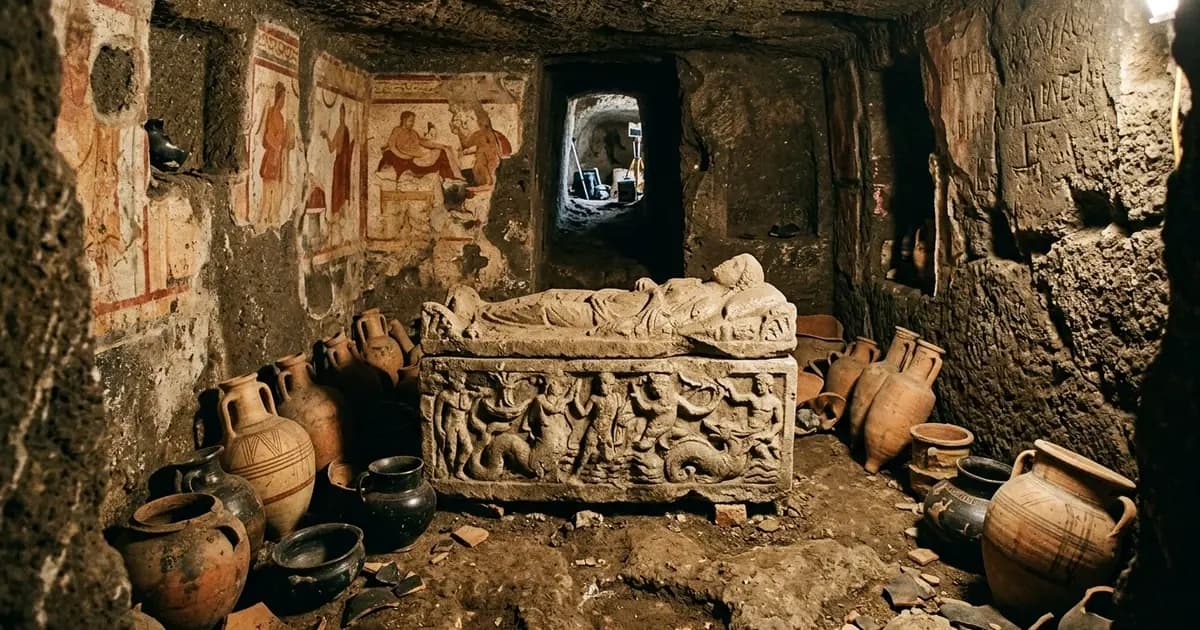
Archaeologists working across central and southern Italy have announced one of the most astonishing archaeological discoveries of the twenty-first century: the excavation of completely untouched seventh-century BC Etruscan burial chambers. Located in the volcanic tuff cliffs of San Giuliano near Viterbo and the fertile alluvial plains of Gragnano in Campania, these monumental tombs escaped both ancient Roman reuse and modern looting by tomb raiders (tombaroli). Sealed behind colossal volcanic blocks for more than twenty-seven hundred years, the chambers preserve intact funeral banquets, gilded bronze weaponry, and exotic imported luxury goods that reveal surprising trans-Mediterranean commercial connections with ancient Egypt.
The findings have sent shockwaves through the international archaeological community. While the Etruscans laid the architectural, religious, and political foundations of pre-Roman Italy, the vast majority of their aristocratic tombs were plundered during antiquity or systematically stripped of their treasures throughout the eighteenth and nineteenth centuries. Finding sealed subterranean vaults preserved in pristine condition provides historians with an uncorrupted snapshot of Etruscan funerary liturgy, social stratification, and early maritime commercial routes.
Field excavations led by the Superintendence of Archaeology, Fine Arts and Landscape for the Province of Viterbo and Southern Etruria, in collaboration with European research institutes, utilized non-destructive geophysical radar to pinpoint the chambers beneath dense Mediterranean brushwood. Upon carefully breaching the monumental stone dromos entrances, researchers entered subterranean stone-carved mortuary salons whose frescoed walls, stone couches, and intact ceramic offerings remained exactly as their mourners arranged them nearly three millennia ago.