The word "mining" has become synonymous with easy money in popular imagination. Who hasn't heard stories of people becoming millionaires mining Bitcoin on their home computer? But does this reality still exist in 2026?
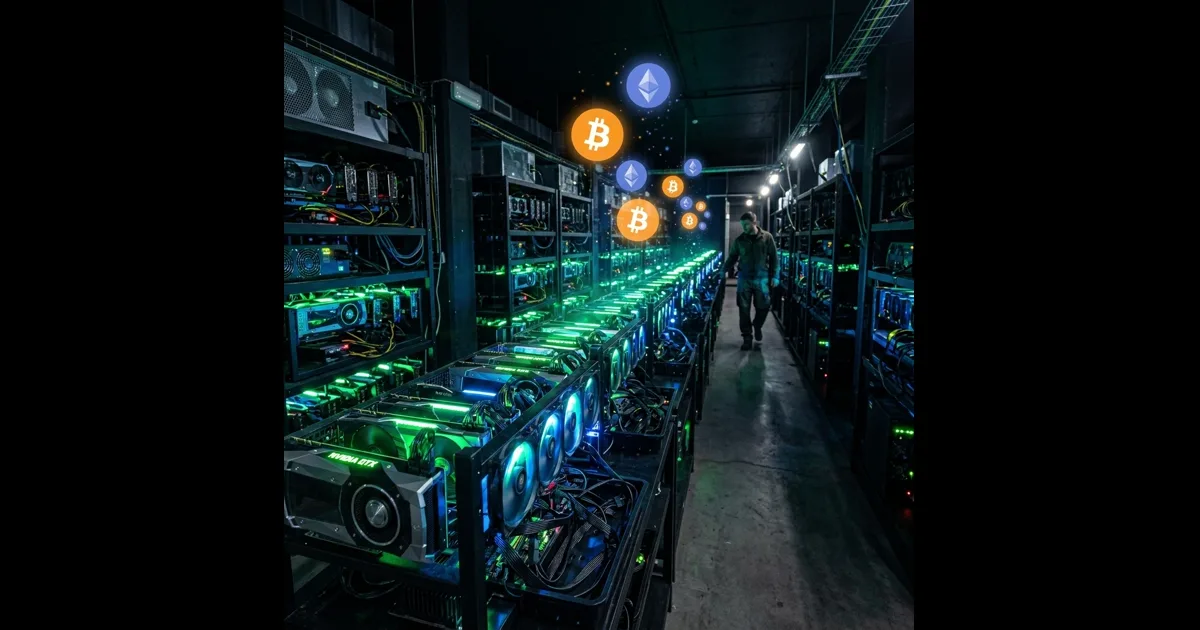
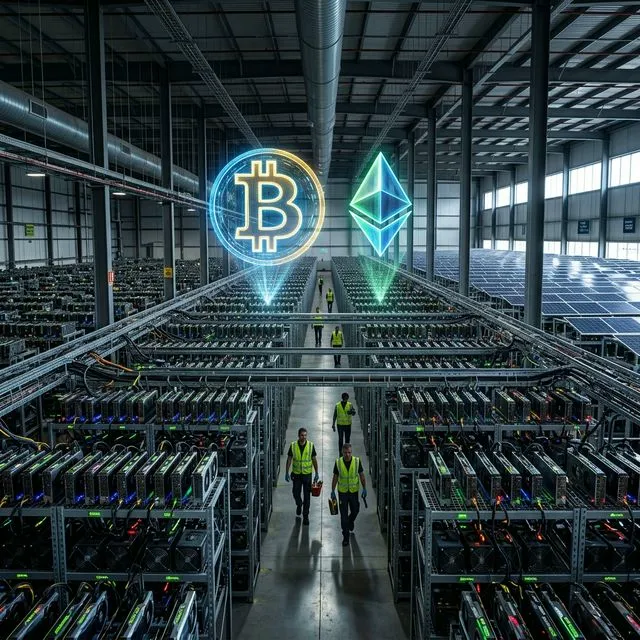
The truth is that mining cryptocurrencies in the classic Proof of Work (PoW) sense looks much more like an industrial operation than passive income. We're talking about specialized hardware, massive energy consumption, intense heat, constant maintenance, and profit margins that change every week.
In this comprehensive article, we'll debunk the main myths, explain how mining really works inside, and run a realistic simulation with updated numbers from January 2026. If you're thinking about investing in mining, this guide will show you exactly what to expect.
Quick Summary: What You Need to Know
Before diving into details, here's a summary of the current scenario:
- Mining (PoW) is a "trial and error" race to find a hash below the target
- In Bitcoin, ASICs rule — gaming PCs almost never compete
- The equation is dominated by energy + efficiency
- The 2024 halving cut the reward to 3.125 BTC per block
- With hashprice at ~$39.88/PH/day (01/19/2026), margins are tight
- To avoid losses, you need very cheap energy
⚠️ Important notice: This is educational material. Simulations are not profit promises. Numbers vary daily.
What Is Cryptocurrency Mining (Without Romanticization)
In Proof of Work networks, mining means competing with thousands of other miners around the world to assemble a block of transactions and find a valid hash.
The process works like this:
- Pending transactions are grouped into a candidate block
- Miners try to find a number (nonce) that, combined with block data, generates a specific hash
- This hash needs to start with a specific number of zeros
- Whoever finds it first wins the block reward + transaction fees
In Bitcoin, difficulty automatically adjusts every 2,016 blocks (approximately 2 weeks) to keep the average block interval around 10 minutes. This means that as more miners join the network, finding a valid block becomes harder.
Not Every Crypto Is Mineable
A common mistake is thinking every cryptocurrency can be mined. In fact, many modern networks use Proof of Stake (staking) instead of PoW:
- Ethereum migrated to PoS in September 2022
- Cardano, Solana, Polkadot use PoS variations
- Bitcoin remains the main example of large-scale PoW mining
Staking is completely different from mining — you "lock" your coins as collateral instead of spending computational energy.
Why "Mining Bitcoin on a PC" Became an Urban Legend
In Bitcoin's early years (2009-2012), it was possible to mine with a regular computer. Satoshi Nakamoto mined the first blocks with a basic CPU. But that time has long passed.
Today, competition is dominated by ASICs (Application-Specific Integrated Circuits) — machines designed exclusively for a single algorithm (SHA-256 in Bitcoin's case).
The Difference Is Brutal
| Hardware | Approximate Hashrate | Consumption |
|---|---|---|
| Regular CPU | ~10 MH/s | 100W |
| Top-tier GPU | ~100 MH/s | 300W |
| ASIC Antminer S21 | 200,000,000 MH/s (200 TH/s) | 3,500W |
A modern ASIC is literally 2 million times more efficient than a GPU for mining Bitcoin. Trying to compete with a gaming PC is like racing a Formula 1 car with a tricycle.
The metric that matters is energy efficiency: joules per terahash (J/TH). The Antminer S21 operates at 17.5 J/TH — the lower this number, the better.
The Halving: The Event That Changes Everything
The halving is an event programmed into Bitcoin's code that cuts the block reward in half. It happens every 210,000 blocks (approximately 4 years).
Halving History
| Date | Block | Reward Before | Reward After |
|---|---|---|---|
| Nov 2012 | 210,000 | 50 BTC | 25 BTC |
| Jul 2016 | 420,000 | 25 BTC | 12.5 BTC |
| May 2020 | 630,000 | 12.5 BTC | 6.25 BTC |
| Apr 2024 | 840,000 | 6.25 BTC | 3.125 BTC |
The most recent halving occurred on April 20, 2024, at block 840,000. The reward dropped from 6.25 to 3.125 BTC per block.
Impact on Profitability
Each halving is a reality check for miners:
- Base revenue drops 50% overnight
- Inefficient miners are forced to shut down machines
- Only operations with low energy costs survive
- Bitcoin price needs to rise to compensate (doesn't always happen short-term)

Hashprice: The Metric That Destroys Fantasies
If you want to understand whether mining is worth it, you need to know hashprice. It's the most direct way to see how much the network is paying per unit of computational power.
Hashprice = Revenue in USD per petahash per day ($/PH/day)
Real Data from January 2026
| Date | Hashprice |
|---|---|
| 01/12/2026 | $40.23/PH/day |
| 01/19/2026 | $39.88/PH/day |
| Change | -0.87% in one week |
Source: Hashrate Index
This constant variation explains why promises of fixed returns are a huge red flag. Anyone guaranteeing "X% per month" in mining is either lying or doesn't understand the market.
Mining Myths and Truths in 2026
Let's separate what's real from what's fantasy:
❌ MYTH: "Mining is passive income"
✅ TRUTH: It's an active operation that requires:
- Constant monitoring of temperature and performance
- Preventive and corrective maintenance
- Energy cost management
- Market metrics tracking
- Decisions about when to turn machines on/off
❌ MYTH: "You can mine any crypto"
✅ TRUTH: Most relevant cryptos today use Proof of Stake. PoW mining is concentrated in Bitcoin and some smaller altcoins.
❌ MYTH: "A gaming PC will do"
✅ TRUTH: For Bitcoin, you need ASICs. For some altcoins (like Ravencoin or Ergo), GPUs still work, but profitability is questionable.
❌ MYTH: "Halving makes everything easier"
✅ TRUTH: Halving cuts your revenue in half. It's only "good" if Bitcoin's price rises proportionally — which isn't guaranteed.
❌ MYTH: "Guaranteed profit exists"
✅ TRUTH: Hashprice, difficulty, and Bitcoin price change constantly. Promised fixed returns are almost always scams.
Real Simulation: 1 ASIC, Costs, and Return
Now let's get to what matters: an educational simulation with real numbers. Not a profit promise — it's for you to understand result sensitivity.
Simulation Parameters
| Item | Value |
|---|---|
| ASIC | Antminer S21 |
| Hashrate | 200 TH/s |
| Wall power | 3,500 W |
| Overhead (ventilation/losses) | +10% |
| Pool fee | 2% |
| Hashprice (01/19/2026) | $39.88/PH/day |
| ASIC price | $5,400 |
| Installation/setup | $800 |
| Total investment | $6,200 |
Calculations
Daily gross revenue:
- 200 TH/s = 0.2 PH/s
- 0.2 PH × $39.88 = $7.98/day
Net revenue (after 2% pool fee):
- $7.98 × 0.98 = $7.82/day
Daily energy consumption:
- 3,500W × 1.10 (overhead) = 3,850W
- 3,850W × 24h = 92.4 kWh/day
Energy break-even point:
- $7.82 ÷ 92.4 kWh = $0.085/kWh
Above $0.085/kWh, you're paying to mine.
Energy Scenarios and Year 1 ROI
| Scenario | Energy ($/kWh) | Energy Cost/Day | Profit/Day | Year 1 Profit | Year 1 ROI |
|---|---|---|---|---|---|
| High residential | 0.15 | $13.86 | -$6.04 | -$2,206 | -35.6% |
| Medium residential | 0.10 | $9.24 | -$1.42 | -$520 | -8.4% |
| Good industrial | 0.07 | $6.47 | +$1.35 | +$492 | +7.9% |
| Hosting/industrial | 0.05 | $4.62 | +$3.20 | +$1,167 | +18.8% |
Results Interpretation
- US residential energy ($0.12-0.20/kWh): certain loss
- Industrial energy ($0.06-0.10/kWh): tight margins
- Specialized hosting ($0.04-0.06/kWh): only viable option
Final Verdict: Is Mining Worth It in 2026?
After all this analysis, here's the honest conclusion:
❌ NOT worth it if:
- You pay residential energy rates
- Don't have proper infrastructure (ventilation, electrical network)
- Expect "passive income" without work
- Don't have capital to absorb temporary losses
- Believe in guaranteed return promises
✅ MAY be worth it if:
- Have access to very cheap energy (< $0.05/kWh)
- Can use professional hosting with ready infrastructure
- Understand it's a tight-margin business
- Have a long-term horizon and tolerate volatility
- Can buy ASICs at good prices (secondary market)
The Naked Truth
For most people, buying Bitcoin directly is simpler, less risky, and potentially more profitable than mining. Mining in 2026 is an industrial business that requires:
- Significant capital
- Technical knowledge
- Access to cheap energy
- Risk tolerance
- Patience
If someone offers you "easy mining" or "guaranteed profit," run. It's almost certainly a scam.
Sources and References
- Luxor Hashrate Index — Hashprice $39.88/PH/day (01/19/2026)
- Hashrate Index Roundup — Weekly hashprice variation
- Bitmain Antminer S21 — Specs: 200 TH/s, 3,500W, 17.5 J/TH, $5,400
- CoinGecko Bitcoin Halving — Halving on 04/20/2024, block 840,000
- Central Bank of Brazil — BCB Resolution No. 520 (effective 02/02/2026)
- Luxor - Why is Bitcoin Mining Hashrate Falling? — Economic pressure context
This article is educational material. Simulations presented do not constitute profit promises or investment recommendations. Market numbers vary daily. Do your own research before making financial decisions.
#herculesgobbi #bitcoin #mining #cryptocurrency #technology #investments #blockchain #ASIC #halving #proofofwork #hashprice #mundoincrivel
Article written by Hercules Gobbi, technology and digital finance specialist. Share this content with anyone who needs to understand the reality of cryptocurrency mining!
Frequently Asked Questions
Is cryptocurrency mining still profitable in 2026?
Profitability depends on electricity costs, hardware efficiency, and crypto prices. After Bitcoin's 2024 halving, mining rewards dropped to 3.125 BTC per block. Large-scale operations with cheap renewable energy remain profitable. Many miners have diversified to AI workloads.
How much energy does crypto mining consume?
Bitcoin mining alone consumes approximately 150-170 TWh annually, comparable to the energy consumption of countries like Poland. The industry is increasingly shifting to renewable energy, with estimates suggesting 50-60% now uses renewables.
What hardware is needed for mining in 2026?
For Bitcoin, ASIC miners like the Antminer S21 are essential, costing $3,000-8,000 each. GPU mining remains viable for altcoins. The initial investment for a profitable operation typically starts at $10,000-50,000.
Will cryptocurrency mining be banned?
Several countries have restricted or banned mining. China banned it in 2021, and some European countries have proposed restrictions. The trend is toward regulation rather than outright bans, with increasing requirements for renewable energy use.