
Bitcoin Plunges 47% Then "Buy Bitcoin" Searches Explode: The 2026 Crypto Roller Coaster
Date: March 6, 2026
Reading time: 24 minutes
Emoji: 📉
From $126,000 in October 2025 to $62,000 in February 2026 — a nearly 47% drop that evaporated more than $1 trillion from the crypto market in a matter of weeks. While veteran investors speak of a "historic opportunity" and newcomers panic-sell at any price, Google searches for "Buy Bitcoin" have hit their highest level in five years. Are we witnessing a capitulation that precedes a new explosive rally, or is this just the beginning of a brutal crypto winter? We analyzed all the data, indicators, and scenarios.
The Crash: What Happened in February 2026
February 2026 was one of the most dramatic months in Bitcoin's history. What started as a moderate correction quickly transformed into what analysts described as "one of the fastest crashes in crypto history," according to rate-of-change (Z-score) analyses.
The Crash Timeline
| Date | BTC Price | Event |
|---|---|---|
| Jan 31 | ~$95,000 | Bitcoin enters February in gradual downtrend |
| Feb 5 | ~$78,000 | Flash crash — largest single-day drop by Z-score in history |
| Feb 10 | ~$72,000 | Failed recovery attempt |
| Feb 15 | ~$65,000 | Cascading liquidations in derivatives market |
| Feb 22 | ~$62,500 | Bitcoin hits the cycle low |
| Feb 28 | ~$68,000 | Beginning of modest recovery |
The February 5 crash was particularly devastating. In a single day, more than $2 billion in leveraged positions were liquidated across the world's largest exchanges. On-chain data shows that spot market liquidity was extraordinarily thin — a condition that amplified both the speed and depth of the decline.

The Factors Behind the Drop
The crash had no single cause but was the result of a confluence of macroeconomic, geopolitical, and crypto-specific factors:
1. Geopolitical Tensions in the Middle East
The coordinated US-Israel attack on Iran on February 28, 2026, triggered a wave of risk aversion across global markets. While gold benefited as a traditional safe haven, Bitcoin initially suffered alongside risk assets like tech stocks.
2. Derivatives Market Deleveraging
The Bitcoin futures and options market had accumulated an extreme level of leverage during the 2025 rally. When selling pressure increased, it triggered a cascade of automatic liquidations that pushed the price down with unprecedented speed.
3. Weak Spot Demand
Unlike the 2024-2025 rally, which was driven by massive institutional purchases via ETFs, spot market demand had cooled significantly by early 2026. US Bitcoin ETFs recorded net outflows for several consecutive weeks.
4. Profit-Taking at the Top
Investors who had bought Bitcoin below $30,000 in 2023 were sitting on 300%+ profits. With the global economy uncertain, many chose to realize their gains, adding selling pressure to the market.
The Recovery: March Brings Hope
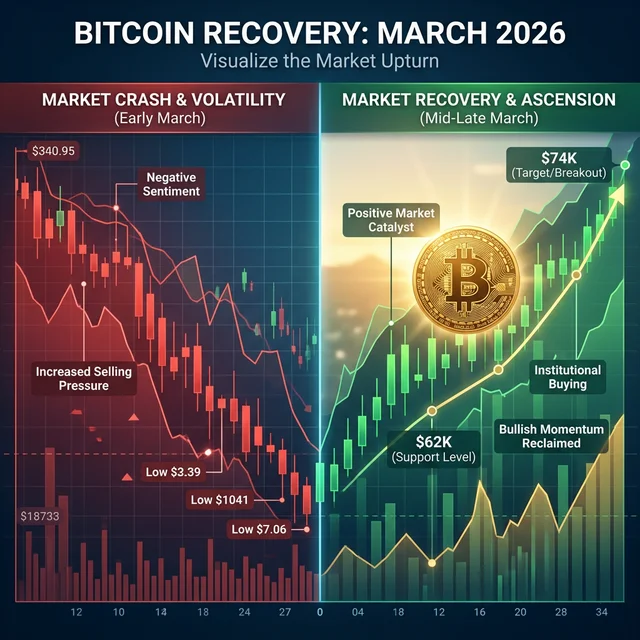
After February's brutality, March 2026 brought the first signs of recovery. Bitcoin reclaimed ground above $70,000 and briefly surpassed $74,000 in the first days of the month.
Recovery Catalysts
ETF Inflows Return
US spot Bitcoin ETFs returned to substantial inflows in early March. Data shows that after weeks of outflows, institutional investors resumed significant purchases, interpreting the $62,000-$65,000 levels as an attractive entry point.
Bitcoin as an Alternative Asset
Paradoxically, the same geopolitical tensions that initially pressured Bitcoin began to benefit it. As the Middle East conflict threatened oil routes and global financial stability, some investors began viewing Bitcoin not just as a speculative asset, but as an alternative store of value in times of systemic uncertainty.
Historic On-Chain Accumulation
Blockchain data reveals that long-term holders (addresses that rarely sell) accumulated record amounts of Bitcoin in the $60,000-$70,000 range since the beginning of the year. This behavior is historically associated with cycle bottoms — moments when "smart money" buys while the market panics.
March Price Update
| Metric | Value |
|---|---|
| Current price (Mar 6) | ~$72,000 |
| March high | $74,000+ |
| Recovery from low | +15% from the $62,500 bottom |
| Distance to ATH | -43% below the $126,000 peak |
| Market cap | ~$1.42 trillion |
"Buy Bitcoin": Google Searches Explode
One of the most fascinating indicators of this cycle is Google search behavior. While Bitcoin's price was plummeting in February, public interest in the cryptocurrency was skyrocketing — but with a surprising twist.

Searches That Reveal Market Sentiment
| Search Term | Behavior | Meaning |
|---|---|---|
| "Bitcoin" | Highest level in 12 months | General interest spiked |
| "Buy Bitcoin" | 5-year high in US | Retail wants to buy the dip |
| "Bitcoin to zero" | All-time record | Panic among less experienced investors |
| "Comprar Bitcoin" (BR) | Absolute peak March 2026 | Brazil leads Latin American interest |
| "Bitcoin crash" | High trend | People seeking to understand what happened |
The most revealing aspect is the contrast: while searches for "Bitcoin to zero" hit an all-time record in the US — a classic sign of capitulation and panic — simultaneously, searches for "Buy Bitcoin" also reached a 5-year high. This divergent pattern suggests that behind the generalized fear, there is a significant layer of investors who see the crash as an opportunity.
The Role of Institutional ETFs
Spot Bitcoin ETFs, approved by the US SEC in January 2024, have irreversibly transformed crypto market dynamics. For the first time, major asset managers like BlackRock, Fidelity, and Invesco offer traditional investors regulated access to Bitcoin — and the flows from these funds have become one of the market's most closely watched indicators.

ETFs: From Rally Engine to Crash Amplifier
During Bitcoin's run from $40,000 to $126,000 between February 2024 and October 2025, ETFs were the primary catalyst. At their peak, these funds were buying more Bitcoin per day than miners produced — creating unprecedented buying pressure.
However, when sentiment turned in January 2026, the same ETFs became a channel for selling pressure. Investors who had entered ETFs during the euphoria began redeeming their investments, forcing funds to sell Bitcoin on the spot market.
| Period | ETF Flows (net) | Impact |
|---|---|---|
| Jan-Oct 2025 | +$35B inflows | Primary rally engine |
| Nov-Dec 2025 | Neutral | Stabilization |
| Jan 2026 | -$5B outflows | Start of selling pressure |
| Feb 2026 | -$12B outflows | Crash amplification |
| Mar 2026 (week 1) | +$3B inflows | Recovery signal |
The Fear & Greed Index: Emotional Thermometer
The Crypto Fear & Greed Index is a composite indicator measuring crypto market sentiment on a scale from 0 (Extreme Fear) to 100 (Extreme Greed). It combines volatility, trading volume, social media sentiment, Bitcoin dominance, and Google search data.

The Emotional Journey of 2026
| Month | Index | Classification | What Happened |
|---|---|---|---|
| Oct 2025 | 85-92 | Extreme Greed | Bitcoin at $126K ATH |
| Dec 2025 | 65-70 | Greed | Healthy correction, optimism prevails |
| Jan 2026 | 40-50 | Neutral/Fear | Decline begins, uncertainty grows |
| Feb 2026 | 10-18 | Extreme Fear | Capitulation, total panic |
| Mar 2026 | 28-35 | Fear | Recovery, but caution dominates |
Historically, Fear & Greed readings below 20 have been excellent buying opportunities for long-term investors. In the last 5 times the index fell below 15 (2018, 2020, 2022, 2023, and 2026), Bitcoin posted average returns of +180% over the following 12 months.
Predictions: Where Is Bitcoin Headed?
Predictions for Bitcoin's price in 2026 vary dramatically, reflecting the fundamental uncertainty that permeates the market.
Analyst Scenarios
| Analyst/Source | 2026 Forecast | Premise |
|---|---|---|
| Bullish | $140K-$150K | Cycle extends, ETFs return strong |
| Moderate | $110K-$120K | Gradual recovery as in previous cycles |
| Base case | $85K-$95K | Partial recovery by year-end |
| Bearish | $38K-$50K | Stagflation + rate hikes = crypto winter |
Fidelity Digital Assets published a particularly interesting analysis, arguing that Bitcoin's recent 50% price drop is actually a positive long-term sign. According to the asset manager, decreasing volatility across successive cycles demonstrates that Bitcoin is gradually transforming from a speculative asset into a more stable store of value — a necessary path for its full institutional adoption.
Conclusion: Opportunity or Trap?
The Bitcoin crash of February 2026 was brutal but not unprecedented. In Bitcoin's relatively short 17-year history since Satoshi Nakamoto's creation in 2009, drops of 50% or more have occurred at least 8 times. On every previous occasion, the cryptocurrency eventually recovered and reached new all-time highs.
However, as the investment saying goes: past performance does not guarantee future results. The current geopolitical context, with military tensions in the Middle East and global economic uncertainty, makes the landscape more volatile and unpredictable than in previous cycles.
For long-term investors with adequate risk tolerance and a disciplined allocation strategy, on-chain data and current institutional accumulation suggest that Bitcoin may be forming a significant bottom. For short-term traders and first-time investors, the current volatility is a brutal reminder that the crypto market is not for the faint of heart.
Sources and References
- CoinDesk — Real-time price data and market analysis
- Glassnode — On-chain analysis and investor behavior metrics
- Forbes — Bitcoin Analysis — Journalistic coverage of the crash and recovery
- TradingView — Charts and technical analysis tools
- Alternative.me Fear & Greed Index — Crypto market sentiment index
- CoinGecko — Market cap and volume data


