
Viral Memes of the Week: From the Nihilist Penguin to the Apocalyptic Drog — Everything That Dominated the Internet This Week
Date: March 8, 2026
Reading time: 15 minutes
Emoji: 😂
If you've been offline for more than 12 hours this week, brace yourself: the internet happened A LOT and you probably missed at least three collective existential crises, two animals going viral for inexplicable reasons, and at least one dangerous challenge that made nutritionists worldwide lose sleep. March 2026 is delivering viral content at a speed that not even TikTok's algorithms can keep up with — and we're here to guide you through the glorious chaos that was the internet this week. From the penguin that became social media's unofficial philosopher to the frog-dog creatures that invaded the entire meme universe, through the collective dark humor about geopolitical tensions and the Pixar movie that was literally born from a meme, we've prepared the definitive guide to the memes that broke the internet in recent days. Grab your popcorn, mute notifications from your boss, and let's dive into this wonderful digital chaos.
🐧 The Nihilist Penguin: The Meme That Defined a Generation
When a Documentary Becomes an Existential Manifesto
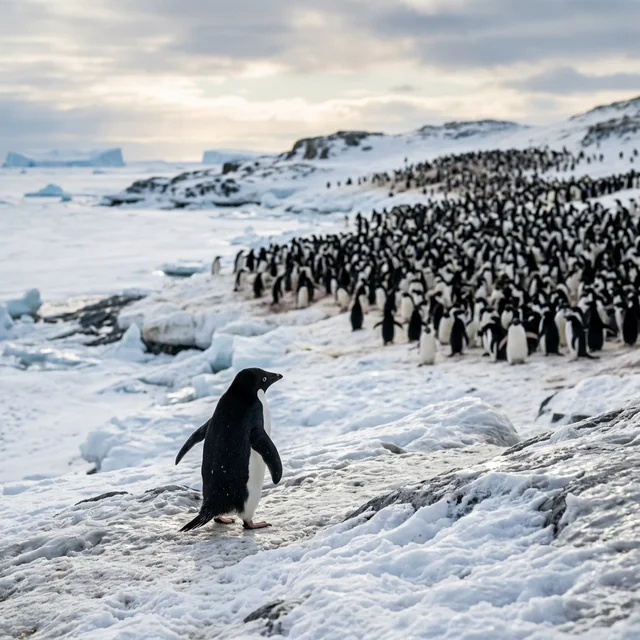
It all started with a seemingly harmless nature documentary clip: an Adélie penguin, in Antarctica, that simply stands up, looks at the crowded colony where hundreds of other penguins are doing penguin-things (pushing each other, fighting over pebbles, screaming for no apparent reason), and decides... to leave. No drama. No looking back. No explanations. It simply turns its back and starts walking toward the empty, glacial, and infinitely lonely horizon. And keeps walking. And walking. And walking some more.
The original clip, extracted from a BBC wildlife documentary about Antarctic life, was posted on TikTok on March 3, 2026, by the @nature.clips account with the caption "mood forever" — and in less than 48 hours had already surpassed 180 million views. But what transformed the video into a global cultural phenomenon wasn't just the view count — it was the DEPTH with which people identified with a penguin abandoning its entire society without prior notice or any form of explanation.
The Penguin as a Mirror of Society
The "Nihilist Penguin" instantly became the unofficial mascot of an entire generation that is exhausted, burned out, and collectively rethinking what it means to participate in modern society. The memes that followed are a true collective masterpiece of contemporary digital culture and creative expression:
- "POV: Me when my boss sends an email at 5:59 PM on Friday" — followed by the clip of the penguin turning its back and walking into the absolute nothingness of the frozen Antarctic landscape
- "My patience for 2026" — with the penguin walking away from the colony while the text displays an endless and ever-growing list of world problems accumulated since January
- "Quiet quitting, but make it literal" — the penguin entering the shift (colony) at the beginning of the video and leaving at the end, with "Elevator Music" playing in the background creating a perfectly comedic contrast
- "Me after reading the news for 5 minutes" — perhaps the most universal and widely-shared version, capturing the collective feeling of informational alienation and digital fatigue that has become the defining emotional experience of the 2020s
- "My social energy after 10 minutes at any family gathering" — a variation that accumulated 45 million views on Instagram Reels alone, spawning thousands of duets and remixes
- "When someone asks me how 2026 is going" — just the penguin walking, no additional text needed, because the image says everything that words cannot adequately express
The phenomenon even generated serious analysis from psychologists in publications like The Atlantic and BBC Culture, which discussed how mass identification with a penguin abandoning its community reflects collective exhaustion, decision fatigue, and the growing desire for a simpler life in times of permanent informational overload. Dr. Marcus Chen, a psychologist at Stanford University, coined the term "Penguin Energy" to describe "the emotional state of someone who has passed the point of no return of burnout and finds peace not in confrontation, but in radical detachment from the systems that caused the burnout in the first place." The cultural impact of the Nihilist Penguin extended beyond simple memes. It became a symbol for a generation grappling with climate anxiety, economic uncertainty, and the relentless pace of digital life. Think pieces in major publications explored "Penguin Energy" as a new form of quiet rebellion, a desire to opt out of systems that feel overwhelming. Online communities dedicated to "Penguincore" emerged, advocating for slow living, digital detoxes, and a return to simpler, more intentional ways of being. This subculture, surprisingly robust, even led to a surge in sales of Antarctic-themed merchandise and ambient soundscapes for meditation and focus.
Perhaps most remarkably, the meme transcended the typical one-week viral lifecycle that most internet phenomena follow before being forgotten. By March 8, the Nihilist Penguin had spawned its own subculture: "Penguincore" accounts dedicated to slow-living content, Antarctic ambient soundscapes designed for working from home, and even a line of merchandise featuring the penguin with inspirational anti-motivational quotes like "Attendance is optional" and "Not my colony, not my problem."
🐸 Drog/Cheems Frog: The Most Absurd Invasion in Meme History
From Douyin to the World: How a Frog-Dog Conquered the Entire Internet
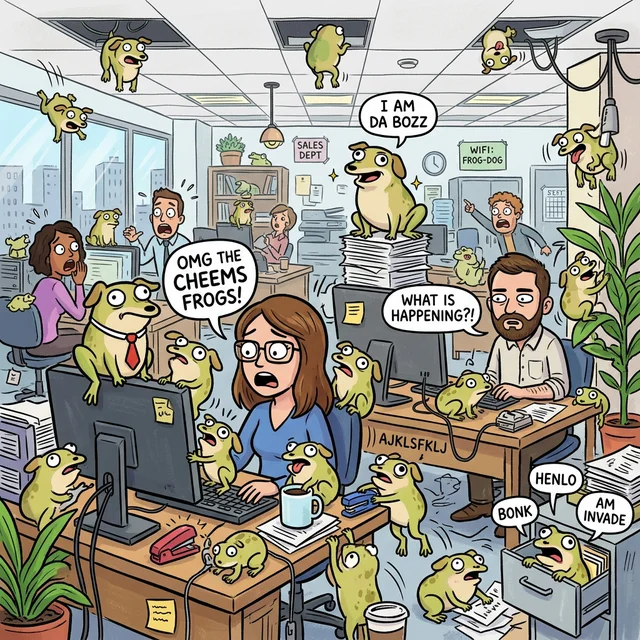
If the Nihilist Penguin is the poetry of the internet, the Drog is the pure meaningless chaos that makes you laugh until you cry without knowing exactly why — and that is precisely what makes meme culture so wonderfully, irreducibly human.
The "Drog" (also called Cheems Frog) is a hybrid creature between the iconic Cheems dog (the Shiba Inu with speech difficulties) and the classic frog from "It's Wednesday My Dudes." The fusion originally emerged on Douyin — the Chinese version of TikTok — where creators began using generative AI tools to create hordes of Drogs invading real-world settings: offices, tourist landmarks, classrooms, restaurants, even parliaments and churches.
What makes the Drog so irresistible is the complete absence of logic, purpose, or message. There is no deep metaphor, no sophisticated social commentary, no hidden political agenda whatsoever. They are simply hundreds of absurd creatures with gigantic eyes and empty expressions invading everyday settings while everyone around them reacts with total confusion. It's the digital equivalent of a collective nervous laughter fit — and in March 2026, with the world literally on fire in multiple geopolitical senses, the pure nonsense of the Drog offers exactly the type of mental escapism that billions of people are desperately searching for.
The numbers are impressive: in just one week, the #Drog hashtag accumulated over 4.7 billion views on TikTok. What digital culture experts find particularly fascinating about the Drog is how it represents the natural evolution of the meme as an art form: while memes of the 2010s generally had a clear textual "joke + punchline" structure, 2026 memes are increasingly visual, surreal, and resistant to any attempt at rational explanation. The Drog isn't funny DESPITE not making sense — it's funny BECAUSE it doesn't make sense. And in a world where everything feels excessively serious, political, and charged with meaning, deliberate nonsense has become a legitimate form of emotional self-preservation.
Brands, as always, tried to ride the wave — with mixed results. Burger King posted a version with Drogs invading one of their stores that was genuinely well-received. Meanwhile, a major bank tried an "educational" version about investments featuring Drogs that was universally destroyed in the comments section. The lesson the internet repeatedly teaches brands: participate in the joke, but never try to hijack the joke.
💣 WW3 Memes: Dark Humor as a Collective Defense Mechanism
The Internet Processes Geopolitical Chaos With Jokes
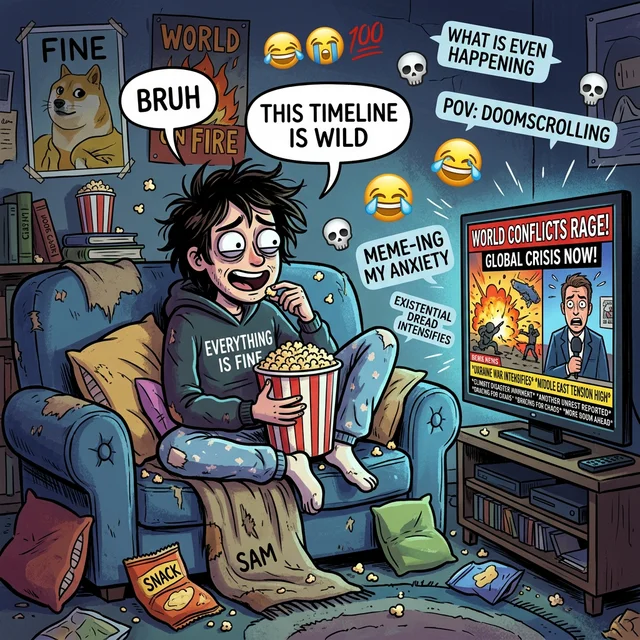
With tensions between Iran, Israel, and the United States reaching levels that experts classify as "the most dangerous since the Cuban Missile Crisis of 1962," the internet did what the internet does best when confronted with the possibility of global catastrophe: it created memes. Many, many memes. An absolutely overwhelming quantity of memes that oscillate between comic genius and existential despair with a disconcerting naturalness that would make any philosophy professor proud.
This week's geopolitical memes fall into fascinating categories:
The "Popcorn" Category: Characters from movies, series, and anime watching the chaos with amused expressions while eating popcorn. Kim Jong Un appears with particular frequency — the internet collectively decided that the North Korean dictator is "watching everything unfold from VIP seats," and images of him with popcorn, 3D glasses, and an entertained expression accumulated hundreds of millions of interactions across every major social media platform.
The "Draft Card" Category: Memes about being drafted for World War III, but with absurdly specific scenarios: "POV: you in the WW3 draft but your squad is the guy who makes food TikToks, your 78-year-old grandma, and the neighbor's dog," or "Me enlisting for WW3 knowing my only skill is making CapCut edits that go marginally viral."
The "Speedrun" Category: A particularly popular subcategory that treats 2026 as a video game where the developers accelerated all the negative events at maximum velocity: "2026 speedrunning the apocalypse," "God doing ANY% apocalypse run," "2026 lore is more complex than Dark Souls and we're only on chapter 3 of this absolute nightmare."
The "This Is Fine" Category: The classic meme of the dog sitting in a room engulfed in flames got updated versions with maps of the Middle East in the background, rising oil price charts, and real newspaper headlines superimposed onto the original comic panel.
🦎 Pixar's Hoppers: When a Meme Becomes a $200 Million Movie
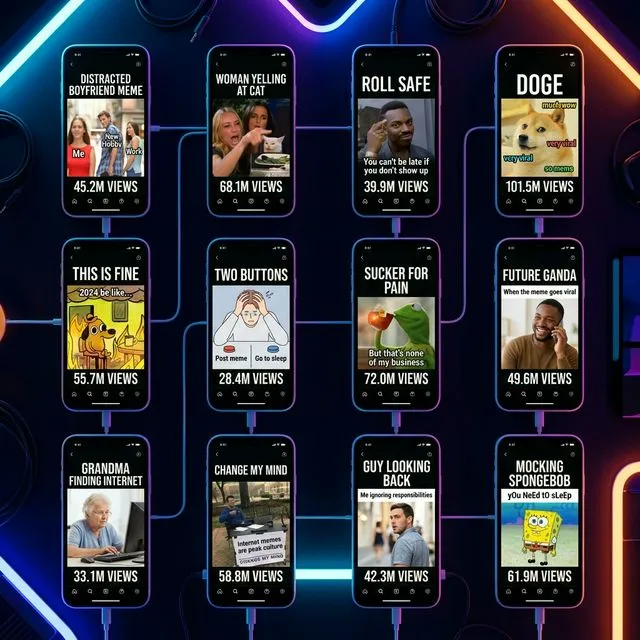
In a plot twist that nobody in the entertainment industry predicted, Disney Pixar is attempting to transform a viral meme into an animation blockbuster — and, against all odds and expectations of the most skeptical analysts, it appears to be working spectacularly well.
"Hoppers," which premiered in theaters this first week of March 2026, tells the story of a group of lizards with extraordinary jumping abilities on an adventure through the tropical jungle. But the real protagonist of the film's marketing isn't the story or the impressive production values — it's the FACE of the main character. A green lizard with monumentally disproportionate eyes, a permanently shocked expression, and an aura of "I cannot believe what I'm seeing" that is impossible to look at without laughing involuntarily.
Pixar, demonstrating marketing intelligence that deserves genuine applause from the entire advertising industry, didn't try to fight the meme or protect the character's image with aggressive copyright takedowns. Instead, the company fully embraced the phenomenon: they released official templates for content creators, sponsored TikTok creators who were already using the meme organically, and even created an official account on X called @HoppersFace that reposted the best fan memes with captions written "in the voice" of the character.
The result? "Hoppers" opened with $127 million in its first week in the US, exceeding projections of $85-95 million that were already considered optimistic by box office analysts. In China, the film earned an additional $89 million, bringing its global opening to a staggering $216 million. The internet, which usually destroys any corporate attempt to "appropriate" meme culture with ruthless efficiency, this time applauded Pixar's strategy — probably because the company was smart enough to participate in the joke instead of trying to control it. Industry analysts are already calling it the "Hoppers Playbook" and predicting that every major studio will attempt to replicate the strategy with varying degrees of success and cringe over the next 18 months.
🍿 The "Eat Plastic" Challenge: When the Internet Goes Too Far
The internet of March 2026 isn't all laughs and harmless memes. The "Plastic Eating Challenge" — yes, the challenge where people film themselves chewing or biting food without removing the plastic packaging — went viral on TikTok and Instagram with hundreds of millions of views, generating legitimate concern among health professionals worldwide.
TikTok implemented automatic warnings on videos with the #PlasticChallenge hashtag, redirecting to health and safety resources. Instagram followed suit, adding alert overlays on Reels containing the challenge content. Health influencers globally recorded specific videos asking young people not to participate, accumulating tens of millions of views in their collective awareness efforts.
The Plastic Challenge case raises a fundamental question about digital platforms in 2026: at what point does the free viralization of potentially dangerous content stop being "just entertainment" and become the legal responsibility of the technology companies that profit from the engagement it generates? It's a question that legislators worldwide have been trying to answer since 2020, but that the speed of the internet always renders obsolete before any regulation can be approved and properly implemented.
📊 This Week's Rankings: What Went Most Viral
| Ranking | Meme/Viral | Main Platform | Estimated Views |
|---|---|---|---|
| 🥇 | Nihilist Penguin | TikTok / Instagram | 180M+ |
| 🥈 | Drog/Cheems Frog | TikTok / X | 4.7B hashtag views |
| 🥉 | WW3 / Kim Jong Un Popcorn | X / TikTok | 900M+ |
| 4 | Hoppers Face (Pixar) | Instagram / TikTok | 650M+ |
| 5 | Plastic Eating Challenge | TikTok | 340M+ |
| 6 | T20 India vs NZ Final Memes | X / Instagram | 280M+ |
| 7 | McDonald's CEO Burger Meme | X | 120M+ |
| 8 | Filipino TikTok Dance Mashups | TikTok | 95M+ |
Conclusion: The Internet Never Changes (And That's Wonderful)
If there's one thing March 2026 proves with crystal clarity, it's that no matter what's happening in the world — wars, economic crises, nuclear tensions, pandemics, or natural disasters — the internet will keep doing exactly what it's been doing since someone posted the first LOLcat in 2007: transforming chaos into shared humor, fear into collective laughter, and loneliness into improvised, wonderfully imperfect community that spans every continent, language, and time zone simultaneously.
What makes meme culture in 2026 particularly special, compared to the earlier, simpler era of Rage Comics and "I Can Has Cheezburger," is its incredible sophistication. Today's memes are layered, self-referential, culturally aware, and emotionally complex in ways that would have been incomprehensible to internet users just a decade ago. The Nihilist Penguin isn't just a funny animal video — it's a collective processing ritual for an entire generation's burnout, anxiety, and existential fatigue. The Drog isn't just random nonsense — it's a deliberate embrace of absurdism as a coping mechanism for a world that feels increasingly difficult to reconcile with logic and reason.
The Nihilist Penguin reminds us that it's okay to want distance from the world when the world is too much to bear. The Drog reminds us that not everything needs to make sense to have value and bring joy. The WW3 memes remind us that laughing at the absurd is profoundly human and necessary for our collective mental health. Hoppers reminds us that even Hollywood can learn something from the spontaneous wisdom of the internet when it decides to listen rather than control. And the plastic challenge reminds us that yes, the internet can also be incredibly stupid — and that this duality between genius and idiocy is exactly what makes it so fascinating and indispensable to modern life.
See you next week, when the internet invents something equally absurd, profound, and inexplicably hilarious. Because it will. It always will. That's what the internet does best — and we wouldn't have it any other way.
Sources and References
- Know Your Meme — Encyclopedia of memes and internet culture
- TikTok Trends — Trending viral videos
- The Atlantic — Internet Culture — Cultural analysis
- BBC Culture — Cultural phenomenon analysis
- CNN — Trending news coverage


