
In a world where geopolitical tensions seem to escalate with every headline, the internet has found its own way of coping with anxiety: memes. And not just any memes — we're talking about masterpieces of dark humor that transform the apocalyptic scenario of a hypothetical World War III into material for laughs shared by millions of people around the globe. Because, let's be honest, if the world is going to end, at least let it be with WiFi and a good laugh.
The culture of memes about world conflicts is not new. Since the internet became humanity's primary communication vehicle, moments of international tension have generated waves of digital humor that serve both as an emotional pressure valve and as social commentary on the absurdity of modern geopolitics. But in 2026, with tensions in the Middle East, disputes in the South China Sea, and an increasingly worrying arms race, WW3 memes have reached a new level of creativity and virality.
The Board Game Nobody Wants to Play
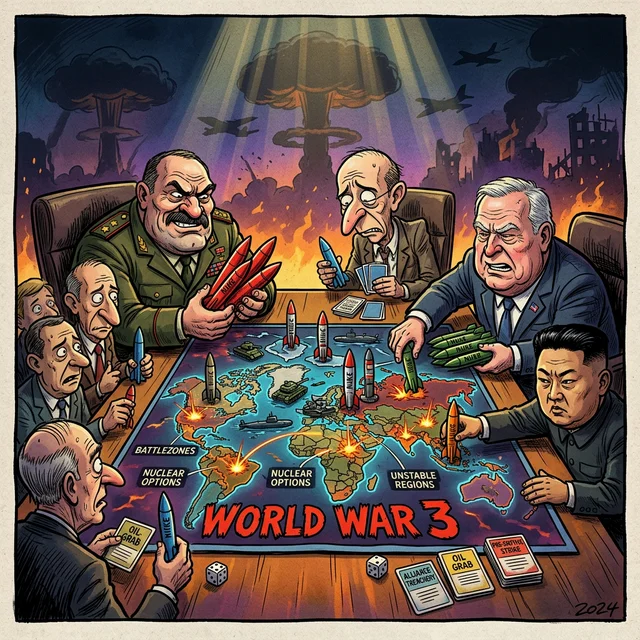
The most viral meme of 2026 so far imagines world geopolitics as a board game, where world leaders sit around a world map holding missile-shaped pieces. The genius of the humor lies in the details: one leader looks confused at the rules, another hides extra pieces under the table, and a third is already assembling a PowerPoint presentation on "winning strategy" while the board catches fire.
This type of humor works because it translates complex and frightening situations into accessible and funny images. The fear of a global nuclear conflict is real and documented by psychologists as one of the main sources of anxiety among young adults worldwide. Memes transform this fear into something that can be emotionally processed in a lighter way, without minimizing the gravity of the real situation.
Why Do We Laugh at What Scares Us?
Psychologists explain that humor in situations of extreme stress is a natural and healthy defense mechanism. Laughter releases endorphins, reduces cortisol levels (the stress hormone), and strengthens social bonds when shared. When millions of people share the same meme about a scary topic, they are essentially creating a collective emotional processing ritual that transcends cultural and linguistic barriers.
Sigmund Freud had already identified humor as a form of "economy of affect" — instead of spending emotional energy on fear and anxiety, we transform the threat into something laughable, saving psychological resources that can be better employed in productive actions. WW3 memes are, in this sense, group therapy on a global scale.
The Millennial Bunker: Apocalypse with Comfort
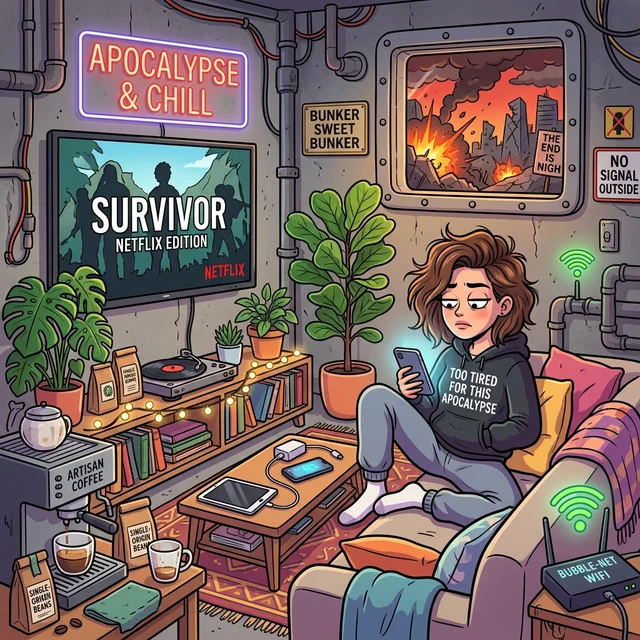
If there is a meme that perfectly defines the millennial generation and Gen Z, it's the luxury bunker meme. The premise is simple and brilliant: while the world outside is in flames, someone has transformed their nuclear shelter into a complete hipster apartment, with high-speed WiFi, streaming TV, artisanal single-origin coffee, and an impressive collection of plants that survived the apocalypse better than most people.
The humor here lies in the implicit social commentary about the priorities of younger generations. While previous generations might have thought about storing canned goods and water, the digital generation worries about the quality of the internet connection in the bunker. The shirt that reads "Too Tired For This Apocalypse" is the perfect finishing touch — because, honestly, a generation that works six freelance jobs to pay rent is already too exhausted to worry about a nuclear apocalypse.
The "Doom Scrolling" Culture
The concept of "doom scrolling" — the obsessive tendency to consume negative news on social media — has gained a completely new dimension in WW3 memes. Several memes show people in bunkers completely indifferent to the explosions outside, but absolutely devastated because Instagram is down. The message is clear and biting: we have become so dependent on our digital lives that even the apocalypse would be considered tolerable as long as the WiFi worked.
Digital behavior researchers observe that this type of humor reflects an uncomfortable truth about humanity's relationship with technology. The generation that grew up with smartphones and social media has developed an emotional dependency on connectivity that would have been unthinkable just two decades ago. Bunker-with-WiFi memes are not just jokes — they are satirical mirrors of a society that needs "likes" to validate its existence, even in an apocalyptic scenario.
Battlefield Selfie: Are Likes Worth More Than Lives?
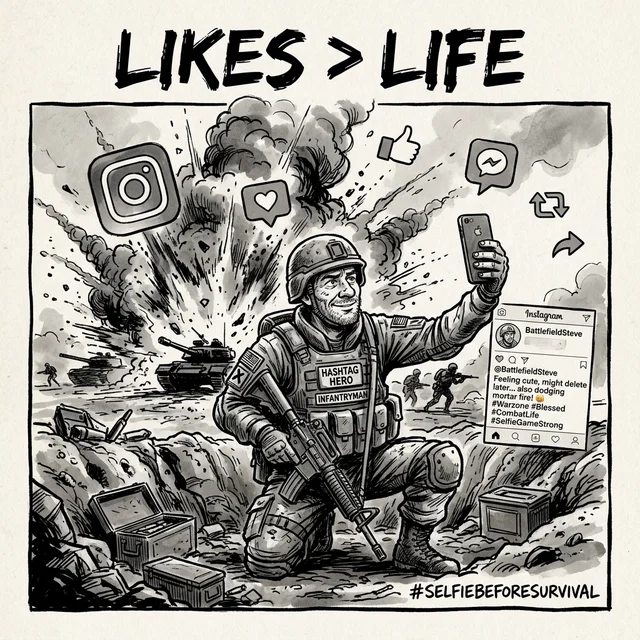
The battlefield selfie meme is perhaps the sharpest social critique among all WW3 memes. With hashtags like #SelfieBeforeSurvival and #WarzoneBlessings, dark humor reaches its peak by satirizing modern society's obsession with social media, suggesting that even in a real armed conflict, some people would be more concerned about documenting the experience for their followers than about surviving.
This meme is particularly relevant because it's not as far from reality as we'd like. Real conflicts around the world are already documented in real time through social media, with civilians and combatants posting videos and photos on platforms like TikTok, Instagram, and Telegram. The line between war as a lived experience and war as digital content for consumption is increasingly blurred.
Memes as Citizen Journalism
On the other hand, the culture of documenting and sharing everything also has its positive side. WW3 memes function as a form of satirized citizen journalism — they highlight real geopolitical tensions that many people might otherwise ignore, drawing attention to serious situations through humor. A meme about "which country started WW3 this time" generates more engagement and discussion than many traditional journalistic articles, forcing people who would normally avoid political news to inform themselves about what is happening in the world.
Researchers at the University of Chicago documented that engagement with satirical political memes increased by more than 400% during periods of heightened geopolitical tension, suggesting that humor functions as a gateway to political information among young people who would not normally consume traditional news. The meme becomes an informative "Trojan horse": the person clicks for the joke but absorbs the geopolitical context through cultural osmosis.
The UN Animal Assembly: Furry Diplomacy
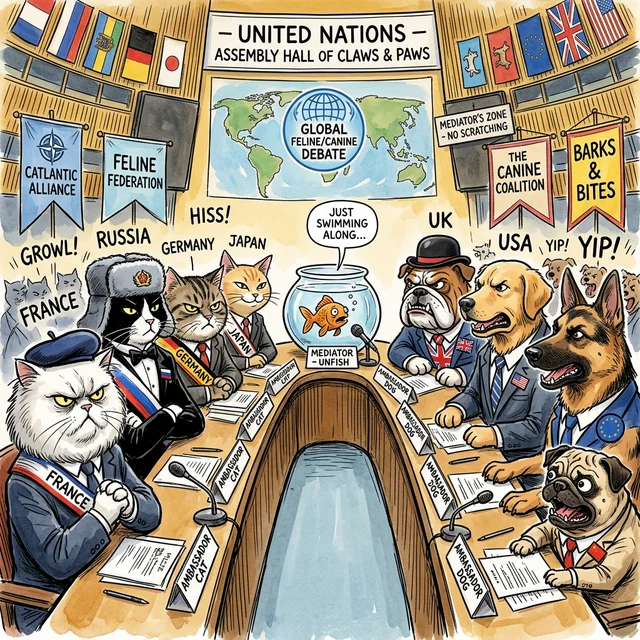
If international diplomacy already seems like a circus, why not put animals in charge? The "UN Animal Assembly" meme imagines cats representing Eastern powers (always with an air of superiority and indifference, like good cats) and dogs representing Western powers (overly enthusiastic and barking for no apparent reason). The mediator? A goldfish that's "just swimming along" — the perfect metaphor for international organizations that seem to float aimlessly while the world disintegrates around them.
The details are priceless: the "Feline Federation" vs. "Canine Coalition," the flags adapted with paw prints, and signs identifying each animal-diplomat by their country and species. The humor works on multiple layers: it's funny on the surface (animals in suits!), but deeply satirical in its message about the questionable effectiveness of international diplomacy in preventing real conflicts.
The Power of Animals on the Internet
It's no coincidence that the most shared memes on the internet involve animals. Digital psychology studies show that content with animals generates on average 67% more engagement than content with humans. When we combine animals with political satire, we create the perfect combo of virality: something that is simultaneously adorable and intellectually stimulating, that can be shared both for its surface humor and its deep social commentary.
Hipster Survival Kit: Apocalypse Priorities
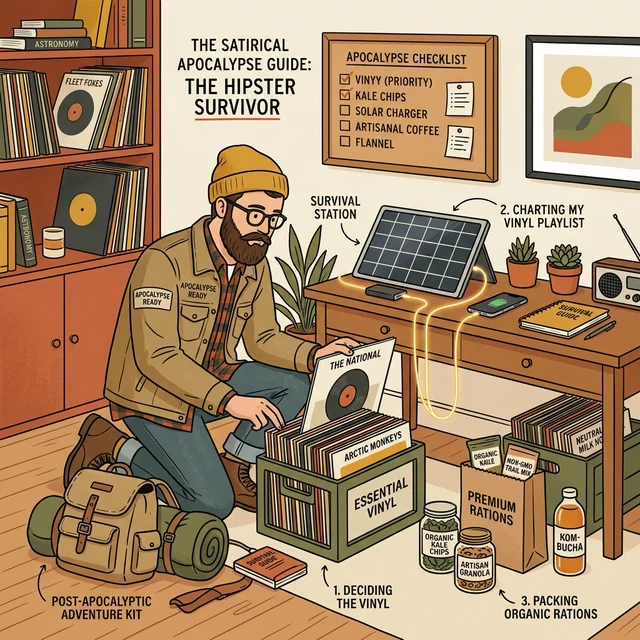
The hipster survival kit meme is the crowning achievement of the entire WW3 humor movement. The survival checklist includes: Vinyl (Priority), Kale Chips, Solar Charger, Artisanal Coffee, and Flannel. Note that water, food, and first aid don't appear on the list — because, in the words of a viral comment, "if there's no single-origin coffee, is surviving the apocalypse even worth it?"
The genius lies in the inversion of expectations: where a traditional survival guide would list essential items like purified water, medications, and emergency radio, the hipster guide prioritizes vinyl, kombucha, and a carefully curated collection of mindfulness books. The humor works because it exaggerates real consumption trends — the "wellness" and sustainability culture that dominates social media — and projects them into a scenario where those priorities become absurdly inadequate.
What Memes Say About Us
Every WW3 meme is, ultimately, a satirical mirror of contemporary society. The WiFi bunker critiques our technological dependence. The battlefield selfie satirizes our social media obsession. The animal diplomats question the effectiveness of international institutions. And the hipster survival kit mocks the consumption priorities of a generation that grew up believing artisanal coffee is a basic necessity.
But there is something profoundly human and beautiful about these memes too. They demonstrate the unique capacity of the human species to find humor in the darkest situations, to create connections through shared laughter, and to process collective fears in a way that strengthens rather than weakens the social fabric. When millions of people around the world laugh at the same WW3 meme, they are collectively saying: "Yes, we're scared. Yes, the situation is serious. But we'll face it together, and we'll laugh along the way."
The Cultural Phenomenon of War Memes
War memes have evolved significantly since the early days of the internet. What began as simple jokes on online forums has transformed into a sophisticated form of social commentary studied by researchers in communications, political science, and social psychology. Universities like MIT, Oxford, and USP already offer courses dedicated to studying memes as tools of political communication and collective emotional processing.
The Meme Economy
The meme market has become a significant business in the digital age. Meme pages on Instagram and TikTok accumulate millions of followers and generate substantial revenue through advertising and partnerships. When a WW3 meme trend emerges, these pages compete to create the most creative and shareable content, generating a cycle of mass humor production that can saturate social media within hours. The speed at which memes are created, shared, and forgotten reflects the ephemeral nature of contemporary digital culture.
The most successful meme creators intuitively understand principles of visual design, comic timing, and social psychology that many marketing professionals take years to master. The ability to capture a collective feeling in a single image with a few words of caption is an art form that deserves recognition, even when the subject is as heavy as a global military conflict. The speed at which memes are created, shared, and forgotten reflects the ephemeral nature of contemporary digital culture, where today's viral sensation is tomorrow's forgotten relic.
The Science of Virality
Researchers at the University of Pennsylvania identified that the most shared content on the internet combines three fundamental elements: surprise, emotion, and social utility. WW3 memes perfectly meet these criteria — they are surprising in their creativity, provoke a strong emotional response (laughter and anxiety relief), and serve as social currency when shared (proving the sharer is "in the loop" on cultural trends and possesses refined humorous sensibility).
The theory of "emotional contagion" also explains why WW3 memes spread so quickly: when a person laughs at a meme and shares it, they are transmitting not just the content but the emotion associated with it. The recipient, experiencing the same emotion, feels compelled to share again, creating a chain reaction of laughter and human connection that can reach millions of people within hours. This phenomenon has been documented across cultures and languages, suggesting that humor is a truly universal human language that transcends geographical and political boundaries.
Memes and Disinformation: The Fine Line
It is important to recognize that not all WW3 memes are harmless. Some are deliberately created to spread disinformation, manipulate emotions, and polarize opinions. The ability of memes to simplify complex situations into images and short phrases can be used both to illuminate and to obscure the truth. Governments and interest groups have already used memes as propaganda tools, disguising biased narratives as innocent humor.
Modern information warfare recognizes memes as low-cost, high-impact weapons. A well-crafted meme can change public perception of a conflict, delegitimize a political leader, or mobilize nationalist sentiments more effectively than an official statement. Therefore, while we laugh at the best WW3 memes, we should keep our critical thinking active and verify information before sharing content that may be more than just an innocent joke. Media literacy education must include meme literacy — the ability to distinguish between genuine humor and weaponized content designed to manipulate public opinion.
The Therapeutic Role of Collective Humor
Therapists specializing in trauma and anxiety increasingly recognize the therapeutic value of memes as tools for emotional processing. In a study published in the Journal of Digital Psychology in 2025, researchers found that people who actively engaged in creating and sharing memes about stressful events showed significantly lower levels of anxiety compared to those who merely passively consumed news about the same events.
The crucial difference is agency: by creating or sharing a meme, the person transforms their passive experience of fear into an active creative action. This transformation from passivity to activity is a fundamental principle of cognitive behavioral therapy, applied instinctively by millions of social media users around the world every time they open Photoshop or Canva to create the next viral meme about the end of the world. The therapeutic benefits extend beyond anxiety reduction — participants also reported feeling more socially connected, more informed about current events, and more capable of discussing difficult topics with friends and family. This suggests that meme culture serves not just as an individual coping mechanism but as a powerful tool for collective resilience and community building during times of crisis.
The next time you receive a WW3 meme and feel like laughing, know that you are participating in an ancestral human ritual — using humor to face fear. And if the world is going to end, at least let it end with us laughing. Because, at the end of the day, memes won't prevent any war — but they certainly make the road there more bearable. And as long as we have WiFi, artisanal coffee, and a carefully curated vinyl collection, maybe the apocalypse won't be so bad after all.
The evolution of war memes ultimately reflects the evolution of humanity itself in its relationship with technology, conflict, and humor. From the political caricatures of 19th-century newspapers to viral TikTok videos, satire has always been one of society's most powerful tools for questioning power, processing collective trauma, and building communities of cultural resistance. WW3 memes are merely the latest chapter in this millennia-old story, written not in ink on paper but in pixels on screens that glow in the pockets of billions of people around the planet. And as long as there are humans with internet access and the ability to transform fear into humor, there will be memes. And that, in itself, is reason enough to have hope for the future of our wonderfully absurd species. After all, a civilization that can laugh at its own potential destruction has already won the most important battle of all: the battle against despair.
This article is a piece of humor and social satire. All images were generated by artificial intelligence for illustrative and educational purposes. No world leaders, animals, or hipsters were harmed in the production of this content.


