
Iran Claims to Have Shot Down an American F-35 and the Internet Won't Let It Go: The Best War Memes
March 19, 2026. In the middle of the chaos of bombings in the Middle East, with missiles crossing the sky and sirens echoing across entire cities, a surprising piece of news stunned the world: Iran officially announced that its air defense forces had shot down an F-35 Lightning II — the most advanced, most expensive, and supposedly most "invisible" military aircraft ever built. Estimated cost? $80 million per unit.
The Pentagon vehemently denied it. Iran displayed wreckage. The international press debated for hours. But the internet? The internet did what it does best: turned everything into memes.
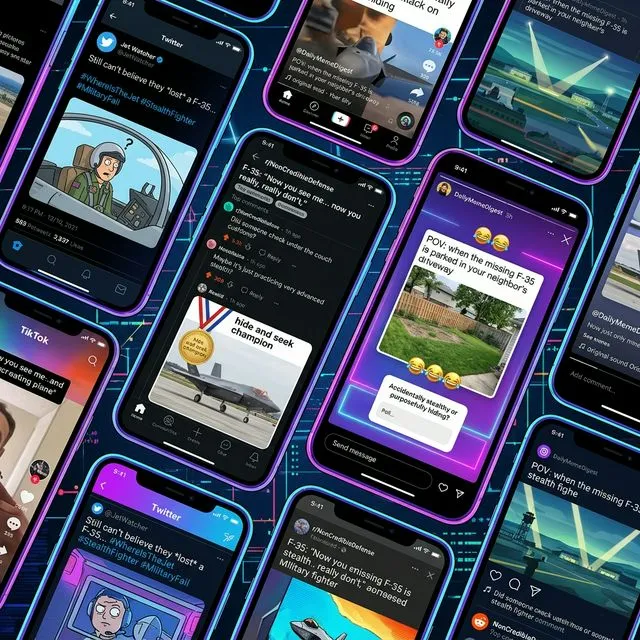
In less than 12 hours, the hashtags #IranF35, #StealthMemes, and #F35ShotDown dominated Twitter/X, TikTok, Instagram, and even Telegram. What happened in the following days was one of the greatest explosions of dark humor and digital creativity the internet has ever seen during an actual armed conflict.
What Happened: Iran's Claim
On March 19, during an escalation of American and Israeli airstrikes against Iranian military and nuclear installations, Iranian state television (IRIB) interrupted its regular programming for a special announcement. General Mohammad Bagheri, Chief of Staff of the Iranian Armed Forces, appeared with a firm statement:
"The air defenses of the Islamic Republic of Iran have successfully intercepted and shot down an American F-35 fighter jet over Isfahan province, using our advanced air defense system."
The announcement was accompanied by footage of supposed metallic debris scattered across a desert region, which Iranian authorities claimed belonged to the American stealth fighter. Military experts were summoned to analyze the footage in real-time on TV channels.
The Pentagon responded within hours with a dry denial: "All American aircraft involved in operations in the region have returned safely to their bases." The Department of Defense spokesperson added: "The Iranian regime's claims are unfounded and do not correspond to operational reality."
But the damage — at least on social media — was already done.
The Meme Explosion: A Timeline of Digital Chaos
Phase 1: The First Hours (0-6h)
In the initial hours after the announcement, the most basic memes began appearing. Most followed a simple format:
"Iran says it shot down an F-35. The F-35: 👻" — a ghost, referencing the fact that the aircraft is "invisible" to radar. If it's invisible, how did they detect it?
One of the first posts to go mega-viral was an Iranian video in anime style showing a missile chasing an F-35 through the sky, with dramatic Japanese anime soundtrack. The video racked up 4.7 million views on Telegram in less than 3 hours.
On Twitter/X, the "This Is Fine" meme (the dog sitting in a room on fire) got a new version: the dog sitting inside a burning F-35 saying "This is fine. I'm stealthy." This post hit 287,000 likes and became one of the most shared images of the day.
Phase 2: Iranian Creativity (6-12h)
The second wave of memes came directly from Iranian users — and this is where things got genuinely creative.
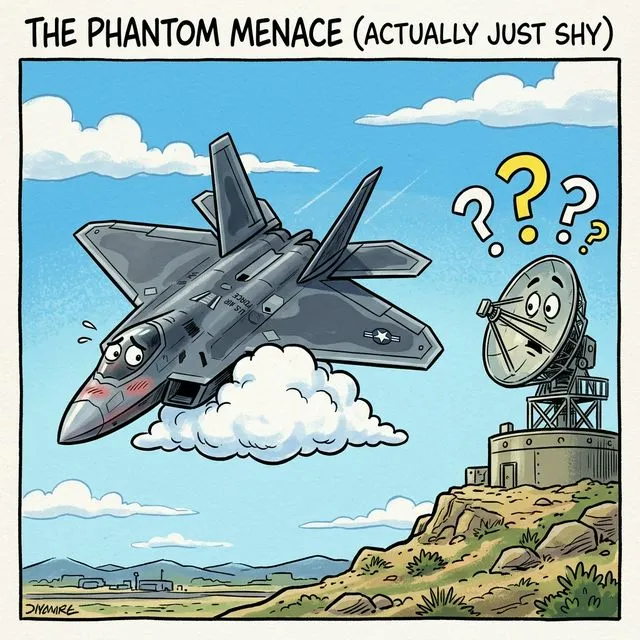
Homemade animations showed Iranian missiles with cartoon eyes "finding" the F-35 behind clouds, with captions like: "stealth mode: deactivated. 😎"
An Iranian creator made a YouTube tutorial-style video: "How We Shot Down an F-35 — Step by Step (full tutorial)". The 45-second video showed: Step 1: Turn on radar. Step 2: Find the "invisible" plane. Step 3: Press the button. "That's literally it," the narrator said, with motivational music playing in the background. The video surpassed 11 million views within 24 hours.
Phase 3: The World Reacts (12-48h)
When the Western world woke up and discovered the Iranian memes, the reaction was immediate: make MORE memes.
Americans took a different approach, creating memes that mocked the Iranian claim. The most popular format was:
"Things Iran has also 'shot down':" — followed by absurd images like the Millennium Falcon from Star Wars, an Amazon delivery drone, a paper bird, and the airplane from the Microsoft Flight Simulator game.
On TikTok, the trend #F35Challenge emerged, where creators filmed paper airplanes being "shot down" by rubber bands, with the sarcastic caption: "BREAKING: Iranian air defense in action 🇮🇷💪"
One of the most shared videos was an edit showing a scene from the film Top Gun: Maverick, with Tom Cruise looking back and saying "They got me?", followed by a cut to the confused man calculating meme. 23 million views.
The Most Viral Memes: The Top 10
1. The Invisible F-35 at the Mall
A meme showing an F-35 "parked" in a shopping mall, with security guards walking past without seeing it. Caption: "Stealth so good even the Iranians didn't... oh, wait."
2. The Peppa Pig Anti-Aircraft
An absurd edit showing Peppa Pig operating an anti-aircraft battery and "shooting down" an F-35, with the caption: "Iran's new military ally confirmed."
3. The Fake Netflix Series
A fake Netflix series cover: "Visible: An F-35 Story", with synopsis: "An $80 million plane discovers that stealth isn't everything in life. Military drama. 1 season."
4. The Car Salesman Meme
- Salesman (Lockheed Martin): slaps roof of F-35 "This bad boy can fit so much stealth technology that no radar in the world can detect it."
- Iran: presses button
- Salesman: 😐
5. The Missile's Resume
A "CV" created for the alleged Iranian missile that reportedly downed the F-35:
Name: Sayyad-3
Experience: Shot down the world's most expensive "invisible" plane
Salary expectation: Negotiable
Special skill: I see the invisible
6. The F-35 GPS
A meme showing a GPS screen (like Waze) with the F-35's route passing through Iran. The GPS warns: "Recalculating... via aircraft cemetery."
7. Hide and Seek Champion
A photo of the F-35 with the title "Former World Hide-and-Seek Champion" below.
8. Lockheed Tech Support
A fake support chat:
Pilot: Hi, my stealth stopped working. Is it under warranty?
Lockheed Martin: Sir, can you describe the problem?
Pilot: I was detected. And shot down.
Lockheed Martin: Have you tried restarting the plane?
9. The F-35 on LinkedIn
A fake LinkedIn post: "After 20 years of stealth experience, I'm looking for new opportunities. #OpenToWork #F35 #Fired"
10. Minecraft F-35
A Minecraft build of an F-35 being destroyed by a Creeper mob, with the caption: "Even in Minecraft stealth didn't work."
The Cultural Phenomenon: Why Do We Make Memes About Wars?
The explosion of humor around such a serious event raises a fundamental question: why does the internet joke about real armed conflicts?
Researchers in digital communication and social psychology point to several explanations:
1. Psychological Defense Mechanism
Dark humor functions as a coping mechanism — a way to process fear and anxiety in the face of existential threats. When the prospect of World War III hangs in the air, laughter is a way to maintain sanity.
2. Democratization of Narrative
Before social media, the narrative around conflicts was controlled exclusively by governments and major media outlets. Today, anyone with a smartphone can create their version of events — and they frequently choose satire.
3. The Emotional Distance of the Screen
For most people in the West, the Middle East conflict is a distant reality. This physical and emotional distance facilitates the creation of humor about events that, for those on the ground, are matters of life and death.
4. Engagement Culture
Social media algorithms prioritize content that generates rapid engagement. Memes are the most efficient way to generate likes, shares, and comments. The "gamification" of attention turns even tragic events into opportunities to go viral.
5. Institutional Distrust
Both Western and Iranian publics demonstrate deep distrust of their respective governments. When Iran says "we shot it down" and the US says "no," many people's natural reaction is: "neither is trustworthy, so at least I'll laugh."
The Ethical Debate: How Far Does Humor Go?
Not everyone found it funny. While millions laughed, critical voices emerged, especially from journalists and Middle East analysts:
"While you make F-35 memes, families in Isfahan are searching for bomb shelters." — This tweet from a Berlin-based Iranian journalist went viral with 180,000 likes and sparked intense debate in the comments.
Organizations like Amnesty International and Doctors Without Borders called for people not to "normalize" war through viral humor.
Digital philosopher Byung-Chul Han, in an interview published during the same period, commented: "The transformation of tragedy into digital entertainment is not just a defense mechanism — it's a symptom of the burnout society. We're so saturated with information that we only process what entertains us. Death became content."
The F-35: The Most Expensive Aircraft in History
To understand why the memes were so impactful, you need to understand what the F-35 Lightning II is:
- Cost per unit: $80 million (F-35A variant)
- Total program cost: $1.7 trillion — the most expensive military program of all time
- Stealth technology: Special coating that absorbs radar waves, making the aircraft "invisible" to detection systems
- Top speed: Mach 1.6 (~1,225 mph)
- Operators: USA, UK, Australia, Israel, Japan, South Korea, and 7 other countries
The idea that this technological titan could have been brought down by an Iranian air defense system — potentially with Russian or Chinese technology — was seen by many as "the digital David toppling the stealth Goliath."
The Legacy: How Memes Changed War Perception
This F-35 meme episode will become a case study in crisis communication and information warfare:
For Iran
The memes created by Iranians served as digital soft power — even if the claim was false, the global perception that Iran "challenged" the American military machine had a real propaganda effect.
For the USA
The fact that millions laughed at the possibility of the F-35 being shot down weakened the perception of invincibility of American military technology — something the Pentagon likely considers a national security concern.
For the global public
The memes functioned as a collective pressure valve, but also normalized the conflict in a concerning way. When war becomes entertainment, empathy decreases and pressure for diplomacy loses force.
FAQ — Frequently Asked Questions
Did Iran really shoot down an F-35?
Iran claimed so on March 19, 2026, but the Pentagon denied it. As of now, there is no independent confirmation. Military analysts consider it possible but not confirmed.
What is the F-35 Lightning II?
It's the most advanced 5th-generation fighter jet in the world, manufactured by Lockheed Martin. It's designed to be "stealth" (invisible to radar) and costs approximately $80 million per unit.
Why does the internet make memes about wars?
Psychologists point out that humor functions as an emotional defense mechanism against fear. Additionally, social media incentivizes the creation of engaging content, and memes about shocking events tend to go viral rapidly.
Which memes went the most viral?
The "This Is Fine" meme adapted for the F-35, Iranian animated videos on Telegram (4.7 million views), the fake tutorial "How to Shoot Down an F-35" (11 million views), and the #F35Challenge trend on TikTok.
Is it ethical to make memes about armed conflicts?
It's an ongoing debate. Defenders argue that humor is a legitimate form of expression and protest. Critics warn that memes normalize violence and diminish empathy for the real victims of conflict.
Sources: Reuters, Al Jazeera, The Guardian, KnowYourMeme, Economic Times, Defense News, TikTok Analytics
This article is a cultural analysis and does not represent support for any side of the conflict.


