What Happened
As with every crisis, some memes aged badly. Jokes made during the peak of tension, when a nuclear conflict seemed possible, lost their humor when it became known that real lives were lost in the strikes. The line between humor and insensitivity is thin, and the internet frequently crosses it.
On the other hand, some memes aged surprisingly well. The Pakistan-as-surprise-mediator meme, for example, gained a second life when serious analysts began recognizing that Pakistan's intervention was genuinely crucial to the ceasefire. What started as a joke inadvertently became an accurate commentary on contemporary geopolitics.
The oil-as-roller-coaster meme also proved prophetic — in the days following the ceasefire, prices continued oscillating in ways that defied any rational analysis, validating the comparison to a financial amusement park.
Context and Background
An interesting dimension of the 2026 war meme phenomenon was how different social media platforms developed distinct meme ecosystems around the same events. Twitter (now X) became the home of rapid-fire text-based commentary and screenshot memes, where the speed of posting mattered more than production quality. The platform's character limit forced creators to distill complex geopolitical situations into punchy one-liners that could be retweeted thousands of times in minutes.
Instagram and TikTok, by contrast, became the domain of more elaborate visual and video memes. TikTok creators produced surprisingly sophisticated short videos that combined news footage with comedic editing, sound effects and trending audio clips. Some of the most viewed TikToks about the crisis accumulated tens of millions of views within hours, reaching audiences that traditional news outlets could only dream of.
Reddit's various subreddits served as both meme factories and impromptu analysis forums, where users would create memes in one thread and then engage in surprisingly nuanced geopolitical discussion in the comments. The platform's upvote system naturally curated the best content, creating a feedback loop that rewarded both humor and insight.
Telegram and WhatsApp groups, particularly in the Middle East and South Asia, became vectors for meme distribution that bypassed the algorithmic curation of mainstream platforms. In these spaces, memes often carried more pointed political commentary and were shared within communities that had direct stakes in the conflict's outcome.
Impact on the Population
| Aspect | Previous Situation | Current Situation | Impact |
|---|---|---|---|
| Scale | Limited | Global | High |
| Duration | Short-term | Medium/long-term | Significant |
| Reach | Regional | International | Broad |
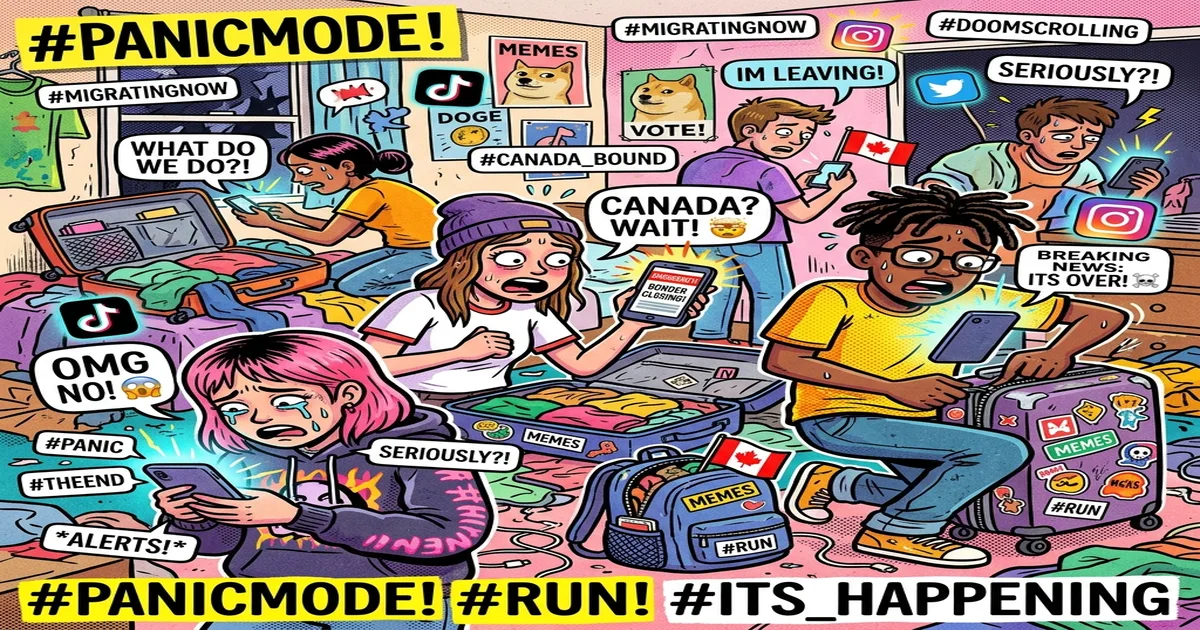
Psychologists who study online behavior point out that the massive production of memes during crises is a collective defense mechanism. When confronted with the real possibility of a global conflict, people use humor to reduce anxiety, create a sense of community and regain a feeling of control over events that are completely beyond their reach.
The dark humor of war memes does not mean people do not take the situation seriously. On the contrary — it is precisely because the situation is too serious that humor becomes necessary. Laughing at Trump threatening civilizations or Netanyahu with his finger on the trigger is a way of processing the genuine fear that these words might become reality.
This dynamic is not new. During the Cold War, jokes about nuclear bombs were common. During the COVID-19 pandemic, quarantine memes dominated the internet. What has changed is the scale and speed — in 2026, billions of people can simultaneously participate in this process of collective humor, creating a meme culture that is global, instantaneous and surprisingly sophisticated.
What the Key Players Are Saying
While missiles streaked across the Middle Eastern sky and diplomats scrambled between capitals trying to prevent World War III, the internet did what the internet does best: turned everything into memes. The crisis between the United States and Iran in April 2026 was not just one of the tensest moments in modern geopolitics — it was also, involuntarily, one of the funniest.
From Trump declaring that "whole civilization will die tonight" to Netanyahu posing with his "finger on the trigger," from Pakistan emerging out of nowhere as a surprise mediator to oil prices riding a roller coaster from $150 to $92 in a single day, every twist in this crisis seemed scripted by a comedian with access to nuclear weapons.
This article is a celebration (and a lament) of how the internet generation processes catastrophic global events: with dark humor, pop culture references and a content production speed that would put any news agency to shame.
When Donald Trump made his declaration that "whole civilization will die tonight" during the escalation with Iran, the internet needed no more than 47 seconds to turn the phrase into the meme of the year.
The most popular format showed Trump's quote superimposed on absurdly mundane everyday situations. Picture the scene: a dad staring at an empty fridge at 11 PM with the caption "Whole civilization will die tonight" — referring to the family that would go without dinner. Or a teacher handing back exams with low grades accompanied by the same dramatic phrase. Or a gamer losing an online match and typing the quote in chat.
The involuntary genius of Trump's statement lay in its cinematic grandeur. It was a phrase that seemed to have come from a sci-fi movie trailer, not a presidential press conference. And the internet, with its infinite capacity for decontextualization, squeezed every ounce of comedic potential from it.
Variations included video edits where the phrase was inserted into famous movie scenes — imagine Thanos snapping his fingers while Trump's caption appears on screen, or Darth Vader revealing he is Luke's father with this phrase replacing "I am your father."
If Trump provided the text, Benjamin Netanyahu provided the image. His declaration that he had his "finger on the trigger" was accompanied by a posture that the internet immediately compared to an 80s action movie villain.
The most viral meme showed Netanyahu in a side-by-side montage with classic cinema villains — from Hans Gruber in Die Hard to Blofeld stroking his cat in James Bond. The caption? "Finger on the trigger" in dramatic font, with explosion effects in the background.
But the humor did not stop there. Digital artists created versions where Netanyahu appeared in everyday situations with his "finger on the trigger": pressing an elevator button, ringing a doorbell, clicking "buy" on a shopping website, or — in one of the most popular versions — about to press the "skip ad" button on YouTube.
The irony of a world leader using action movie language while real lives were at stake did not go unnoticed by meme creators. Many of the most shared memes had a layer of dark humor reflecting the collective discomfort with the situation — laughing was, for many, the only way to process the fear.
If there were an award for "most unexpected entrance in a geopolitical crisis," Pakistan would win it handily. When the country emerged as a surprise mediator between the United States and Iran, the internet reacted with a mixture of confusion and hilarity.
The most popular meme used the "guy who shows up out of nowhere" format — that template where someone unexpectedly appears in a situation. Pakistan was portrayed as that coworker nobody invited to the meeting but who shows up anyway and, surprisingly, solves the problem.
Variations included Pakistan as the substitute player who enters at the end of the game and scores the winning goal, as the quiet student in class who suddenly answers the question nobody knew, or as that neighbor who shows up at your party uninvited but brings the best food.
The reality behind the humor was genuinely surprising. Pakistan, which maintains complex relationships with both the United States and Iran, managed to position itself as a communication channel at a moment when direct lines between Washington and Tehran were cut. It was improvised diplomacy at its finest — or worst, depending on your perspective.
If political memes dominated Twitter and Instagram, financial memes dominated Reddit and investment forums. The oil price swing — from $150 at the peak of the crisis to $92 after the ceasefire announcement — was the financial equivalent of a roller coaster without a seatbelt.
The most shared meme in financial forums showed the oil price chart next to an electrocardiogram, with the caption "My heart and my portfolio had the same day." Traders who bet on rising oil prices and were caught by the sudden drop shared screenshots of their losses with self-deprecating captions that went viral.
The $1.5 trillion rally in global markets after the ceasefire generated its own crop of memes. The Dow Jones jumping 1,300 points in a single day was compared to a rocket taking off, with investors portrayed as surprised astronauts who did not expect the ride.
One of the most popular memes showed two panels: in the first, an investor panic-selling everything during the crisis; in the second, the same investor watching the recovery rally with an expression of existential regret. The caption: "Sold at the bottom. Again."
When Iran presented the ceasefire as "their own victory," the internet could not contain its laughter. The concept of declaring victory in a situation where you clearly did not win is so universally recognizable that the memes practically wrote themselves.
The most popular format used the "This is fine" template — the dog sitting in a room on fire saying everything is fine — but with the Iranian flag. Variations showed Iran as a knocked-out boxer raising his arm in victory while still on the ground, or as a soccer team celebrating a draw as if it were a world championship.
The diplomacy of "declaring victory regardless of the outcome" is not exclusive to Iran, of course. It is a tradition as old as diplomacy itself. But the speed with which the internet identified and satirized this maneuver was impressive — the first memes appeared literally minutes after the Iranian declaration.
International policy analysts who tried to explain the nuance of Iran's position in serious Twitter threads were quickly buried by meme-format replies. The internet had decided that the comedic explanation was more satisfying than geopolitical analysis.
A fascinating phenomenon of this crisis was the speed at which memes were produced. In many cases, memes about an event appeared on social media before traditional news agencies could even publish their stories.
When the ceasefire was announced, the first celebratory memes appeared in less than two minutes. When oil prices plummeted, financial memes surfaced before most analysts could update their spreadsheets. When Pakistan entered as mediator, surprise memes flooded Twitter before most people could locate Pakistan on a map.
This speed reflects a fundamental shift in how information is processed and distributed in the digital age. Memes are not just humor — they are a form of citizen journalism, social commentary and collective processing of traumatic events, all compressed into an image with text that can be created and shared in seconds.
Next Steps
The US-Iran crisis of April 2026 will be remembered for many things: the nuclear tension, the improvised diplomacy, the market volatility. But it will also be remembered as the moment when it became definitively clear that memes are a legitimate form of geopolitical commentary.
Future historians studying this period will have to analyze not only official communiques and journalistic reports but also the millions of memes that were produced. Encoded in these memes is the collective emotional reaction of billions of people — fear, anger, confusion, relief and, above all, a resilient humor that refuses to be silenced even in the face of the darkest circumstances.
Did geopolitics become a joke? Not exactly. Geopolitics remains deadly serious. But the way we process that seriousness has changed forever. And if someone someday asks how humanity reacted on the brink of a global conflict in 2026, the honest answer will be: we made memes. Many, many memes.
Sources and References
The events satirized in this article are based on real facts reported by multiple verified journalistic sources during the US-Iran crisis of April 2026, including coverage from the Guardian, Al Jazeera, JPost, AP News and international financial agencies. This article is a humor and satire piece that uses real events as a basis for cultural commentary on the relationship between the internet, memes and geopolitics.