
"Extinct" for 6,000 Years: Two Marsupial Species Found Alive in New Guinea
In a tropical forest so remote it takes 5 days of trekking to reach, a team of Australian and Papuan biologists found something textbooks say is impossible: two marsupial species that science declared extinct over 6,000 years ago. The animals — diminutive relatives of tree-kangaroos — were living peacefully in an ecosystem that modern humanity had simply never reached. The discovery, published in Nature Ecology & Evolution in March 2026, is not merely a zoological curiosity: it's a profound lesson about the limitations of our knowledge, the resilience of life, and the fragility of ecosystems that protect these remnant species.
The Discovery
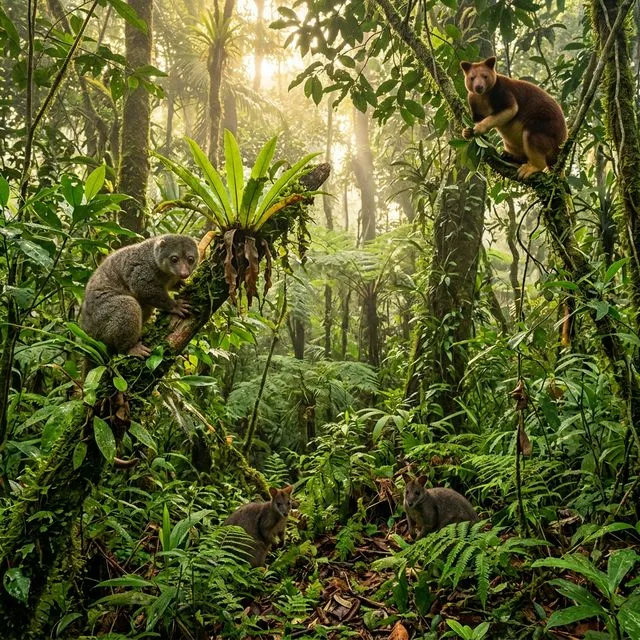
What Was Found
The expedition, led by the Australian Museum in Sydney in collaboration with the University of Papua New Guinea, focused on the montane forests of Papua New Guinea's central mountain range — one of the most biodiverse and least explored regions on the planet. At altitudes between 1,800 and 2,500 meters, in cloud forests covered with moss and epiphytes, the team found:
Species 1: Protemnodon tumbuna (provisional name)
- Terrestrial marsupial the size of a large domestic cat (~4 kg)
- Previously known only from fossil records dated 5,000-8,000 years ago
- Dense reddish-brown fur, robust tail, hind legs adapted for mountainous terrain
- Crepuscular behavior (active at dawn and dusk)
Species 2: Nombe nombe (name from local tradition)
- Smaller arboreal marsupial (~1.5 kg)
- Fossil records dated 6,000+ years, found in archaeological caves
- Silver-grey fur, large eyes (night adaptation), prehensile tail
- Fully arboreal — never descends to the ground
How They Were Found
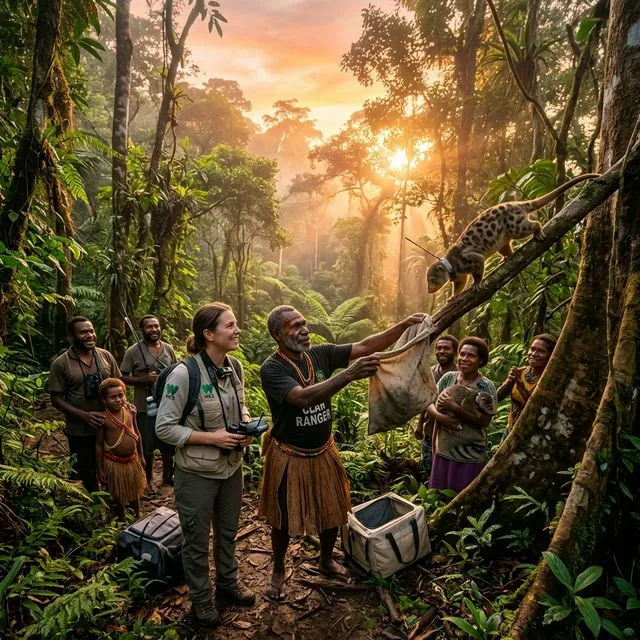
The key to the discovery wasn't sophisticated technology — it was local indigenous peoples. The Huli and Duna communities inhabiting the valleys adjacent to the forest had known these animals for generations, describing them in their oral traditions. The scientists simply listened.
"We knew they were there. Our grandparents hunted the nombe when they were hungry. For the scientists, they were 'extinct.' For us, they'd been there our whole lives."
— Duna community leader (translated)
The Lazarus Phenomenon: When the Extinct Return
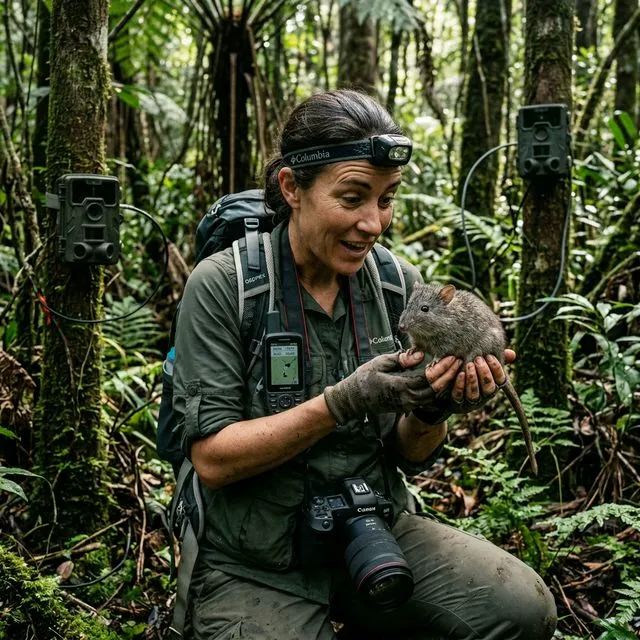
The name comes from Lazarus, the biblical figure who rose from the dead. In biology, "Lazarus species" are those that disappear from the fossil record for long periods, only to be rediscovered alive, sometimes thousands of years later.
Notable Historical Cases
| Species | Declared Extinct | Rediscovered | "Gap" |
|---|---|---|---|
| Coelacanth | 66 million years | 1938 | 66 M years |
| Wollemi Pine | 2 million years | 1994 | 2 M years |
| Bermuda Petrel | 1620 (330 years) | 1951 | 330 years |
| Protemnodon tumbuna | ~6,000 years | 2026 | 6,000 years |
| Nombe nombe | ~6,000 years | 2026 | 6,000 years |
The most famous case is the coelacanth — a prehistoric fish contemporary with dinosaurs that science considered extinct for 66 million years, until a fisherman caught one off the coast of Madagascar in 1938. The New Guinea discovery joins this pantheon of "biological resurrections."
Why New Guinea?
The Last Frontier of Biodiversity
New Guinea (divided between the independent nation of Papua New Guinea and Indonesia's Papua province) is the world's second-largest island and possibly the most biodiverse place on the planet per unit area:
- Over 5% of all global biodiversity on less than 0.5% of Earth's land surface
- 800+ bird species — many found nowhere else
- Over 13,000 plant species documented (real estimate: 25,000+)
- Untouched forests: Vast areas of montane tropical forest never explored by Western science
- Constantly new species: On average, 3-5 new vertebrate species are described per year in the region
The reason these two marsupial species survived without being documented is simply the inaccessibility of the habitat. The montane cloud forests of the central mountain range are reachable only by indigenous trails taking days of trekking, with no roads, no airports, and extremely challenging weather (rain 300+ days per year).
To reach the discovery site, the team of 14 researchers and 30 Huli indigenous guides trekked for 5 days from the nearest airstrip, carrying research equipment, camera traps, DNA collection kits, and supplies for 3 weeks of fieldwork. The maximum altitude reached was 2,480 meters, in a cloud forest where visibility often doesn't exceed 20 meters due to constant fog.
The Role of Indigenous Peoples in the Discovery
A particularly significant aspect of this discovery is the central role of indigenous peoples. The expedition was only possible because Huli and Duna communities agreed to guide researchers to areas not normally accessed by outsiders. In return, the scientific team committed to involving local communities in all stages of research and ensuring any economic benefits derived from the discovery (ecotourism, bioprospecting) would be shared equitably.
This model of "indigenous participatory science" is gaining momentum globally. The Huli, in particular, possess their own taxonomy for local fauna that in many respects is more detailed than Western scientific taxonomy — distinguishing subspecies and seasonal variations that biologists hadn't yet documented.
The co-authorship of indigenous community members on the Nature Ecology & Evolution paper — a rarity that's becoming increasingly common — formally acknowledges that without the knowledge and generosity of the Huli and Duna peoples, this discovery would never have happened.
What This Means for Science
Extinction Isn't Always Permanent
The central premise of conservation biology is that "extinction is forever." This premise is statistically true — the vast majority of extinct species are genuinely lost forever. But Lazarus cases like this remind us of important truths that science sometimes forgets:
Our record is deeply incomplete: Not finding a species doesn't mean it doesn't exist — it may just mean we haven't looked in the right place, with the right methods, or for long enough.
Indigenous knowledge is valid science: The Huli and Duna peoples knew about these species for centuries. Their oral traditions preserved information about behavior, habitat, and seasonality that scientists are now "discovering."
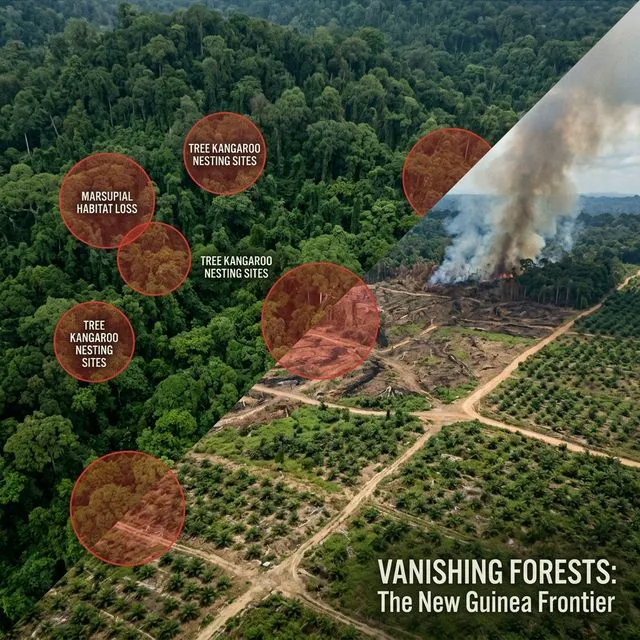
Untouched habitats are living laboratories: These animals survived precisely because their habitat wasn't disturbed by deforestation, agriculture, mining, or urbanization. Every hectare of primary forest that disappears may be eliminating species that were never even documented.
The Conservation Paradox
The irony is cruel and well known to biologists: now that science has "discovered" these species, they paradoxically become more vulnerable. The publicity of the discovery may attract curiosity seekers, exotic animal traffickers, predatory tourism companies, and economic interest in the region.
The researchers deliberately omitted the animals' exact location in the publication — a growing practice called "geoprivacy" — to protect them.
DNA Analysis: What the Genes Reveal
An Unexpected Genetic Treasure
Preliminary genetic analyses of the two rediscovered marsupials revealed fascinating surprises. The Protemnodon tumbuna's mitochondrial DNA indicates the current population is genetically healthy, with genetic diversity comparable to common Australian marsupial species.
More surprising: the Nombe nombe's genome contains sequences that don't exist in any known living marsupial, suggesting this species diverged evolutionarily from its closest relatives at least 8 million years ago — far earlier than the fossil record indicated.
These genetic discoveries have implications beyond pure zoology. The Nombe nombe genome may contain genes for unique biochemical adaptations — such as antimicrobial proteins or unknown enzymes — developed over millions of years of isolated evolution.
The Evolution of New Guinea's Marsupials
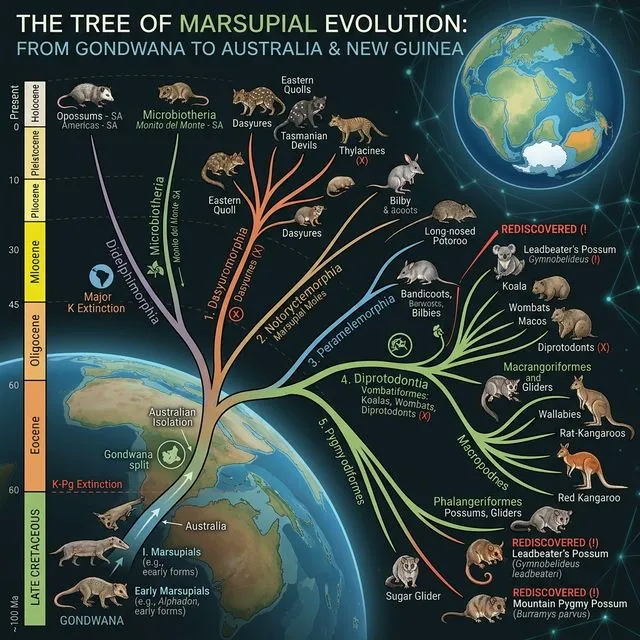
New Guinea was connected to Australia by a land bridge (today the Torres Strait) during glacial periods, when sea levels were up to 120 meters lower than today. This connection allowed marsupials to colonize New Guinea from Australia in multiple migratory waves over the past 4 million years.
When sea levels rose again, populations became isolated — and evolution did its work. The montane forests, with their extremely varied microclimates and fragmented geography, functioned as "islands within an island," promoting rapid speciation.
Conservation Challenges
Growing Threats to New Guinea's Forest
Though New Guinea's forests remain among the most intact in the tropics, they face growing pressures:
- Deforestation for agriculture: Palm oil cultivation expansion is advancing rapidly
- Mining: New Guinea is rich in gold, copper, and nickel. Large-scale mining projects destroy and contaminate forest habitats
- Climate change: Montane cloud forests are particularly vulnerable to global warming
- Invasive species: Cats, dogs, and rats introduced by human settlements can devastate native marsupial populations
Protection Proposals
The research team proposed creating a 50,000-hectare protected area in the discovery region, jointly managed by scientists and local indigenous communities. A crowdfunding campaign raised over $500,000 in the first two weeks — demonstrating the mobilization power that Lazarus species discoveries can have.
Frequently Asked Questions (FAQ)
Could more "extinct" species be hiding in New Guinea?
Almost certainly yes. Biologists estimate 5-10% of species classified as extinct in the Australasian fossil record may actually survive in remote, unexplored habitats of New Guinea, Solomon Islands, and northern Australia.
Can the animals be bred in captivity?
In theory yes, but researchers oppose this currently. Removing individuals from a potentially small population could weaken it genetically. The priority is protecting natural habitat.
Why didn't indigenous peoples inform scientists before?
They likely tried — but weren't heard. Biology history is full of cases where indigenous knowledge was dismissed as "folklore." This discovery joins a growing trend of recognizing and integrating traditional knowledge, known as "ethnoecology."
Are New Guinea's marsupials related to kangaroos?
Yes, both belong to the order Diprotodontia. However, the diversification occurred millions of years ago. The Nombe nombe is more closely related to tree-kangaroos (genus Dendrolagus) than to the terrestrial Australian kangaroos most people know.
How many animals were found?
The expedition photographically documented 12 individuals of Protemnodon tumbuna and 4 of Nombe nombe. Activity and territoriality patterns suggest populations of 200-500 individuals of each species.
Conclusion
In an era dominated by news of extinction, deforestation, and ecological collapse, the discovery of two "extinct" species living peacefully in a forest that humanity never disturbed is a rarely needed reminder: nature is more resilient than we think, and vaster than we imagine.
But that resilience has limits. And the best thing we can do for these species — and for the countless others likely living in unexplored corners of the planet — is the same thing that allowed them to survive for 6,000 years: leave them alone.
The discovery also teaches us humility. Science is an extraordinarily powerful tool for understanding the world — but it's not omniscient. When we declare a species extinct, we're actually saying "we haven't found it anymore with the methods we have and in the places where we looked." The difference between these two statements can be a cloud forest at the end of the world.


