The autism spectrum disorder has always been considered one of the great mysteries of modern genetics due to its enormous underlying complexity. For decades, scientists have tried to unravel the biological roots of this fascinating and challenging condition. The idea that a single genetic mutation would be responsible was quickly discarded by researchers.
Instead, the scientific community discovered that autism results from an intricate interplay of multiple subtle genetic variations. A recent landmark study managed to map over eighteen hundred protein interactions across one hundred genes associated with autism risk. This monumental achievement represents a watershed moment in our understanding of neurobiology.
The detailed mapping of these protein interactions revealed a surprising panorama of cellular function in the brain. Before this discovery, the vast amount of genes involved suggested that each patient might need highly individualized treatment. However, the new data shows that these disparate mutations converge on shared focal points.
These convergence points are now known as "molecular hubs," and they completely change the therapeutic perspective. The research demonstrated that, regardless of which specific gene presents a mutation, the impact often affects the same protein circuits. This means the biology of autism might be far more unified than previously thought.
The identification of these molecular hubs opens exciting possibilities for the development of more universal treatments. Rather than trying to correct each genetic mutation individually, scientists can now focus on stabilizing the affected protein networks. This protein-based approach offers a much more viable and pragmatic path forward.
The Genetic Complexity of the Autism Spectrum
To understand the magnitude of this discovery, it is essential to analyze the genetic complexity that defines the autism spectrum. Over a hundred genes have been strongly associated with the development of autism traits. Each of these genes encodes specific proteins that play crucial roles in brain development and function.
The major difficulty has always been understanding how so many different mutations could result in similar behavioral phenotypes. Some patients have mutations in genes controlling synapse formation, while others have alterations in genes linked to gene expression. This heterogeneity made the search for pharmacological treatments an almost impossible task.
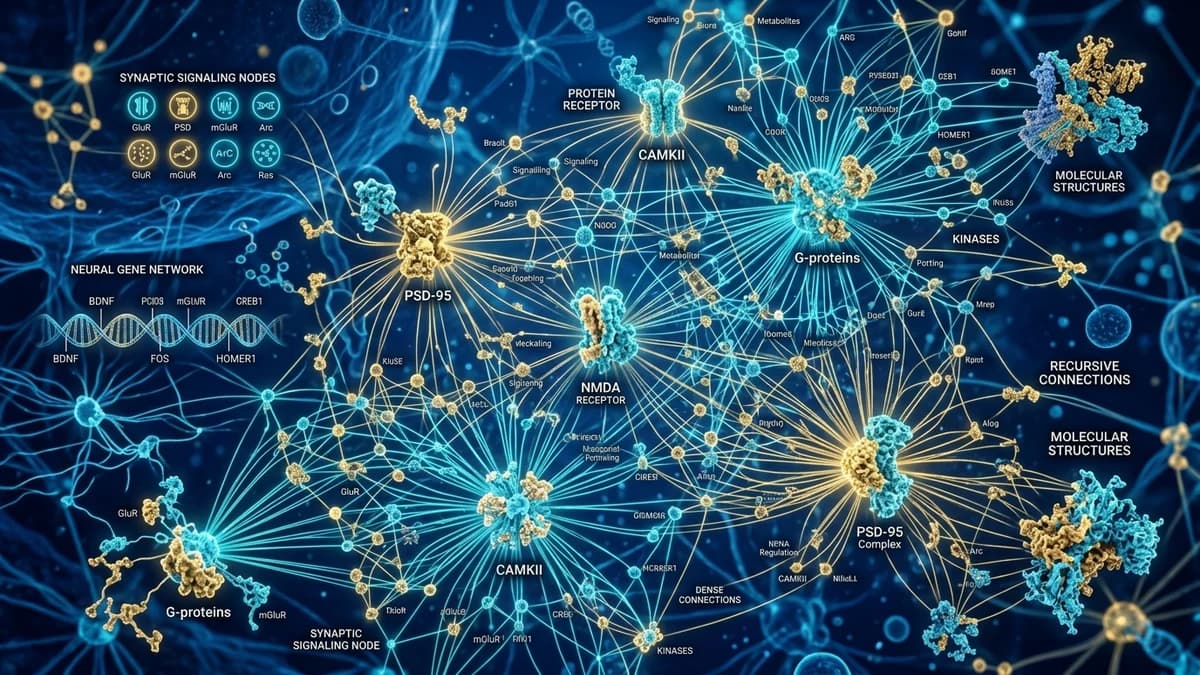
With the new protein-focused approach, researchers began to see the invisible connections between these distinct genes. They used advanced structural biology and mass spectrometry techniques to track how proteins physically interact. The result was a complex map resembling an intricate spider web, where many threads lead to the same center.
These connections reveal that proteins do not act in isolation, but rather in large macromolecular complexes. When a gene suffers a mutation, the resulting protein may fail to connect properly with its partners. This causes a domino effect that destabilizes the entire molecular hub, affecting neuron function.
Mapping the Protein Interactions
The effort to map over eighteen hundred protein interactions required massive international collaboration and years of research. Scientists had to analyze not just which proteins were present, but how they bound to each other in real time. This dynamic analysis was fundamental to capturing the true essence of cellular biology.
By examining the one hundred autism risk genes, the team noted their respective proteins frequently clustered into dense networks. Some of these proteins acted as "main nodes," connecting dozens of other essential cellular pathways. If a main node is affected by a mutation, the impact reverberates throughout the entire neurological system.
The study particularly highlighted the importance of proteins involved in cytoskeleton regulation and synaptic vesicle trafficking. These pathways are essential for communication between neurons and for brain plasticity during development. The discovery that different mutations affect the same pathways reinforces the idea of a shared cellular pathology.
Furthermore, the interaction map revealed new potential targets for pharmacological interventions focused on stabilizing these networks. Drugs that can reinforce interactions in weakened molecular hubs could, in theory, alleviate certain neurological symptoms. This is a profound departure from the previous view that focused exclusively on corrective gene therapy.
Molecular Hubs: A New Hope
The concept of molecular hubs represents a true paradigm shift in the biological research of autism. A hub acts like a central train station where multiple biological pathways cross and interact. If the tracks arriving at the station are damaged, the flow of cellular information is severely compromised.
The research revealed that many of the studied genetic mutations converge on just three or four of these main hubs. This discovery incredibly simplifies the problem, reducing dozens of potential therapeutic targets to just a few. It is a matter of finding the molecular bottleneck and focusing therapeutic efforts directly on it.
This also explains why individuals with completely different genetic profiles can share such similar clinical characteristics. The final phenotype is determined by the functioning of the molecular hub, rather than the specific genetic mutation that initiated the problem. Thus, treatments focused on these hubs could benefit a much larger portion of individuals on the spectrum.
Scientists are now focused on developing compounds that act as molecular stabilizers for these protein networks. The goal is to restore the normal function of the hub, compensating for the deficiency caused by the initial genetic mutation. Although still in the experimental phase, this strategy has shown promising results in laboratory models.
Therapy Comparison: Traditional vs. Molecular Hubs
The table below illustrates the main differences between traditional approaches and the new focus on molecular hubs. This shift in focus is crucial to understanding the future of personalized medicine for autism.
| Characteristic | Traditional Gene Therapy | Molecular Hub Approach |
|---|---|---|
| Primary Target | Correction of specific genetic mutations | Stabilization of shared protein networks |
| Scope of Application | Very restricted (patients with same mutation) | Universal (patients with convergent mutations) |
| Technical Challenge | Cellular delivery and DNA editing difficulty | Identification of protein-modulating compounds |
| Estimated Cost | Extremely high per patient | Potentially accessible via common medications |
| Short-term Viability | Low to medium, many safety hurdles | Medium to high, drug repurposing potential |
This table clearly demonstrates why the scientific community is so optimistic about protein-based therapies. The genetic approach, while promising for certain monogenic diseases, faces formidable challenges in the context of autism. Modifying DNA in the living human brain still presents significant risks and complex technical obstacles.
In contrast, modulating protein interactions with small molecule drugs is a tested and proven strategy. Many modern medications act precisely this way, altering the shape or function of specific protein complexes. This means we can leverage decades of pharmacological experience to develop new therapies for autism.
Moreover, the protein-focused approach may allow the repurposing of drugs already approved for other conditions. If an existing medication can stabilize one of the autism molecular hubs, it could enter clinical trials very quickly. This would immensely accelerate the time required to bring new treatments from the laboratory to patients.
Implications for Universal Treatments
The implications of more universal therapies based on these molecular hubs are simply transformative for medical practice. Currently, autism management is focused on highly individualized behavioral therapies and support interventions. While these therapies are invaluable, there is a great need for complementary biological approaches for those suffering from severe symptoms.
The new protein interaction map provides the exact roadmap researchers needed to begin developing targeted medications. The fact that different genes converge on the same biological pathways justifies the search for a "universal treatment." This treatment would not seek to change who the person is, but rather to alleviate specific neurological challenges associated with the condition.
This universality does not mean there will be a single pill for everyone, but that treatments can apply to larger groups. Patients could be grouped based on the specific molecular hub their mutations affect, allowing for targeted therapies. This would revolutionize clinical trial design and future psychiatric care.
Researchers are particularly interested in how these discoveries can help in cases where autism is accompanied by epilepsy or severe intellectual disability. In these more acute cases, the destabilization of molecular hubs appears to be even more pronounced and widespread. Therapies focused on these protein complexes could bring essential relief for the most challenging aspects of the condition.
The Role of Artificial Intelligence in Mapping
None of these advances would have been possible without the integration of cutting-edge artificial intelligence and computational biology. The volume of data generated by protein-protein interaction studies on such a scale is virtually impossible for humans alone to analyze. Machine learning algorithms were essential to identify hidden patterns within this sea of genomic and proteomic information.
Artificial intelligence tools allowed researchers to predict interactions that had not yet been observed in the laboratory. By analyzing the three-dimensional structure of proteins, computers could model how they would fit together, almost like puzzle pieces. This accelerated the discovery of crucial molecular hubs by years, if not decades, of manual work.
Beyond mapping current interactions, artificial intelligence is now being used to simulate the effect of potential drugs. Scientists can virtually test millions of chemical compounds against the identified molecular hubs in a matter of days. This makes the drug discovery process much more efficient and less prone to failure in advanced stages.
This convergence between molecular biology and computer science is defining the future of medical research. The success in mapping autism-associated proteins will serve as a model for studying other complex neurological conditions. The future of medicine is undoubtedly data-driven, powered by artificial intelligence, and deeply grounded in systems biology.
The Road Ahead in Scientific Research
While mapping these protein interactions is a formidable milestone, there is still a long road ahead in research. Scientists must now validate these findings in living animal models and brain organoids grown from patient stem cells. These tests are vital to confirm that stabilizing molecular hubs will have the desired therapeutic effects.
Another major challenge will be ensuring any developed therapy is safe and does not interfere with other healthy brain functions. The human brain is the most complex organ in the known universe, and altering its molecular networks demands extreme precision. Patient safety must always remain the absolute priority in all future trials.
The expansion of molecular hub studies has also revealed the importance of the intracellular environment in genetic regulation. Many mapped proteins are extremely sensitive to changes in oxidative stress and nutrient availability in the developing brain. This suggests that environmental factors could influence the function of these hubs during early pregnancy stages.
Despite the challenges, the energy and optimism in the scientific community have never been higher. The molecular roadmap drawn by this study provides a clear sense of direction and purpose for the next decade of research. For the first time, researchers feel they are beginning to understand the true molecular language of autism.
Conclusion
Mapping over eighteen hundred protein interactions across one hundred risk genes represents a biological revolution. The discovery that disparate genetic mutations converge on shared molecular hubs radically simplifies the complexity of autism. This shift in focus offers new and realistic hopes for developing innovative and more universal therapies.
While individualized gene therapy faces nearly insurmountable barriers, the regulation of protein networks emerges as a pragmatic path. The potential to alleviate challenging neurological symptoms by stabilizing cellular focal points opens a new medical frontier. Science has taken a gigantic step toward a deeper understanding of neurobiology.
As we move forward, continuous support for fundamental research and the use of artificial intelligence will be indispensable for success. The future holds incredible discoveries as we unravel the mysteries of our own cells. The journey to fully understand autism has entered a new, exciting, and profoundly promising phase.
Frequently Asked Questions
What exactly is a molecular hub in the context of this autism research?
A molecular hub is a convergence point within the cell where multiple different proteins interact intensely to perform joint vital functions. In the context of this research, scientists discovered that many genetic mutations linked to autism end up affecting the same central protein networks. Think of these hubs as the main traffic intersections in a busy city. If that intersection fails, the impact is felt throughout the entire network, regardless of which specific street caused the initial blockage. This discovery is fundamental because it suggests that stabilizing these hubs can treat autism more universally, rather than focusing on each patient's individual genetic mutation.
Why is focusing on protein interactions better than focusing on traditional gene therapy?
Focusing on traditional gene therapies for autism is extremely complex because the disorder is associated with hundreds of different genes. Developing a specific and safe genetic treatment for each individual mutation would be incredibly time-consuming, expensive, and technically challenging. Protein interactions, on the other hand, show that these countless genetic mutations converge on just a few biological pathways or shared hubs. Developing drugs that act on these few molecular hubs allows for creating treatments that can benefit much larger groups of individuals simultaneously. This makes drug development significantly more pragmatic, scalable, and faster for the needs of the current clinical population.
Does this new approach seek to "cure" autism and eliminate all its inherent characteristics?
No, the molecular hub-focused approach does not seek to eliminate neurodivergence or change who the person fundamentally is at their core. The main goal of the therapies derived from this research is to mitigate severe associated symptoms that cause substantial distress, such as severe epileptic seizures, chronic sleep disorders, or processing deficits that affect well-being. The research respects the value of human neurological diversity while seeking medical solutions purely for the disabling aspects of the spectrum. It is about improving the quality of life and neurological comfort of patients by balancing cellular circuits, providing support where the biological system is struggling to remain stable.