Alzheimer's disease today represents one of the greatest global challenges in the fields of public health and contemporary neurology. This progressive neurodegenerative condition affects millions of individuals worldwide, causing severe cognitive decline and an irreparable impact on human memory. For decades, the scientific community has intensely focused its efforts on the identification and treatment of beta-amyloid protein plaques.
These plaques, historically considered the primary biological marker of Alzheimer's, form toxic clusters that impair crucial communication between brain neurons. The detection of these structures has traditionally been accomplished through sophisticated imaging examinations, such as Positron Emission Tomography (PET) scans. However, by the time amyloid plaques become visible in these conventional scans, irreversible neuronal damage has usually already occurred.
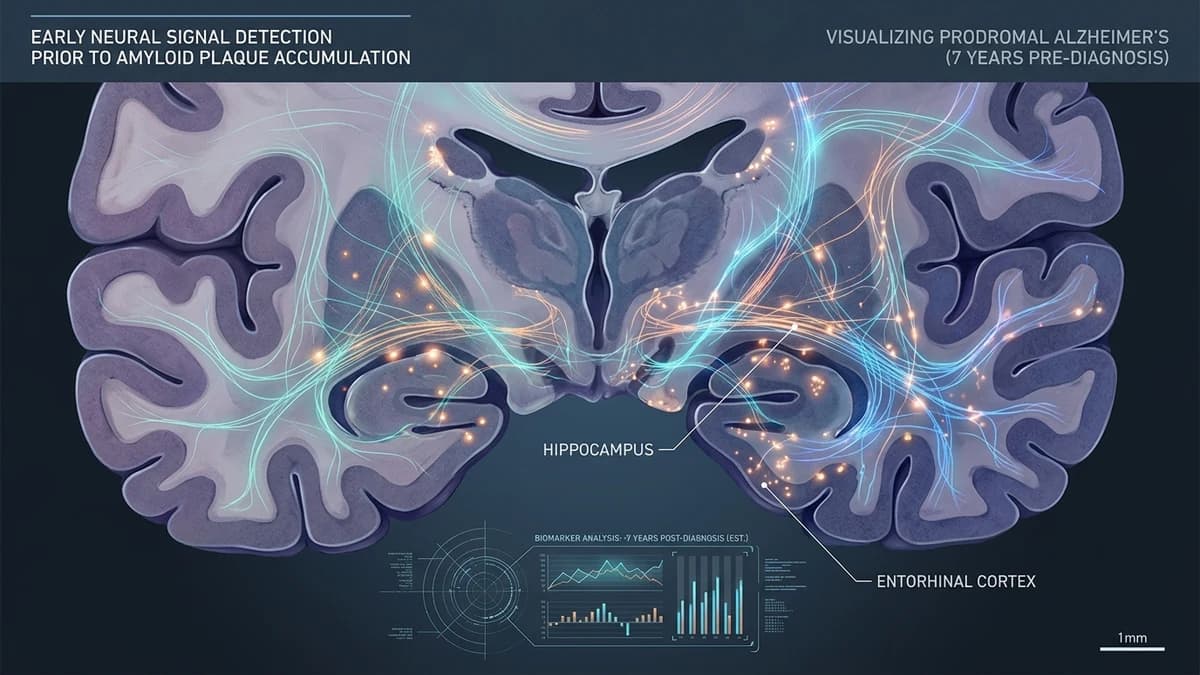
A recent and revolutionary neurological study promises to fundamentally change our deep understanding of the initial stages of this devastating pathology. Leading-edge researchers have successfully identified subtle cellular alterations and profound metabolic anomalies in the human brain that manifest very prominently. The most impressive aspect of this massive discovery is that these specific signs precede the formation of amyloid plaques by at least seven full years.
This extended temporal window offers an absolutely unprecedented opportunity for early medical interventions and highly targeted preventative therapeutic approaches. By thoroughly analyzing cerebrospinal fluids and highly sensitive blood biomarkers, the scientific team was able to draw an incredibly precise predictive biochemical profile. The detected molecular signature reflects initial states of neural inflammation and oxidative stress, well before any clinical symptoms visibly emerge.
The advanced technology utilized in this comprehensive study is fundamentally based on recent breakthroughs in genetic sequencing and high-resolution proteomic analysis. The scientists diligently monitored designated risk groups over several decades, precisely correlating small fluctuations in specific proteins with future disease development. This meticulous longitudinal follow-up was absolutely crucial to establishing a clear chronological timeline of the otherwise invisible pathological progression.
The complex metabolism of glucose within the human brain was also a central focal point in the intricate investigations of this team of neuroscience experts. They astutely observed that specific areas of the cerebral cortex begin to demonstrate notable failures in energy utilization long before toxic protein accumulation begins. This early metabolic dysfunction clearly signals the immediate onset of a neurodegenerative process that could potentially be halted or significantly slowed down.
One of the most profound implications of this particular study is the exciting possibility of redirecting pharmaceutical focus toward the development of novel neuroprotective drugs. Instead of futilely attempting to destroy previously formed plaques, the pharmaceutical industry could innovatively create compounds that act directly on the original defective cellular mechanisms. This could, theoretically, actively prevent the dangerous formation of the toxic internal environment that ultimately leads to large-scale, devastating neuronal cell death.
In addition to advanced pharmacological treatments, this monumental discovery substantially reinforces the immense importance of intensive lifestyle interventions and functional nutrition. Significant changes in daily diet, highly specific exercise regimens, and constant targeted cognitive stimuli could be medically prescribed in a much more directed and effective manner. Patients accurately identified as high-risk could proactively initiate robust preventative protocols long before the very first tragic sign of memory loss ever appeared.
The undeniable correlation between the human intestinal microbiome and early neurological inflammation has also been deeply studied within the context of these initial microscopic alterations. Systemic biological factors that were previously considered merely peripheral are now gaining a completely new level of extreme urgency and unquestionable medical relevance. Comprehensively understanding the body as a seamlessly integrated ecosystem is absolutely essential to effectively combating the fundamental root causes of early Alzheimer's pathology.
Global healthcare systems may urgently need to significantly adapt their broad screening strategies in direct response to these newly discovered, highly accurate biological markers. Advanced molecular tracking tests could eventually become routine medical examinations for all individuals starting from the age of fifty, quite similar to other preventative measures. This necessary paradigm shift will strictly require massive financial investments in laboratory infrastructure and specialized medical training uniformly across the entire globe.
The public health sector currently faces a truly monumental challenge to ensure that these diagnostic innovations remain fully accessible to all vulnerable global populations. Severe disparities in equitable access to healthcare could aggressively worsen if only a small privileged fraction of society is able to afford these early preventative exams. Comprehensive and inclusive public policies will be absolutely essential to successfully mitigate the glaring risks of technological exclusion in early Alzheimer's preventative care.
The lead researchers emphatically highlight that the diagnostic precision of these new biomarkers reaches astonishing levels that far surpass any early diagnostic method previously tested. Advanced machine learning analyses and modern artificial intelligence actively played vital roles in the rapid processing of these enormous, complex biological data sets. These highly sophisticated algorithms successfully managed to identify deeply hidden, subtle patterns that the naked human eye would never be able to detect in normal clinical scenarios.
Profound and complex ethical questions inevitably arise with the newfound possibility of diagnosing Alzheimer's seven full years before its visible clinical symptoms strongly manifest. Worried patients may unfortunately face severe anxiety upon learning of their high predisposition to a devastating disease for which definitive permanent cures do not yet exist. Dedicated psychological support and professional genetic counseling will swiftly become mandatory core components in the standard protocol of any advanced preventative neurological screening.
The natural plasticity of the adult brain is a very powerful biological tool that scientists strongly hope to leverage heavily during this newly expanded intervention window. Essential neurogenesis can be proactively stimulated with much greater success when the chemical and structural environment of the brain is still largely robust and fully intact. Successfully protecting and actively repairing highly vulnerable neural circuits is exponentially more viable long before extensive, irreversible brain atrophy permanently takes hold.
Exciting new clinical studies are already being swiftly organized to rigorously replicate and greatly expand these transformative findings across much larger and ethnically diverse human populations. Seamless international collaboration has proven to be the foundational pillar for advancing our deep understanding of the highly complex genetics surrounding modern neurodegenerative dementias. Leading research institutions operating across multiple continents are currently joining forces to fully validate and widely implement these early cellular mapping diagnostic tools.
It is strongly expected that global regulatory agencies will move to expedite the official approval of vital clinical trials focused on the novel therapeutic targets identified through this technology. The immense gain of time, after all, is the single most precious resource available in the continuous, grueling fight against progressive and inexorable diseases like severe Alzheimer's. Modern society eagerly awaits with great, unwavering hope the rapid emergence of new medical protocols truly capable of eradicating this heavy neurocognitive burden from humanity.
The rapidly approaching next few years will be absolutely critical for successfully translating these complex molecular signatures into commercially viable and financially accessible diagnostic testing solutions. The crucial bridge connecting academic research of excellence and daily clinical medical practice will critically need to be paved with strict, unyielding scientific rigor. We are currently about to proudly witness one of the most highly impactful medical revolutions of the entire twenty-first century in the vital field of applied neurobiology.
The beautiful concept of healthy human aging is currently being rapidly rewritten as we successfully unravel the hidden deep mysteries located in brain tissue at microscopic levels. Aging does not necessarily have to remain strictly synonymous with inevitable, crushing cognitive decline, provided these vital prevention windows can be fully and properly utilized by clinical care teams. The brilliant future of modern medicine firmly relies on proactive prevention, acting decisively and aggressively long before structural cellular damage becomes clearly visible or permanently irreversible.
This incredible breakthrough in the early cellular mapping of Alzheimer's is not just a remarkable, highly impressive technical feat, but a genuine, powerful symbol of renewed global hope. Millions of loving families all around the world may one day be completely spared from the overwhelming, tragic suffering that this terrible neurodegenerative condition heartlessly imposes on everyone. Meticulous scientific research continues to repeatedly prove that tireless, focused persistence is the absolute key to successfully unlocking the complex cures for humanity's deepest biological ailments.
The unwavering global commitment to constant medical innovation and the robust, continued support for long-term clinical funding must firmly remain fundamental to successfully maintaining this historical, life-changing momentum. The accurate detection of cellular changes a full seven years before traditional amyloid plaques vividly appear is merely the very first crucial step toward a future world entirely free from the dark shadow of this heavy affliction. Together, humanity will bravely continue to boldly expand the wide horizons of our scientific knowledge to fiercely protect the most precious, delicate element of the human experience: our cherished memories and our vibrant consciousness.
Comparison: Traditional PET Scan vs. Early Biomarker Detection
| Feature | Traditional (PET Scan) | New Approach (Biomarkers) |
|---|---|---|
| Focus | Visible beta-amyloid plaques | Cellular and metabolic changes |
| Lead Time | Clinical or near-clinical stage | At least 7 years prior |
| Sensitivity | Moderate in the initial phase | Very high at cellular level |
| Application | Confirmatory diagnosis | Early prevention and intervention |
Frequently Asked Questions
1. What does it mean to detect Alzheimer's seven years in advance?
Detecting Alzheimer's a full seven years in advance means that medical professionals can visualize cellular stress and incipient inflammation within the brain long before damage becomes irreversible. At this microscopic stage, the infamous toxic amyloid plaques and dangerous tau protein tangles have not yet physically consolidated to actively destroy complex neuronal networks. This crucial timeframe provides scientific researchers and clinical specialists with a prolonged, valuable window to apply aggressive medical interventions aimed at stabilizing overall neurological health.
2. How do the new biomarker tests differ from a conventional PET Scan?
A traditional medical PET scan primarily focuses on mapping and visibly illuminating mature clusters of amyloid plaques that have already physically settled deep into the patient's brain tissue. In sharp contrast, the innovative tests based on highly sensitive biomarkers operate on an entirely different scientific scale, accurately analyzing early metabolic anomalies in bodily fluids. While a traditional PET scan frequently serves to simply confirm a severe disease that has already caused memory loss, these new biomarkers function as early warnings.
3. What are the realistic treatment possibilities following this early detection?
Although the international medical community still does not possess a definitive permanent cure for Alzheimer's disease, extremely early detection monumentally expands the available range of therapeutic options. High-risk patients diagnosed at this very incipient stage can be immediately enrolled in rigorous clinical protocols involving highly specific nutritional changes and innovative pharmacological therapies. The primary, overriding objective of these intensive medical approaches is to successfully restore essential brain homeostasis, effectively protecting the physical integrity of fragile neurons completely.