
Israel Strikes Lebanon: 254 Dead in the Largest Bombing Since Operation Roaring Lion
Date: April 9, 2026
Read time: 12 minutes
Emoji: 🇱🇧
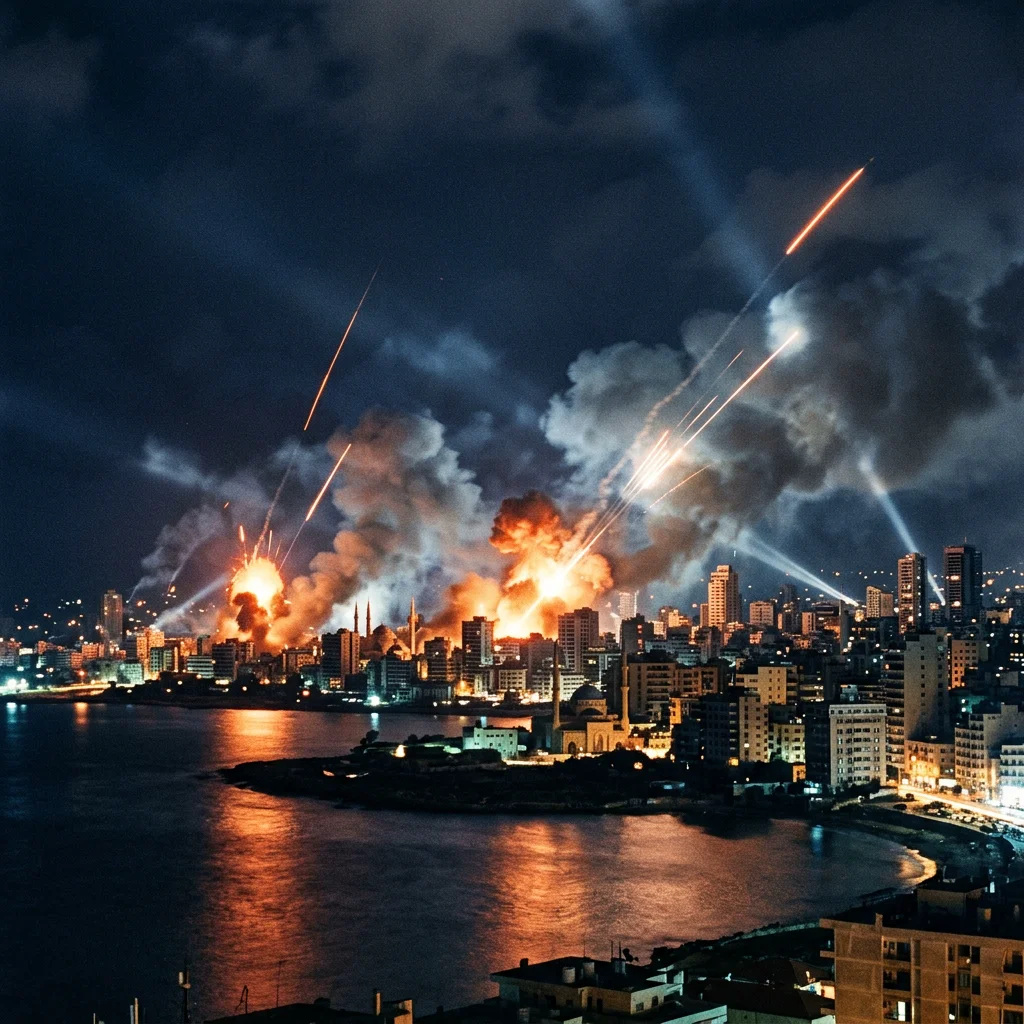
At 2:37 p.m. local time on April 8, 2026 — less than three hours after the Islamabad Accords ceasefire between the United States and Iran was announced — consecutive explosions rocked Beirut, sending thick columns of black smoke billowing across the Lebanese capital. The Lebanese Health Ministry confirmed at least 254 people killed and more than 1,160 wounded in what the Israel Defense Forces (IDF) acknowledged as "the largest coordinated wave of strikes across Lebanon" since Operation Roaring Lion began. Over 100 Hezbollah command centers and military sites were targeted in Beirut, the Bekaa Valley, and southern Lebanon — but strikes also hit dense commercial and residential areas in central Beirut without warning. The international community responded with immediate condemnation, while Iranian officials warned that Tehran could withdraw from the newly signed ceasefire.
What Happened
The morning of April 8, 2026, began with a rare breath of diplomatic hope. In Islamabad, representatives of the United States and Iran announced a ceasefire agreement brokered by Pakistan — the so-called Islamabad Accords — that promised to de-escalate tensions that had been mounting across the Middle East since the start of the year. Diplomats on both sides described the moment as "historic" and "a decisive step toward regional stability."
Within hours, that hope was shattered.
Around 2:30 p.m. Beirut time, the first missiles struck the southern suburbs of the Lebanese capital — an area historically associated with Hezbollah but also home to hundreds of thousands of civilians. Within minutes, the strikes spread to the Bekaa Valley in the east and to dozens of towns in southern Lebanon along the Israeli border.
Witnesses in Beirut described an unrelenting sequence of explosions lasting more than two hours. "The ground shook like an earthquake," a resident of the Hamra neighborhood told Al Jazeera. "Windows shattered and smoke covered everything. We didn't know where to run."
The IDF confirmed the operation in an official statement, describing it as "the largest coordinated wave of strikes across Lebanon" since Operation Roaring Lion was launched. According to the statement, more than 100 targets were hit simultaneously, including Hezbollah command centers, weapons depots, communication tunnels, and rocket launch positions.
The Lebanese Health Ministry, in a press conference held at 9 p.m. that evening, released preliminary figures: at least 254 dead and more than 1,160 wounded. Officials warned that the death toll could rise as rescue teams continued working through rubble at multiple sites.
The Israeli operation on April 8 was described by military analysts as the most comprehensive aerial offensive against Lebanon in decades — surpassing in scale even the bombardments of the 2006 war.
Beirut: The Capital's Heart Under Fire
The strikes in Beirut initially focused on the southern suburbs (Dahieh), Hezbollah's traditional stronghold. However, what set this operation apart from previous offensives was its reach: commercial and residential areas in central Beirut were also struck without prior warning, according to reports from the Middle East Eye and The Guardian.
Commercial buildings in the Verdun district and near the Corniche — the seaside promenade that serves as the city's postcard — sustained significant damage. Shattered glass, destroyed vehicles, and craters in public roads marked the urban landscape in the hours following the attacks.
Rafik Hariri Hospital, Lebanon's largest public medical center, reported receiving more than 300 wounded in the first four hours alone. Doctors described scenes of "absolute chaos," with patients being treated in hallways and parking lots due to a lack of available beds.
Bekaa Valley: Military Infrastructure Devastated
In the Bekaa Valley, an agricultural region that also hosts a significant Hezbollah military presence, Israeli strikes hit what the IDF described as "underground command and control complexes" and "medium-range missile depots."
Residents of the city of Baalbek told Al Jazeera that at least six residential buildings were destroyed in neighborhoods adjacent to military installations. "They say they're attacking Hezbollah, but it's our homes that collapse," said a 67-year-old resident who lost two grandchildren in the bombings.
Southern Lebanon: The Border Zone in Flames
Southern Lebanon, which had already been suffering intermittent attacks since the start of Operation Roaring Lion, was targeted by dozens of simultaneous strikes. Villages such as Khiam, Marjayoun, and Bint Jbeil — still bearing the scars of the 2006 war — were hit once again.
UNIFIL (the United Nations Interim Force in Lebanon) reported that at least three of its observation posts sustained collateral damage, although no peacekeepers were killed in this particular attack. The UNIFIL spokesperson called for "immediate restraint by all parties" and reiterated that strikes near UN positions violate international law.
The Al Jazeera headline on the evening of April 8 captured the global sentiment: world leaders condemned the attacks as "brutal."
United Nations
The UN Secretary-General, in a statement issued from New York, expressed "deep concern" over the scale of the attacks and called for "immediate and unrestricted humanitarian access" to affected areas. The Security Council convened an emergency session for the following day, though expectations for a binding resolution were low given the history of American vetoes on issues involving Israel.
Europe
The European Union, through its High Representative for Foreign Affairs, described the attacks as "disproportionate" and called for an "independent investigation" into civilian casualties. France and Spain were particularly vocal: Paris summoned the Israeli ambassador for explanations, while Madrid announced a temporary suspension of arms exports to Israel.
Arab World
The Arab League called an extraordinary meeting of foreign ministers. Saudi Arabia, Egypt, and Jordan issued joint statements condemning the attacks and calling for "the immediate cessation of hostilities against the Lebanese people." Qatar, which had been mediating parallel negotiations, described the bombings as "a deliberate blow to peace efforts."
Social Media and Public Opinion
On social media, hashtags such as #LebanonUnderAttack, #StopBombingLebanon, and #IsraelAttacksLebanon dominated global trending topics on X (formerly Twitter), Instagram, and TikTok. Videos recorded by Beirut residents showing explosions, burning buildings, and wounded civilians accumulated tens of millions of views within hours.
Context and Background
Impact on the Population
| Aspect | Previous Situation | Current Situation | Impact |
|---|---|---|---|
| Scale | Limited | Global | High |
| Duration | Short-term | Medium/long-term | Significant |
| Reach | Regional | International | Broad |
The 254 dead and 1,160 wounded are not mere statistics — they are interrupted lives, shattered families, and devastated communities.
Overwhelmed Hospitals
Lebanon's healthcare system, already weakened by years of economic crisis and the COVID-19 pandemic, entered functional collapse in the hours following the attacks. Rafik Hariri Hospital operated at 400% above normal capacity. Doctors performed emergency surgeries under precarious conditions, with reports of shortages of anesthetics and blood for transfusions.
The Lebanese Red Cross mobilized all available teams — more than 3,000 volunteers — for rescue operations and transport of the wounded. Ambulances navigated streets covered in rubble, often under the risk of further bombardment.
Mass Displacement
In the hours following the attacks, roads leading out of Beirut toward the north became gridlocked with families fleeing the capital. Scenes reminiscent of the 2006 exodus repeated themselves: packed cars, families on foot carrying what they could, children crying in the arms of desperate parents.
UNHCR (the United Nations High Commissioner for Refugees) estimated that at least 50,000 people were displaced in the first 12 hours after the April 8 attacks alone — adding to the more than 800,000 who had already been displaced in previous waves of bombardment since the start of Operation Roaring Lion.
The Psychological Toll
"People are afraid," a Lebanese psychologist told Al Jazeera. "It's not just the fear of bombs — it's the fear that this will never end. Many of my patients are survivors of the 2020 port explosion. They thought the worst was behind them. Now they realize it wasn't."
Mental health organizations warned of a "silent epidemic" of post-traumatic stress disorder (PTSD) in Lebanon, particularly among children. UNICEF estimated that more than 400,000 Lebanese children had been directly affected by the bombings since the conflict began.
What the Key Players Are Saying
The most controversial aspect of the April 8 attacks was their timing: they occurred just hours after the announcement of the US-Iran ceasefire under the Islamabad Accords.
Israel was quick to clarify its position. In an official statement, the prime minister's office declared that "the ceasefire with Iran does not apply to operations in Lebanon," arguing that Operation Roaring Lion targets exclusively Hezbollah and its military capabilities, which represent "a direct existential threat to Israel's security."
This legal and strategic distinction triggered immediate reactions on multiple fronts.
On the Iranian side, senior government officials warned that Tehran could "reconsider its participation in the ceasefire" if Israel continued attacking Lebanon. Iran's Foreign Ministry spokesperson stated that "one cannot speak of peace while bombs fall on Lebanese civilians" and that "Hezbollah is an integral part of the axis of resistance that Iran is committed to protecting."
In the United States, Defense Secretary Pete Hegseth struck a cautious tone. At a Pentagon press conference, Hegseth stated that "we hope and believe the ceasefire will hold" but stopped short of directly condemning the Israeli strikes on Lebanon. The American position reflected the delicate diplomatic balancing act Washington was attempting: preserving the deal with Iran without alienating Israel, its principal ally in the region.
International policy analysts pointed to the fundamental contradiction: how can a regional ceasefire be sustained when one of the key actors — Israel — openly declares that part of the theater of operations is excluded from the agreement?
Next Steps
The April 8, 2026, attacks opened multiple scenarios for the future of the Middle East conflict.
Scenario 1: Controlled Escalation
Israel continues striking Hezbollah in Lebanon while the ceasefire with Iran formally holds. Iran protests diplomatically but avoids direct military action. Hezbollah absorbs the blows and maintains limited retaliatory capacity. This scenario prolongs civilian suffering in Lebanon without resolving the underlying conflict.
Scenario 2: Ceasefire Collapse
Iran follows through on its threat and withdraws from the Islamabad Accords, resuming direct or indirect hostilities against American and Israeli interests in the region. This scenario would represent a significant escalation with the potential to involve multiple regional actors.
Scenario 3: Effective Diplomatic Pressure
The international community, led by European powers and moderate Arab states, succeeds in pressuring Israel to include Lebanon within the scope of the ceasefire. This scenario, while the most desirable, is considered the least likely by analysts given Israel's historical resistance to external pressure on security matters.
Closing
Sources and References
Understanding the April 8 attacks requires examining the broader strategic context.
Operation Roaring Lion
Operation Roaring Lion, launched by Israel weeks earlier, had the stated objective of "significantly degrading Hezbollah's military capabilities" and "eliminating the rocket and missile threat against Israeli territory." The operation included airstrikes, intelligence operations, and, according to military sources, limited ground incursions into southern Lebanon.
Israel argued that Hezbollah had amassed an arsenal of more than 150,000 rockets and missiles — many supplied by Iran — and that the organization represented the greatest conventional threat to Israeli security.
The Timing Calculation
Military and diplomatic analysts offered different interpretations of the timing:
Hypothesis 1 — Window of opportunity: With the US-Iran ceasefire in place, Israel may have calculated that Iran would be temporarily unable to retaliate directly, creating a window to intensify operations against Hezbollah without the risk of escalation with Tehran.
Hypothesis 2 — Pressure on the ceasefire: By attacking Lebanon immediately after the agreement, Israel may have sought to test the limits of the ceasefire and establish the precedent that operations against Hezbollah fall outside the scope of the deal.
Hypothesis 3 — Domestic dynamics: Domestic political pressures in Israel, including demands from northern communities living under constant threat of Hezbollah rockets, may have accelerated the decision to intensify strikes.
Implications for the Ceasefire
The central question that emerged after April 8 was: will the US-Iran ceasefire survive? The answer depended on multiple factors.
Iran faced a dilemma: abandoning the ceasefire would mean returning to direct confrontation with the US, but remaining in the agreement while its most important ally (Hezbollah) was being bombed would undermine its credibility within the so-called "axis of resistance."
The United States, in turn, needed to balance its commitment to Israel with the preservation of the Iran deal — two objectives that, after April 8, appeared increasingly incompatible.
- The Guardian — Israel operations in Lebanon to continue despite Trump ceasefire
- Al Jazeera — World reacts to 'brutal' Israeli attacks on Lebanon amid US-Iran ceasefire
- Jerusalem Post — Israel launches massive wave of strikes across Lebanon
- Middle East Eye — Israel launches massive wave of strikes across Lebanon amid Iran ceasefire
- USA Today — Israeli strikes in Lebanon kill 89, wound 700
- Al Jazeera — 'People are afraid': Lebanese reeling after Israel's devastating attacks


