Incredible Discovery of a New Fish Species That Glows in the Dark in Deep Waters
On July 15, 2026, the international scientific community was taken by storm by the announcement of one of the most extraordinary marine biology discoveries of this century. An advanced oceanographic expedition successfully recorded and collected specimens of a new species of bioluminescent fish living at an incredible depth of 8,000 meters in the Pacific Ocean. This unprecedented achievement redefines the known limits for the survival of complex organisms under conditions of extreme physical pressure and absolute darkness.
Scientists had long assumed that the extreme environmental pressures of the deep ocean trenches prevented vertebrate animals from thriving below certain depths. However, this remarkable finding proves that adaptation can overcome seemingly impossible physical barriers. The discovery has ignited excitement across global scientific institutes, prompting new debates about the ocean's depths.
What Happened
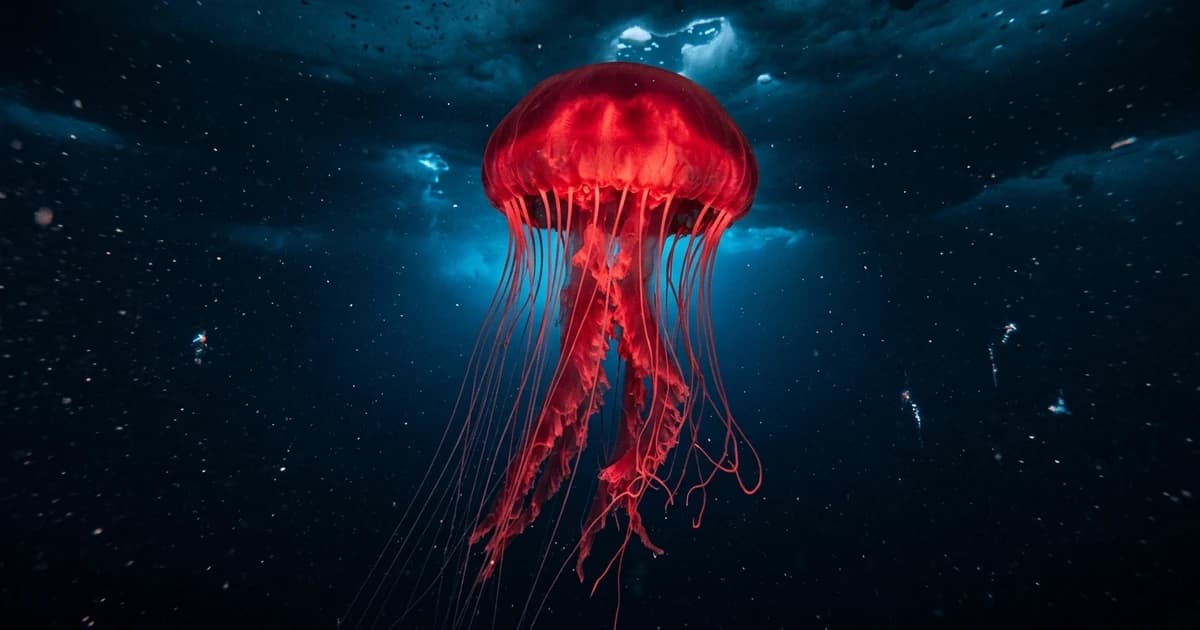
The historic discovery occurred in the abyssal plains of the Mariana Trench, one of the deepest and least explored regions on our planet. A team of scientists aboard the research vessel Nadir located the organism during a series of deep-sea dives. The specimen, tentatively named Marianalux abissalis, is a elongated, translucent-skinned fish that emits a continuous and pulsating blue-green glow.
To capture the fish and record high-definition footage, researchers deployed the advanced remotely operated vehicle (ROV) Hades-X. This underwater robot was constructed using a specialized titanium and carbon fiber alloy designed to withstand the crushing pressure of the abyss. Equipped with ultra-high-resolution cameras calibrated for near-zero light environments, the vehicle successfully spotted the fish swimming close to the sandy seabed.
The capture of the animals was executed with extreme care using a low-pressure hydraulic suction chamber custom-designed by the oceanographic institute. The two captured specimens were carefully brought to the surface in pressurized biological containers that kept the temperature and pressure constant. This delicate procedure was absolutely critical to prevent the immediate cellular collapse of the fish, allowing for unprecedented laboratory analyses.
Context and History
Exploring the ocean's abyssal trenches has always represented a technological challenge comparable to manned space travel. Since the historic dive of the bathyscaphe Trieste in 1960, very few expeditions have managed to document active life forms below 7,000 meters. Most previous studies suggested that the extreme scarcity of nutrients and crushing hydrostatic pressure limited vertebrate fish to shallower depths.
In recent years, however, rapid advancements in underwater robotics and biological sensors have allowed scientists to map previously inaccessible areas of the ocean floor. The search for extremophile organisms has intensified due to growing interest from the biotechnology sector in enzymes that function under extreme conditions. The discovery of Marianalux abissalis crowns a dedicated five-year research effort focused on the tectonic fissures of the Western Pacific.
Previous studies in this specific area had only cataloged small amphipods and single-celled microorganisms inhabiting such deep trenches. The presence of an active predatory fish with a complex bioluminescence system at 8,000 meters contradicts long-standing ecological theories about deep-sea food chains. This discovery proves that complex life has found unique evolutionary pathways to colonize the harshest environments.
Impact on the Population
Although the discovery took place thousands of meters below the surface, the technological innovations developed for the expedition will have practical benefits for society. The advanced metallic alloys and sealing systems engineered for the ROV Hades-X are already being studied to improve deep-sea pipelines. Additionally, the discovery of unique enzymes within the fish's body could open new pathways for industrial processes and medications.
To help readers understand how this new species differs from other known fish, we have compiled a detailed comparative table showing their biological characteristics:
| Aspect | Shallow Water Fish | Common Abyssal Fish | New Bioluminescent Species (Marianalux) |
|---|---|---|---|
| Habitual Depth | 0 to 200 meters | 1,000 to 4,000 meters | 7,500 to 8,200 meters |
| Bone Structure | Rigid and highly calcified | Partially cartilaginous | Pure cartilage and highly maleable |
| Swim Bladder | Present and functional | Reduced or absent | Completely absent |
| Light Source | Absent in most | External symbiotic bacteria | Autonomous enzymatic production (Own Luciferin) |
| Pressure Factor | 1 to 20 atmospheres | 100 to 400 atmospheres | 750 to 820 atmospheres |
| TMAO Content | Low | Moderate | Extremely elevated |
Understanding these physiological adaptations helps humanity map Earth's ecological resilience during a period of rapid global changes. The knowledge generated by this research also supports the creation of marine sanctuaries protected from deep-sea mining. Preserving these pristine abyssal plains ensures that the vast genetic library hidden in the ocean depths remains available for future generations.
What Those Involved Say
Dr. Karen Osborn, the expedition's chief biologist and a researcher at the Smithsonian National Museum of Natural History, shared her enthusiasm in an official statement. She highlighted that seeing the fish glowing actively in the deep darkness was the most defining moment of her scientific career. According to the researcher, this discovery shows that human knowledge of the oceans is still in its absolute infancy.
The project's robotic systems engineer, Dr. Marcus Vance, explained the immense technical difficulties the team had to overcome during the retrieval operation. He emphasized that designing a sealing system capable of maintaining constant pressurization at a depth of 8,000 meters required months of complex virtual simulations. Vance stated that the mission's success paves the way for a new era of low-cost abyssal exploration.
Finally, oceanographer Dr. Ricardo Mendes, who participated in the initial genetic analyses aboard the vessel Nadir, commented on the animal's light-emitting mechanism. He revealed that preliminary DNA sequencing indicates the fish's luciferase has a unique and highly stable molecular structure. Mendes believes this stability could be useful for developing new biological markers for medical research on land.
Next Steps
The coming months will be dedicated to detailed histological and genetic analyses of the two specimens collected in the Mariana Trench. The fish are currently housed in special temperature-controlled facilities at the oceanographic institute so their chemical reactions can be studied in real time. Biologists aim to decode the complete gene sequence responsible for synthesizing the animal's unique luciferin.
Another major development will be the application of this knowledge to astrobiology research conducted by international space agencies. Scientists planning missions to search for life on the icy moons of Jupiter and Saturn have already shown great interest in the fish's cellular adaptations. The discovery provides a practical model of how complex life might survive in dark oceans beneath thick crusts of ice.
Additionally, new expeditions using the Hades-X robot are being planned to map other abyssal plains in the Pacific and South Atlantic Oceans. Researchers hope to discover whether Marianalux abissalis has a wide geographic distribution or if it is endemic only to the Mariana Trench. Expanding abyssal monitoring will help build a global atlas of our planet's deepest biodiversity.
Closing
The discovery of the bioluminescent fish in the Mariana Trench serves as a powerful reminder that Earth still holds fascinating mysteries. The ocean abyss, far from being a lifeless desert, reveals itself as a cradle of extraordinary evolutionary innovations that challenge our imagination. The survival of Marianalux abissalis teaches us that biological resilience finds ways to prosper even under the most hostile conditions.
This close connection between all layers of the ocean warns us of the critical importance of environmental conservation on a global scale. Ecological events in the deep sea directly affect the marine food chain that extends to coastal and surface waters. It is the same unified ocean where humpback whales gather in a rare spectacle off the coast of New Zealand during their annual migratory journey.
Protecting these waters, from the dark abyss to the sunlit coastal bays, is both an ethical and scientific duty of our society. Human curiosity must continue to guide us toward the unknown while preserving the biological wealth of our wonderful blue planet. By doing so, we ensure that the delicate balance of our global marine ecosystem remains intact for generations to come.