
While missiles crossed the Persian Gulf and diplomats in Geneva negotiated ceasefires, something bizarre was happening on the phones of 4 billion people: the internet was transforming the largest military conflict since the Iraq War into an avalanche of memes so absurd that it would be impossible to tell whether humanity was laughing to keep from crying or had simply lost all grip on reality. In March 2026, the war between the United States-Israel and Iran isn't just happening on the battlefields — it's happening on TikTok, X (formerly Twitter), Instagram, and even on the official channels of sovereign governments that decided the best way to win a conflict is with Lego-style montages.
Welcome to the era of memetic warfare, where the Pentagon produces attack videos with Call of Duty aesthetics, Iran responds with Lego-style satirical animations mocking Trump, and Generation Z is collectively having a panic attack while making jokes about fleeing to New Zealand to avoid the military draft.
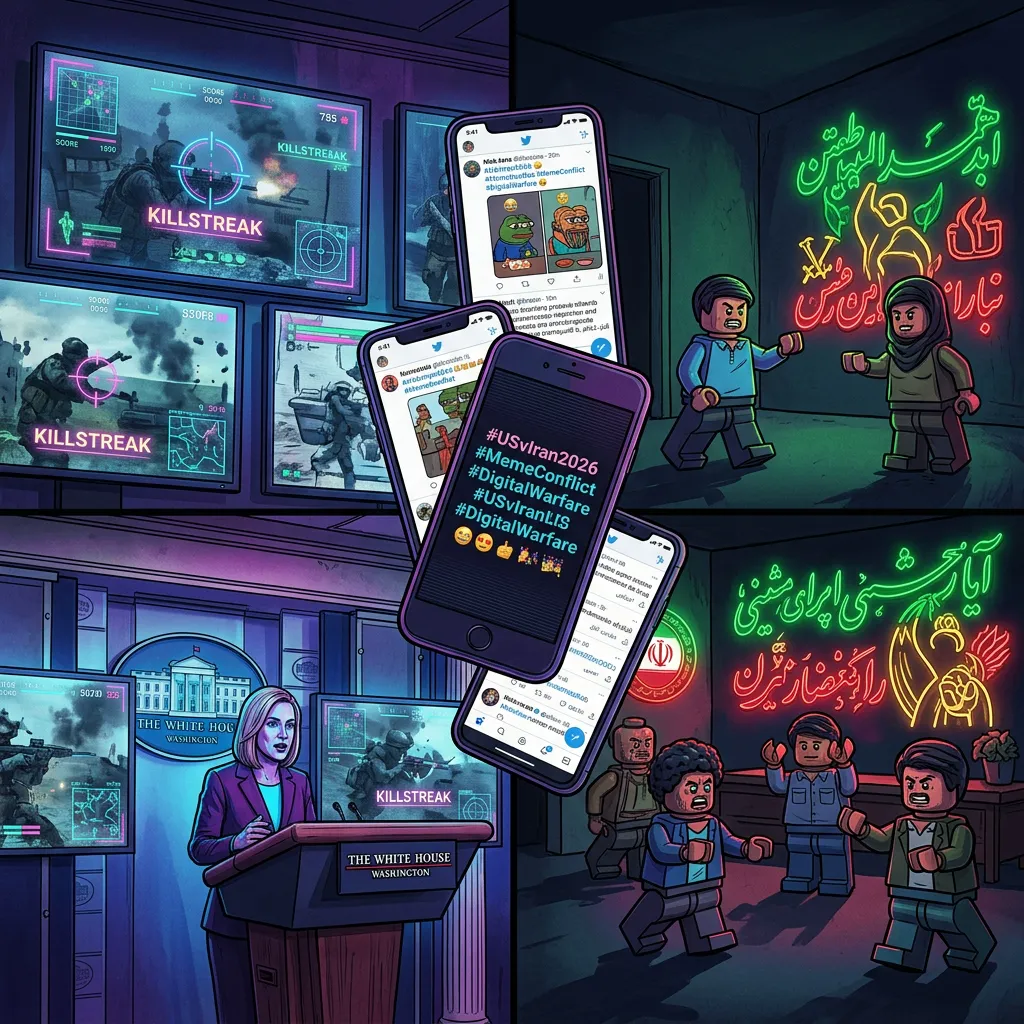
The White House That Gamified War
It all started (or reached its peak of absurdity) when the White House communications team published, on its official channels, videos of American airstrikes against Iranian installations with cinematic editing worthy of a blockbuster trailer. Real footage of bombings was interspersed with video game-style transitions, glowing fonts reminiscent of the Halo franchise, and a soundtrack that could have been the background music for a final level in Call of Duty: Modern Warfare.
The reaction was immediate and brutal. The Washington Post published a piece titled "The White House is gamifying war" that went viral with over 12 million views within 48 hours. Academics, war veterans, and humanitarian organizations condemned what they called the "obscene trivialization of human suffering."
What the White House published vs. the public reaction:
| Official Content | Public Criticism |
|---|---|
| Airstrike video with Halo aesthetics | "This is recruitment propaganda, not information" — NYT Editorial Board |
| "Mission accomplished" montage, Call of Duty style | "Every explosion in that video killed real people" — Veterans Against War |
| Infographic celebrating destroyed targets | "These look like pitch slides for the apocalypse" — User @darkhumor_vibes |
| Epic background music in briefings | "Someone tell the Pentagon that war isn't a Spotify playlist" — Viral on TikTok |
What made everything even more surreal was the official defense: the National Security Council spokesperson argued that "modern communication requires contemporary visual language" and that the videos were "legitimate tools of transparency with the American public." The internet, predictably, turned that statement into yet another meme.
Iran's Counter-Attack: Lego, Satire, and Propaganda 2.0
If the White House decided that war could be packaged as entertainment, Iran responded in kind — but with a completely different aesthetic. Channels affiliated with the Tehran regime (the new provisional government after the death of Ayatollah Khamenei in Operation "Roaring Lion") began producing propaganda videos in Lego-style animation that satirized American military operations and, especially, the figure of Donald Trump.
One video in particular — showing a Lego Trump figurine fleeing a bunker while toy missiles exploded around him — accumulated 87 million views on non-Western platforms like Telegram and Weibo before being reposted on X and going globally viral. The Jerusalem Post dedicated a comprehensive analysis to what it called "the unexpected sophistication of Iran's post-Khamenei propaganda machine."
The escalation of memetic warfare:
- Week 1 (early March): Homemade memes from ordinary citizens expressing fear and dark humor
- Week 2: Governments begin using memes as official communication tools
- Week 3: Memes become active disinformation weapons — fake images of attacks, deepfakes of leaders, and fabricated narratives in meme format
- Week 4 (now): Academics and NGOs warn that the "memeification of war" is causing massive desensitization in young populations
The phenomenon even earned an academic name: Meme Warfare. Researchers at Oxford University published an emergency paper in the Journal of Digital Conflict arguing that "for the first time in history, memes are not merely a reaction to conflict — they are an integral part of the military strategy on both sides."
Generation Z and Draft Panic: "I Can't Shoot, But I Can Make Memes"
If there's one demographic group that's living the US-Iran conflict entirely through memes, it's Generation Z (born between 1997 and 2012). For a generation that grew up with smartphones in hand and Middle Eastern wars as background noise of childhood, the 2026 escalation brought an anxiety that could only be processed the way they know how: making jokes on the internet.
The Gen Z military draft memes have become a genre of their own, with variations ranging from absurdist existentialism to slapstick comedy:
Top 10 Gen Z war memes that broke the internet:
"TACO" (Trump Always Chickens Out): A format satirizing Trump's military promises followed by reversals. It surged back when Trump postponed the ultimatum on the Strait of Hormuz.
"Enlisting in the Navy vs. My actual resume": Comparison between required military skills and actual youth abilities (editing CapCut videos, making latte art, running 47 Chrome tabs simultaneously).
"Gen Z at military training": Videos of young people doing push-ups while asking the sergeant to "respect their boundaries" and inquiring whether the barracks have Wi-Fi.
"POV: You're the Pentagon intern": Fictional video series of a Gen Z intern responsible for the White House's official memes.
"Is New Zealand accepting applications?": Posts about emigrating to New Zealand — the country farthest from any conflict zone — which generated a real wave of Google searches (340% increase in "how to move to New Zealand" in March).
"Wait, it's already March?": A meme of someone staring into the void with the caption "what do you mean it's already March," capturing the information-overload feeling of 2026.
"Anime vs. The Reality of War": Montages comparing epic anime battle scenes with the bureaucratic and terrifying reality of an actual conflict.
"My dad vs. Me when WW3 approaches": Dad: motivated, patriotic, grabs the flag. Son: "Mom, does the Canada VPN work?"
"Explaining the war to my grandma using memes": Format where young people try to summarize the 2026 geopolitical crisis using exclusively memes, emojis, and TikTok references.
"Pakistan brokering world peace": After reports about possible Pakistani mediation between Iran and the US, the internet turned Pakistan into the "unexpected hero" of the war, with superhero memes and "hold my shawarma" templates.
What the numbers say:
| Metric | Data |
|---|---|
| Posts with #WW3 on TikTok (March 2026) | 2.8 billion views |
| Increase in searches for "how to avoid draft" (USA) | +890% in 2 weeks |
| War memes created per day (estimate) | ~45,000 |
| Average lifespan of a war meme | 18 hours before a new iteration |
| Average age of #WW3 meme creators | 19 years old |
The "Memeification of Tragedy": When Laughing Becomes a Problem
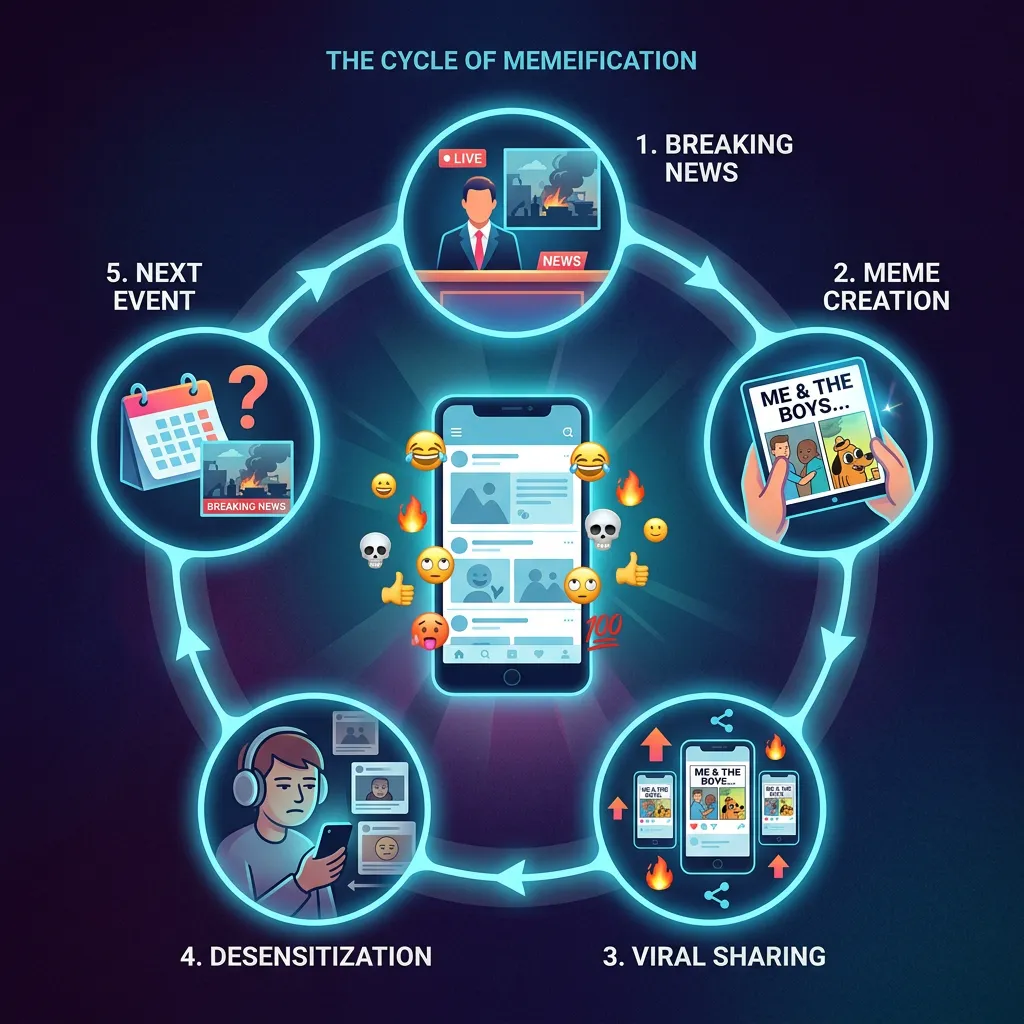
While the internet laughs, mental health and communication experts are sounding the alarm. Researchers at Minnesota State University published a study titled "Compassion Fatigue in the Age of Memeification" documenting a concerning phenomenon: constant exposure to tragedies packaged as humor is causing what they call digital compassion fatigue — a growing inability to feel empathy for real suffering when it is constantly presented in joke format.
The study interviewed 3,200 young people between 16 and 25 and found disturbing data:
- 67% said their first reaction upon seeing news about the conflict was to look for the meme version
- 43% admitted feeling "emotionally disconnected" from the suffering in the Middle East
- 78% said memes are their primary source of information about the war
- 31% could not name a country affected besides "Iran" when asked without multiple-choice options
Dr. Sarah Kozlowski, co-author of the study, was direct: "We're not saying humor is wrong. Humor is an ancestral and legitimate coping mechanism. What we are documenting is what happens when an entire generation processes catastrophic events exclusively through humor — without ever pausing at the real gravity of the situation. Memes become an emotional shield that, over time, transforms into a wall."
The paradox of information through memes:
The phenomenon has created a paradoxical situation: young people who consume war memes are more informed about specific events (because they obsessively follow the meme timeline) but less understanding of the context, the causes, and, crucially, the real human consequences.
A parallel survey by the Reuters Institute showed that 52% of young people aged 18-24 in the US knew about the Strait of Hormuz blockade (information that went viral in meme format), but only 11% could explain why the strait is strategically important.
History Repeats Itself (But Now in 4K and With a Filter)
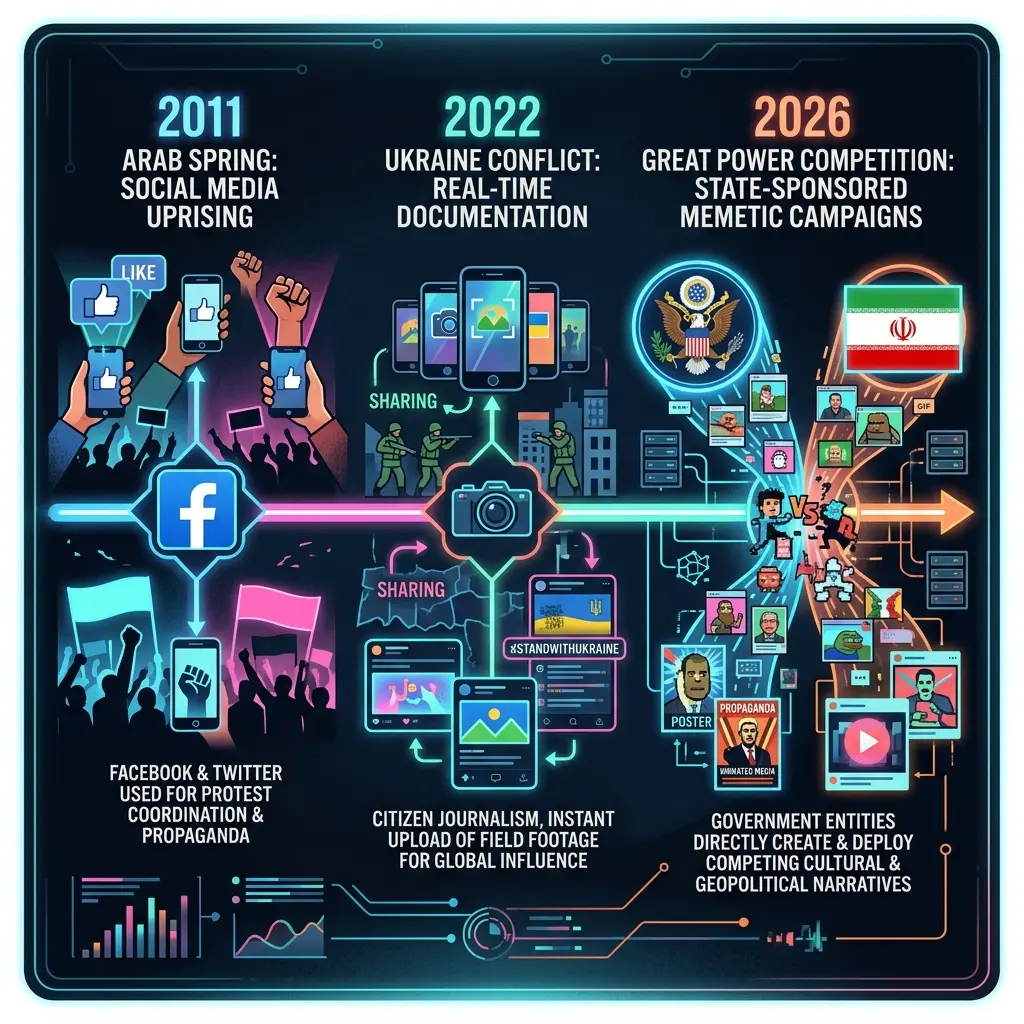
The memeification of conflict is not entirely new. During the Gulf War (1991), CNN was accused of turning bombings into "televised spectacle." During the Iraq War (2003), blogs and online forums became spaces for political satire. In 2014, ISIS memes went viral on 4chan and Reddit. And during the Russian invasion of Ukraine in 2022, Zelensky memes became tools of symbolic resistance.
But 2026 is different for one fundamental reason: for the first time, governments are not just targets of memes — they are active producers of memes as military strategy. The White House produces content with video game aesthetics. Iran responds with Lego animations. Israel publishes infographics in Instagram story format about military operations. It's as if meme language has been co-opted by the very power systems it originally satirized.
Historical comparison:
| Conflict | Dominant Media | Role of Memes |
|---|---|---|
| Gulf War (1991) | CNN live | Nonexistent |
| Iraq War (2003) | Blogs + TV | Marginal reaction in forums |
| Arab Spring (2011) | Facebook + Twitter | Mobilization tool |
| Ukraine Invasion (2022) | TikTok + Telegram | Cultural resistance + propaganda |
| US-Iran Conflict (2026) | All platforms | Active government weapon + mass coping |
Media theorist Lev Manovich, professor at the City University of New York, coined the term "military-memetic complex" in an article published in Wired in March 2026, arguing that "we are witnessing the birth of a new military doctrine where narrative victory on social media is as strategic as victory on the battlefield."
Dark Humor as a Survival Mechanism
Before completely condemning war meme culture, it's worth recognizing something psychologists have documented for decades: dark humor is one of humanity's oldest and most effective coping mechanisms. Soldiers in World War I trenches made jokes about grenades. Prisoners in concentration camps developed humor as a way to preserve sanity. Firefighters and paramedics are known for their acidic humor as emotional protection.
Dr. Peter McGraw, director of the Humor Research Lab at the University of Colorado Boulder and author of The Humor Code, explains: "Humor happens when something is simultaneously threatening and benign. War is the ultimate threat. Memes are the attempt to render it benign enough so that we can continue functioning. It's not insensitivity — it's cognitive survival."
Research data corroborates this: longitudinal studies show that people who use humor to process traumatic events exhibit lower rates of PTSD and greater emotional resilience than those who completely avoid the subject or passively expose themselves without active processing.
The problem, as Dr. Kozlowski points out, is not humor itself — it's when humor replaces all forms of engagement with reality:
- ✅ Healthy: See a meme, laugh, then read a serious analysis about the conflict
- ❌ Problematic: See a meme, laugh, scroll to the next meme, never get informed beyond the joke
- ⚠️ Critical: Being unable to process "serious" news unless it comes in humor format
What Comes Next: The Internet Is Already Preparing Tomorrow's Memes
As this article is being written, the meme machine doesn't stop. It's estimated that over 45,000 new memes about the US-Iran conflict are created daily, with an average lifespan of 18 hours before being replaced by a new version or iteration. It's a frenetic cycle that accompanies — and sometimes anticipates — the pace of real-world events.
The question that historians, psychologists, and media theorists are asking is no longer "should people make memes about war?" It's: "What happens to a civilization that processes all of its reality — including the deaths of thousands of people — through funny 5-second images?"
The answer, ironically, will probably come in meme format.
FAQ — Frequently Asked Questions
Do governments actually make propaganda memes?
Yes. In 2026, both the White House and the Iranian regime use memes, stylized videos, and humorous content as official strategic communication and propaganda tools. The phenomenon is documented and academically studied as "Meme Warfare."
Can war memes cause desensitization?
Research indicates that exclusive consumption of information in meme format, without serious journalistic counterpart, can lead to "digital compassion fatigue" — a measurable reduction in the ability to empathize with real suffering. However, when combined with contextualized information, humor can be a healthy coping mechanism.
Is Gen Z really worried about the draft?
Searches for "how to avoid the military draft" in the US increased by 890% in March 2026. Although there is no active mandatory conscription, the anxiety is real and manifests predominantly in dark humor memes about fleeing to distant countries.
What was the most viral war meme of 2026?
The Lego-style video produced by Iranian channels satirizing Trump accumulated 87 million views. In the US, the "TACO" (Trump Always Chickens Out) format and the Gen Z draft memes are the most shared.
Is this a new phenomenon?
The memeification of tragic events has existed since the dawn of the internet, but 2026 marks the first time governments are both targets and active producers of memes as official military strategy. Researcher Lev Manovich has termed this the "military-memetic complex."
Sources and References
- Washington Post: "The White House is gamifying war" — March 2026
- Oxford Internet Institute: "Meme Warfare: Digital Propaganda in the US-Iran Conflict" — Journal of Digital Conflict, March 2026
- Minnesota State University: "Compassion Fatigue in the Age of Memeification" — March 2026
- Reuters Institute for the Study of Journalism: Digital News Report — Special Update March 2026
- Jerusalem Post: "Iran's Post-Khamenei Propaganda Machine Goes Viral" — March 2026
- Lev Manovich: "The Military-Memetic Complex" — Wired, March 2026
- Dr. Peter McGraw, Humor Research Lab, University of Colorado Boulder
- Hindustan Times: "2026's relentless rollercoaster: Internet reacts with memes" — March 2026
- Know Your Meme: "#WW3 Memes Database" — Updated March 2026


