
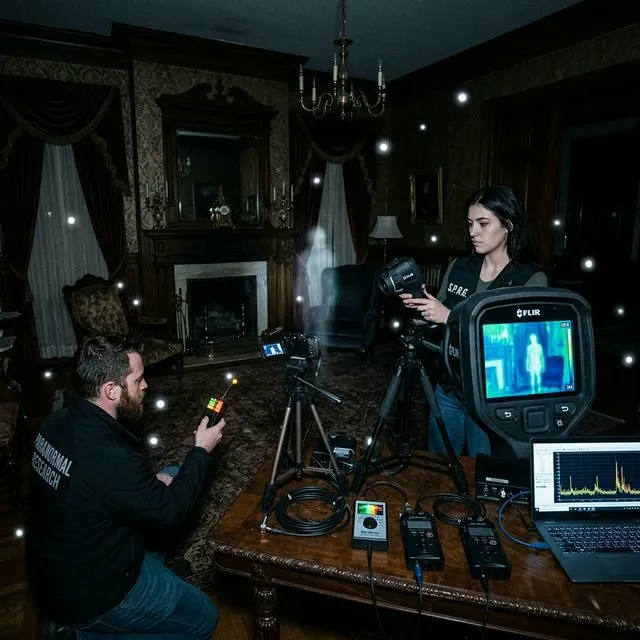
In 2026, the field of paranormal studies has undergone a quiet but profound transformation. Universities that once avoided the subject now maintain dedicated laboratories. Neuroscientists, physicists, and psychologists collaborate on research that would have been unthinkable two decades ago.
The result is not a validation of the supernatural — nor its complete denial. It's something more interesting: an understanding that many "paranormal" phenomena reveal fascinating aspects of the human mind, physics, and perception that we still don't fully comprehend.
The State of Paranormal Research in 2026
Serious Institutions Studying the Subject
Unlike what many imagine, serious paranormal research exists at prestigious institutions:
University of Virginia (USA)
- Division of Perceptual Studies (DOPS)
- Has studied near-death experiences and past-life memories since 1967
- Database with more than 2,500 documented cases
University of Edinburgh (Scotland)
- Koestler Parapsychology Unit
- Focus on extrasensory perception and psychokinesis
- Rigorous methodology with double-blind controls
Institute of Noetic Sciences (USA)
- Founded by astronaut Edgar Mitchell
- Research on consciousness and anomalous phenomena
- Collaborations with Stanford and MIT
University of São Paulo (Brazil)
- Inter Psi - Laboratory of Anomalistic Psychology
- Studies anomalous experiences in the Brazilian population
- Skeptical but open approach
The Paradigm Shift
What changed was not the acceptance of the "supernatural," but the approach:
Before: "This is impossible, therefore it doesn't deserve study"
Now: "People report these experiences — what's happening in the brain/environment?"
Phenomenon 1: Haunted Houses
What People Report
- Feeling of invisible presence
- Unexplained sounds (footsteps, knocks, voices)
- Objects that move on their own
- Visual apparitions
- Feeling of being touched
- Sudden temperature changes
What Science Discovered
Infrasound (Sounds Below 20 Hz)
Research by Dr. Vic Tandy (Coventry University) demonstrated that sound frequencies below the human hearing threshold can cause:
- Feeling of presence
- Unexplained anxiety
- Blurred peripheral vision
- Chills
Common sources of infrasound in houses:
- Industrial fans
- Air conditioning systems
- Heavy traffic nearby
- Wind in specific structures
2024 Study: Researchers installed infrasound generators in a "non-haunted" house and 22% of participants reported typical haunting experiences.
Electromagnetic Fields (EMF)
Neuroscientist Michael Persinger developed the "God Helmet" — a device that applies weak magnetic fields to the brain.
Results:
- 80% of participants reported "feeling of presence"
- Some described mystical or religious experiences
- Effects varied depending on the brain region stimulated
Implication: Houses with faulty electrical wiring or near high-voltage lines can generate magnetic fields that affect perception.
Carbon Monoxide
CO leaks (odorless and colorless) cause:
- Visual and auditory hallucinations
- Mental confusion
- Feeling of weight on the chest
- Temporary paralysis
Documented case: A family in Ohio reported hauntings for months. Investigation revealed a CO leak from the furnace. After repair, the "ghosts" disappeared.
Toxic Mold
Certain mold species (Stachybotrys) release mycotoxins that cause:
- Hallucinations
- Paranoia
- Respiratory problems
- Extreme fatigue
Old, damp houses — exactly the type associated with hauntings — are prone to mold infestations.
Phenomenon 2: Near-Death Experiences (NDE)
What People Report
Approximately 10-20% of people who undergo cardiac arrest and are resuscitated report:
- Feeling of floating outside the body
- Tunnel vision with bright light
- Encounter with deceased loved ones
- Panoramic life review
- Feeling of deep peace
- Reluctance to "return"
What Science Discovered
AWARE Study (2014-2024)
The largest scientific study on NDEs, conducted in 25 hospitals in the USA, UK, and Austria.
Methodology:
- Images were placed on high shelves in resuscitation rooms
- Visible only from above (if someone actually "floated")
- 2,060 patients with cardiac arrest studied
Results:
- 330 survived
- 140 were interviewed
- 55 reported some awareness during the arrest
- 9 had classic NDEs
- 0 saw the images on the shelves
Neuroscientific Explanations
1. Cerebral Hypoxia
Lack of oxygen in the brain causes:
- Tunnel vision (peripheral retinal cells die first)
- Feeling of euphoria (endorphin release)
- Vivid hallucinations
2. DMT Release
The pineal gland may release dimethyltryptamine (DMT) during extreme stress, causing:
- Intense mystical experiences
- Feeling of transcendence
- Encounters with "entities"
3. Temporal Lobe Activity
Stimulation of the right temporal lobe reproduces NDE elements:
- Feeling of presence
- Out-of-body experiences
- Vivid memories
4. Intrusive REM
The brain may enter REM dream state during trauma, causing hyper-realistic dream experiences.
Phenomenon 3: Poltergeist
What People Report
- Objects that fly or move on their own
- Knocks and noises without identifiable source
- Electronic devices that turn on/off by themselves
- Phenomena centered on a specific person (usually a teenager)
What Science Discovered
Focal Agent Theory
Most poltergeist cases involve a "focal agent" — usually a teenager going through intense emotional stress.
RSPK Hypothesis (Recurrent Spontaneous Psychokinesis):
Some researchers propose that extreme stress can somehow affect the physical environment. There's no known mechanism for this, but the patterns are consistent.
Psychological Hypothesis:
More scientifically accepted — the focal agent is, consciously or unconsciously, causing the phenomena through:
- Deliberate fraud (attention-seeking)
- Unconscious actions (dissociative states)
- False memory (normal events reinterpreted)
Enfield Case (1977-1978)
One of the most documented poltergeist cases in history, investigated by researchers from the Society for Psychical Research.
Phenomena reported:
- Furniture moving
- Strange voices
- Levitation of one of the children
Investigation:
- Some photos clearly showed the girl jumping from bed (not levitating)
- The children admitted to faking some events
- But investigators claim not everything was explained
Phenomenon 4: Premonitions and Prophetic Dreams
What Science Discovered
Confirmation Bias
We have thousands of dreams per year. Statistically, some will coincide with real events by pure chance.
What we remember:
- Dreams that "came true"
What we forget:
- Thousands of dreams that didn't come true
2023 Study (Harvard University):
Participants recorded all dreams for 6 months. Then evaluated which "came true."
Result: The "hit" rate was exactly what was expected by statistical coincidence.
Unconscious Processing
The brain processes much more information than consciousness perceives. "Premonitions" may be:
- Unconsciously detected patterns
- Interpreted microexpressions
- Forgotten information resurfacing as "intuition"
Phenomenon 5: Apparitions and Ghosts
What Science Discovered
Pareidolia
The human brain is programmed to recognize faces — so programmed that it sees faces where none exist.
- Stains on the wall
- Shadows
- Random patterns
In low-light conditions and high expectation, the brain "completes" ambiguous visual information with faces and human figures.
Sleep Paralysis
Affects 8% of the population at least once in their lifetime.
What happens:
- You wake up but can't move
- Vivid hallucinations (often threatening figures)
- Feeling of weight on the chest
- Intense terror
Explanation: The brain wakes up before the muscle paralysis of REM sleep is turned off. The hallucinations are REM dreams invading waking consciousness.
Grief Hallucinations
Studies show that 30-60% of bereaved people report seeing, hearing, or feeling the presence of the deceased.
Characteristics:
- More common in the first weeks after death
- Generally comforting (not frightening)
- Diminishes over time
What Science CANNOT Explain (Yet)
Genuinely Intriguing Cases
Despite explanations for most phenomena, some cases resist analysis:
1. Cross-Correspondences
In the early 20th century, mediums in different countries produced fragmented messages that only made sense when combined. Coordinated fraud seems unlikely given the historical context.
2. Past-Life Memory Cases
Dr. Ian Stevenson documented more than 2,500 cases of children reporting memories of previous lives, some with verifiable details. Conventional explanations don't cover all cases.
3. Imminent Death Phenomena
Reports from nurses and doctors about patients who "know" they're going to die, or who have visions of deceased relatives shortly before death. Consistent patterns that deserve study.
The Current Scientific Position
Science does not claim that the paranormal is impossible. It states that:
- There is no replicable evidence of paranormal phenomena under controlled conditions
- Natural explanations cover the vast majority of cases
- Some phenomena remain genuinely unexplained
- More research is needed, with rigorous methodology
Conclusion: Between Skepticism and Openness
The scientific study of the paranormal in 2026 teaches us something valuable: reality is stranger than we imagine, but perhaps not in the way we expected.
"Paranormal" phenomena reveal:
- The incredible capacity of the brain to create vivid experiences
- How little we understand about consciousness and perception
- That the physical environment affects our mind in subtle ways
- That the boundary between "normal" and "paranormal" is blurrier than it seems
The only certainty is that investigation must continue — with an open mind, but not so open that the brain falls out.
Modern Theories and Investigations
The mysteries that fascinate humanity continue to be investigated with increasingly sophisticated tools. Modern forensic science, with its DNA analysis techniques, digital facial reconstruction, and advanced chemical analysis, is solving cases that remained unanswered for decades or even centuries. However, for every mystery solved, new enigmas emerge, keeping the flame of human curiosity alive.
Psychology also offers valuable insights into why we are so attracted to mysteries. The human brain is programmed to seek patterns and explanations, and when confronted with the unexplained, it enters a state of cognitive tension that is only relieved by resolution. This innate need to understand the unknown is what drives both science and popular fascination with mysteries.
Social media and the internet have created a new era of collaborative investigation. Online communities of amateur detectives have contributed to solving real cases, although they have also generated unfounded conspiracy theories. The challenge is separating legitimate investigation from irresponsible speculation while maintaining scientific rigor even when dealing with topics that defy conventional explanation.
The Human Fascination with the Unknown
Since the dawn of civilization, humanity has been drawn to the mysterious and the unexplained. Myths, legends, and supernatural stories exist in every culture around the world, suggesting that fascination with the unknown is a fundamental characteristic of human nature. This curiosity is the engine that drives both scientific exploration and artistic creation across all societies.
The boundary between the explained and the unexplained is constantly shifting. Phenomena that were considered supernatural in the past — such as lightning, eclipses, and diseases — now have clear scientific explanations. Similarly, mysteries that intrigue us today may find answers in future scientific discoveries. History teaches us to keep an open mind without abandoning healthy skepticism.
The entertainment industry capitalizes on our fascination with mysteries in increasingly creative ways. True crime podcasts, documentaries about unexplained phenomena, and science fiction series feed our appetite for the mysterious while making us question the limits of human knowledge. The mystery genre continues to be one of the most popular across all forms of media worldwide.
Mysterious Places Around the World
Planet Earth is home to countless places shrouded in mystery and fascination. From the Bermuda Triangle to the Nazca Lines, through Mexico's Zone of Silence and Romania's Hoia Baciu Forest, these locations continue to defy conventional scientific explanations and fuel popular imagination. Each of these places has a unique history of unexplained phenomena and disturbing accounts.
Abandoned cities and ancient ruins also exert a special fascination. Pripyat, the ghost city near Chernobyl, has become a haunting symbol of the destructive power of technology. The ruins of Angkor Wat in Cambodia and Machu Picchu in Peru raise questions about how ancient civilizations managed to build such impressive structures with the technology available at the time.
Cryptozoology, the study of creatures whose existence has not been scientifically proven, continues to attract enthusiasts worldwide. From the Loch Ness Monster to Bigfoot, through the Chupacabra and the Yeti, these legendary creatures occupy a fascinating space between science and folklore. Although most scientists are skeptical, new species continue to be discovered regularly, keeping alive the possibility that some legends may have a kernel of truth.
Mysteries of the Human Mind
The human brain is perhaps the greatest mystery of all. Despite enormous advances in neuroscience, we still understand only a fraction of how this extraordinary organ works. Consciousness, dreams, intuition, and near-death experiences continue to defy scientific explanations and fuel philosophical debates that have lasted millennia across cultures and civilizations.
Phenomena such as eidetic memory, synesthesia, and savant syndrome demonstrate brain capabilities that seem almost supernatural. People who can memorize entire books after a single reading, who see colors when hearing music, or who perform complex mathematical calculations instantly show us that the potential of the human brain goes far beyond what we use in everyday life.
The relationship between mind and body also holds fascinating mysteries. The placebo effect, where patients improve simply by believing they are receiving treatment, demonstrates the power of the mind over the body in ways that medicine still cannot fully explain. Practices like meditation and hypnosis are being studied with scientific rigor, revealing measurable effects that challenge the traditional materialist worldview.
Unsolved Cases That Intrigue the World
There are cases that, despite decades of investigation, remain unsolved. The Zodiac Killer, Jack the Ripper, and the Tamam Shud case are just a few examples of mysteries that continue to challenge investigators and fascinate the public. Each year, new forensic technologies reopen hopes that these enigmas may finally be unraveled and justice served.
Genetic genealogy, which combines DNA testing with genealogical databases, has already solved dozens of cold cases in recent years. The Golden State Killer case, solved in 2018 through this technique, opened a new chapter in criminal investigation. This approach raises important questions about genetic privacy and the limits of state surveillance in modern society.
Supernatural Phenomena Under the Lens of Science
Science has dedicated itself to investigating phenomena traditionally considered supernatural with rigorous methodology. Studies on near-death experiences have revealed consistent neurological patterns that may explain visions of light tunnels and encounters with deceased loved ones. Sleep paralysis, frequently associated with visions of malevolent entities, has a well-documented neurological explanation.
However, some phenomena continue to resist satisfactory scientific explanations. Reports of precognition, telepathy, and out-of-body experiences persist across all cultures and eras. Although most scientists remain skeptical, some serious researchers continue investigating these phenomena, arguing that dismissing them without adequate investigation would itself be unscientific.
Frequently Asked Questions
Has science proven any paranormal phenomena?
No paranormal phenomenon has been scientifically proven under controlled conditions. The James Randi Foundation offered $1 million for decades to anyone demonstrating supernatural abilities and no one claimed it. Some phenomena previously considered paranormal have been explained by science.
Why do people believe in the paranormal?
Several psychological factors explain it: pattern recognition, confirmation bias, the need for control, grief and loss, and cultural conditioning. Studies show paranormal beliefs correlate with intuitive rather than analytical cognitive styles.
What is the most studied paranormal phenomenon?
Extrasensory perception (ESP) is the most scientifically studied claim. Ganzfeld experiments since the 1970s show a small statistical effect but critics argue this is due to methodological flaws and publication bias.
Can science explain near-death experiences?
Science offers several explanations: oxygen deprivation causes tunnel vision and euphoria, endorphin release creates peace, REM intrusion produces vivid imagery, and temporal lobe activity generates out-of-body sensations.
Sources: Division of Perceptual Studies (UVA), Koestler Parapsychology Unit, AWARE Study, Journal of Nervous and Mental Disease, Consciousness and Cognition. Updated February 2026.


